Lubricant Oxidation Decoded: Why Oil Life Varies 10x Under Similar Conditions
Summary: Two identical gearboxes running the same lubricant under seemingly similar conditions can show oil life differences of 10x or more, with one lasting two years and the other degrading in under three months. This article decodes the free radical chain reaction mechanism of lubricant oxidation and reveals how trace contaminants, specifically water at concentrations as low as 200 ppm and dissolved copper at just 5 ppm, can accelerate oxidation rates by 50x to 65x compared to clean, dry conditions. By understanding the interaction matrix of temperature, water content, and catalytic metals, engineers can shift from time-based oil change schedules to condition-based strategies that extend lubricant life while preventing the unplanned equipment failures that oxidized oil causes.
Table of Contents
I. The 10x Oil Life Variation Problem
II. The Free Radical Chain Reaction: How Lubricants Oxidize
III. The Three Hidden Accelerators of Oxidation
IV. The Interaction Matrix: When Accelerators Combine
V. From Time-Based to Condition-Based Oil Management
VI. Field Cases: Finding the Real Oxidation Driver
VII. Key Takeaway
VIII. References
I. The 10x Oil Life Variation Problem
Lubricant oxidation is the single largest cause of oil degradation in industrial equipment, yet the factors that control its rate are widely misunderstood. Maintenance teams routinely replace oil on fixed time intervals, treating lubricant life as a constant determined by the oil specification and the equipment type. In practice, lubricant life under field conditions varies by a factor of 10 or more between machines that appear to operate identically. This variation is not random. It is the predictable result of specific chemical conditions that most maintenance programs neither measure nor control.
The Cost of Misunderstanding Oil Life
Approximately 43 percent of industrial equipment mechanical failures originate from lubrication-related issues (Machinery Lubrication, 2022). When lubricant oxidation progresses unchecked, the consequences extend far beyond the cost of the oil itself. Oxidized oil generates acids that corrode bearing surfaces, produces sludge that blocks oil passages and filters, and increases viscosity to the point where pumps cannot deliver adequate flow. The cost of a single bearing failure from degraded lubricant, including the bearing, labor, downtime, and consequential damage, typically ranges from USD 5,000 to USD 50,000 depending on the equipment size and criticality (Plant Engineering, 2023). For large turbine or compressor systems, a single lubrication-related failure can exceed USD 500,000. These costs make it clear that understanding what actually controls oil life has significant economic value.
Why Fixed-Interval Changes Waste Money or Cause Failures
Time-based oil change schedules assume that oil degrades at a predictable, constant rate. This assumption fails because the actual rate of oxidation depends on conditions that vary continuously during operation. A turbine oil rated for 5 years of service under clean, dry, moderate-temperature conditions may last only 6 months if water ingression, catalytic metal contamination, or temperature excursions are present. Conversely, the same oil in a well-maintained system with effective contamination control may last 8 years or more. Fixed-interval schedules either change oil too early, wasting lubricant and labor, or too late, allowing degraded oil to damage equipment. Neither outcome is acceptable when the actual condition of the oil can be measured and managed.
II. The Free Radical Chain Reaction: How Lubricants Oxidize
Lubricant oxidation follows the classic free radical chain reaction mechanism, also known as the Bolland-Gee autoxidation scheme. Understanding this three-stage process reveals why oxidation accelerates exponentially once it begins and why early intervention is far more effective than late-stage treatment.
Stage 1: Initiation
The oxidation process begins when energy input, typically heat or mechanical shear, breaks a carbon-hydrogen bond in a hydrocarbon molecule, generating a free radical (R-dot). This initiation step requires significant energy and proceeds slowly under normal conditions. However, the presence of catalytic metals such as copper, iron, or lead dramatically lowers the energy threshold for initiation by facilitating the decomposition of hydroperoxides (ROOH) into free radicals. A single copper ion can catalyze thousands of initiation events before being consumed, making even trace concentrations of dissolved metals powerful accelerators of the initiation phase (IntechOpen, 2018).
Stage 2: Propagation
Once formed, free radicals react rapidly with dissolved oxygen to form peroxy radicals (ROO-dot), which in turn abstract hydrogen atoms from neighboring hydrocarbon molecules to form hydroperoxides (ROOH) and new free radicals. This propagation cycle is self-sustaining: each reaction produces a new radical that continues the chain. The hydroperoxides formed during propagation are themselves unstable and decompose to generate additional free radicals, creating a branching chain reaction. This branching mechanism is why oxidation appears to accelerate suddenly after an initial induction period. During the induction period, antioxidant additives in the lubricant scavenge free radicals faster than they are produced, keeping the net radical concentration low. Once the antioxidant reserve is depleted, the radical population grows exponentially and oxidation rate increases dramatically.
Stage 3: Termination and Degradation Products
The chain reaction terminates when two radicals combine to form stable products. However, the termination products include organic acids, aldehydes, ketones, and polymerized sludge, all of which are harmful to the lubricant and the equipment. Organic acids attack copper and lead bearing surfaces, creating more dissolved metals that feed back into the initiation stage. Sludge and varnish deposits restrict oil flow, reduce heat transfer, and cause valve sticking. Viscosity increases as polymerization progresses, increasing energy consumption and reducing the lubricant's ability to form adequate hydrodynamic films. The degradation products of oxidation are themselves catalysts for further oxidation, creating a positive feedback loop that makes late-stage intervention increasingly difficult.
III. The Three Hidden Accelerators of Oxidation
While temperature is widely recognized as a factor in lubricant oxidation, two other variables, water contamination and catalytic metal content, have equal or greater impact on oxidation rate. These three factors interact multiplicatively rather than additively, meaning their combined effect is far greater than the sum of their individual contributions.
Accelerator 1: Temperature (The Arrhenius Effect)
The relationship between temperature and oxidation rate follows the Arrhenius equation: for most mineral oil lubricants, the rate of oxidation doubles for every 10 degrees C increase in temperature above the activation threshold (Machinery Lubrication, 2023). This means a lubricant operating at 80 degrees C oxidizes twice as fast as the same lubricant at 70 degrees C, four times as fast as at 60 degrees C, and eight times as fast as at 50 degrees C. An industrial gearbox rated for a 2-year oil life at 69 degrees C would require annual oil changes at 79 degrees C and semi-annual changes at 89 degrees C, assuming temperature is the only variable. In practice, hot spots on bearing surfaces and at gear tooth contacts create localized temperatures 20 to 40 degrees C above the bulk oil temperature, meaning the effective oxidation temperature at critical surfaces is significantly higher than the sump temperature that maintenance teams typically measure.
Accelerator 2: Water Contamination
Water in lubricating oil accelerates oxidation through multiple mechanisms. It facilitates the hydrolysis of ester-based additives including antioxidants, directly depleting the lubricant's primary defense against oxidation. It promotes the formation of hydrogen peroxide, a powerful oxidizing agent, from dissolved oxygen. Most critically, water dramatically enhances the catalytic activity of dissolved metals by providing a medium for metal ion transport and hydroperoxide decomposition. Research has demonstrated that the presence of water increases oxidation rates by approximately 10-fold as a standalone factor (Machinery Lubrication, 2020). Most industrial oils can hold 200 to 600 ppm of water in the dissolved state without visible turbidity, meaning the oil can appear perfectly clear while carrying enough water to significantly accelerate oxidation. Even at concentrations as low as 100 ppm, water begins to measurably affect oxidation kinetics in systems containing catalytic metals.
Accelerator 3: Catalytic Metals (Copper, Iron, Lead)
Dissolved metals from bearing surfaces, gear wear, and system corrosion are the most potent catalysts of lubricant oxidation. Copper is particularly aggressive: as little as 5 ppm of dissolved copper can increase oxidation rates by 5x to 10x compared to metal-free conditions (UNP Chemicals, 2023). Iron has a similar but slightly weaker catalytic effect. The catalytic mechanism involves the metal ion cycling between two oxidation states, decomposing hydroperoxides into free radicals at each cycle. Unlike a chemical reagent that is consumed in the reaction, a metal catalyst is regenerated and can initiate thousands of radical chains before being deactivated. This is why even trace metal concentrations have such a disproportionate effect on oil life.
Figure 1. Oxidation Rate Multipliers by Contaminant Type
Contaminant | Concentration | Oxidation Rate Multiplier | Mechanism |
|---|---|---|---|
Temperature | +10 degrees C above baseline | 2x | Arrhenius kinetics |
Temperature | +20 degrees C above baseline | 4x | Arrhenius kinetics |
Temperature | +30 degrees C above baseline | 8x | Arrhenius kinetics |
Water | 200-500 ppm | 10x | Hydroperoxide formation, additive hydrolysis |
Copper | 5 ppm dissolved | 5-10x | Catalytic radical initiation |
Iron | 10 ppm dissolved | 3-5x | Catalytic radical initiation |
Water + Copper | 300 ppm + 5 ppm | 48-65x | Synergistic catalytic acceleration |
Figure 3. Oxidation Rate Multiplier by Contaminant Type and Combination
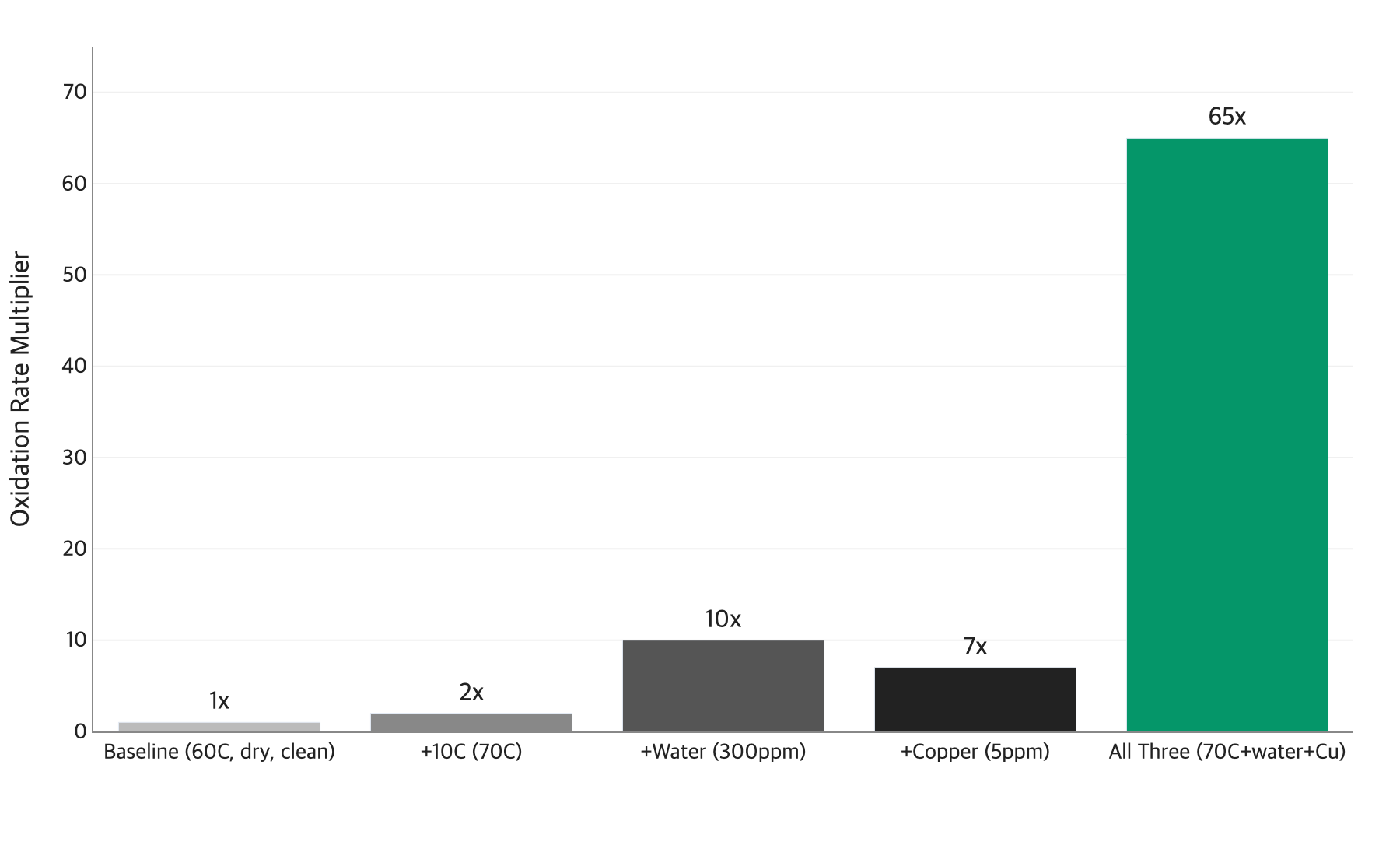
The chart above visualizes the dramatic synergistic effect when contaminants combine. While individual factors increase oxidation by 2x to 10x, the combination of elevated temperature, water, and dissolved copper produces a 65x acceleration that transforms a multi-year oil life into a matter of days. This multiplicative relationship is the core reason why trace contaminant control delivers disproportionate returns on investment.
This table reveals the critical insight that water and metals together produce a synergistic effect far exceeding their individual contributions. The combination of 300 ppm water and 5 ppm dissolved copper can accelerate oxidation by 48x to 65x compared to clean, dry baseline conditions (Machinery Lubrication, 2020). This synergistic multiplication explains why two machines running identical oil at the same temperature can show radically different oil life if one has a water ingression issue and copper-alloy bearings.
IV. The Interaction Matrix: When Accelerators Combine
The three accelerators of lubricant oxidation do not operate independently. They interact in a multiplicative fashion that creates a three-dimensional risk landscape where small changes in any single variable can trigger dramatic shifts in oil life. Understanding this interaction matrix is essential for identifying which factor to address first in any given system.
The Multiplicative Effect
Consider a turbine oil with a baseline life of 5 years under ideal conditions of 60 degrees C, less than 50 ppm water, and less than 1 ppm dissolved metals. If the operating temperature increases to 80 degrees C, the Arrhenius effect reduces life by 4x, to approximately 15 months. If water ingression raises moisture to 400 ppm, the additional 10x multiplier reduces life to approximately 6 weeks. If bearing wear introduces 8 ppm of dissolved copper, the metal catalysis adds another 5x multiplier, reducing theoretical oil life to less than 2 weeks. The same oil that should last 5 years is now oxidizing in days. This extreme example illustrates why trace contaminants have such outsized impact: they operate as multipliers on an already accelerated rate, creating exponential rather than linear degradation.
Figure 2. Combined Effect on Oil Life Under Different Contamination Scenarios
Scenario | Temp | Water | Metals | Combined Multiplier | Effective Oil Life (from 5-year baseline) |
|---|---|---|---|---|---|
Ideal | 60 C | < 50 ppm | < 1 ppm | 1x | 5 years |
Warm | 70 C | < 50 ppm | < 1 ppm | 2x | 2.5 years |
Warm + Wet | 70 C | 300 ppm | < 1 ppm | 20x | 3 months |
Warm + Metals | 70 C | < 50 ppm | 5 ppm Cu | 10x | 6 months |
Hot + Wet + Metals | 80 C | 300 ppm | 5 ppm Cu | 200x | 9 days |
Figure 4. Effective Oil Life Under Combined Contamination Scenarios
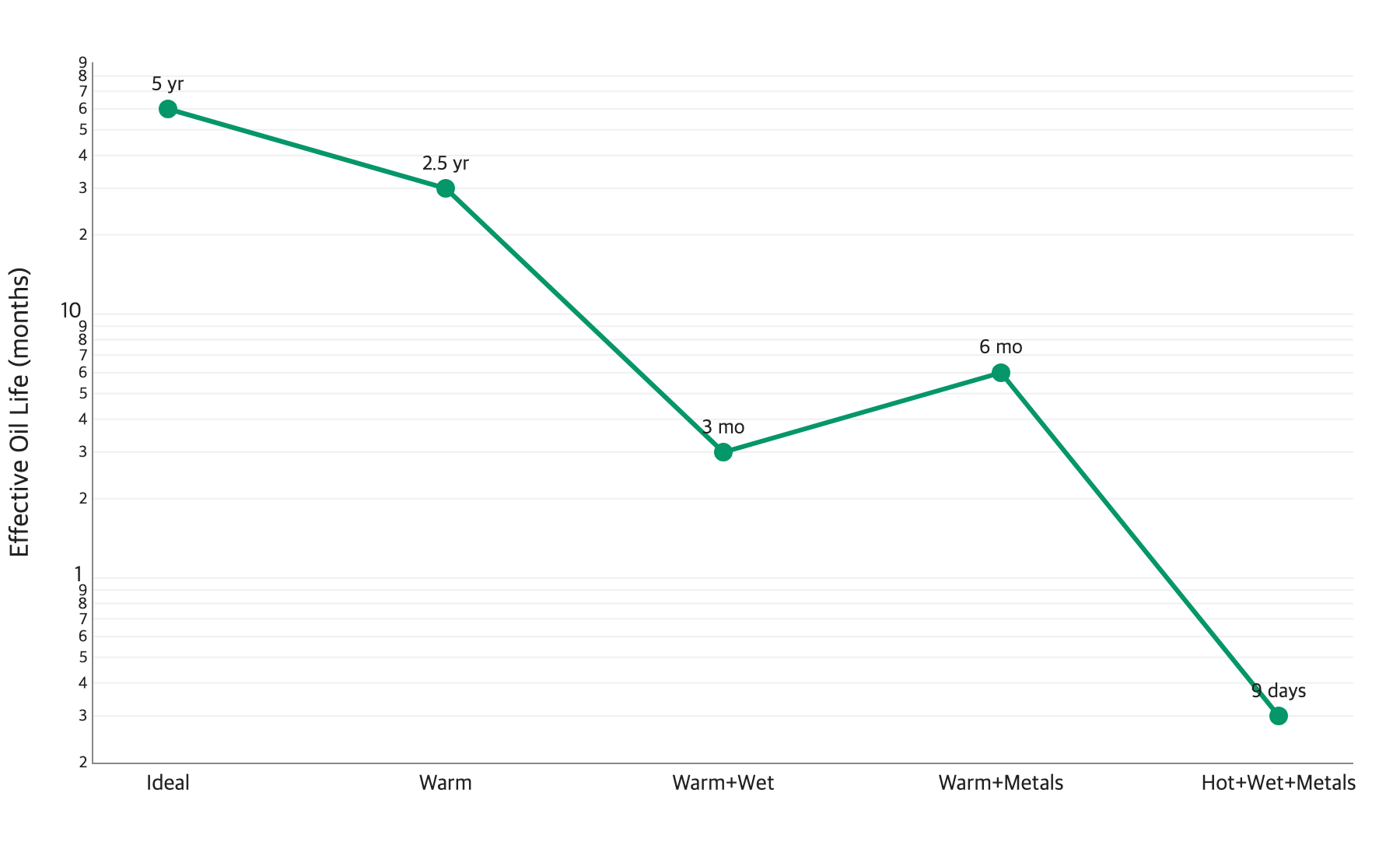
This logarithmic-scale chart illustrates how oil life collapses from years to days as contamination factors accumulate. The steep decline between "Warm" and "Warm+Wet" scenarios highlights that water contamination, not temperature, is typically the tipping point that converts manageable degradation into rapid failure. Engineers should prioritize water control as the first line of defense in extending lubricant service life.
This matrix demonstrates that temperature alone, even at 80 degrees C, reduces oil life by a manageable factor. It is the combination of elevated temperature with water and metals that produces the catastrophic multipliers. The practical implication is that contamination control, specifically water removal and metal passivation, delivers far more oil life extension per dollar invested than temperature reduction, which often requires expensive equipment modifications.
Identifying the Dominant Accelerator
In any given system, one of the three accelerators is typically the dominant factor limiting oil life. Identifying the dominant factor requires oil analysis data for three parameters: oxidation onset temperature from differential scanning calorimetry (DSC) or remaining useful life from rotary pressure vessel oxidation test (RPVOT), water content from Karl Fischer titration, and dissolved metals from inductively coupled plasma (ICP) spectroscopy. If RPVOT values are declining but water and metals are within limits, temperature is the dominant factor. If water is elevated and metals are low, water is the primary driver. If metals are elevated, the priority is identifying and controlling the metal source, which is almost always a wear or corrosion issue in the system.
V. From Time-Based to Condition-Based Oil Management
The evidence presented above makes a clear case for abandoning fixed-interval oil changes in favor of condition-based oil management. The key monitoring parameters and their action thresholds provide the framework for this transition.
Critical Monitoring Parameters
Effective condition-based oil management requires regular measurement of five parameters. Oil oxidation level, measured by FTIR (Fourier Transform Infrared) spectroscopy as the carbonyl absorption peak, provides a direct measure of oxidation progress. Total Acid Number (TAN), measured by titration, tracks the accumulation of organic acids that cause corrosion. Water content, measured by Karl Fischer titration, identifies one of the two most potent oxidation accelerators. Dissolved metals, measured by ICP spectroscopy, identifies the other key accelerator and simultaneously provides wear metal data for equipment condition monitoring. Viscosity, measured by capillary viscometry, tracks the polymerization that accompanies advanced oxidation.
Action Thresholds
Parameter | Normal | Warning | Critical | Action |
|---|---|---|---|---|
Water (ppm) | < 100 | 100-300 | > 300 | Investigate source, apply vacuum dehydration |
Copper (ppm) | < 2 | 2-5 | > 5 | Check bearing condition, add metal passivator |
Iron (ppm) | < 5 | 5-15 | > 15 | Investigate wear source, improve filtration |
TAN increase | < 0.2 | 0.2-0.5 | > 0.5 | Partial oil replacement or additive replenishment |
RPVOT (% of new) | > 75% | 50-75% | < 50% | Plan oil change, investigate accelerators |
This threshold framework enables proactive intervention at the warning level, where corrective action such as water removal or filtration improvement can arrest oxidation progression and extend oil life, rather than reactive response at the critical level where oil change is the only option.
VI. Field Cases: Finding the Real Oxidation Driver
The following cases illustrate how identifying and controlling the dominant oxidation accelerator transforms oil life and maintenance economics.
Case 1: Company A, Paper Mill Gearbox Train
Company A operated a paper mill with 8 large worm gearboxes driving press and dryer rolls, each containing approximately 400 liters of ISO VG 320 mineral gear oil. The maintenance schedule specified oil changes every 12 months based on the manufacturer's recommendation. Despite this schedule, 3 of the 8 gearboxes consistently showed signs of advanced oxidation, including elevated TAN, dark oil color, and sludge accumulation on filter screens, at the 8-month mark. Two bearing failures attributed to acid corrosion occurred within a single year, costing approximately USD 65,000 each in parts, labor, and lost production.
Oil analysis of the three problematic gearboxes revealed the root cause was not time but a specific contamination pattern. All three gearboxes showed dissolved copper levels of 8 to 12 ppm, compared to less than 2 ppm in the five trouble-free units. Investigation traced the copper to bronze worm wheels that were generating elevated wear particles due to a misalignment condition. Water content was also elevated at 280 to 350 ppm in the affected units, entering through condensation in the headspace above the oil level during temperature cycling between production and shutdown periods.
The corrective program addressed both accelerators simultaneously. First, the alignment condition was corrected on all three gearboxes, reducing copper generation from 8 to 12 ppm to 2 to 3 ppm within two oil change cycles. Second, desiccant breathers replaced standard vent caps, reducing water ingression from 280 to 350 ppm to consistently below 80 ppm. Third, the initial oil charge after correction was supplemented with a metal passivator additive at 200 ppm to deactivate residual dissolved copper. After these corrections, oil in the previously problematic gearboxes reached 18 months with TAN and RPVOT values still within normal limits, representing a 125 percent extension beyond the original 8-month degradation point. Annual lubricant and bearing maintenance costs for the gearbox train dropped from approximately USD 195,000 to USD 42,000. The total investment in desiccant breathers, alignment correction, and passivator additive was approximately USD 18,000.
Case 2: Company B, Gas Compression Station
Company B operated a 4-unit natural gas compression station with centrifugal compressors using ISO VG 32 turbine oil in a 6,000-liter shared lubrication system. The oil supplier recommended a 3-year oil life based on the oil specification, but Company B had been changing oil annually due to persistent oxidation issues. Each oil change consumed approximately 6,000 liters of premium turbine oil at USD 8.50 per liter, plus labor and disposal costs, totaling approximately USD 62,000 per event. Annual oil-related maintenance costs including analysis, top-ups, and the annual change totaled approximately USD 85,000.
Trending of quarterly oil analysis data over 18 months revealed the oxidation pattern. RPVOT values declined steadily from 95 percent of new oil value to 45 percent at the 10-month mark, triggering the annual change. TAN rose correspondingly. However, the critical insight came from correlating the oxidation trend with seasonal operating data. During summer months, when ambient temperatures exceeded 35 degrees C, the oil cooler struggled to maintain reservoir temperature below 70 degrees C, with frequent excursions to 78 degrees C during peak load periods. Water content remained consistently low at 40 to 60 ppm due to effective reservoir sealing. Dissolved metals were also low at less than 3 ppm total.
The dominant accelerator was temperature alone. The 70 to 78 degrees C operating range during summer months doubled the oxidation rate compared to the 60 degrees C winter baseline, burning through antioxidant reserves at twice the expected rate for 4 to 5 months per year. The corrective action was straightforward: the oil cooler was upgraded from a single-pass to a double-pass design at a cost of USD 28,000, reducing peak oil temperature from 78 degrees C to 62 degrees C. After the cooler upgrade, RPVOT values at the 12-month mark remained above 80 percent of new oil value. The oil change interval was extended from 12 months to 36 months, matching the supplier's original specification. Over a 3-year cycle, oil change costs dropped from USD 186,000 (3 annual changes) to USD 62,000 (1 change), saving USD 124,000. The cooler investment achieved payback in less than 9 months.
VII. Key Takeaway
Lubricant oxidation follows a free radical chain reaction that accelerates exponentially once antioxidant reserves are depleted. The induction period before rapid oxidation begins is determined not by time alone but by the combined intensity of three accelerators: temperature, water, and catalytic metals.
The Arrhenius rate rule, which doubles oxidation rate per 10 degrees C temperature increase, is only one piece of the equation. Water at 200 to 500 ppm adds a 10x multiplier, and dissolved copper at 5 ppm adds a 5x to 10x multiplier. Combined, these contaminants can produce a 50x to 65x acceleration that reduces a 5-year oil life to weeks.
Contamination control, specifically water removal and metal passivation, delivers the highest return on investment for extending lubricant life. Temperature reduction requires expensive equipment modifications, while contamination control requires relatively inexpensive breathers, filters, and dehydration equipment.
Five monitoring parameters, water content, dissolved metals, TAN, RPVOT, and viscosity, provide the complete picture needed for condition-based oil management. Oil analysis at quarterly intervals catches developing problems before they reach the critical threshold.
Shifting from time-based to condition-based oil changes typically reduces lubricant costs by 40 to 60 percent while simultaneously reducing lubrication-related equipment failures by 70 percent or more.
Lubinpla's Assistant can analyze your oil analysis trending data alongside equipment operating conditions to identify which of the three oxidation accelerators is the dominant factor in your system and calculate the expected oil life extension from targeted contamination control measures.
VIII. References
[1] Machinery Lubrication, "Advice for Extending Lubricant Life", 2022. https://www.machinerylubrication.com/Read/28822/extending-lubricant-life
[2] Machinery Lubrication, "How Heat Affects Lubricants: Understanding the Arrhenius Rate Rule", 2023. https://www.machinerylubrication.com/Read/32752/how-heat-affects-lubricants-understanding-the-arrhenius-rate-rule
[3] Machinery Lubrication, "Water In Oil Contamination", 2020. https://www.machinerylubrication.com/Read/192/water-contaminant-oil
[4] Machinery Lubrication, "Water Contamination of Lube Oils", 2020. https://www.machinerylubrication.com/Read/1379/contaminating-oil
[5] IntechOpen, "Antioxidants Classification and Applications in Lubricants", 2018. https://www.intechopen.com/chapters/58293
[6] UNP Chemicals, "Understand the Members of the Lubricant Antioxidant Family", 2023. https://www.unpchemicals.com/resources/understand-the-members-of-the-lubricant-antioxidant-family-and-their-antioxidant-mechanism-in-one-article.html
[7] Precision Lubrication, "The Great Debate: Does Heat Truly Halve Your Lubricant's Lifespan?", 2023. https://precisionlubrication.com/articles/heat-halve-lubricant-lifespan/
[8] Precision Lubrication, "Why Oxidation and Thermal Stress Degrade Lubricants in Unique Ways", 2023. https://precisionlubrication.com/articles/oxidation-and-thermal-stress-degrade-lubricant/
[9] Machinery Lubrication, "The Importance of Oil Oxidation Stability", 2022. https://www.machinerylubrication.com/Read/28966/oil-oxidation-stability
[10] Machinery Lubrication, "Finding the Root Causes of Oil Degradation", 2022. https://www.machinerylubrication.com/Read/989/fluid-degradation-causes
[11] Plant Engineering, "The Basics of Lubricant Water Contamination", 2023. https://www.plantengineering.com/the-basics-of-lubricant-water-contamination/
[12] Machinery Lubrication, "How to Determine When Oil Has Reached Its Temperature Limit", 2023. https://www.machinerylubrication.com/Read/31466/oil-temperature-limit
[13] Ayalytical, "Oil Oxidation: Rancid Ravaging of Lubricant Systems", 2023. https://ayalytical.com/oil-oxidation-rancid-ravaging-of-lubricant-systems/
[14] Machinery Lubrication, "Predicting Oil and Grease Life", 2022. https://www.machinerylubrication.com/Read/537/predict-oil-life
Powered by Lubinpla
Discover how technical teams solve complex challenges faster with AI.