Corrosion Under Insulation: Choosing the Right Protection Chemistry Before It Is Too Late
Summary: Corrosion under insulation (CUI) is one of the most costly and difficult-to-detect failure modes in process industries, responsible for an estimated 40 to 60 percent of piping maintenance costs in petrochemical and refining facilities. This article maps the three CUI mechanisms, general wastage, pitting, and chloride-induced stress corrosion cracking, to their specific temperature ranges and provides a protection chemistry selection matrix that matches the right coating and inhibitor system to each CUI zone. It also examines how insulation material properties, inspection methods, and design-level moisture management contribute to CUI protection outcomes. By selecting protection chemistry based on the actual corrosion mechanism rather than applying a generic coating, engineers can prevent CUI before it requires expensive repairs or causes unplanned shutdowns.
Table of Contents
I. The Hidden Cost of CUI
II. CUI Mechanisms by Temperature Zone
III. How Insulation Materials Influence CUI
IV. Connecting CUI Symptoms to Corrosion Mechanism
V. Inspection Methods: Finding CUI Without Removing Insulation
VI. Protection Chemistry Selection by CUI Zone
VII. Design-Level Prevention: Stopping Moisture Before It Reaches the Metal
VIII. Common Pitfalls: Why Generic Coatings Fail Under Insulation
IX. Key Takeaway
X. References
I. The Hidden Cost of CUI
Corrosion under insulation is uniquely dangerous because it is invisible during normal operation. The insulation that protects equipment from heat loss or personnel from burn injuries also conceals the corrosion that is progressively thinning pipe walls, pitting vessel surfaces, and initiating stress corrosion cracks. By the time CUI is discovered, typically during a scheduled turnaround inspection or after a leak, the damage is often extensive and the repair costs are substantial. Industry estimates indicate that CUI accounts for 40 to 60 percent of piping maintenance expenditure in petrochemical plants and is responsible for approximately 10 percent of the total maintenance budget in refineries (Inspectioneering, 2023).
Why CUI Is So Prevalent
CUI occurs whenever moisture contacts the metal surface beneath insulation in the presence of oxygen. Three conditions make this inevitable. First, no insulation system remains perfectly sealed over its full service life. Sealant joints crack, jacketing is damaged by foot traffic, and thermal cycling opens gaps at penetrations. Second, the most aggressive CUI temperature range, negative 4 to 149 degrees C, encompasses the majority of process piping in chemical plants and refineries. Third, once moisture enters the insulation space, it is trapped against the metal surface, creating persistent wet conditions that drive corrosion at rates far exceeding atmospheric exposure.
The Scale of Financial Impact
The financial consequences extend far beyond pipe replacement. In 2006, a CUI-caused leak at a petrochemical plant led to a fire that destroyed half the processing unit at approximately 50 million USD in damages (MDPI, 2022). In the North Sea, 60 percent of pipe failures are attributed to CUI, and across Europe, CUI accounts for 20 percent of major oil and gas incidents reported since 1984 (MDPI, 2022). API RP 583 exists specifically because CUI failure frequency and severity demanded a dedicated framework for risk ranking, inspection planning, and mitigation design (API, 2014).
II. CUI Mechanisms by Temperature Zone
CUI is not a single corrosion mechanism. The specific mechanism depends on operating temperature, substrate metallurgy, and the chemical composition of the moisture reaching the metal surface. Selecting the right protection chemistry requires identifying which mechanism will be active in each temperature zone.
Figure 3. CUI Risk Severity by Temperature Zone
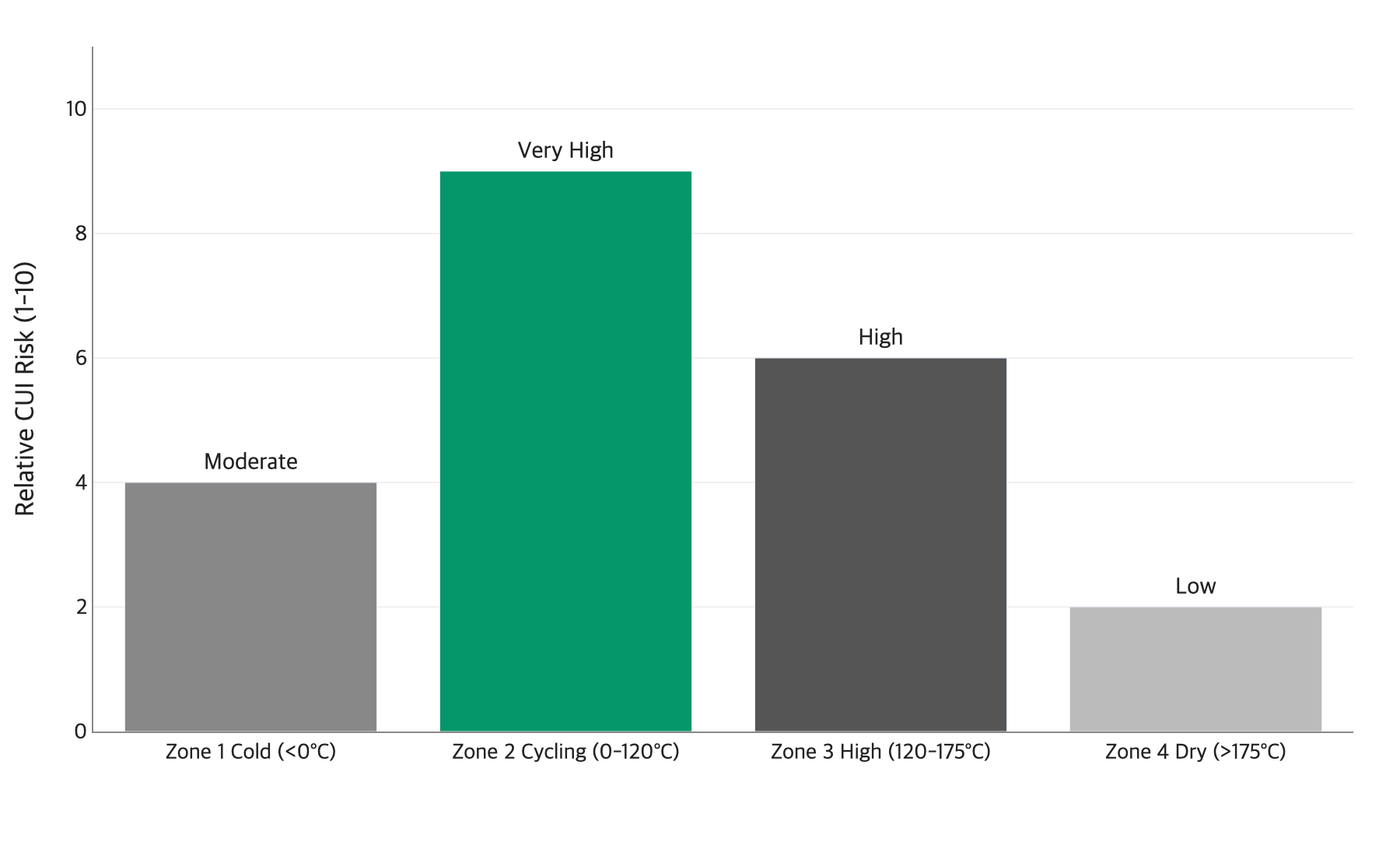
Zone 2, the cycling range from 0 to 120 degrees C, dominates with the highest severity rating due to wet-dry cycling that concentrates chlorides and activates multiple corrosion mechanisms simultaneously. This risk profile should guide inspection prioritization and protection investment allocation.
Zone 1: Cold Service (Below Ambient to 0 degrees C)
Equipment operating below ambient temperature experiences CUI through condensation. Moisture from the atmosphere condenses on the cold metal surface beneath the insulation, and if the temperature is below the dew point, condensation is continuous. The corrosion mechanism is general wastage driven by dissolved oxygen. The rate is relatively slow because low temperature limits electrochemical reaction kinetics, but the continuous wetness means corrosion is persistent and cumulative. Any gap in the vapor barrier allows warm, humid air to reach the cold surface, producing heavy condensation, so vapor barriers in cold service must be continuous and sealed at every joint and penetration.
Zone 2: Cycling and Moderate Temperature (0 to 120 degrees C)
This is the most aggressive CUI zone. Equipment in this temperature range experiences wet-dry cycling as the surface alternately absorbs moisture and partially evaporates it. Each evaporation cycle concentrates dissolved salts, particularly chlorides and sulfates leached from insulation materials or introduced from atmospheric sources, reaching concentrations 10 to 100 times higher than the original moisture source. For carbon steel, this produces aggressive pitting in addition to general wastage. For austenitic stainless steels such as 304 and 316, the combination of concentrated chlorides, temperatures above 50 degrees C, and residual tensile stresses creates the conditions for chloride-induced stress corrosion cracking (CISCC), which can cause sudden rupture without warning (HSE UK, 2023).
Unlike atmospheric corrosion where rainwater washes contaminants away, insulated surfaces have no washout mechanism. A pipe section receiving moisture with 50 ppm chloride can accumulate surface concentrations exceeding 5,000 ppm after repeated cycling.
Zone 3: High Temperature (120 to 175 degrees C)
Above 120 degrees C, the metal surface evaporates moisture relatively quickly but is not hot enough to remain permanently dry. This zone experiences intermittent wetting from rain events, steam leaks, or deluge system activation, followed by rapid evaporation that concentrates contaminants. The dominant mechanism is general wastage with accelerated rates. The Arrhenius relationship means each 10 degree C increase roughly doubles the corrosion rate during wet periods, making even brief wetting events disproportionately damaging.
Zone 4: Dry Service (Above 175 degrees C)
Above 175 degrees C, the metal surface temperature is sufficient to flash-evaporate any moisture, keeping the surface essentially dry under normal conditions. CUI risk in this zone is low during continuous operation but becomes significant during shutdowns when the surface cools through the aggressive Zone 2 range while covered by insulation that may contain trapped moisture. Any piping that undergoes periodic shutdowns will spend hours or days in Zone 2 temperatures as it cools, and during that transition, trapped moisture drives the same chloride concentration mechanisms that make Zone 2 the highest-risk zone.
Figure 1. CUI Risk Profile by Temperature Zone
Temperature Zone | Range | Primary Mechanism | Substrate at Risk | Relative Severity |
|---|---|---|---|---|
Zone 1: Cold | Below 0 C | General wastage from condensation | Carbon steel | Moderate |
Zone 2: Cycling | 0-120 C | Pitting + CISCC from chloride concentration | Carbon steel, stainless steel | Very High |
Zone 3: High | 120-175 C | Accelerated general wastage | Carbon steel | High |
Zone 4: Dry | Above 175 C | Minimal (risk during shutdown) | All | Low (operational) |
This zone mapping is the foundation for protection chemistry selection. Zone 2 presents the highest risk, and its protection chemistry must address chloride tolerance, a requirement not shared by the other zones.
III. How Insulation Materials Influence CUI
The insulation material itself is an active participant in the CUI mechanism, not merely a passive thermal barrier. Different insulation types vary widely in their water absorption behavior, chloride content, and chemical interaction with the metal surface. Selecting insulation without considering its contribution to corrosion risk is a frequent and costly oversight.
Chloride Content and Water Absorption
Many insulation materials contain leachable chlorides, sulfates, and fluorides released when water contacts the insulation. Specifications typically require leachable chloride content not exceed 90 ppm, but field conditions can exceed this threshold in older insulation that has absorbed atmospheric contaminants (Armacell, 2019). Calcium silicate manufactured in North America includes corrosion inhibitors for CUI reduction, but older or imported products may lack this formulation. Mineral wool is porous and readily absorbs water, holding several times its dry weight once saturated, sustaining corrosion long after the original moisture source is removed. Closed-cell cellular glass resists water absorption but is brittle and prone to cracking at joints. Aerogel offers minimal water absorption but high cost limits its use. Field engineers should consider water absorption rate, chloride content, and coating compatibility alongside thermal performance when selecting insulation.
Figure 4. Insulation Material CUI Risk Characteristics
Material | Water Absorption | Chloride Content Risk | Temperature Range | CUI Risk Factor |
|---|---|---|---|---|
Mineral wool | High | Moderate (leachable ions) | Up to 650 C | High |
Calcium silicate | Moderate | Low (inhibited grades) | Up to 1050 C | Moderate |
Cellular glass | Very low | Very low | -268 to 482 C | Low |
Expanded perlite | High | Moderate | Up to 650 C | High |
Aerogel | Very low | Very low | Up to 650 C | Very low |
The coating must be selected to withstand the specific chemical environment created by the insulation material, not just the operating temperature.
IV. Connecting CUI Symptoms to Corrosion Mechanism
When CUI is discovered during inspection, the surface morphology provides diagnostic clues that identify the active mechanism and inform protection chemistry selection for reinstatement.
Field Identification Guide
General wastage appears as uniform metal loss with a rough, evenly corroded surface covered by loose, flaky rust. The corrosion product is typically red-brown iron oxide that can be easily brushed away, revealing a uniformly thinned surface beneath. Wall thickness measurements will show a gradual reduction, often following the bottom half of horizontal pipe runs where moisture accumulates by gravity. Pitting appears as localized, deep cavities surrounded by relatively intact metal. The pitting pattern may be clustered at low points, support rings, or areas where insulation joints allow preferential water entry. Pit depth can be several times the average wall loss, making pitting a more immediate structural threat than general wastage even when total metal loss is lower. Stress corrosion cracking appears as fine, branching cracks that may be invisible to the naked eye but can be detected by dye penetrant or magnetic particle inspection. The cracks are typically transgranular in austenitic stainless steels and propagate perpendicular to the direction of tensile stress. The surface may appear relatively clean, making CISCC easy to miss during visual inspection. This is why stainless steel piping in Zone 2 requires inspection methods beyond visual examination.
V. Inspection Methods: Finding CUI Without Removing Insulation
The fundamental challenge of CUI inspection is that damage is hidden beneath insulation that is expensive to remove. Modern nondestructive examination (NDE) methods now allow engineers to detect CUI indicators without full insulation removal, expanding inspection coverage and reducing turnaround time.
Key Inspection Technologies
The most straightforward approach is cutting inspection plugs in the insulation for ultrasonic thickness testing, with plug density prioritized in Zone 2 temperature ranges and at moisture entry points such as supports and dead legs. Infrared thermography identifies wet insulation by detecting thermal signatures caused by moisture, and works without physical contact with the piping (Eddyfi, 2023). Pulsed eddy current (PEC) testing measures wall thickness through the insulation and jacketing without removal, though its resolution is limited for small pitting. Long-range ultrasonic testing (LRUT) uses guided waves to screen tens of meters from a single access point. Combining LRUT for broad screening with PEC for follow-up at flagged locations provides a practical strategy that balances coverage with accuracy.
Figure 5. CUI Inspection Method Comparison
Method | Insulation Removal Required | Coverage per Test | Detects Wall Loss | Detects Moisture | Best Application |
|---|---|---|---|---|---|
Ultrasonic (UT) plugs | Partial (plug holes) | Point measurement | Yes | No | Targeted verification |
Infrared thermography | No | Large area screening | No | Yes | Moisture detection |
Pulsed eddy current (PEC) | No | Local area | Yes (general) | No | Wall thinning through insulation |
Long-range UT (LRUT) | No (single access) | Tens of meters | Yes (general) | No | Broad screening of long runs |
Full insulation removal | Yes | Complete surface | Yes (all types) | Yes | Turnaround inspection |
For Zone 2 stainless steel where CISCC is the primary concern, wall thinning detection methods are insufficient because stress corrosion cracking does not produce measurable wall loss until crack propagation. These applications require dye penetrant or magnetic particle testing, which require insulation removal.
VI. Protection Chemistry Selection by CUI Zone
The protection system must be matched to the specific mechanism and temperature range of each zone. The selection matrix below maps coating chemistry and inhibitor options to the four temperature zones and two primary substrate metallurgies.
Figure 2. CUI Protection Chemistry Selection Matrix
Temperature Zone | Recommended Coating | Inhibitor Option | Key Properties Required | Service Temp Rating |
|---|---|---|---|---|
Zone 1: Cold | Epoxy phenolic | Vapor-phase corrosion inhibitor (VpCI) | Moisture resistance, low-temp adhesion | -45 to 150 C |
Zone 2: Cycling (carbon steel) | Epoxy novolac or thermal spray aluminum (TSA) | VpCI emitter pads | Chloride resistance, wet-dry cycling tolerance | -45 to 205 C |
Zone 2: Cycling (stainless steel) | TSA or low-chloride silicone | None (avoid chloride-containing products) | Zero chloride content, CISCC prevention | -45 to 540 C |
Zone 3: High | High-temp silicone or inorganic zinc | High-temp VpCI | Heat resistance, oxidation resistance | 150 to 540 C |
Zone 4: Dry | Standard primer (for shutdown protection) | Shutdown-specific VpCI | Cost-effective, easy application | Varies |
Two critical rules emerge from this matrix. First, Zone 2 stainless steel requires zero-chloride coating materials, because standard epoxy coatings may contain chloride-based curing agents that leach chlorides at elevated temperatures, making them unsuitable despite being effective on carbon steel. Second, thermal spray aluminum (TSA) provides both barrier protection and cathodic protection, making it the premium choice for Zone 2 where long-term reliability justifies the higher application cost.
Thermal Spray Aluminum: The Premium CUI Defense
TSA addresses the limitations that cause conventional organic coatings to fail under insulation. A properly applied TSA coating creates a continuous metallic barrier that isolates the steel substrate from moisture and electrolytes. If the coating is locally damaged, the aluminum corrodes preferentially to the underlying steel, providing galvanic (sacrificial) protection at the damage site. This self-healing characteristic is critical under insulation because coating damage cannot be detected during normal operation. Industry testing indicates that TSA can protect assets for more than 25 years without renewal, compared to organic coatings that typically require reapplication every 5 to 10 years (Integrated Global, 2023). Free corrosion rates of 2 to 3 microns per year imply theoretical service lives exceeding 60 years for a standard 200-micron coating. TSA coatings are applied to white metal cleanliness (SA 3 / NACE 1) following standards such as NORSOK M-501 and ISO 2063. The higher upfront cost is offset by eliminating coating renewal cycles over the equipment life.
Vapor-Phase Corrosion Inhibitors as a Supplementary Layer
VpCI molecules vaporize from a source such as emitter pads placed within the insulation annulus, migrate to the metal surface, and adsorb to form a hydrophobic monomolecular layer that displaces water and interrupts the electrochemical corrosion process (Cortec, 2023). VpCI is particularly valuable for existing insulated piping where removing insulation to apply coatings is impractical. Injectable formulations can be introduced through the insulation without requiring its removal, providing immediate corrosion protection while operations continue. However, the protective layer can be disrupted by maintenance activities and requires periodic replenishment. VpCI should be considered a supplementary measure, not a substitute for appropriate coating selection in new construction or reinstatement.
VII. Design-Level Prevention: Stopping Moisture Before It Reaches the Metal
The most effective CUI prevention strategy addresses moisture at the design stage. API RP 583 emphasizes that proactive prevention through design, material selection, and installation quality is more effective and less costly than damage correction (API, 2014). Metal jacketing with overlapping joints oriented to shed water, sealed seams, and a moisture barrier laminated to the underside provides the first line of defense. Sealant selection at joints is critical because silicone-based sealants that perform at ambient temperature may lose adhesion at elevated operating temperatures. Piping layout decisions also matter: eliminating dead legs, designing supports to avoid insulation compression, and sloping piping to prevent water ponding all reduce metal-moisture contact duration. Penetrations such as instrument connections and support attachments are the most common moisture entry points and require particular attention to sealing detail.
VIII. Common Pitfalls: Why Generic Coatings Fail Under Insulation
The most frequent CUI protection errors recur across industries not because the solutions are unknown, but because CUI-specific requirements are often overlooked in favor of standardized coating specifications developed for atmospheric service.
Pitfall 1: One Coating for All Temperatures
Applying a single coating system across a piping system that spans multiple temperature zones guarantees failure in at least one zone. An epoxy rated for 120 degrees C maximum will degrade on piping at 150 degrees C. A high-temperature silicone applied to cold-service piping may not provide adequate moisture barrier performance. Each CUI zone requires its own matched protection chemistry. The transition points between zones are often the most vulnerable locations because they receive whatever coating was specified for the adjacent zone.
Pitfall 2: Ignoring Chloride Content of Coating Materials
Many standard coatings contain chlorinated solvents or chloride-based curing agents that are harmless in atmospheric service but become a corrosion source when trapped beneath insulation at elevated temperature. For stainless steel in Zone 2, every component must be verified for chloride content. The CISCC threshold in austenitic stainless steels can be as low as 10 ppm chloride at temperatures above 50 degrees C with tensile stress present. This requirement extends to any adhesive, tape, or marking material in contact with the stainless steel surface.
Pitfall 3: Surface Preparation Shortcuts
CUI coatings require higher surface preparation quality than atmospheric coatings because they will be sealed beneath insulation with no opportunity for visual monitoring. The minimum for CUI coatings is SSPC-SP10 near-white blast cleaning, compared to the SSPC-SP6 commercial blast acceptable for many atmospheric applications. For TSA, the requirement is even more stringent: SA 3 (white metal) per ISO 8501-1. Proper surface preparation is the single highest-return action in a CUI protection program because no coating can compensate for inadequate substrate preparation.
Pitfall 4: Neglecting Reinstatement Quality
CUI protection is only as durable as its weakest maintenance intervention. Common reinstatement failures include damaged coating areas left unrepaired, jacketing joints left unsealed, and vapor barriers punctured without being restored. Establishing clear reinstatement procedures that specify coating touch-up requirements and jacketing overlap orientation prevents maintenance activities from creating the moisture entry points that CUI protection is designed to prevent.
IX. Key Takeaway
CUI is not a single mechanism. Four temperature zones produce different corrosion behaviors, and each zone requires a matched protection approach. The 0 to 120 degrees C cycling zone is the highest risk because wet-dry cycling concentrates chlorides to 10 to 100 times the original moisture source level.
Stainless steel in Zone 2 is vulnerable to chloride-induced stress corrosion cracking, requiring zero-chloride materials across all system components including coating, sealant, and insulation.
Protection chemistry must be matched to temperature zone and substrate metallurgy: epoxy phenolic for cold service, epoxy novolac or TSA for carbon steel cycling zone, TSA or low-chloride silicone for stainless steel cycling zone, and high-temperature silicone for the high zone.
Insulation material selection is a CUI variable, not just a thermal variable. Water absorption rate and chloride content directly influence corrosion severity.
Design-level prevention through proper jacketing, moisture barriers, and piping layout is more cost-effective than relying on coatings alone.
Lubinpla's Assistant can map your piping and equipment operating temperature profiles against the CUI zone framework and recommend the specific protection chemistry for each section, including cross-referencing coating material chloride content against substrate metallurgy and flagging insulation material compatibility risks for stainless steel applications.
X. References
[1] Inspectioneering, "Corrosion Under Insulation (CUI)", 2023. https://inspectioneering.com/tag/corrosion+under+insulation
[2] Inspectioneering, "Introduction to Corrosion Under Insulation", 2023. https://inspectioneering.com/blog/2014-12-08/4286/what-is-corrosion-under-insulation-cui
[3] Sherwin-Williams, "Corrosion Under Insulation: The Hidden Challenge", 2023. https://industrial.sherwin-williams.com/emeai/gb/en/protective-marine/media-center/articles/corrosion-under-insulation.html
[4] HSE UK, "Corrosion Under Insulation of Plant and Pipework", 2023. https://www.hse.gov.uk/foi/internalops/hid_circs/technical_general/spc_tech_gen_18.htm
[5] Belzona, "Corrosion Under Insulation (CUI)", 2023. https://www.belzona.com/en/focus/cui.aspx
[6] Insulation Outlook, "CUI: An In-Depth Analysis", 2023. https://insulation.org/io/articles/cui-an-in-depth-analysis/
[7] EonCoat, "How To Prevent Corrosion Under Insulation", 2023. https://eoncoat.com/how-to-prevent-corrosion-under-insulation-cui/
[8] Corrosionpedia, "Understanding the Causes and Cures for CUI", 2023. https://www.corrosionpedia.com/understanding-the-causes-and-cures-for-corrosion-under-insulation/2/7297
[9] Corrosionpedia, "High Temperature Range in CUI Considerations", 2023. https://www.corrosionpedia.com/what-is-the-significance-of-the-high-temperature-range-when-considering-corrosion-under-insulation-cui/7/6873
[10] Armacell, "CUI Fundamentals Technical Paper", 2019. https://www.armacell.com/sites/default/files/2025/01/20/CUI%20Fundamentals_Tech%20Paper%20_032019_lowres.pdf
[11] MDPI Metals, "A Review of Corrosion under Insulation: A Critical Issue in the Oil and Gas Industry", 2022. https://www.mdpi.com/2075-4701/12/4/561
[12] API, "Recommended Practice 583: Corrosion Under Insulation and Fireproofing", 2014. https://www.api.org/~/media/files/publications/whats%20new/583%20e1%20pa.pdf
[13] Eddyfi, "Corrosion Under Insulation: The 7 Inspection Methods You Must Know About", 2023. https://blog.eddyfi.com/en/corrosion-under-insulation-the-7-inspection-methods-you-must-know-about
[14] Integrated Global Solutions, "Corrosion Under Insulation (CUI) with Thermal Spray Aluminium (TSA)", 2023. https://integratedglobal.com/en/industries/corrosion-under-insulation-cui/
[15] Cortec Corporation, "CUI Prevention in Oil and Gas with Injection-Based VpCI", 2023. https://www.cortecvci.com/cui-prevention-injection-based-vpci-oil-gas/
Powered by Lubinpla
Discover how technical teams solve complex challenges faster with AI.