Why VCI Film Fails After 30 Days in Southeast Asian Export Routes
Summary: More than 10% of corrosion-related shipping claims in tropical export corridors trace back to VCI film packages that passed quality inspection at origin but delivered corroded parts 30 to 45 days later. This article examines the chemical mechanisms behind VCI film failure under sustained high-humidity and high-temperature container environments, quantifies the vapor pressure saturation limits that determine protection duration, and calculates the cost gap between reactive claim management and proactive packaging system upgrades. Manufacturers exporting metal components to or through Southeast Asia will find a field-tested, multi-layer protection strategy that extends reliable corrosion protection from 30 days to over 180 days.
Table of Contents
I. Introduction
II. Why Does Standard VCI Film Fail in Tropical Shipping Containers?
III. How Does Container Temperature Accelerate VCI Inhibitor Depletion?
IV. Cost of Corrosion Claims vs. Packaging System Upgrades
V. Integrated Protection Strategy for Tropical Shipping Corridors
VI. Field Cases
VII. Key Takeaway
VIII. References
I. Introduction
A sealed VCI film bag leaves the packaging line at a cold-forged parts manufacturer in South Korea. The humidity indicator card reads 30% RH. Thirty-two days later, the same bag arrives at a distribution center in Ho Chi Minh City with visible rust spots on 14 of 120 carbon steel suspension components inside. The VCI film is intact, the heat seal shows no breach, and the indicator card now reads above 50% RH. The packaging did not fail mechanically. It failed chemically.
This scenario repeats across export routes that traverse or terminate in tropical Southeast Asia, where container interior temperatures routinely exceed 55 degrees C and relative humidity stays between 75% and 90% for the entire transit duration. The fundamental problem is not that VCI technology is ineffective. The problem is that standard single-layer VCI film systems are designed around assumptions of moderate humidity and temperature that do not hold in tropical shipping corridors. Understanding the precise chemical mechanisms behind this failure is the first step toward eliminating it.
How Large Is the Financial Impact of Tropical Route Corrosion?
The global cost of corrosion reaches approximately USD 2.5 trillion annually, equivalent to roughly 3.1% of global GDP (NACE International, 2016). Within that figure, transit-related corrosion represents one of the costliest failure modes for manufacturers, because the damage occurs after production costs are fully invested and often triggers warranty claims, replacement shipments, and customer relationship damage simultaneously. For manufacturers shipping metal components through Southeast Asian routes, corrosion claims on VCI-packaged goods can accumulate to between USD 50,000 and USD 200,000 per year depending on product value and shipment volume.
II. Why Does Standard VCI Film Fail in Tropical Shipping Containers?
Standard single-layer LDPE VCI film loses effective moisture protection in tropical containers because water vapor transmission rate (WVTR) increases approximately 5% per degree C above 38 degrees C. At 55 degrees C, WVTR nearly doubles compared to laboratory-rated values, admitting enough moisture to exceed the critical 60% RH corrosion threshold inside sealed packages within 25 to 30 days of transit.
VCI film creates a closed micro-environment around the protected metal part. The corrosion inhibitor molecules vaporize from the film substrate, saturate the enclosed air space, and adsorb onto exposed metal surfaces to form a protective molecular layer. This system works reliably when the enclosed environment remains relatively stable. In tropical shipping containers, that stability breaks down through two concurrent mechanisms: water vapor transmission through the film itself and condensation cycling driven by temperature differentials.
How Does Temperature Push WVTR Beyond the Rated Film Specification?
Every polymer film allows some degree of moisture permeation. Standard low-density polyethylene (LDPE) VCI film, the most commonly used packaging material for metal parts export, has a water vapor transmission rate (WVTR) typically between 6 and 18 g per m2 per 24h at 38 degrees C and 90% RH (ASTM F1249 standard conditions). This rate is not fixed. Permeability increases roughly 5% per degree C rise in temperature (PNNL, 2016). In a shipping container sitting at a Southeast Asian port where interior temperatures can reach 60 to 65 degrees C, the effective WVTR of a standard LDPE VCI film can increase by 110% to 135% compared to the laboratory-rated value at 38 degrees C.
Figure 1. WVTR Increase by Temperature for Standard LDPE VCI Film
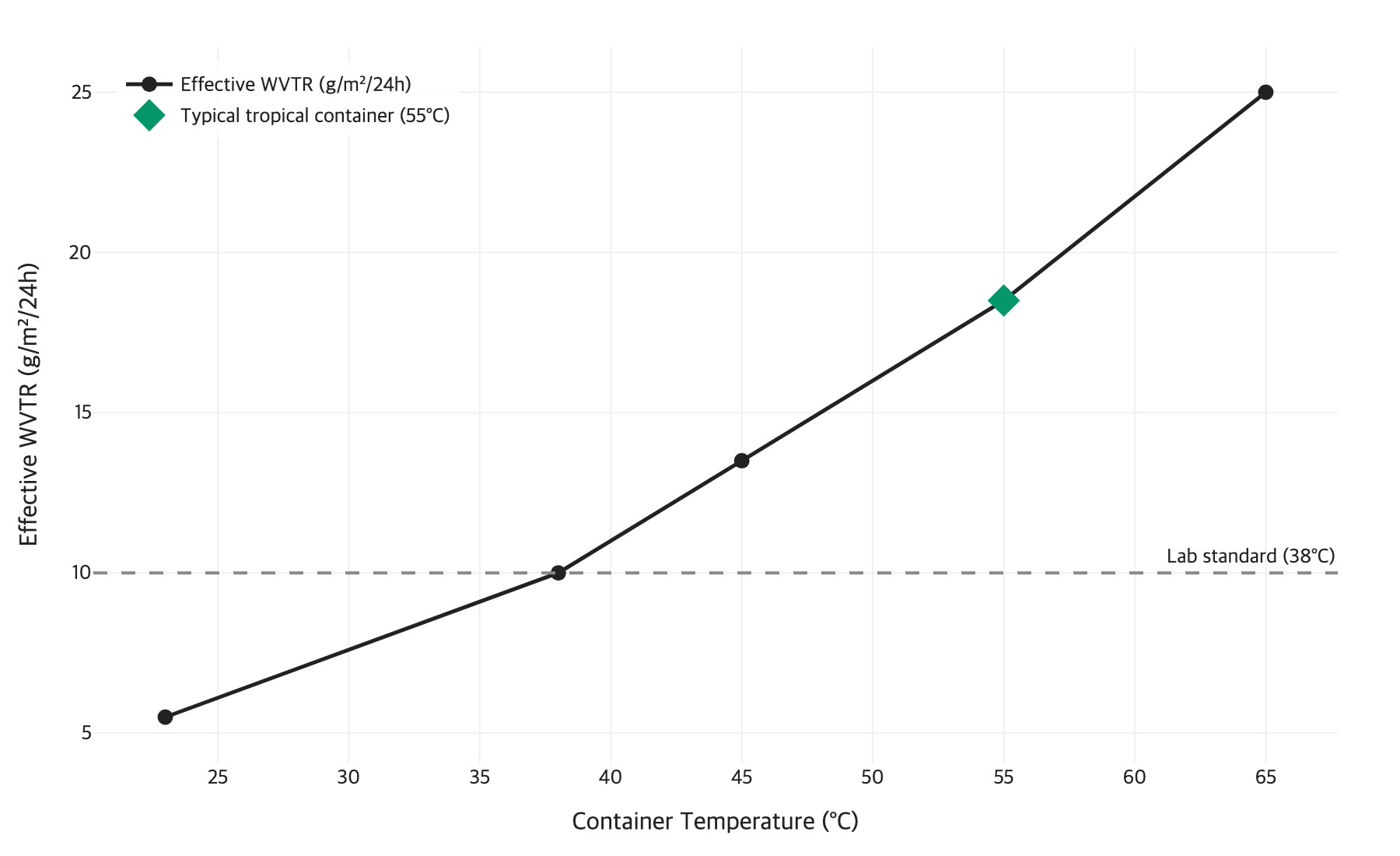
Temperature (C) | Relative WVTR (%) | Effective WVTR (g per m2 per 24h, baseline 10) |
|---|---|---|
23 | 55 | 5.5 |
38 (lab standard) | 100 | 10.0 |
45 | 135 | 13.5 |
55 | 185 | 18.5 |
65 | 250 | 25.0 |
At 55 degrees C, a standard LDPE VCI bag with a surface area of 1.2 m2 admits approximately 22.2 g of water vapor per day. Over a 30-day transit, this amounts to approximately 666 g of moisture ingress, enough to raise the relative humidity inside a sealed bag from 30% to well above the critical 60% RH threshold where carbon steel corrosion rates accelerate sharply.
What Is Container Rain and Why Does It Defeat Sealed VCI Bags?
Beyond steady-state permeation, tropical shipping routes introduce a second moisture source: container rain. This phenomenon occurs when warm, moist air inside the container cools to its dew point, typically during nighttime temperature drops or when vessels transit from equatorial waters to slightly cooler zones (Greencarrier, 2023). Water droplets form on the container ceiling and walls, then drip onto cargo. Temperature differentials of 15 to 25 degrees C between daytime and nighttime conditions are common on routes through the Strait of Malacca and the South China Sea (Cargo Handbook, 2023).
Even inside a sealed VCI bag, condensation cycling creates localized moisture concentrations that overwhelm the VCI protective layer at specific points on the metal surface. The inhibitor molecules adsorbed on the metal surface are water-soluble by design, since they must dissolve in the thin moisture film on the metal to provide electrochemical protection. When a condensation droplet deposits directly on the metal surface, it locally dilutes the VCI concentration below the effective threshold, creating a corrosion initiation site that the vapor-phase replenishment cannot close fast enough.
III. How Does Container Temperature Accelerate VCI Inhibitor Depletion?
VCI compound vapor pressure roughly doubles every 10 to 15 degrees C (Clausius-Clapeyron relationship). At sustained container temperatures of 50 to 60 degrees C on Southeast Asian routes, VCI vaporization runs 4 to 8 times faster than the 23 degrees C laboratory benchmark, exhausting the film's inhibitor reservoir in 4 to 6 months instead of the rated 24 months.
The effectiveness of VCI protection depends on maintaining a minimum vapor-phase concentration of inhibitor molecules in the enclosed air space. This concentration is governed by the VCI compound's vapor pressure, which is itself a function of temperature and the remaining inhibitor reservoir in the film substrate.
What Vapor Pressure Range Keeps VCI Inhibitors Effective?
The most effective VCI compounds operate within a vapor pressure range of 0.001 to 0.01 Pa at room temperature, approximately 20 to 25 degrees C (Transhield, 2016). This range represents a balance: sufficient pressure to establish a protective molecular layer on the metal surface within hours, but not so high that the inhibitor depletes from the film substrate too quickly. At vapor pressures above 0.01 Pa, the VCI compound vaporizes rapidly, saturating the enclosed space quickly but exhausting the film's inhibitor reservoir in weeks rather than months.
Temperature Acceleration of VCI Depletion
Vapor pressure follows the Clausius-Clapeyron relationship, roughly doubling for every 10 to 15 degree C increase in temperature for typical VCI compounds. In a shipping container on a Southeast Asian route, where sustained temperatures of 50 to 60 degrees C are documented, the VCI vaporization rate can be 4 to 8 times higher than the rate at the 23 degrees C laboratory benchmark.
Figure 2. VCI Vaporization Rate Multiplier by Container Temperature
Container Temperature (C) | Vaporization Rate Multiplier (vs. 23C baseline) | Estimated Reservoir Depletion (months) |
|---|---|---|
23 (lab baseline) | 1.0x | 24-36 |
35 | 2.0x | 12-18 |
45 | 3.5x | 7-10 |
55 | 6.0x | 4-6 |
65 | 10.0x | 2.4-3.6 |
At 55 degrees C sustained temperature, a VCI film rated for 24 months of protection at laboratory conditions depletes its effective inhibitor reservoir in approximately 4 to 6 months. This sounds adequate for a 30-day transit, but the calculation changes when combined with moisture ingress. As relative humidity inside the bag rises above 60%, the corrosion rate on unprotected steel increases exponentially while the VCI protective layer is simultaneously being diluted by condensed moisture. The protection window narrows from both sides: the inhibitor is leaving the film faster than designed, and the corrosion challenge is more severe than the remaining inhibitor concentration can neutralize.
Why Do VCI Failures Peak at the 30-Day Mark on Tropical Routes?
The convergence of accelerated VCI depletion and elevated moisture ingress explains why 30 days is a common failure threshold on tropical routes. In the first 10 to 15 days, the VCI system maintains adequate protection because the initial vapor-phase concentration is high and moisture accumulation has not yet reached critical levels. Between days 15 and 25, the system enters a degradation zone where the VCI concentration is declining, moisture levels are rising, and condensation events are becoming more frequent. By day 30, the system reaches a tipping point where localized VCI concentration drops below the minimum effective threshold at condensation sites, and corrosion initiates. Once initiated, the corrosion process itself generates ions and pH changes that further interfere with VCI adsorption, creating a self-accelerating failure mode.
IV. Cost of Corrosion Claims vs. Packaging System Upgrades
For a mid-size manufacturer exporting 500 to 1,000 metric tons of carbon steel components annually on Southeast Asian routes, annual corrosion claim costs typically range from USD 75,000 to USD 197,000. A multi-barrier packaging upgrade costs approximately USD 4,000 more per 1,000 packages and delivers a return exceeding 18:1 against avoided claims, with a breakeven point under 55 upgraded packages per year.
The financial impact of VCI film failure on tropical export routes extends well beyond the direct cost of damaged parts. A complete cost analysis must account for material losses, claim processing, replacement shipments, production disruption, and customer relationship damage.
What Does a Single Corrosion Incident Cost in Total?
For a mid-size manufacturer exporting 500 to 1,000 metric tons of carbon steel components annually through Southeast Asian routes, corrosion claim data from industry benchmarks suggests the following cost structure.
Figure 3. Annual Corrosion Claim Cost Breakdown for a Mid-Size Exporter
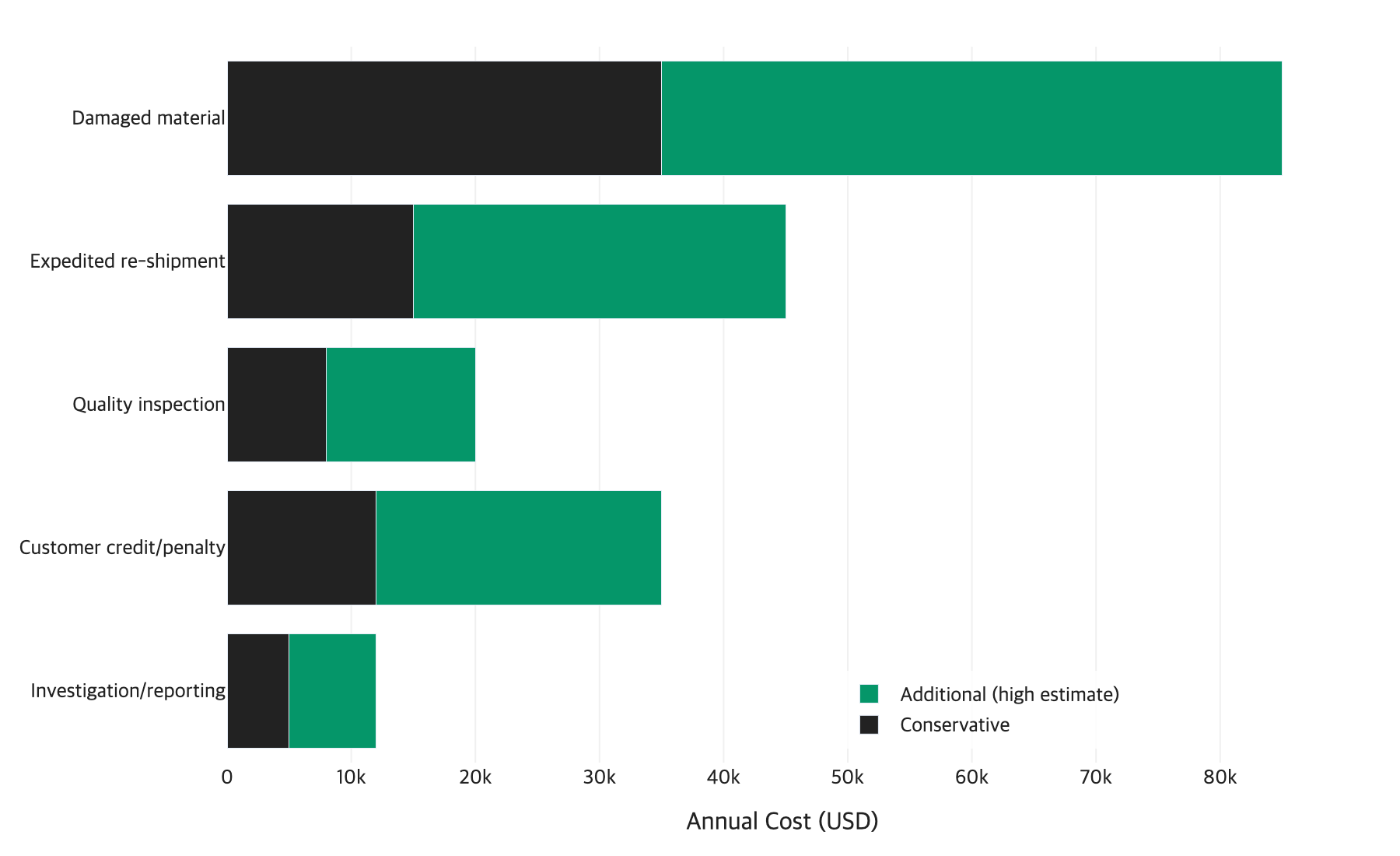
Cost Category | Conservative Estimate (USD) | High Estimate (USD) |
|---|---|---|
Damaged material replacement | 35,000 | 85,000 |
Expedited re-shipment (air freight) | 15,000 | 45,000 |
Quality inspection and sorting | 8,000 | 20,000 |
Customer credit and penalty | 12,000 | 35,000 |
Internal investigation and reporting | 5,000 | 12,000 |
Total annual claim cost | 75,000 | 197,000 |
These figures do not include the harder-to-quantify costs of customer trust erosion and potential contract loss. A single emergency air freight shipment to replace corroded parts can cost between USD 15,000 and USD 23,000 depending on volume and destination, often exceeding the value of the damaged goods themselves (Cortec Corporation, 2023).
What Does a Packaging System Upgrade Cost vs. Annual Corrosion Claim Losses?
Upgrading from a single-layer LDPE VCI film system to a multi-barrier packaging approach designed for tropical conditions requires incremental investment but delivers measurable return.
Figure 4. Packaging System Cost Comparison (per 1,000 Packages Annually)
Component | Standard LDPE VCI | Multi-Barrier Tropical System | Incremental Cost |
|---|---|---|---|
VCI film (multi-metal, high-barrier) | USD 2,800 | USD 4,200 | +USD 1,400 |
Desiccant (container-grade, 2 kg units) | USD 0 | USD 1,600 | +USD 1,600 |
Humidity indicator cards (3-spot) | USD 200 | USD 400 | +USD 200 |
Heat-seal validation protocol | USD 0 | USD 800 | +USD 800 |
Total packaging cost | USD 3,000 | USD 7,000 | +USD 4,000 |
The incremental packaging investment of USD 4,000 per 1,000 packages compares against a conservative annual claim cost of USD 75,000. Even at the low end, the return on packaging investment exceeds 18:1 when measured against avoided claim costs. The breakeven point is fewer than 55 upgraded packages per year, assuming each prevents one corrosion incident that would otherwise generate a USD 75 average claim cost.
V. Integrated Protection Strategy for Tropical Shipping Corridors
Reliable corrosion protection on tropical export routes requires three concurrent interventions: replacing standard LDPE VCI film with a co-extruded multi-layer barrier film (WVTR 1 to 3 g per m2 per 24h at 38 degrees C), adding 2 kg calcium chloride desiccant units inside each sealed package, and standardizing heat-seal protocols to below a 3% defect rate. Together these reduce moisture ingress by 80% to 90% and extend protection from 30 days to over 180 days.
Solving VCI film failure in tropical conditions requires moving from a single-barrier approach to an integrated system that addresses all three root causes simultaneously: moisture ingress, VCI depletion, and condensation cycling.
Layer 1: High-Barrier VCI Film Selection
Replace standard LDPE VCI film (WVTR 10-18 g per m2 per 24h at 38 degrees C) with a co-extruded multi-layer film incorporating a nylon or EVOH barrier layer. Multi-layer barrier films achieve WVTR values of 1 to 3 g per m2 per 24h at 38 degrees C, reducing moisture ingress by 80% to 90% compared to standard LDPE. The VCI compound should be formulated for multi-metal protection with a carbon steel primary target, using cyclohexylamine or dicyclohexylamine-based inhibitor systems that maintain effective vapor pressure across the 20 to 65 degree C operating range.
Layer 2: Active Desiccation Inside the Sealed Package
Add container-grade desiccant units rated for at least 2 kg of moisture absorption capacity inside each sealed VCI bag. Position desiccant pouches away from direct metal contact to prevent localized moisture concentration during desiccant saturation. Include 3-spot humidity indicator cards (30/40/50% RH) visible through a transparent window in the VCI bag for receiving inspection verification.
Layer 3: Seal Integrity Assurance
Standardize heat-sealing parameters to the VCI film manufacturer's specification, typically 170 plus or minus 5 degrees C for standard PE-based VCI films. Implement a sealing defect audit protocol targeting a maximum 3% defect rate on heat-sealed joints. Common defects include incomplete seals from contaminated sealing surfaces, wrinkled seals from improper film tension, and cold seals from insufficient dwell time.
Layer 4: Container-Level Moisture Management
Deploy container desiccant blankets or pole-mounted desiccant units rated for the expected moisture load based on route duration and climate. For Southeast Asian routes with 25 to 35 day transit times, a minimum of 6 to 8 kg of calcium chloride-based container desiccant per 20-foot equivalent unit provides adequate moisture absorption capacity (Desiccare, 2024).
System Validation
Validate the integrated system through controlled shipping trials with data loggers recording temperature and humidity at 15-minute intervals inside both the container and representative VCI bags. Acceptable performance criteria: relative humidity inside sealed VCI bags remains below 50% RH for the entire transit duration, and no visible corrosion on test coupons placed inside bags at multiple positions.
VI. Field Cases
The two cases below illustrate the two most common VCI failure patterns on tropical routes: moisture barrier inadequacy (Case 1, where film upgrade resolved the issue) and pre-packaging contamination (Case 2, where the root cause was upstream of the packaging system entirely). Both cases resolved at under USD 20,000 in corrective investment with annual savings exceeding USD 100,000.
Case 1: Trial-and-Error at a Cold-Forged Parts Exporter
Company A manufactures cold-forged carbon steel suspension components (material S45C) for automotive aftermarket customers in Vietnam and Thailand. The facility exports approximately 8,000 metric tons annually in 40-foot containers, with transit durations of 7 to 14 days to Ho Chi Minh City and 5 to 10 days to Laem Chabang.
In 2024, Company A recorded 31 corrosion claim incidents across 840 container shipments, a 3.7% incident rate. The accumulated annual loss including replacement parts, expedited re-shipment, and customer penalties reached approximately USD 127,000. The packaging system at that time consisted of single-layer LDPE VCI film bags (100 micron thickness, WVTR approximately 12 g per m2 per 24h at 38 degrees C) with 500 g silica gel desiccant pouches per bag.
The initial corrective action increased desiccant quantity from 500 g to 1 kg per bag. After three months, the incident rate declined marginally from 3.7% to 3.1%, a reduction insufficient to meet the target of below 1.0%. Root cause analysis of continued failures revealed that the single-layer LDPE film's moisture permeation rate at actual container temperatures (measured at 52 to 58 degrees C via data loggers) was 2.0 to 2.5 times the laboratory-rated value, overwhelming the additional desiccant capacity within 20 days.
The second corrective action replaced the VCI film with a 3-layer co-extruded film (PE/Nylon/PE, 120 micron total, WVTR 2.5 g per m2 per 24h at 38 degrees C), increased desiccant to 2 kg calcium chloride-based units, and standardized heat-sealing temperature to 170 plus or minus 5 degrees C, reducing sealing defect rate from 12% to 2.8%. After six months under the revised system, the corrosion incident rate dropped from 3.1% to 0.2% (1 incident in 420 shipments). Annual claim costs declined from USD 127,000 to an estimated USD 8,000, while incremental packaging costs increased by approximately USD 18,000 annually, yielding a net annual savings of approximately USD 101,000.
Case 2: Unexpected Cause at an Industrial Fastener Producer
Company B produces high-strength bolts and nuts (Grade 10.9, material SCM440) for construction equipment manufacturers in Indonesia and the Philippines. Monthly export volume is approximately 350 metric tons in 20-foot containers, with transit durations of 10 to 18 days.
Company B had invested in a high-quality multi-layer VCI film system and container desiccants, yet continued to experience a 2.1% corrosion incident rate concentrated on a specific product line of large-diameter anchor bolts (M24 to M36). Investigation initially focused on the VCI film barrier properties and desiccant capacity, both of which tested within specification.
The root cause turned out to be unrelated to the VCI film itself. The anchor bolts were stored in an outdoor staging yard for 2 to 5 days before packaging, exposed to morning dew and ambient humidity of 75% to 85% RH. By the time the bolts were sealed inside VCI bags, their surface moisture content was already elevated. The VCI system's desiccant capacity was sized for moisture ingress during transit, not for pre-existing surface moisture on the product.
The corrective action was straightforward: relocate the staging area to a covered, dehumidified zone (maintained below 50% RH) and add a 4-hour minimum drying period before packaging. No changes were made to the VCI film or desiccant specification. Within two months, the corrosion incident rate for anchor bolts dropped from 2.1% to 0.3%. The cost of the covered staging area and dehumidifier installation was approximately USD 9,500, recovered within 4 months through eliminated claim costs averaging USD 2,800 per incident.
VII. Key Takeaway
Standard single-layer LDPE VCI film loses effective moisture barrier performance at container temperatures above 45 degrees C because WVTR increases approximately 5% per degree C, nearly doubling at 55 degrees C compared to laboratory conditions at 38 degrees C.
VCI compound depletion accelerates 4 to 8 times at sustained tropical container temperatures of 50 to 60 degrees C, narrowing the effective protection window from the rated 24 months to as few as 4 to 6 months, and creating critical vulnerability after 30 days when combined with moisture accumulation.
Replace single-layer LDPE with co-extruded multi-layer VCI film (PE/Nylon/PE or PE/EVOH/PE) to reduce WVTR by 80% to 90%, and pair with 2 kg calcium chloride-based desiccant units and standardized heat-sealing protocols to maintain below 50% RH inside sealed packages throughout transit.
Validate pre-packaging conditions as rigorously as the packaging system itself, since surface moisture on parts at the time of sealing can defeat an otherwise adequate VCI and desiccant system.
The incremental cost of a multi-barrier packaging system (approximately USD 4 per package) delivers a return exceeding 18:1 against avoided corrosion claim costs for typical mid-size exporters on Southeast Asian routes.
Lubinpla is an industrial chemistry AI company that automates technical operations for chemical manufacturers and industrial operators. Its AI Shooting platform simulates VCI concentration profiles, moisture ingress rates, and temperature-dependent inhibitor depletion across specific shipping routes, enabling manufacturers to validate packaging system performance before committing to production changes. If your current packaging specifications are based on laboratory conditions rather than actual transit data, AI Shooting can identify the protection gap before your next claim does.
VIII. References
[1] NACE International, "Corrosion Costs and Preventive Strategies in the United States", 2016. https://rosap.ntl.bts.gov/view/dot/39217
[2] PNNL, "Water Vapor Permeation in Plastics", 2016. https://www.pnnl.gov/publications/water-vapor-permeation-plastics
[3] Transhield, "What Are Volatile Corrosion Inhibitors?", 2016. https://transhield-usa.com/what-are-vapor-corrosion-inhibitors/
[4] ZERUST/EXCOR, "What is the Shelf Life of VCI Film?", 2024. https://www.zerust.com/faq/what-is-the-shelf-life-of-vci-film/
[5] Greencarrier, "Container Rain: What It Is and How to Prevent Moisture Damage", 2023. https://blog.greencarrier.com/container-rain/
[6] Cargo Handbook, "Container Climate", 2023. https://www.cargohandbook.com/Container_Climate
[7] Cortec Corporation, "Are You Counting the Cost of Corrosion?", 2023. https://www.cortecvci.com/press-release-cost-of-corrosion/
[8] EPGNA, "What Causes Container Rain?", 2024. https://epgna.com/causes-container-rain/
[9] EPG Industries, "How Temperature Fluctuations Impact Shipping Container Condensation", 2024. https://epgindustries.com/temperature-fluctuations-condensation/
[10] Desiccare, "Cargo Dry", 2024. https://desiccare.com/pages/cargo-dry
[11] GreenVCI, "How Long Do VCI Films Last?", 2024. https://greenvci.com/how-long-do-vci-films-last/
[12] SciELO Brazil, "Corrosion Protection of Steel by Volatile Corrosion Inhibitors", 2023. https://www.scielo.br/j/jbchs/
[13] Poly Print, "Water Vapor Transmission Rate", 2024. https://www.polyprint.com/understanding-film-properties/
[14] Armor VCI, "How Long Does VCI Paper Last?", 2024. https://www.armorvci.com/news/how-long-does-vci-paper-last/