Why Coating Adhesion Fails After 6 Months in Coastal Environments
Summary: Protective coatings on steel structures in coastal environments lose adhesion far faster than identical systems in inland facilities, with blistering and disbondment frequently appearing within 3 to 12 months of application. This article traces the chemical pathway by which chloride ions penetrate coating layers to trigger osmotic blistering and cathodic disbondment, then identifies the two root causes responsible for the majority of failures: residual surface contamination and incorrect primer selection. A condition-based coating system selection matrix and a 3-step pre-application inspection protocol provide field engineers with the tools to prevent these failures before they occur. With industry data showing that 60 to 80 percent of premature coating failures originate from surface preparation deficiencies, the case for a prevention-first approach is clear.
Table of Contents
I. The Recurring Problem: Coastal Coating Failures
II. How Chloride Ions Penetrate Coating Layers
III. Osmotic Blistering and Cathodic Disbondment: Two Mechanisms, One Outcome
IV. Root Causes: Surface Contamination and Primer Selection Error
V. Coating System Selection by Corrosion Classification
VI. Field Cases
VII. Key Takeaway
VIII. References
I. The Recurring Problem: Coastal Coating Failures
Plants, port cranes, and offshore structures located within 500 meters of the coastline face a corrosion environment fundamentally different from inland facilities. Airborne salt, persistent humidity above 80 percent, and UV radiation act simultaneously on coating systems, degrading them far faster than designed. Reports of adhesion loss, blistering, and underfilm corrosion appearing within 3 to 12 months of application are common across coastal industrial sites worldwide. For field engineers responsible for asset integrity, these early failures represent a systemic breakdown in the chain of decisions from specification through application that, once understood at the mechanism level, can be prevented.
The Scale of the Problem
The global cost of corrosion is estimated at approximately USD 2.5 trillion per year, equivalent to 3.4 percent of global GDP (NACE International, 2016). The maritime sector alone accounts for USD 50 to 80 billion in annual corrosion costs, with a significant share consumed by recoating and structural repair following coating failures. Applying proper corrosion control practices could save 15 to 35 percent of these costs (NACE International, 2016). The economic leverage of getting the coating right at first application is enormous: recoating in marine environments typically costs 3 to 5 times the original application cost, driven by access constraints and weather-limited workable days.
Why Coastal Environments Are Uniquely Aggressive
The destructiveness of coastal environments comes from the simultaneous action of multiple stressors rather than any single factor. Airborne salt deposition within 500 meters of the shoreline reaches 10 to 100 times inland levels. When relative humidity consistently exceeds 80 percent, deposited salt absorbs moisture to form an electrolyte film that transports chloride ions toward the coating-substrate interface. UV radiation directly degrades organic coating molecules, causing chalking and micro-cracking that create additional penetration pathways. Thermal cycling adds interfacial stress between the coating and substrate. These factors acting in combination frequently reduce coating service life in coastal environments to one-third to one-half of inland performance.
The 2018 revision of ISO 12944 acknowledged this severity by replacing the older C5-I and C5-M sub-categories with a unified C5 category for harsh onshore environments and introducing a new CX (extreme) category specifically for offshore and direct sea-spray conditions (ISO 12944-2, 2017). Under ISO 12944-9, CX-rated coating systems must survive 4,200 hours of cyclic testing, equivalent to 25 one-week cycles, each consisting of 72 hours of UV exposure, 72 hours of salt spray, and 24 hours of freezing. This testing protocol reflects the relentless, multi-vector degradation that coastal structures endure in service.
II. How Chloride Ions Penetrate Coating Layers
No organic coating is a perfect barrier. All organic coatings exhibit microscopic moisture permeability, and dissolved ions migrate along with the permeating water. The root of coastal coating failure lies in this chloride ion penetration mechanism, which operates through two distinct pathways that are often active simultaneously.
Diffusion Through Intact Film
Moisture permeation through organic coatings proceeds by diffusion, driven by the concentration gradient between the high water vapor pressure outside the coating and the lower pressure at the coating-substrate interface. For epoxy coatings, moisture diffusion coefficients typically fall in the range of 10^-13 to 10^-12 m2/s, varying with film thickness, crosslink density, and pigment volume concentration. Chloride ions dissolved in the surface moisture migrate along with the permeating water, accumulating progressively at the coating-substrate interface. This accumulation is invisible from the exterior. By the time visible symptoms appear, the interfacial chloride concentration has already exceeded the critical threshold, and degradation proceeds in a self-accelerating manner from that point.
Direct Penetration Through Defects
Physical defects in the coating, including micro-cracks, pinholes, insufficient film thickness zones, and coating retreat from edges, provide direct pathways for chloride-laden electrolyte to reach the substrate. In coastal environments, airborne salt particles can also become entrapped within the coating during application if proper environmental controls are not maintained. Electrolyte reaching the substrate through defects initiates immediate electrochemical corrosion, and the volume expansion of iron corrosion products (2 to 6 times the original iron volume) physically destroys the surrounding coating-substrate bond. Disbondment that begins at defect sites propagates outward progressively, making early detection and repair a critical factor in coastal coating longevity.
III. Osmotic Blistering and Cathodic Disbondment: Two Mechanisms, One Outcome
Once chloride accumulates at the coating-substrate interface, two distinct degradation mechanisms activate. Though they differ in chemistry and progression, they frequently operate simultaneously in coastal environments and interact to accelerate failure beyond what either mechanism would produce alone. Distinguishing between these mechanisms in the field determines whether a repair strategy will succeed or simply delay the next failure.
Osmotic Blistering
Osmotic blistering occurs when the coating acts as a semipermeable membrane. Soluble salts (chlorides, sulfates) at the coating-substrate interface create a high-concentration solution beneath the film. Lower-concentration moisture from outside migrates inward through the coating to reach equilibrium, generating hydraulic pressure beneath the film. When this pressure exceeds the coating's adhesive or cohesive strength, the film lifts from the substrate to form blisters. The solution inside blisters is typically acidic at pH 2 to 5 with high chloride concentration. Corrosion of the steel substrate under these conditions generates additional soluble products that increase osmotic pressure further, creating a self-reinforcing degradation cycle.
Research has demonstrated that as little as 10 micrograms per square centimeter of chloride can produce substantial blistering within two weeks under condensing humidity conditions (KTA-Tator, 2023). This finding illustrates why surface cleanliness requirements in coastal environments are so stringent.
Cathodic Disbondment
Cathodic disbondment is an electrochemical mechanism initiated at coating defects or beneath existing blisters. Where the steel substrate is exposed, that area acts as the anode (iron oxidation), while adjacent areas beneath intact coating act as the cathode (oxygen reduction). The cathodic reaction generates hydroxide ions that raise the local pH to 10 to 14, a strongly alkaline environment that chemically destroys the metal oxide-coating bond. The result is disbondment that progresses beneath visually intact coating, making it extremely difficult to detect without adhesion testing. Cathodic disbondment rate depends on the coating's moisture permeation rate, oxygen diffusion rate, and substrate surface cleanliness.
Combined Action and Acceleration
In coastal environments, osmotic blistering and cathodic disbondment interact destructively. Blisters formed by osmotic pressure act as localized defects that trigger cathodic disbondment. The alkaline solution from cathodic reactions provides additional osmotic driving force. This interaction accelerates degradation 2 to 3 times faster than either mechanism alone.
Figure 1. Comparison of Coastal Coating Degradation Mechanisms
Parameter | Osmotic Blistering | Cathodic Disbondment |
|---|---|---|
Driving Force | Moisture migration from concentration gradient | Alkaline generation from electrochemical reaction |
Initiation Condition | Soluble salts at coating-substrate interface | Substrate exposed at coating defect |
Interface pH | 2 to 5 (acidic) | 10 to 14 (alkaline) |
Failure Mode | Hydraulic pressure lifts coating | OH- destroys metal oxide-coating bond |
Visual Symptom | Blister formation | Subsurface discoloration, invisible disbondment |
Progression Rate | Days to weeks | Weeks to months |
Key Factors | Salt concentration, moisture permeability | Defect size, oxygen concentration, substrate cleanliness |
The mechanisms differ fundamentally in driving force and interface chemistry, but coastal conditions (high salt, continuous moisture) activate both simultaneously. Measuring blister fluid pH in the field can distinguish which mechanism dominates, and this distinction determines the appropriate repair strategy. Acidic blister fluid (pH 2 to 5) points to osmotic blistering driven by residual salt contamination, indicating that the repair must include thorough salt removal. Alkaline fluid (pH 10 to 14) indicates cathodic disbondment, suggesting that the defect geometry and oxygen access pathway must be addressed.
IV. Root Causes: Surface Contamination and Primer Selection Error
When premature coastal coating failures are investigated to their root cause, the majority converge on two factors: inadequate surface preparation allowing residual chloride contamination, and primer selection that does not match the corrosion environment severity. Industry data consistently indicates that 60 to 80 percent of premature coating failures are attributable to surface preparation deficiencies (Sherwin-Williams, 2024).
Figure 2. Coating Failure Root Cause Distribution
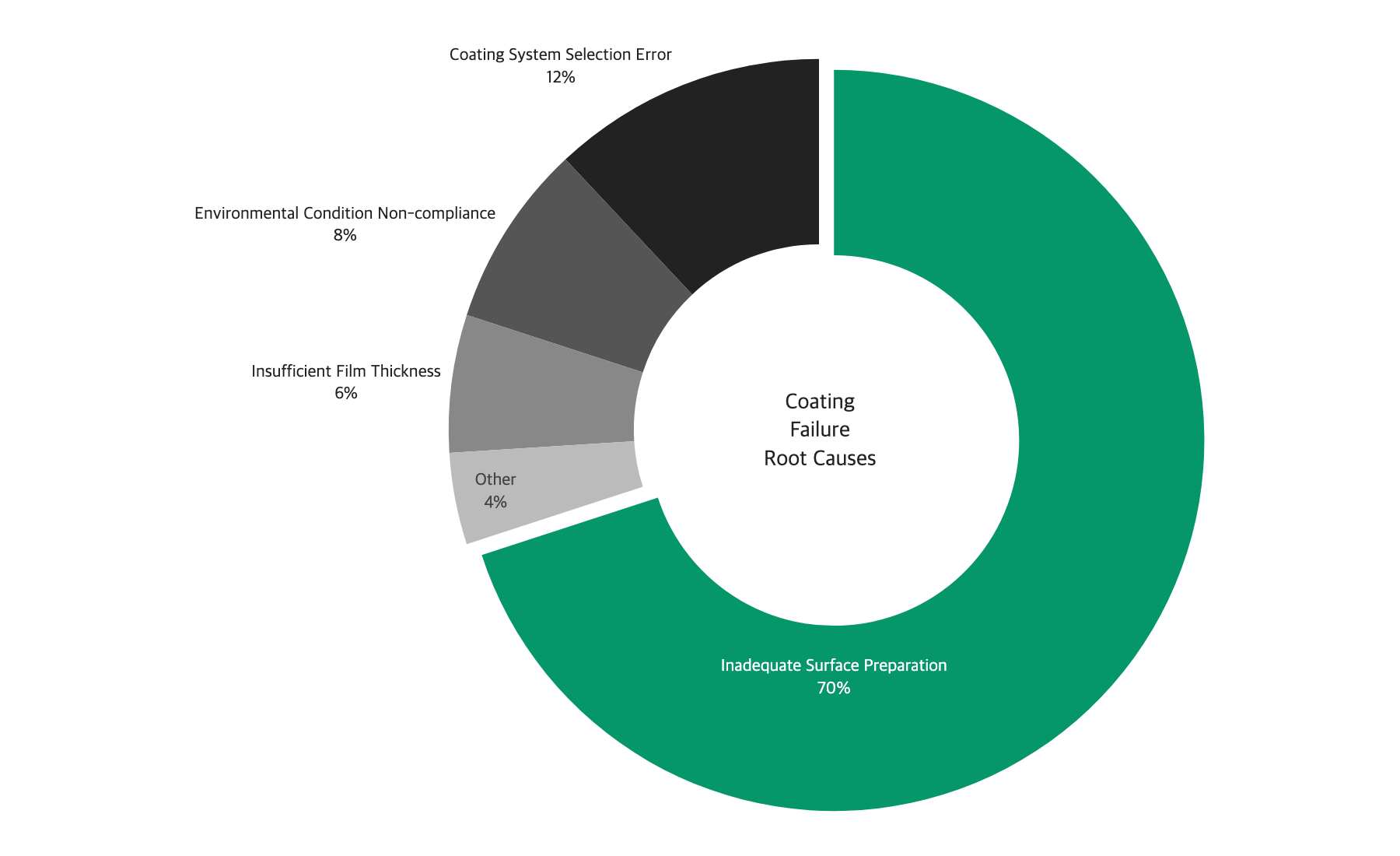
The chart confirms that surface preparation quality dominates all other failure causes combined. The most cost-effective path to improved coating performance in coastal environments is not a more expensive coating product but rather ensuring that the substrate is properly prepared before application.
Residual Chloride: The Invisible Threat
Surface preparation aims to create conditions for stable coating adhesion: adequate profile, cleanliness, and acceptably low soluble salt residue. In coastal environments, the most frequently overlooked element is residual chloride. Blasting may remove all visible rust and old coating, but if chloride ions trapped in pits and crevices are not removed, coating failure is a matter of time.
The ISO 8502 standard series provides methods for measuring surface soluble salt concentration using the Bresle patch method. Chloride acceptance limits vary by service condition, with seawater immersion environments typically specified at 3 to 50 micrograms per square centimeter (ISO 8502-6/9). For long-term coastal exposure, many coating manufacturers recommend below 20 micrograms per square centimeter. Critically, the blasting process itself can introduce contamination: if blast abrasive media contains chloride, surface preparation actively deposits salt onto the substrate. In coastal environments, airborne salt re-deposits on blasted surfaces within hours, making the blast-to-prime interval a critical quality parameter.
Primer Selection: Barrier vs. Sacrificial Protection
Even with perfect surface preparation, selecting a primer that does not match the corrosion severity shortens the entire coating system's life. The most common error in coastal environments is specifying a general-purpose epoxy primer (barrier-only protection) where a zinc primer (sacrificial anode protection) is required. Zinc primers contain zinc pigment that is electrochemically more active than iron, so zinc oxidizes preferentially to protect the substrate even when coating defects occur. This cathodic protection effect is particularly valuable in electrolyte-rich coastal conditions. General-purpose epoxy primers offer only barrier protection, leaving the substrate immediately exposed when any defect occurs.
The sacrificial protection mechanism of zinc primers operates in two phases. In the initial phase, metallic zinc particles in electrical contact with the steel substrate provide active cathodic protection. As zinc corrosion products (zinc oxide, zinc hydroxide, and zinc carbonates) accumulate, they fill pores in the primer film, transitioning the mechanism from primarily sacrificial to primarily barrier. Inorganic zinc silicate primers maintain the sacrificial phase longer than organic zinc epoxy primers due to higher zinc loading and inorganic binder chemistry.
Figure 3. Primer Coastal Durability by Type
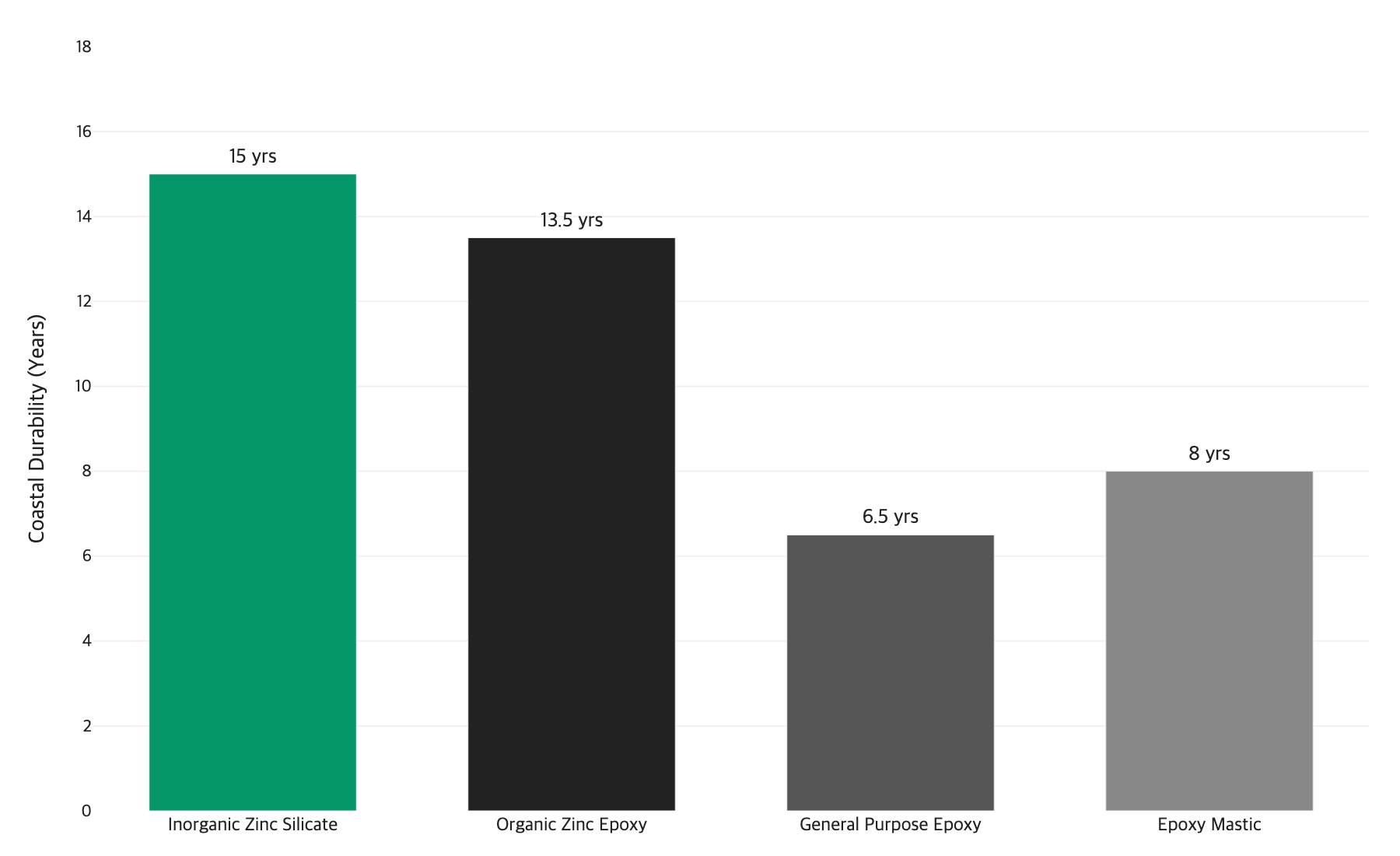
Inorganic zinc silicate primers deliver approximately 15 years of coastal service, while general-purpose epoxy primers last only 5 to 8 years. The critical differentiator is self-healing capability at defects: zinc primers continue protecting the substrate through sacrificial oxidation even after coating damage, while epoxy primers lose all protective function at the point of damage.
Figure 4. Primer Type Performance Summary
Primer Type | Mechanism | Coastal Durability | Self-Healing | Application Difficulty |
|---|---|---|---|---|
Inorganic Zinc Silicate | Sacrificial anode + barrier | ~15 years | Excellent | High (humidity/temp control) |
Organic Zinc Epoxy | Sacrificial anode + barrier | ~13.5 years | Good | Moderate |
General Purpose Epoxy | Barrier only | ~5 to 8 years | None | Low |
Epoxy Mastic | Barrier (high build) | ~8 years | None | Low |
The table confirms that the primer mechanism, not the total film thickness, determines long-term coastal performance. Zinc-based sacrificial protection is the distinguishing feature that separates high-performing systems from those that fail prematurely.
V. Coating System Selection by Corrosion Classification
Selecting the right coating system for coastal environments requires cross-analysis of corrosion classification, substrate type, and exposure conditions. ISO 12944 classifies environments from C1 (very low) through CX (extreme), with coastal environments falling in the C4 through CX range. The selection framework below translates classification into specific coating system recommendations.
Figure 5. Recommended Coating Systems by Corrosion Classification
Corrosion Class | Environment | Primer | Intermediate | Topcoat | Total DFT |
|---|---|---|---|---|---|
C4 (High) | 1-5 km from coast | Organic zinc epoxy, 75 um | Epoxy, 125 um | Polyurethane, 50 um | 250 um+ |
C5 (Very High) | 500 m to 1 km | Inorganic zinc silicate, 75 um | Epoxy, 150 um | Polyurethane, 50 um | 275 um+ |
CX (Extreme) | Within 500 m, sea spray | Inorganic zinc silicate, 75 um | High-build epoxy, 200 um | Polyurethane, 80 um | 355 um+ |
As classification severity increases, the primer mechanism shifts from barrier-only to sacrificial anode, and intermediate coat thickness increases to extend the chloride penetration path. The design principle is dual defense: extending penetration time through barrier function and providing post-penetration protection through cathodic protection.
Figure 6. Critical Management Parameters by Classification
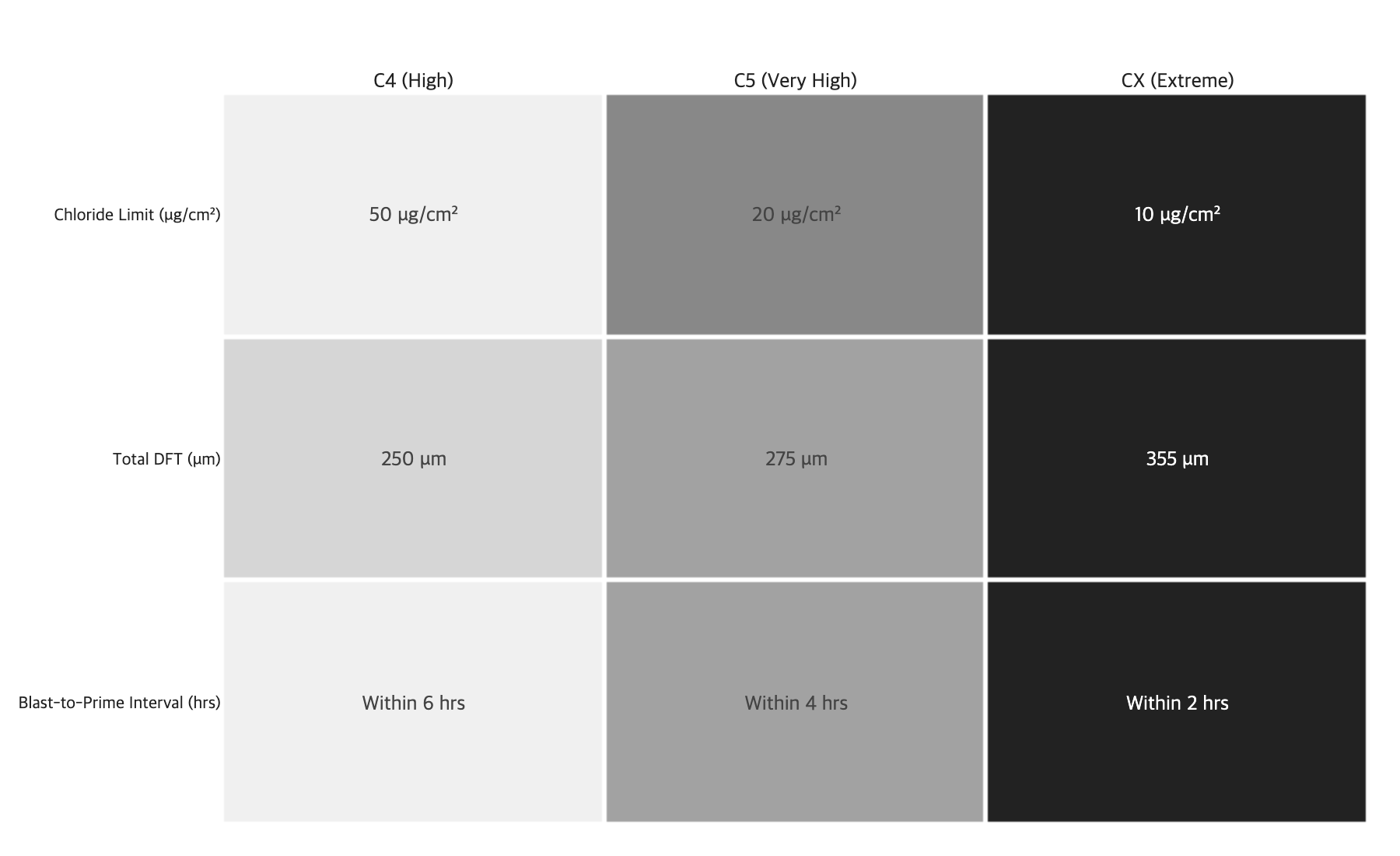
The heatmap illustrates how all management parameters become more stringent as corrosion classification increases. At CX classification, the chloride limit drops to 10 micrograms per square centimeter and the blast-to-prime interval narrows to 2 hours, reflecting the extreme sensitivity of these environments to any contamination or delay.
Substrate Considerations
Even within the same corrosion classification, substrate type affects system selection. Zinc primers are effective on carbon steel but should not be used on galvanized steel (insufficient potential difference for sacrificial effect). For stainless steel or aluminum, etch primers or wash primers are required to establish chemical bonding with the substrate.
VI. Field Cases
Two cases from coastal field environments illustrate how the root causes identified above lead to real failures and how systematic correction resolves them.
Case 1: Port Crane Coating Disbondment from Primer Substitution
Company A performed exterior coating on 12 gantry cranes at a port facility. The structural material was SS400 carbon steel, located approximately 200 meters from the shoreline in a C5 environment. Total coating area was approximately 28,000 square meters with a contract value of approximately USD 630,000.
Company A substituted general-purpose epoxy primer for the specified inorganic zinc primer to reduce material cost. They applied 75 um epoxy primer, 125 um epoxy intermediate, and 50 um polyurethane topcoat for 250 um total dry film thickness (DFT). At 5 months post-application, blisters appeared on boom undersides and lower leg sections. By month 8, 9 of 12 cranes showed ASTM D714 Grade 4 blistering, with coating peeling by hand in some areas.
Analysis found blister fluid at pH 3.2 to 4.5 with 850 mg/L chloride, consistent with osmotic blistering. The average blast-to-prime interval had been 18 hours. Surface chloride measured 12 micrograms per square centimeter immediately after blasting but rose to 38 micrograms per square centimeter after the 18-hour delay, exceeding the 20 microgram C5 limit.
Company A re-blasted and recoated all 9 affected cranes with inorganic zinc primer per original specification. Recoating cost was approximately USD 420,000, roughly 4.7 times the USD 90,000 incremental cost of using inorganic zinc primer originally. During recoating, the 4-hour blast-to-prime limit was strictly enforced with Bresle patch verification at each work zone.
Case 2: Offshore Piping Failure from Contaminated Blast Abrasive
Carbon steel piping (168.3 mm OD, 7.11 mm wall, approximately 3,200 meters total) on Company B's offshore platform showed exterior coating disbondment at 7 months. The piping was installed on a deck 15 meters above sea level in a CX environment with direct sea spray exposure.
Initial analysis assumed UV-induced topcoat degradation. Detailed investigation revealed disbondment at the primer-substrate interface with normal topcoat condition. XRF analysis of substrate corrosion products detected 2.8 weight percent chloride. The copper slag blast abrasive conductivity measured 350 microsiemens per centimeter, exceeding the 250 microsiemens per centimeter guideline by 40 percent, confirming the abrasive itself as the contamination source.
Company B replaced the contaminated abrasive and implemented a 2-stage surface preparation process: wet blasting to remove soluble salts, followed by dry blasting to establish the required profile. At 18 months post-recoating, pull-off adhesion (ASTM D4541) remains above 5 MPa with zero blistering. Total recoating cost was USD 315,000, including USD 135,000 for platform scaffolding. The abrasive quality control program (conductivity testing equipment and incoming inspection) cost approximately USD 11,000, only 3.5 percent of the recoating expense.
VII. Key Takeaway
60 to 80 percent of premature coastal coating failures trace back to surface preparation deficiency, specifically residual chloride contamination. Measure surface chloride after blasting using the Bresle patch method (ISO 8502-6/9) and do not proceed to primer application if levels exceed the corrosion classification limit.
In C5 and CX environments, zinc primers (sacrificial anode protection) are not optional. General-purpose epoxy primers (barrier-only) will fail prematurely regardless of film thickness.
Control the blast-to-prime interval: 4 hours maximum for C5, 2 hours for CX. Airborne salt re-deposits rapidly in coastal environments, and every hour of delay increases contamination risk.
Verify blast abrasive quality on every incoming lot. Abrasive conductivity above 250 microsiemens per centimeter means the abrasive is transferring salt to the surface you are trying to clean.
Osmotic blistering and cathodic disbondment interact to accelerate failure. Measuring blister fluid pH (acidic = osmotic, alkaline = cathodic) guides the correct repair strategy.
When the number of variables involved in coating system selection, surface preparation verification, and failure diagnosis exceeds what field teams can reliably track from experience alone, structured analytical tools become essential for consistent, mechanism-based decision-making. Lubinpla's AI-powered platform can cross-reference corrosion classification, substrate type, primer chemistry, surface contamination data, and environmental conditions to recommend coating systems matched to the specific operating environment, and trace coating failures back to their root cause using the same mechanism-based reasoning described in this article.
VIII. References
[1] NACE International, "International Measures of Prevention, Application, and Economics of Corrosion Technologies Study (IMPACT)", 2016. http://impact.nace.org/economic-impact.aspx
[2] Sherwin-Williams, "Surface Preparation", 2024. https://www.sherwin-williams.com/architects-specifiers-designers/products/resources/surface-preparation
[3] KTA-Tator, "Let's Talk Surface Soluble Salt Testing", 2023. https://kta.com/surface-soluble-salt-testing/
[4] KTA-Tator, "Coating Blister Failures and Associated Coating and Substrate Risks", 2023. https://kta.com/coating-blister-failures-risks/
[5] Corrosionpedia, "The Role of Soluble Salts in Osmotic Blistering for Best Coating Performance", 2023. https://www.corrosionpedia.com/2/1996/failure/the-role-of-soluble-salts-in-osmotic-blistering
[6] DeFelsko, "Measuring Soluble Salts in Accordance with ISO 8502-6 and ISO 8502-9", 2023. https://www.defelsko.com/resources/measuring-soluble-salts-on-surfaces-in-accordance-with-iso-8502-6-and-iso-8502-9-the-bresle-method
[7] ISO, "ISO 8502-2:2017 Preparation of steel substrates before application of paints", 2017. https://www.iso.org/standard/58058.html
[8] V&A Consulting Engineers, "Surface Preparation: Key to Protective Coating Excellence", 2024. https://www.vaengineering.com/blog-1/2024/05/07/surface-preparation-key-to-protective-coating-excellence
[9] Springer Nature, "Comparative study on the degradation of a zinc-rich epoxy primer/acrylic polyurethane coating", 2020. https://link.springer.com/article/10.1007/s11998-020-00410-8
[10] PMC, "Failure Mechanisms of the Coating/Metal Interface in Waterborne Coatings", 2017. https://pmc.ncbi.nlm.nih.gov/articles/PMC5506901/
[11] Wikipedia, "Osmotic blistering", 2024. https://en.wikipedia.org/wiki/Osmotic_blistering
[12] Corrosion Alliance, "Explanation of the ISO 8502 on surface cleanliness", 2023. https://www.corrosionalliance.com/corrosion-mechanisms/explanation-of-the-iso-8502-on-surface-cleanliness/
[13] Johns Manville, "NACE Study Estimates Global Cost of Corrosion at $2.5 trillion annually", 2017. https://www.jm.com/en/blog/2017/march/nace-study-estimates-global-cost-of-corrosion-at-25-trillion-annually/
[14] DeFelsko, "Measuring Environmental Conditions for the Application of Paints and Coatings", 2023. https://www.defelsko.com/resources/measuring-environmental-conditions
[15] ISO, "ISO 12944-9:2018 Protective paint systems and laboratory performance test methods for offshore and related structures", 2018. https://www.iso.org/standard/64835.html
Powered by Lubinpla
Discover how technical teams solve complex challenges faster with AI.