The Hidden Chemistry Behind Unexpected Scale Formation in Heat Exchangers
Summary: Heat exchangers across petrochemical plants, power stations, and water treatment facilities frequently develop scale deposits despite chemical treatment programs operating within specification. This article examines the three dominant scale formation pathways, calcium carbonate, calcium sulfate, and silica, and reveals how pH fluctuations and temperature cycling create localized supersaturation zones that standard dosing calculations consistently miss. Understanding these precipitation mechanisms at the chemical level enables engineers to shift from reactive descaling to targeted prevention, reducing unplanned shutdowns and extending heat exchanger service life by addressing the actual root cause rather than the visible symptom.
Table of Contents
I. The Persistent Problem of Scale Despite Treatment
II. Three Scale Formation Pathways and Their Precipitation Chemistry
III. Why Standard Dosing Calculations Miss Localized Supersaturation
IV. Identifying Scale Type from Appearance and Composition
V. Mechanism-Based Corrective Action by Scale Type
VI. Field Cases: When the Root Cause Was Not What It Seemed
VII. Key Takeaway
VIII. References
I. The Persistent Problem of Scale Despite Treatment
Scale formation in heat exchangers remains one of the most persistent and costly problems in industrial water systems. Even when treatment chemical dosing falls within the manufacturer's recommended range, scale deposits continue to accumulate on heat transfer surfaces, reducing thermal efficiency and forcing unplanned maintenance shutdowns. The global cost of heat exchanger fouling, of which scaling is the dominant mechanism in water-side systems, exceeds USD 4.4 billion annually across industrialized nations (Muller-Steinhagen, 2000). Approximately 15 percent of total process plant maintenance costs are attributable to heat exchangers and boilers, and roughly half of that figure is caused directly by fouling deposits (Bott, 1995).
The Gap Between Specification and Reality
The core issue is not that treatment chemicals fail to work. It is that the conditions under which they are expected to work often diverge from the conditions that actually exist at the heat transfer surface. Bulk water chemistry measurements, taken at sampling points distant from the exchanger, represent average conditions across the entire system. They do not capture the localized temperature spikes, pH excursions, and concentration gradients that develop at the tube wall boundary layer. A treatment program designed around bulk water parameters may show acceptable Langelier Saturation Index (LSI) values system-wide while the fluid film immediately adjacent to the heat transfer surface has already crossed the supersaturation threshold. This disconnect between measured conditions and actual surface conditions is the fundamental reason why scale forms despite seemingly adequate chemical treatment.
The Cost of Reactive Descaling
When scale is discovered, the standard response is chemical or mechanical cleaning. Cleaning costs typically range from USD 40,000 to USD 50,000 per heat exchanger per event (Garrett-Price, 1985). However, the direct cleaning cost is only a fraction of the total impact. As little as 1.5 mm of calcium carbonate scale on a heat transfer surface can reduce thermal efficiency by approximately 12 percent, and a 3 mm deposit can increase energy costs by up to 25 percent (Engineering Toolbox, 2023). When scaling forces an unplanned shutdown in a refinery pre-heat train, lost production costs can exceed USD 1 million per day. These economics make it clear that understanding the root cause of scale formation, rather than simply treating its symptoms, has significant financial value.
Figure 3. Energy Cost Increase by Scale Deposit Thickness
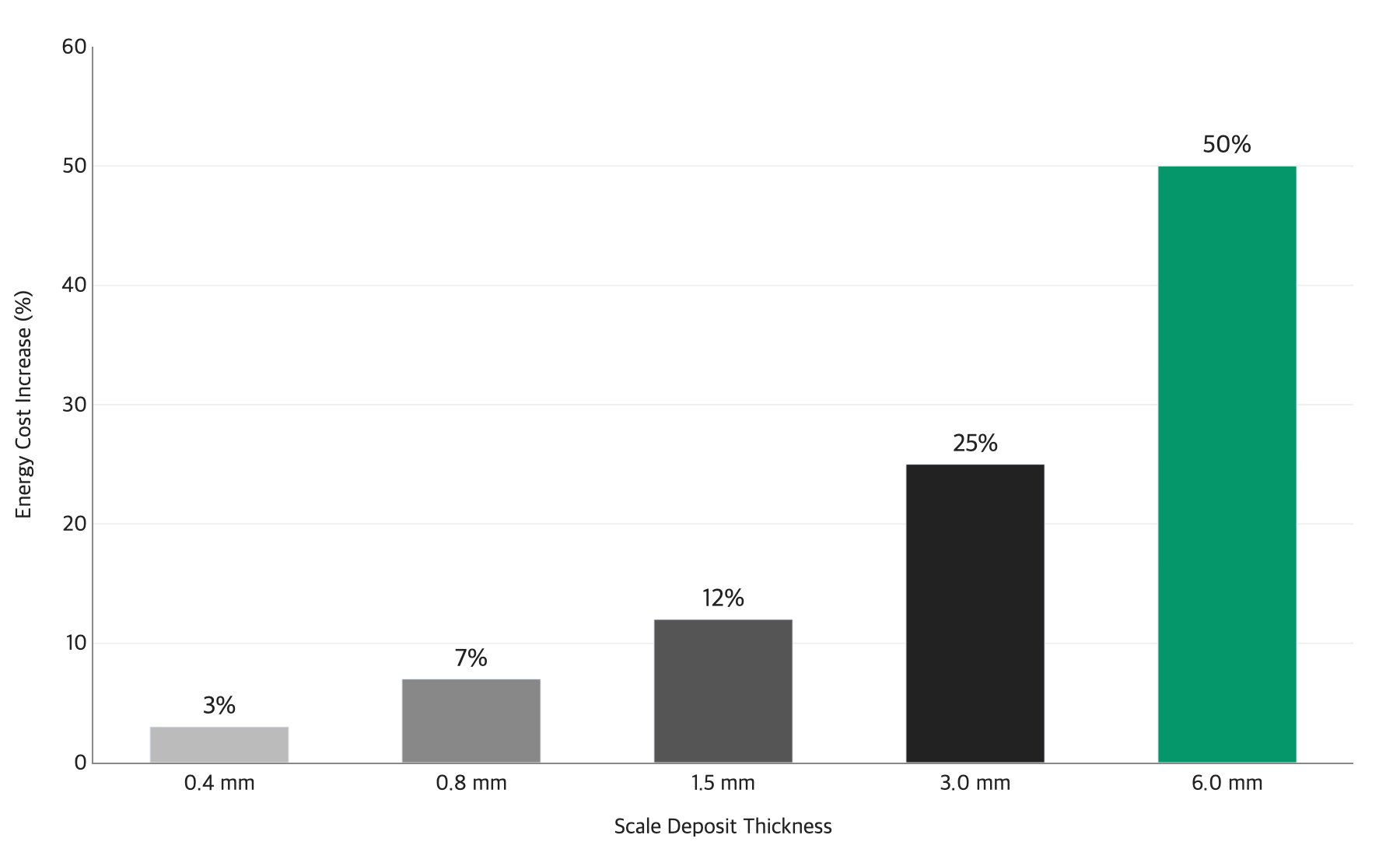
The chart above quantifies the relationship between scale deposit thickness and the resulting increase in energy costs for heat transfer operations. Even a thin 0.4 mm deposit raises costs by approximately 3 percent, while a 6 mm buildup, common in systems left untreated for extended periods, can drive costs up by 50 percent. This exponential relationship underscores why early detection and prevention are far more economical than allowing scale to accumulate before intervening.
II. Three Scale Formation Pathways and Their Precipitation Chemistry
Scale deposits in heat exchangers are not a single phenomenon. Three distinct mineral types account for over 90 percent of scaling problems in industrial water systems, and each follows a fundamentally different precipitation pathway. Misidentifying the scale type leads directly to misapplied treatment, which is why understanding the chemistry behind each pathway is essential for effective prevention.
Calcium Carbonate: The Inverse Solubility Problem
Calcium carbonate (CaCO3) is the most common scale type found in cooling water and heat exchanger systems. Its formation is governed by the equilibrium between calcium ions, bicarbonate ions, and dissolved carbon dioxide in water. The critical characteristic of CaCO3 is its inverse solubility behavior: as temperature increases, solubility decreases (Hasson, 1981). This is the opposite of what most engineers intuitively expect, and it is the primary reason CaCO3 scale preferentially deposits on the hottest surfaces in the system. The thermodynamic explanation lies in the exothermic nature of CaCO3 dissolution. According to Le Chatelier's principle, adding heat to an exothermic dissolution reaction shifts the equilibrium toward the solid phase, driving precipitation. At the tube wall of a heat exchanger, where the surface temperature may be 10 to 30 degrees C higher than the bulk water temperature, the local solubility of CaCO3 drops significantly below the bulk value. The precipitation reaction proceeds as follows: Ca2+ plus 2HCO3- yields CaCO3 (solid) plus H2O plus CO2. As temperature rises, CO2 is driven off, shifting the equilibrium further toward CaCO3 deposition.
Calcium Sulfate: The Threshold and Induction Time Challenge
Calcium sulfate (CaSO4) scale, primarily in its dihydrate form (gypsum), presents a different challenge. While it also exhibits inverse solubility at elevated temperatures, CaSO4 has a notably higher solubility than CaCO3 under most cooling water conditions. This means CaSO4 scaling typically occurs only when concentration cycles are high or when system temperatures exceed the gypsum solubility limit, approximately 40 degrees C for saturated solutions (Hasson, 1968). A key distinguishing feature of CaSO4 scale is its long induction time. Research has shown that gypsum scale formation on heat exchanger surfaces can require induction periods of up to 25 hours before visible deposition begins (Amjad, 1988). During this induction period, the water may appear stable and treatment may seem effective, but nucleation sites are forming on the metal surface. Once nucleation is established, crystal growth proceeds rapidly. This behavior makes CaSO4 scaling particularly dangerous because it can appear suddenly after weeks or months of apparently normal operation. Unlike CaCO3, which dissolves readily in acid, CaSO4 scale is significantly more difficult to remove chemically and often requires mechanical cleaning methods.
Silica: The Polymerization Pathway
Silica (SiO2) scaling follows a fundamentally different mechanism from both CaCO3 and CaSO4. Rather than crystallizing from ionic solution, silica deposits through a polymerization process. When dissolved silica concentration exceeds the saturation limit, typically 150 to 180 ppm depending on pH and temperature, monomeric silicic acid (Si(OH)4) begins to polymerize into colloidal silica particles (Gunnarsson, 2005). These colloidal particles then deposit on surfaces through a combination of particle transport and adhesion mechanisms. The polymerization rate is strongly dependent on pH. In the pH range of 7 to 8.5, typical for cooling water systems, the polymerization rate is moderate. Above pH 8.5, silica solubility actually increases due to the formation of silicate anions. Below pH 7, polymerization slows but surface adhesion of existing colloidal particles increases. This pH sensitivity makes silica scaling particularly problematic in systems where pH control is inconsistent. Unlike carbonate and sulfate scales, silica deposits are amorphous rather than crystalline. They form a hard, glassy layer that is extremely resistant to both chemical and mechanical removal. Hydrofluoric acid is one of the few chemicals effective against silica scale, but its extreme toxicity and corrosivity make it impractical for routine use. Prevention is therefore far more critical for silica than for other scale types.
III. Why Standard Dosing Calculations Miss Localized Supersaturation
The root cause of unexpected scale formation in properly treated systems lies in the disconnect between bulk water chemistry and the conditions that exist at the heat transfer surface. Standard treatment programs are designed around bulk water parameters, but precipitation occurs at the boundary layer where conditions can differ dramatically from the bulk.
Temperature Gradient at the Tube Wall
In a typical shell-and-tube heat exchanger, the bulk cooling water temperature may be 32 degrees C, well within the safe operating range for CaCO3 solubility. However, the temperature at the inner tube wall surface, where the hot process fluid transfers heat through the metal, can reach 55 to 65 degrees C or higher depending on the heat duty and flow velocity. This temperature gradient creates a zone of reduced solubility immediately adjacent to the surface. The Langelier Saturation Index calculated from bulk water conditions may show -0.3, indicating non-scaling water, while the LSI at the actual tube wall temperature could be +1.2 or higher, strongly scaling (Langelier, 1936).
pH Excursions and CO2 Stripping
Temperature is not the only variable that changes at the boundary layer. As water temperature increases near the tube wall, dissolved CO2 is stripped from solution. Since CO2 acts as a weak acid in water, its removal raises the local pH. A bulk water pH of 7.8 can shift to 8.4 or higher at the heated surface. This pH increase has a compounding effect on CaCO3 supersaturation because CaCO3 solubility decreases with increasing pH. The combination of higher temperature and higher pH at the tube wall creates a supersaturation condition that is invisible to bulk water monitoring. Engineers measuring pH and alkalinity at the system sampling point see values well within specification, unaware that the fluid film at the heat transfer surface has already crossed the precipitation threshold.
Concentration by Evaporation and Low-Flow Zones
In cooling tower systems operating at 4 to 6 cycles of concentration, the dissolved mineral content is already elevated compared to the makeup water source. At the heat transfer surface, micro-evaporation at the boundary layer can further concentrate these minerals by an additional 10 to 20 percent locally. Low-flow zones, dead legs, and areas of reduced turbulence compound this effect by allowing the concentrated boundary layer to persist rather than being swept away by bulk flow. The result is a patchwork of localized supersaturation zones distributed across the heat transfer surface. Scale formation initiates at these hot spots and gradually spreads, even as the overall system chemistry remains within acceptable limits. This explains the common field observation where scale deposits appear in specific areas of the tube bundle rather than uniformly across the entire surface.
Figure 1. Comparison of Scale Formation Conditions: Bulk Water vs. Tube Wall Boundary Layer
Parameter | Bulk Water (Measured) | Tube Wall Boundary Layer (Actual) | Impact |
|---|---|---|---|
Temperature | 32 degrees C | 55-65 degrees C | CaCO3 solubility drops 30-50% |
pH | 7.8 | 8.2-8.5 | Supersaturation ratio doubles |
LSI | -0.3 (non-scaling) | +0.8 to +1.5 (scaling) | Precipitation threshold exceeded |
Dissolved CO2 | 12 ppm | 3-5 ppm | pH shift driver |
Mineral concentration | 1x (cycles of concentration) | 1.1-1.2x (micro-evaporation) | Additional supersaturation |
This table illustrates how conditions at the tube wall diverge significantly from measured bulk water values. Treatment programs based solely on bulk water analysis will underestimate the actual scaling potential at the heat transfer surface, which is where scale actually forms. The LSI shift from -0.3 to above +0.8 represents a transition from non-scaling to actively precipitating conditions, all occurring within a boundary layer only fractions of a millimeter thick.
IV. Identifying Scale Type from Appearance and Composition
Effective scale treatment begins with correct identification. Each scale type has distinctive visual and chemical characteristics that enable field-level diagnosis before laboratory analysis is available. Applying the wrong treatment to misidentified scale wastes chemical inventory, delays resolution, and can accelerate damage to the heat transfer surface.
Visual Identification Guide
Visual inspection provides the first diagnostic indicator. CaCO3 scale typically appears as a white to off-white, chalky or crystalline deposit that varies from soft and porous in early-stage formation to dense and layered in mature deposits. CaSO4 scale is distinctly harder, appearing as a white to gray crystalline deposit with a more uniform, compact structure. Silica scale is the most visually distinctive, presenting as a glassy, translucent to opaque deposit that is smooth to the touch and may have a vitreous luster.
Chemical Field Test
A simple acid dissolution test provides reliable differentiation in the field. Applying a few drops of 10 percent hydrochloric acid (HCl) to the deposit surface produces immediate, vigorous effervescence (CO2 gas release) if the deposit is CaCO3. CaSO4 shows no reaction or extremely slow dissolution in HCl. Silica shows no visible reaction with HCl. This 30-second test eliminates the most common misidentification error, treating CaSO4 or silica scale with acid programs designed for CaCO3.
Figure 2. Scale Type Identification and Diagnostic Summary
Characteristic | CaCO3 (Calcium Carbonate) | CaSO4 (Calcium Sulfate) | SiO2 (Silica) |
|---|---|---|---|
Appearance | White, chalky, layered | White-gray, crystalline, compact | Glassy, smooth, translucent |
Hardness | Soft to moderate | Hard | Very hard |
Crystal structure | Crystalline (calcite/aragonite) | Crystalline (gypsum/anhydrite) | Amorphous |
HCl acid test | Vigorous fizzing (CO2 release) | No reaction | No reaction |
Solubility in acid | Readily soluble in dilute HCl | Slightly soluble in HCl | Insoluble (requires HF) |
Formation driver | Inverse solubility + pH increase | High concentration + temperature | Polymerization above 150 ppm |
Typical location | Hottest tube surfaces | High-concentration zones | pH-unstable zones |
Removal difficulty | Low (acid cleaning) | Moderate (mechanical + chemical) | High (prevention preferred) |
The table above provides a practical field reference for distinguishing the three major scale types. The acid test alone resolves the majority of identification questions within seconds. For cases requiring definitive confirmation, X-ray diffraction (XRD) analysis provides precise mineral phase identification, distinguishing not only between CaCO3 and CaSO4 but also between polymorphs such as calcite versus aragonite, or gypsum versus anhydrite, which have different formation conditions and treatment implications.
Figure 4. Scale Type Risk Profile Comparison (CaCO3 vs CaSO4 vs SiO2)
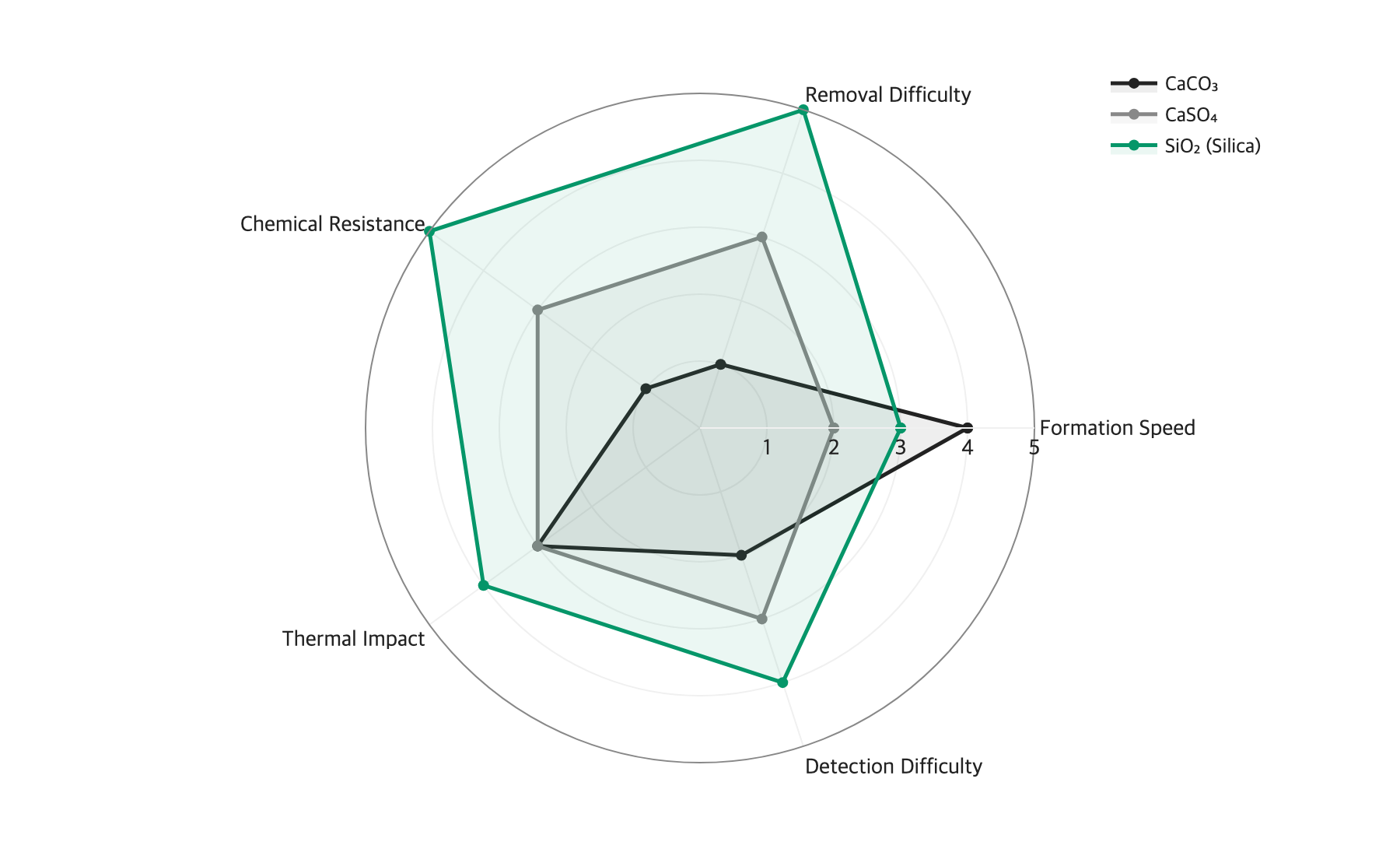
This radar chart compares the three major scale types across five critical risk dimensions. Silica (SiO2) scores highest on removal difficulty and chemical resistance, confirming why prevention is the only practical strategy for silica-prone systems. CaCO3 leads in formation speed due to its inverse solubility response to temperature, but scores lowest on removal difficulty because it dissolves readily in dilute acid. CaSO4 occupies the middle ground across most dimensions but is notably harder to detect than CaCO3 due to its long induction time before visible deposition. Engineers should use this risk profile to prioritize monitoring and prevention resources toward the scale type that poses the highest combined threat in their specific operating conditions.
V. Mechanism-Based Corrective Action by Scale Type
Once the scale type is correctly identified, the treatment strategy must address the specific precipitation mechanism rather than applying a generic descaling approach. Each scale type requires a different combination of chemical treatment, process adjustment, and monitoring parameters to prevent recurrence.
CaCO3: pH and Temperature Management
For calcium carbonate scale, the treatment strategy centers on controlling the supersaturation ratio at the heat transfer surface. This involves three coordinated actions. First, pH control within a tighter band than typical specifications require. Rather than allowing pH to fluctuate between 7.0 and 9.0, which many treatment programs permit, CaCO3 prevention requires maintaining pH between 7.2 and 7.8 to limit the CO2 stripping effect at heated surfaces. Second, scale inhibitor selection must account for surface temperature conditions. Phosphonate-based inhibitors such as HEDP (1-hydroxyethylidene-1,1-diphosphonic acid) are effective threshold inhibitors that prevent CaCO3 crystal growth at dosages as low as 2 to 5 ppm, but their effectiveness decreases above 60 degrees C surface temperature. For systems with higher surface temperatures, polymer-based inhibitors such as polyacrylic acid or maleic acid copolymers provide better high-temperature stability. Third, monitoring must shift from periodic grab samples to continuous measurement of pH, conductivity, and calcium hardness, with alarm thresholds set based on calculated surface conditions rather than bulk water limits.
CaSO4: Concentration Cycle Control
Calcium sulfate scale prevention focuses primarily on preventing the system from exceeding the CaSO4 solubility limit. Since CaSO4 solubility in the gypsum form is approximately 2,000 ppm at 40 degrees C and decreases to approximately 1,500 ppm at 80 degrees C, the primary control mechanism is limiting cycles of concentration. In systems with high-sulfate makeup water (above 250 ppm SO4), this may require reducing cycles of concentration from the typical 4 to 6 down to 3 or fewer, with a corresponding increase in blowdown water consumption. Scale inhibitors specific to CaSO4, particularly phosphonate and carboxylate-based polymers, can extend the allowable concentration range. Polyepoxysuccinic acid (PESA) has demonstrated strong inhibition performance against CaSO4, achieving greater than 80 percent inhibition at hardness levels up to 700 ppm (IWA Publishing, 2023). Unlike CaCO3, where treatment failure means a relatively easy acid cleaning, CaSO4 treatment failure results in scale that is resistant to chemical dissolution and typically requires high-pressure hydroblasting or mechanical removal at significantly greater cost.
Silica: Prevention Over Cure
Silica scale prevention is overwhelmingly preferred over removal because the removal options are severely limited. The primary strategy is maintaining dissolved silica concentration below the saturation threshold, which requires understanding the relationship between silica solubility, pH, and temperature in the specific system. At pH 7.0, amorphous silica solubility is approximately 120 ppm at 25 degrees C and increases to approximately 350 ppm at 100 degrees C. Maintaining the system above 150 ppm dissolved silica requires either reducing cycles of concentration to keep silica below saturation, or increasing pH above 8.5 where silica solubility rises due to ionization. However, raising pH to control silica creates a direct conflict with CaCO3 prevention, which requires lower pH. This chemical conflict is one of the most challenging aspects of cooling water treatment and often requires careful optimization with specialized dispersant polymers that can maintain silica in a dispersed colloidal state even above the solubility limit. For systems where silica scale has already formed, hot alkaline cleaning with sodium hydroxide solution (5 to 10 percent NaOH at 80 to 90 degrees C) can slowly dissolve amorphous silica, but the process requires extended contact times of 12 to 24 hours and generates a highly alkaline waste stream that requires neutralization before disposal.
VI. Field Cases: When the Root Cause Was Not What It Seemed
The following cases illustrate how mechanism-based analysis reveals the actual root cause of unexpected scale formation, which is often different from the initial assumption.
Case 1: Company A, Petrochemical Cooling Water System
Company A operated a petrochemical facility with 14 shell-and-tube heat exchangers in the cooling water loop, processing approximately 8,500 cubic meters per hour of cooling water. Despite maintaining a treatment program with phosphonate-based scale inhibitor dosed at 4 ppm, three exchangers showed recurring CaCO3 scale deposits every 4 to 5 months, requiring chemical cleaning at approximately USD 45,000 per event. Annual scale-related costs totaled approximately USD 270,000 across the three affected units. The initial diagnosis pointed to insufficient inhibitor dosage, and the dosing rate was increased from 4 ppm to 6 ppm. Scaling continued. A second investigation suggested microbiological fouling as a contributing factor, and biocide treatment was intensified. Scaling continued. The actual root cause was discovered when continuous pH monitoring was installed directly at the affected exchangers. Data revealed that the cooling tower fan cycling pattern caused pH fluctuations of 0.4 to 0.6 units over 15-minute intervals as CO2 absorption and stripping rates varied with airflow. During peak stripping periods, local pH at the exchanger inlet reached 8.6, pushing the LSI at the tube wall surface above +1.8. The solution involved three changes. First, fan cycling was modified to reduce on-off frequency, limiting pH fluctuation to within 0.2 units. Second, supplemental CO2 injection was installed at the cooling tower basin to buffer pH excursions. Third, the scale inhibitor was changed from a phosphonate to a phosphonate-polymer blend optimized for high-LSI conditions. After implementation, the cleaning interval extended from 4 to 5 months to over 18 months. Annual scale-related maintenance costs dropped from USD 270,000 to approximately USD 45,000, representing an 83 percent reduction. Capital investment for the CO2 injection system and monitoring equipment totaled approximately USD 85,000, achieving payback within 4 months.
Case 2: Company B, Power Plant Condenser
Company B operated a 200 MW combined-cycle power plant with titanium-tubed condensers cooled by river water intake at approximately 15,000 cubic meters per hour. The facility experienced progressive condenser fouling that reduced vacuum pressure from the design value of 50 mbar to 72 mbar over a 6-month operating cycle, corresponding to approximately 1.5 percent loss in turbine efficiency and an estimated annual revenue loss of USD 420,000. The water treatment team focused on CaCO3 prevention based on the river water's moderate hardness of 180 ppm as CaCO3 and alkalinity of 120 ppm. Acid dosing maintained bulk water pH at 7.5 and LSI at -0.2. However, scale analysis by XRD revealed that 65 percent of the deposit was amorphous silica, 20 percent was CaCO3, and 15 percent was iron oxide. The river water source contained 45 ppm dissolved silica, and at 5.2 cycles of concentration, the recirculating water carried approximately 234 ppm silica, well above the 150 ppm polymerization threshold. Because the treatment program was designed exclusively for CaCO3 control, silica had never been monitored or treated. After correct identification, Company B implemented a three-stage correction. First, cycles of concentration were reduced from 5.2 to 3.8, bringing silica to approximately 171 ppm, still above threshold but significantly reduced. Second, a dispersant polymer specific to silica (modified polyacrylamide, 8 ppm dosage) was added to the treatment program. Third, a continuous silica analyzer was installed on the recirculating water loop with an alarm threshold at 160 ppm. Within 3 months, condenser vacuum recovered to 53 mbar, and the 6-month fouling rate decreased by 72 percent. Annual water consumption increased by approximately 12 percent due to lower cycles of concentration, adding approximately USD 35,000 in water and sewer costs, but the net annual benefit after subtracting water costs and treatment chemical costs was approximately USD 340,000.
VII. Key Takeaway
Scale formation on heat exchangers is driven by localized conditions at the tube wall boundary layer, not by the bulk water chemistry that standard monitoring captures. Treatment programs must account for surface temperature, local pH shift from CO2 stripping, and micro-concentration effects.
The three dominant scale types, CaCO3, CaSO4, and silica, follow fundamentally different precipitation mechanisms and require different prevention strategies. A 30-second HCl acid test in the field reliably differentiates CaCO3 from CaSO4 and silica deposits.
pH fluctuations of as little as 0.4 to 0.6 units can shift the LSI at the tube wall from non-scaling to actively precipitating conditions. Continuous pH monitoring at the exchanger, not just at the cooling tower basin, is essential for detecting these transient supersaturation events.
Silica scaling is frequently overlooked in treatment programs focused on calcium-based scales. Any system operating above 150 ppm dissolved silica requires specific monitoring and dispersant treatment, regardless of calcium scale prevention measures.
Mechanism-based treatment selection, matching the inhibitor chemistry to the actual scale formation pathway, consistently outperforms generic dosing increases. Correct root cause identification typically reduces scale-related maintenance costs by 70 to 85 percent.
Lubinpla's Assistant can cross-reference your cooling water parameters, including surface temperature estimates and pH fluctuation patterns, against all three scale formation mechanisms simultaneously to identify which precipitation pathway poses the highest risk in your specific operating conditions.
VIII. References
[1] Muller-Steinhagen, H., "Heat Exchanger Fouling: Mitigation and Cleaning Technologies", 2000. https://www.intechopen.com/chapters/39353
[2] Bott, T.R., "Fouling of Heat Exchangers", 1995. https://www.thermopedia.com/content/779/
[3] Garrett-Price, B.A., "Fouling of Heat Exchangers: Characteristics, Costs, Prevention, Control, and Removal", 1985. https://www.wermac.org/equipment/heatexchanger_fouling.html
[4] Hasson, D., "Precipitation Fouling of Heat Transfer Surfaces", 1981. https://www.sciencedirect.com/science/article/abs/pii/S0011916400801988
[5] Hasson, D. and Zahavi, J., "Mechanism of Calcium Sulfate Scale Deposition on Heat-Transfer Surfaces", 1968. https://pubs.acs.org/doi/10.1021/i160033a001
[6] Amjad, Z., "Calcium sulfate dihydrate (gypsum) scale formation on heat exchanger surfaces", 1988. https://www.sciencedirect.com/science/article/abs/pii/0021979788902743
[7] Gunnarsson, I. and Arnorsson, S., "Impact of silica scaling on the efficiency of heat extraction from high-temperature geothermal fluids", 2005. https://www.sciencedirect.com/science/article/abs/pii/S0375650505000349
[8] Langelier, W.F., "The Analytical Control of Anti-Corrosion Water Treatment", 1936. https://www.corrosion-doctors.org/Cooling-Water-Towers/Index-Langelier.htm
[9] Springer, "Calcium carbonate scale formation and control", 2004. https://link.springer.com/content/pdf/10.1007/s11157-004-3849-1.pdf
[10] French Creek Software, "The Kinetics of Cooling Water Scale Formation and Control", 2020. https://www.frenchcreeksoftware.com/THE-KINETICS-OF-COOLING-WATER-SCALE-FORMATION-AND-CONTROL.pdf
[11] IWA Publishing, "Review on descaling and anti-scaling technology of heat exchanger in high-salt wastewater thermal desalination", 2023. https://iwaponline.com/wst/article/88/8/2081/98086/Review-on-descaling-and-anti-scaling-technology-of
[12] Engineering Toolbox, "Heat Exchangers - Fouling and Reduced Heat Transfer", 2023. https://www.engineeringtoolbox.com/fouling-heat-transfer-d_1661.html
[13] Klaren Technology, "Controlling Scaling: Calcium Carbonate, Calcium Sulfate, Sodium Sulfate", 2023. https://klarenbv.com/scaling/
[14] IntechOpen, "Effect of Operating Parameters and Foreign Ions on the Crystal Growth of Calcium Carbonate during Scale Formation", 2020. https://www.intechopen.com/chapters/73922
Powered by Lubinpla
Discover how technical teams solve complex challenges faster with AI.