What Cleaning Bath Degradation Patterns Tell You About Process Drift and Contamination Sources
Summary: Industrial cleaning baths degrade in predictable patterns that reveal specific contamination sources. Oil drag-in, metal ion accumulation, surfactant depletion, and microbial growth each produce characteristic changes in bath chemistry over time. This article presents a data-driven approach to bath monitoring that identifies contamination types from degradation patterns, enables targeted corrective actions rather than blanket bath replacements, and provides a bath monitoring protocol with key parameters, sampling frequency, and trend interpretation guidelines for maximizing bath life while maintaining cleaning quality.
Table of Contents
I. Why Bath Degradation Patterns Matter
II. Understanding Bath Chemistry Degradation Kinetics
III. Degradation Pattern 1: Oil Drag-In and Emulsification Capacity Loss
IV. Degradation Pattern 2: Metal Ion Accumulation and Surfactant Interference
V. Degradation Pattern 3: Surfactant Depletion and Activity Loss
VI. Degradation Pattern 4: Microbial Growth and Biofilm Formation
VII. Bath Monitoring Protocol and Trend Interpretation
VIII. Bath Life Extension Techniques with Quantified Results
IX. Cost Analysis: Premature vs Optimized Dump Schedules
X. Key Takeaway
XI. References
I. Why Bath Degradation Patterns Matter
Every industrial cleaning bath is a dynamic chemical system that changes with use. The traditional approach is time-based replacement: dump and recharge every N weeks regardless of actual condition. This either replaces baths too early (wasting chemistry and production time) or too late (after cleaning quality has degraded below specification).
The Data-Driven Alternative
Monitoring bath chemistry over time reveals degradation patterns specific to each contamination source. Oil loading produces a different pattern than metal ion accumulation or microbial growth. By reading these patterns, engineers can identify the specific cause, apply targeted corrective actions rather than complete bath replacement, and predict when the bath will reach end of useful life.
Surface tension measurement illustrates the principle: only free surfactants reduce surface tension and participate in cleaning. When surfactant molecules are tied up emulsifying oil or complexed with metal ions, surface tension rises and cleaning power drops, even if total concentration appears acceptable by refractometer.
The Economic Case
Extending bath life by even 25 percent reduces chemical consumption, wastewater treatment costs, and production downtime. For a facility running 5 to 10 cleaning baths, annual savings from optimized bath management typically range from USD 30,000 to USD 100,000.
II. Understanding Bath Chemistry Degradation Kinetics
Bath degradation is not a single process but a combination of simultaneous chemical and physical changes, each following its own kinetic behavior.
First-Order Depletion Processes
Surfactant thermal decomposition follows first-order kinetics: a fixed percentage of remaining surfactant degrades per unit time, producing exponential decay. A bath at 60 degrees Celsius might lose 2 to 5 percent of surfactant activity per week through thermal degradation alone.
Zero-Order (Linear) Depletion Processes
Drag-out loss is effectively zero-order: each part removes a roughly constant volume of solution (typically 0.5 to 5 mL per square meter of part surface area). At constant production rate, this produces a linear decline in active chemistry. Evaporative water loss concentrates dissolved solids while reducing total volume.
Saturation Kinetics and Capacity Limits
Surfactant molecules can emulsify a limited quantity of oil, determined by the surfactant's hydrophilic-lipophilic balance (HLB). When emulsification capacity approaches saturation, the system transitions from gradual decline to rapid failure. This is why baths "running fine for weeks" can suddenly produce cleaning failures overnight.
Knowing which kinetic regime the bath is operating in determines the correct intervention: a bath losing effectiveness through drag-out depletion needs replenishment, while a bath approaching emulsification saturation needs oil removal.
III. Degradation Pattern 1: Oil Drag-In and Emulsification Capacity Loss
Oil drag-in is the most common cause of cleaning bath degradation. Parts entering the bath carry machining oils, coolant residues, and rust preventive coatings that transfer into the cleaning solution.
Contaminant Accumulation Rates
The rate of oil drag-in depends on the upstream process and drainage before parts enter the bath. Neat cutting oils deposit 5 to 50 grams of oil per square meter of part surface. Soluble coolant residues contribute less oil by mass but introduce additional emulsifiers. Rust preventive oils leave films of 1 to 10 grams per square meter.
For a line processing 500 parts per shift at 0.1 square meters per part and 5 grams per square meter drag-in, each shift introduces 250 grams of oil. Over a five-day workweek running two shifts, a 2,000-liter bath accumulates roughly 1,250 mg/L per week of additional oil loading.
The Pattern
As oil accumulates, surfactant molecules become increasingly occupied with emulsifying existing oil rather than cleaning incoming parts. Nonionic surfactants commonly used in alkaline cleaners have critical micelle concentrations (CMC) below 1 millimolar, and manufacturers recommend operating at 4 times the CMC or higher for adequate cleaning capacity. When free surfactant drops below this threshold due to oil loading, the solution can no longer emulsify additional oil effectively.
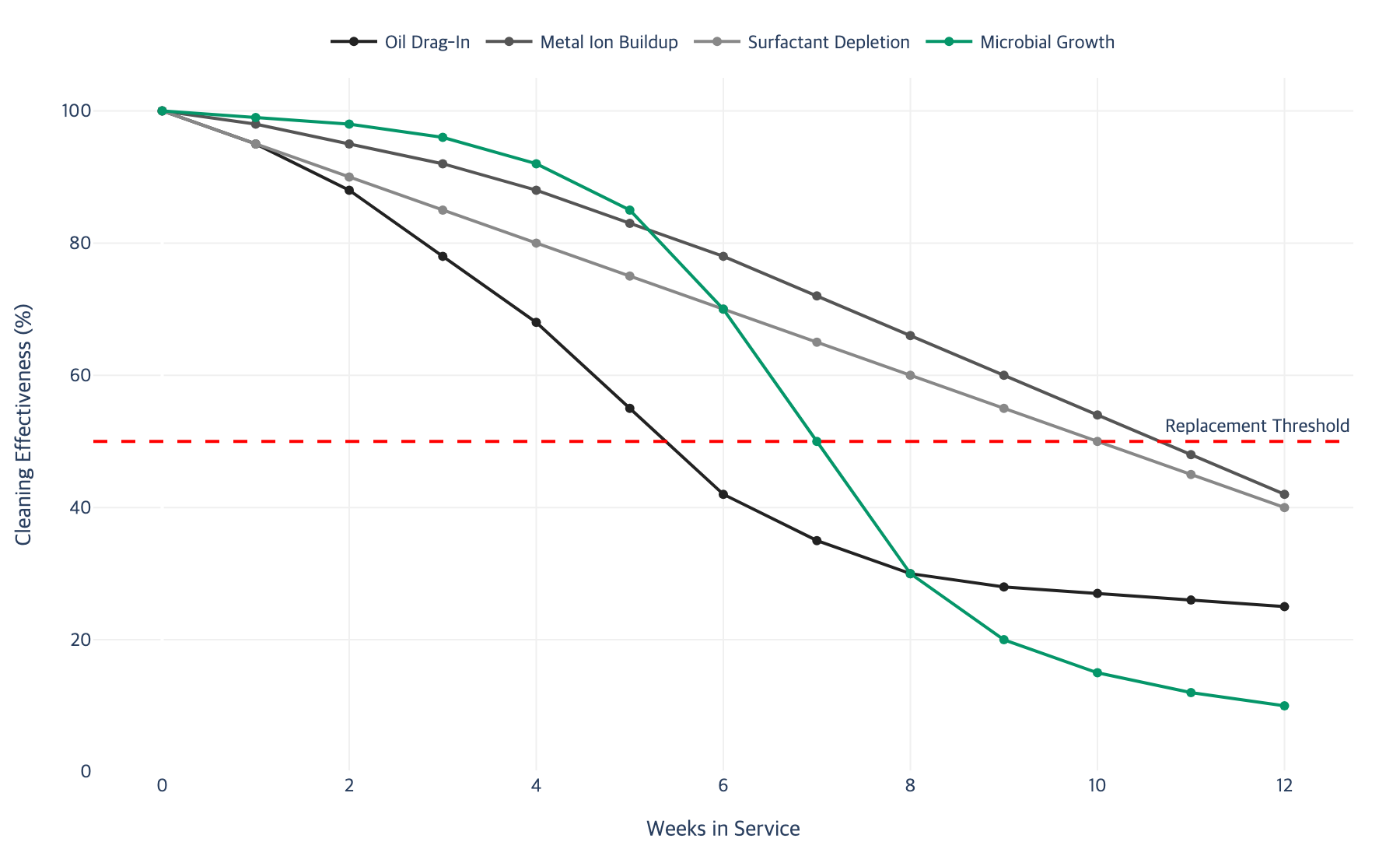
The failure mode is characteristically sudden. The bath performs adequately until emulsification capacity reaches roughly 80 to 90 percent saturation, at which point cleaning quality degrades rapidly. This deceptive pattern means routine monitoring shows acceptable performance right up until failure.
Monitoring Indicators
Free alkalinity decreases as alkaline components are consumed by saponification. Turbidity increases with emulsified oil loading. An oil layer may appear on the bath surface when emulsification capacity is saturated. The water break test begins to fail (water beading instead of sheeting). Rising surface tension in a bath with apparently adequate total concentration indicates surfactant is being consumed by oil emulsification.
Corrective Actions
Oil skimmers (belt, disc, or coalescence type) continuously remove free-floating oil. A properly sized coalescence separator removes 90 percent or more of free oil, significantly extending bath life. Periodic surfactant replenishment restores active cleaning agent concentration. Establishing an oil drag-in rate measurement enables predicting when the bath will reach saturation.
IV. Degradation Pattern 2: Metal Ion Accumulation and Surfactant Interference
Parts cleaning dissolves small amounts of metal from the substrate surface, particularly when cleaning removes oxide layers or operates at elevated pH on reactive metals.
Accumulation Rates and Sources
Alkaline cleaners at pH 10 to 12 dissolve aluminum at 0.5 to 5 micrometers per minute at typical operating temperatures. Steel dissolution is slower under alkaline conditions but accelerates in acidic baths. Zinc from galvanized components dissolves readily at both pH extremes.
Processing 1,000 aluminum parts per day, each losing 1 micrometer of surface across 0.05 square meters, introduces roughly 135 milligrams of aluminum daily (aluminum density 2.7 g/cm3). In a 1,000-liter tank, monthly accumulation reaches about 4 mg/L. This sounds small, but aluminum ions precipitate as aluminum hydroxide gel, creating voluminous sludge far exceeding the original metal mass.
Hard water makeup compounds the problem. In areas with hard water (above 150 mg/L calcium carbonate equivalent), accumulated hardness ions from top-ups can become the dominant source of surfactant interference.
The Pattern
Metal ions interfere with surfactant function through multiple mechanisms: iron catalyzes surfactant oxidation; aluminum precipitates as hydroxide sludge, reducing effective bath volume; zinc and calcium form insoluble soap compounds with anionic surfactants, consuming cleaning agents without benefit.
Unlike the sudden failure of oil-saturated baths, metal ion interference produces gradual, progressive decline that accelerates as concentrations increase. Doubling the metal ion concentration approximately doubles the rate of surfactant deactivation.
Monitoring Indicators
Metal ion concentration increases linearly with bath use (measurable by test strips or photometry). Sludge at the tank bottom indicates metal hydroxide precipitation. pH may drift as metal dissolution consumes alkaline components. A key diagnostic clue: fresh surfactant additions produce only temporary improvement because new surfactant is quickly deactivated by accumulated metal ions.
Corrective Actions
Filtration removes suspended metal hydroxide particles. Chelating agents sequester dissolved metal ions: Na4EDTA, a hexadentate ligand that binds metal ions in a 1:1 molar ratio, is the most widely used in industrial cleaning formulations. Citric acid provides a biodegradable alternative where EDTA discharge is restricted. For high metal-loading applications, periodic partial bath replacement (25 to 50 percent of the volume) dilutes accumulated metals while preserving active chemistry.
V. Degradation Pattern 3: Surfactant Depletion and Activity Loss
Even without oil loading or metal ion interference, surfactant concentration decreases over time through drag-out (solution carried away on parts), evaporation, and thermal degradation.
Quantifying Depletion Rates
Drag-out is typically the largest single cause of surfactant loss in well-managed baths. Typical drag-out rates range from 50 to 200 mL per square meter of part surface area for simple flat parts, and up to 500 mL per square meter for complex geometries with blind holes and recesses.
For a bath at 5 percent concentration processing 200 parts per hour with 2 mL drag-out per part, each shift loses 160 grams of active chemistry. In a 2,000-liter bath, this equates to roughly 1.6 percent loss per 10-shift workweek.
Thermal degradation adds to this baseline loss. Nonionic surfactants undergo slow thermal decomposition at temperatures above 50 degrees Celsius. A bath operating at 70 degrees Celsius may experience thermal surfactant loss rates 3 to 5 times higher than the same chemistry at 50 degrees Celsius. Evaporative loss concentrates the bath but does not increase the absolute amount of surfactant, which can mask true surfactant depletion when monitoring by refractometer alone.
The Pattern
Unlike oil-loading degradation (gradual then sudden failure), surfactant depletion produces a linear decline in cleaning effectiveness. Water break test failure rate increases gradually rather than suddenly.
Monitoring Indicators
Titration is the most direct concentration measurement. Refractometer readings correlate with concentration for fresh solutions but become less reliable as contaminants accumulate. Surface tension measurement provides a direct measure of free surfactant activity independent of contamination effects.
Corrective Actions
Establish a minimum concentration threshold (typically 50 to 70 percent of initial) below which replenishment is required. Automated dosing systems using conductivity, pH, or refractometer-based sensors provide the most consistent management by maintaining concentration within a narrow window.
VI. Degradation Pattern 4: Microbial Growth and Biofilm Formation
Aqueous cleaning baths provide a warm, nutrient-rich environment that supports microbial growth, particularly bacteria and fungi.
Growth Kinetics and Conditions
Microbial contamination follows an exponential growth curve. After a lag phase (hours to days), populations can double every 4 to 8 hours under favorable conditions. A single bacterium entering the bath at the start of a weekend shutdown can theoretically produce over 4,000 descendants by Monday morning (assuming 6-hour doubling time over 72 hours).
Favorable conditions are common in cleaning baths: pH between 6 and 9, temperature between 25 and 45 degrees Celsius, organic nutrients from accumulated oil, and mineral nutrients from dissolved metals. Baths that operate at lower temperatures or sit idle during weekends are particularly vulnerable.
Biofilm formation compounds the problem. Bacteria attach to tank walls, plumbing, and spray nozzles, forming structured communities encased in a polysaccharide matrix. Biofilm bacteria are 100 to 1,000 times more resistant to biocides than free-floating (planktonic) bacteria, allowing rapid recontamination after treatment.
The Pattern
As the population grows, bacteria produce biosurfactants that cause persistent foaming, metabolic acids that reduce bath pH, and biofilm that harbors contaminant reservoirs. The operational impact progresses through stages: early contamination (below 1,000 CFU/mL) is typically undetectable without testing; moderate contamination (1,000 to 100,000 CFU/mL) produces slight odor and foaming changes; heavy contamination (above 100,000 CFU/mL) causes obvious odor, persistent foaming, pH drop, visible biofilm, and active surfactant degradation.
Monitoring Indicators
Unusual odor (rancid, sulfurous, or musty) is often the first indicator. Unexplained foaming and pH drift downward follow. Slippery biofilm on tank walls confirms established contamination. Dip slide tests confirm bacterial count (action threshold typically 10,000 CFU/mL).
Corrective Actions
Biocide addition (isothiazolinone-based or formaldehyde-releasing) reduces microbial populations. Physical cleaning of tank walls removes biofilm reservoirs. Adjusting bath temperature above 55 degrees Celsius inhibits most common bacteria. Running circulation pumps during idle periods prevents stagnation that promotes anaerobic growth.
VII. Bath Monitoring Protocol and Trend Interpretation
Figure 1. Four Degradation Patterns Over Time
Recommended Monitoring Parameters and Frequency
Parameter | Method | Frequency | Action Threshold |
|---|---|---|---|
pH | pH meter | Daily | More than 1.0 unit from target |
Free alkalinity | Titration | Twice weekly | Below 70% of initial |
Surfactant concentration | Titration or refractometer | Twice weekly | Below 60% of initial |
Oil loading | Visual + turbidity meter | Daily | Visible surface oil or turbidity spike |
Metal ion concentration | Test strips or photometry | Weekly | Above supplier specification |
Microbial count | Dip slide | Weekly | Above 10,000 CFU/mL |
Water break test (parts) | Visual | Every shift | Any failure triggers investigation |
Temperature | Thermometer | Continuous | More than 5C from setpoint |
Surface tension | Tensiometer | Weekly | Above 35 mN/m (indicates surfactant depletion) |
Conductivity | Conductivity meter | Daily | Deviation of more than 20% from target |
Sampling Best Practices
Always sample from the same tank location at the same time relative to production (ideally at shift start, after circulation has mixed the bath). Use dedicated sampling equipment per bath to avoid cross-contamination. Record bath temperature, as pH, conductivity, and refractometer readings are temperature-sensitive.
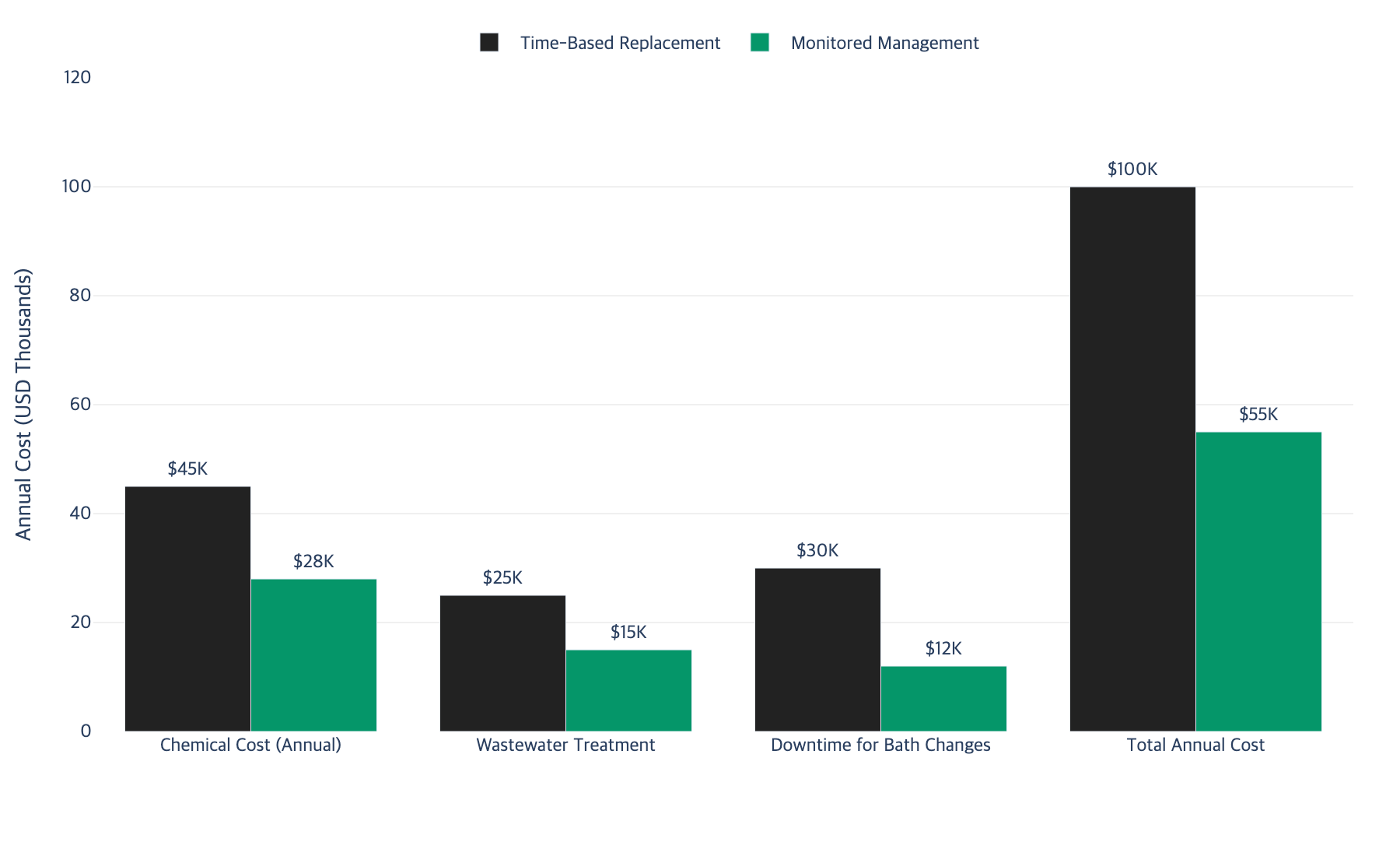
Figure 2. Cost Comparison: Time-Based vs Monitored Bath Management
Degradation Pattern Recognition Guide
Symptom | Oil Loading | Metal Ion | Surfactant Depletion | Microbial |
|---|---|---|---|---|
Cleaning quality decline | Sudden | Gradual with interference | Linear/gradual | Moderate |
Surface oil on bath | Yes | No | No | No |
Sludge in tank | No | Yes | No | No |
Odor change | Possible (rancid oil) | No | No | Yes (strong) |
Foaming increase | Possible | No | No | Yes |
pH drift | Slight down | Variable | Slight down | Down (acids) |
Water break failure | Yes | Sometimes | Yes | Sometimes |
Surface tension rise | Yes (masked) | Yes | Yes | Variable |
Response to replenishment | Temporary | Temporary | Sustained | No effect |
The "Response to replenishment" row is particularly diagnostic: sustained improvement after adding fresh concentrate indicates simple surfactant depletion; temporary improvement suggests contaminant interference consuming the added surfactant; no improvement points to microbial issues or contamination exceeding bath capacity. When multiple patterns overlap, address the most severe one first, then monitor whether the remaining symptoms resolve.
VIII. Bath Life Extension Techniques with Quantified Results
Several proven techniques extend bath life by 25 to 200 percent depending on the contamination profile.
Oil Removal Systems
Continuous oil removal is the single most effective technique for oil-dominated degradation.
Belt skimmers suit light oils and are inexpensive but have limited throughput. Disc skimmers handle heavier oils at higher loading rates. Coalescence separators aggregate small oil droplets for gravity separation and provide the highest removal efficiency: a properly designed system removing 85 to 95 percent of free oil can extend bath life by 100 to 200 percent. Ultrafiltration (UF) membrane systems separate even emulsified oil, but also remove some surfactant, requiring periodic replenishment to offset losses.
Metal Ion Management
Chelating agent addition at dosages sufficient to sequester incoming metal load prevents surfactant interference and sludge formation. Using deionized or reverse osmosis water for bath makeup eliminates hardness ion contribution; for facilities with hard water (above 200 mg/L calcium carbonate), switching to DI water reduces total metal ion loading by 30 to 60 percent. Scheduled partial bath replacement (for example, replacing 30 percent of volume monthly) extends the interval between complete bath changes by 2 to 3 times.
Surfactant Management and Automated Dosing
Automated dosing systems measure concentration via conductivity, pH, or refractive index and trigger dosing pumps to maintain a narrow concentration window. Facilities that implement automated dosing typically achieve 20 to 40 percent bath life extension by eliminating the concentration swings that characterize manual management.
Microbial Control Strategies
Preventive biocide addition at low concentrations on a weekly schedule prevents populations from reaching problematic levels. Reactive treatment after heavy contamination requires much higher doses that can interfere with cleaning chemistry. Maintaining bath temperature above 45 degrees Celsius during idle periods and running circulation pumps during weekends prevents the conditions that favor explosive microbial growth.
IX. Cost Analysis: Premature vs Optimized Dump Schedules
Components of Bath Change Cost
A complete bath change involves several cost categories that facilities often underestimate.
Chemical cost: for a 2,000-liter bath at 5 percent concentration, recharging requires 100 liters of concentrate. At USD 5 to USD 15 per liter, each recharge costs USD 500 to USD 1,500.
Wastewater disposal: if spent bath is hauled off-site, disposal ranges from USD 0.10 to USD 1.00 per liter depending on contaminant classification, costing USD 200 to USD 2,000 per bath. Hazardous waste classification due to metal content or extreme pH increases costs substantially.
Labor: at a loaded rate of USD 50 to USD 75 per hour, a bath change requiring 4 to 8 hours costs USD 200 to USD 600.
Production downtime: often the largest cost. On a production-critical line, downtime during a bath change can exceed USD 1,000 per hour of lost output.
Comparative Scenarios
Consider a facility operating 8 cleaning baths with an average bath change cost of USD 2,500 (chemistry plus disposal plus labor, excluding downtime). Under a fixed 4-week dump schedule, the facility performs 104 bath changes per year, costing USD 260,000. Condition-based management extending bath life by 50 percent reduces this to 69 changes per year. After monitoring investment of USD 10,000 to USD 25,000, net annual savings are USD 62,500 to USD 77,500 in direct costs alone. Including downtime at USD 500 per hour, reducing changes by one-third saves over USD 100,000 additionally.
The Optimization Challenge
The optimal dump schedule for a bath dominated by oil drag-in differs from one dominated by metal ion accumulation. A bath with stable contamination rates has a different optimal monitoring frequency than one with variable incoming contamination. Determining the right strategy for each bath requires analyzing its specific degradation pattern and cost parameters.
X. Key Takeaway
Cleaning bath degradation follows predictable patterns specific to each contamination source, each with distinct kinetics: oil loading shows sudden failure at saturation, metal ions cause progressive interference, surfactant depletion is linear, and microbial growth is exponential
Monitor bath chemistry with a structured protocol rather than relying on time-based replacement schedules
Use the degradation pattern recognition guide to identify the primary contamination source and apply targeted corrective actions
Oil skimming, chelating agents, surfactant replenishment, and biocide treatment extend bath life by 25 to 200 percent compared to time-based dump-and-recharge approaches
Condition-based management saves USD 60,000 to USD 180,000 annually for a typical multi-bath facility, with payback within the first year
Here is the challenge: optimizing bath management across multiple baths with different chemistries and contamination profiles generates monitoring data that exceeds what manual analysis can handle. Tracking degradation trends across 8 or 10 baths, correlating patterns with upstream process changes, and predicting optimal intervention timing for each bath is a data problem as much as a chemistry problem.
This is where AI-driven analysis changes the game. Imagine a system that continuously ingests bath monitoring data, identifies which degradation pattern each bath is following, detects trend inflections signaling approaching capacity limits, and recommends the specific corrective action for each bath, across every bath in the facility simultaneously. That is what Lubinpla's platform does. If you are still managing cleaning baths by calendar and gut feel, the data in your logbooks already holds the answers. You just need a system that can read the patterns.
XI. References
[1] Products Finishing, "Parts Cleaning in Manufacturing", 2024. https://www.pfonline.com/topics/clean
[2] Ecolink, "Precision Cleaning of Parts", 2024. https://ecolink.com/info/precision-cleaning-of-parts/
[3] Better Engineering, "Solvent vs. Aqueous Cleaners", 2024. https://www.betterengineering.com/blog/solvent-vs-aqueous-cleaners/
[4] Arrow Chemical, "Guide to Industrial Cleaners", 2024. https://www.arrowchem.com/the-ultimate-guide-to-industrial-aqueous-and-solvent-cleaners-degreasers/
[5] SAFECHEM, "Industrial Parts Cleaning 101", 2024. https://safechem.com/en/metal-cleaning/chemaware/chemawaretm-industrial-parts-cleaning-101
[6] Best Technology, "Aqueous Cleaning Chemistries", 2024. https://www.besttechnologyinc.com/bestsolv/aqueous-cleaning-chemistries/
[7] Reliance Specialty, "Industrial Parts Washing", 2024. https://relspec.com/vapor-degreasing-blog/industrial-parts-cleaning
[8] Hogge Precision Parts, "Cleaning Precision Machined Parts", 2024. https://www.hoggeprecision.com/what-you-need-to-know-about-cleaning-precision-machined-parts/
[9] JAYCO Cleaning, "Precision Parts Cleaning", 2024. https://jaycoclean.com/industrial-parts-cleaning-applications/precision-parts-cleaning/
[10] Ecoclean Group, "Knowledge Base: Parts Cleaning", 2024. https://ecoclean-group.us/academy/knowledge-base/
[11] EPA, "Safer Alternatives for Solvent Degreasing", 2024. https://www.epa.gov/p2/case-studies-safer-alternatives-solvent-degreasing-applications
[12] Fictiv, "Best Methods for Cleaning CNC Machined Parts", 2024. https://www.fictiv.com/articles/cnc-materials-series-best-methods-for-cleaning-cnc-machined-parts-an-overview
[13] Alconox TechNotes, "Advanced Cleaning Mechanisms: Chelation", 2024. https://technotes.alconox.com/industry/advanced-cleaning-mechanisms/advanced-cleaning-mechanisms-chelation/
[14] Alconox TechNotes, "The Critical Micelle Concentration of Detergent", 2024. https://technotes.alconox.com/industry/pharmaceutical/critical-micelle-concentration-detergent/
[15] Dyne Testing, "Monitoring the Concentration of Cleaning Agents", 2017. https://dynetesting.com/2017/05/monitoring-the-concentration-of-cleaning-agents/
[16] DST Chemicals, "The Risks of Switching Your Industrial Parts Cleaner", 2024. https://dstchemicals.com/resources/knowledge/the-risks-of-switching-your-industrial-parts-cleaner
[17] The Global 1 Group, "The Hidden Costs of Inefficient Parts Cleaning", 2024. https://theglobal1group.com/the-hidden-costs-of-inefficient-parts-cleaning/
Powered by Lubinpla
Discover how technical teams solve complex challenges faster with AI.