Epoxy vs Polyurethane Coatings: Chemical Resistance and Flexibility Trade-offs
Summary: Epoxy and polyurethane coatings are the two most widely specified protective coating systems in industrial environments, yet selecting between them remains a persistent source of specification errors. This article provides a mechanism-level comparison of their cross-linking chemistry, chemical resistance profiles, flexibility behavior, and degradation pathways under real operating conditions. The analysis reveals that neither system is universally superior, and that optimal selection depends on the specific balance of chemical exposure, mechanical stress, UV exposure, and lifecycle cost at each application site. Engineers can use the condition-based decision framework presented here to match coating chemistry to actual service requirements and avoid the costly consequences of mismatched specifications.
Table of Contents
I. The Specification Dilemma in Protective Coatings
II. Cross-Linking Chemistry: Why Molecular Architecture Determines Performance
III. Chemical Resistance Under Immersion and Splash Conditions
IV. Flexibility, Impact Resistance, and Mechanical Performance
V. UV Stability and Outdoor Weathering Behavior
VI. Lifecycle Cost and Maintenance Frequency Comparison
VII. Application Environment Decision Framework
VIII. Key Takeaway
IX. References
I. The Specification Dilemma in Protective Coatings
Protective coating selection in industrial facilities often defaults to familiarity rather than mechanism-based analysis. Maintenance teams specify epoxy because it has always worked in their chemical processing area, or they choose polyurethane because a supplier recommended it for outdoor structures. This approach works until conditions change, and then premature failures reveal the gap between assumed performance and actual chemistry.
The core of the epoxy-versus-polyurethane decision lies not in brand comparisons or generic data sheet rankings, but in the fundamental differences in their polymer network architecture. Epoxy coatings build rigid, densely cross-linked aromatic networks that resist chemical penetration. Polyurethane coatings form segmented structures with alternating hard and soft domains that absorb mechanical energy and resist UV degradation. Understanding these mechanisms is the foundation for making specification decisions that hold up in service.
This article breaks down the chemical mechanisms behind each coating system's strengths and weaknesses, compares their performance under matched industrial conditions, and provides an environment-based decision framework for selecting the right system.
II. Cross-Linking Chemistry: Why Molecular Architecture Determines Performance
The performance differences between epoxy and polyurethane coatings originate at the molecular level, in the type of chemical bonds formed during curing and the resulting network topology. Understanding these structures explains why each system excels in different service conditions.
Epoxy: Dense Aromatic Cross-Linked Networks
Epoxy coatings cure through the reaction of epoxide functional groups with polyamine or polyamide hardeners. Primary amines undergo addition reactions with epoxide rings, forming hydroxyl groups and secondary amines. These secondary amines react further with additional epoxide groups, creating tertiary amines and a three-dimensional cross-linked network (ACS Applied Polymer Materials, 2021).
The aromatic backbone of bisphenol A-based epoxy resins contributes rigidity and chemical resistance to the cured film. Aromatic monomers produce denser, better-performing networks compared to aliphatic alternatives, with lower and slower uptake of solvents such as methanol and ethanol (ACS Applied Polymer Materials, 2021). Cross-link density directly controls the glass transition temperature (Tg), free volume, and chain mobility of the cured network. Higher cross-link density means less space for chemical molecules to penetrate, which is why heavily cross-linked epoxy systems outperform most other coating chemistries in chemical immersion service.
However, the same dense aromatic structure that provides chemical resistance also creates brittleness. High cross-link density restricts chain segment mobility, making the coating susceptible to cracking under impact, thermal cycling, or substrate movement.
Polyurethane: Segmented Hard-Soft Domain Architecture
Polyurethane coatings form through the reaction of polyol hydroxyl groups with isocyanate functional groups, producing urethane (carbamate) linkages. The resulting polymer has a segmented microstructure consisting of hard segments (derived from the isocyanate and chain extender) and soft segments (derived from the polyol backbone) (SpecialChem, 2024).
This segmented architecture is the key to polyurethane's flexibility. Upon mechanical deformation, soft segments uncoil and absorb energy while hard segments align in the stress direction. Hydrogen bonding between hard segment domains acts as physical cross-links that can reform after deformation, providing both high tensile strength and high elongation (Gallagher Corporation, 2023). The balance between hard and soft segment ratio can be tuned during formulation, allowing polyurethane coatings to range from rigid to highly flexible depending on the application requirement.
Aliphatic isocyanate-based polyurethanes, such as those using hexamethylene diisocyanate (HDI) or isophorone diisocyanate (IPDI), lack the UV-absorbing aromatic chromophores present in epoxy resins. This structural difference is directly responsible for polyurethane's superior UV stability and color retention in outdoor service.
Figure 1. Molecular Architecture Comparison of Epoxy and Polyurethane Coating Systems
Property | Epoxy (Bisphenol A) | Polyurethane (Aliphatic) |
|---|---|---|
Primary bond type | Amine-epoxide cross-link | Urethane (carbamate) linkage |
Network structure | Dense 3D aromatic network | Segmented hard-soft domains |
Cross-link density | High | Moderate (tunable) |
Glass transition temperature (Tg) | 80-150 C | 40-100 C (varies by formulation) |
Chain mobility | Low (rigid) | High in soft segments |
UV-active chromophores | Present (aromatic rings) | Absent (aliphatic backbone) |
The table above highlights why these two systems respond so differently to the same service environment. Epoxy's dense aromatic network resists chemical diffusion but cracks under mechanical stress. Polyurethane's segmented structure absorbs mechanical energy but permits more chemical permeation through its softer domains.
Figure 6. Performance Profile Comparison: Epoxy vs Polyurethane (1-10 Scale)
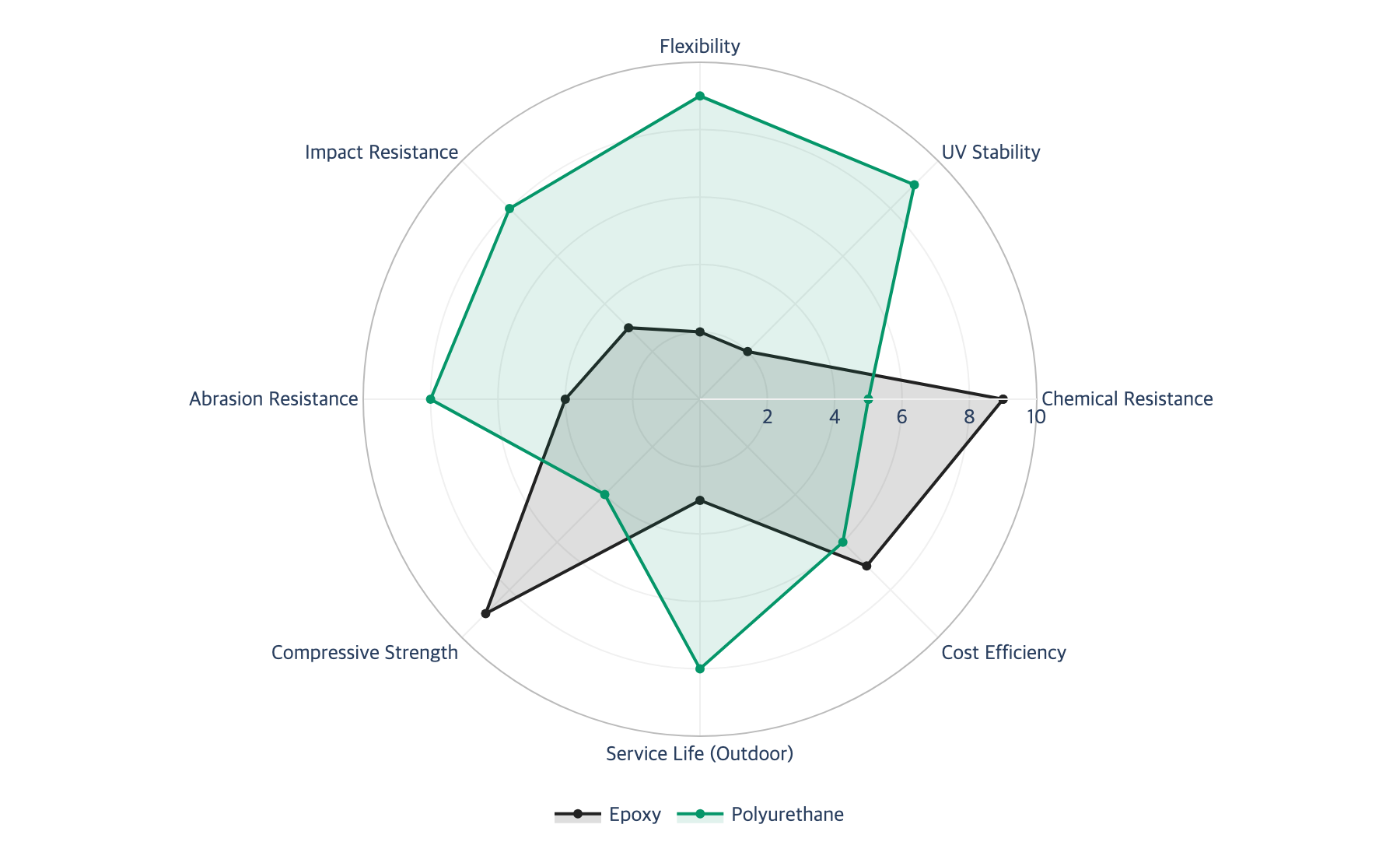
The radar chart illustrates the complementary nature of these two coating systems. Epoxy dominates in chemical resistance and compressive strength, while polyurethane excels in flexibility, impact resistance, UV stability, and outdoor service life. No single system covers all performance dimensions equally, which is why application-specific selection is essential.
III. Chemical Resistance Under Immersion and Splash Conditions
Chemical resistance is often the primary driver in coating selection for process facilities, tank linings, and secondary containment areas. The mechanism of chemical attack differs between acids, alkalis, solvents, and oxidizers, and epoxy and polyurethane respond differently to each.
Acid and Alkali Resistance
Epoxy coatings demonstrate superior resistance to a broad range of inorganic acids (sulfuric, hydrochloric, phosphoric) and alkalis (sodium hydroxide, potassium hydroxide) at moderate concentrations. The dense cross-linked aromatic network creates a tortuous diffusion path that slows ion transport through the film. Novolac epoxy systems, with even higher cross-link density than standard bisphenol A formulations, extend this resistance to concentrated acids and elevated temperatures up to 120 C.
Polyurethane coatings show moderate acid resistance but are generally inferior to epoxy in concentrated acid immersion. However, polyurethane demonstrates better resistance to certain organic acids, particularly lactic acid and acetic acid, making it preferable in food processing and dairy facility flooring (Imenpol, 2024). The urethane bond is susceptible to hydrolysis under strongly alkaline conditions, particularly above pH 12, which limits polyurethane's use in caustic environments.
Solvent Resistance
Epoxy coatings resist most aromatic and aliphatic solvents, ketones (MEK, acetone), and chlorinated solvents at splash exposure levels. The aromatic backbone follows the principle that chemically similar structures resist each other less effectively, but the high cross-link density compensates by physically restricting solvent diffusion into the film matrix.
Polyurethane coatings are more vulnerable to aggressive solvents, particularly ketones and chlorinated hydrocarbons, which can soften the polymer by disrupting hydrogen bonding between hard segments. However, polyurethane's resistance to fuels, hydraulic fluids, and petroleum-based products is adequate for most industrial applications.
Figure 2. Chemical Resistance Comparison by Exposure Type
Chemical Category | Epoxy (Standard) | Epoxy (Novolac) | Polyurethane (Aliphatic) |
|---|---|---|---|
Inorganic acids (dilute) | Excellent | Excellent | Good |
Inorganic acids (concentrated) | Good | Excellent | Fair |
Organic acids (lactic, acetic) | Good | Good | Excellent |
Alkalis (up to pH 12) | Excellent | Excellent | Good |
Alkalis (above pH 12) | Good | Excellent | Poor |
Aromatic solvents | Excellent | Excellent | Fair |
Ketones (MEK, acetone) | Good | Excellent | Poor |
Fuels and hydraulic fluids | Excellent | Excellent | Good |
Oxidizing agents | Good | Good | Fair |
The chemical resistance comparison reveals that epoxy systems dominate in acid, alkali, and solvent immersion service. Novolac epoxy variants extend this advantage to concentrated chemicals and elevated temperatures. Polyurethane's resistance profile is adequate for splash and intermittent exposure but insufficient for continuous immersion in aggressive chemicals. The notable exception is organic acids, where polyurethane's chemistry provides superior resistance.
IV. Flexibility, Impact Resistance, and Mechanical Performance
Mechanical performance under service conditions is where the architectural differences between epoxy and polyurethane become most visible. Substrate movement, thermal cycling, impact from dropped tools or equipment, and abrasion from foot traffic or wheeled loads all test the coating's ability to absorb and distribute mechanical energy.
Elongation and Substrate Movement Tolerance
Standard bisphenol A epoxy coatings typically exhibit elongation at break values of 3-6 percent, reflecting their rigid cross-linked structure. This limited elongation means that substrate movement from thermal expansion, structural flexing, or settlement can generate stresses that exceed the coating's strain capacity, resulting in cracking and delamination.
Polyurethane coatings achieve elongation at break values ranging from 30 percent to over 500 percent, depending on the hard-to-soft segment ratio. This allows polyurethane to bridge hairline cracks in concrete substrates, accommodate thermal cycling stresses, and maintain film integrity on flexible substrates such as rubber-lined equipment or vibrating machinery mounts.
Impact and Abrasion Resistance
The energy absorption mechanism in polyurethane coatings provides significantly higher impact resistance compared to epoxy. When subjected to impact, the soft segments in polyurethane uncoil and dissipate energy elastically, then recover their original configuration. This resilience is quantified by the coating's ability to withstand direct and reverse impact testing per ASTM D2794 without cracking or adhesion loss.
Polyurethane's abrasion resistance is particularly notable. The elastic deformation mechanism allows the surface to absorb the kinetic energy of abrasive particles and recover, rather than fracturing and losing material as rigid coatings do (Gallagher Corporation, 2023). In comparative Taber abrasion testing (ASTM D4060), polyurethane coatings typically lose 30-60 percent less material than epoxy coatings under identical test conditions.
Epoxy coatings compensate for their lower elongation with higher surface hardness, which resists indentation and compression loading. In applications where compressive loads dominate (heavy pallet storage, forklift traffic on flat floors), epoxy's hardness can provide better resistance to surface deformation.
Figure 3. Mechanical Performance Comparison
Mechanical Property | Epoxy (Standard) | Polyurethane (Rigid) | Polyurethane (Flexible) |
|---|---|---|---|
Elongation at break (%) | 3-6 | 30-80 | 200-500+ |
Tensile strength (MPa) | 40-80 | 25-50 | 10-30 |
Shore D hardness | 80-85 | 65-75 | 40-60 |
Impact resistance (direct, in-lb) | 40-80 | 100-160+ | 160+ |
Taber abrasion loss (mg/1000 cycles) | 80-120 | 40-70 | 30-50 |
Compressive strength (MPa) | 80-120 | 40-70 | 20-40 |
The mechanical property data confirms that neither system is universally superior. Epoxy provides higher compressive and tensile strength for static load applications. Polyurethane excels in environments requiring impact absorption, abrasion resistance, and tolerance for substrate movement.
V. UV Stability and Outdoor Weathering Behavior
UV degradation is the single most significant performance differentiator for outdoor coating applications. The mechanism of UV attack is directly linked to the presence or absence of aromatic structures in the polymer backbone.
Epoxy's UV Vulnerability
Bisphenol A epoxy resins contain aromatic rings that absorb ultraviolet radiation in the 290-400 nm wavelength range. This absorbed energy initiates photo-oxidative degradation through free radical chain reactions that break covalent bonds in the polymer backbone. The visible result is chalking, a progressive loss of surface resin that exposes pigment particles as a powdery residue on the coating surface (High Performance Coatings, 2024).
Chalking typically becomes visible within 6-12 months of outdoor UV exposure in temperate climates, and faster in tropical or high-altitude environments with higher UV irradiance. Beyond aesthetic degradation, chalking reduces film thickness over time and eventually compromises the coating's barrier properties. Gloss retention for standard epoxy coatings drops below 50 percent within 12-18 months of outdoor exposure.
Polyurethane's UV Resistance
Aliphatic polyurethane coatings, formulated with HDI or IPDI isocyanates, lack the aromatic chromophores that initiate photo-oxidation. This structural advantage translates directly to superior gloss retention, color stability, and resistance to chalking in outdoor service. Aliphatic polyurethane topcoats maintain above 80 percent gloss retention after 5 or more years of outdoor exposure, compared to epoxy's rapid decline within the first year (SpecialChem, 2024).
This UV stability is why the majority of high-performance outdoor coating systems use a dual-coat approach: epoxy primer for chemical resistance and substrate adhesion, topped with an aliphatic polyurethane finish coat for UV protection and aesthetic durability. The two-coat system leverages the strengths of both chemistries while compensating for their individual weaknesses.
Temperature Cycling Effects
Thermal cycling introduces mechanical stress at the coating-substrate interface due to differential thermal expansion coefficients. Epoxy coatings, with their low elongation, are more susceptible to micro-cracking during repeated thermal cycling between wide temperature extremes. Polyurethane's higher elongation allows it to accommodate these dimensional changes without cracking.
In environments with daily temperature swings exceeding 40 C (such as desert industrial facilities or uninsulated metal roofs), polyurethane coatings demonstrate measurably longer service life before the onset of mechanical failure compared to epoxy.
VI. Lifecycle Cost and Maintenance Frequency Comparison
Coating selection decisions based solely on initial material and application cost consistently underestimate the total cost of ownership. The lifecycle cost comparison between epoxy and polyurethane must account for service life, maintenance frequency, surface preparation for recoating, and production downtime during coating work.
Initial Cost Comparison
Epoxy coatings generally cost 10-15 percent less than polyurethane systems on a material-and-application basis. For floor coating applications, typical installed costs range from USD 5-7 per square foot for epoxy versus USD 7-9 per square foot for polyurethane (KTA Engineering, 2024). This cost advantage reflects epoxy's simpler formulation chemistry and less expensive raw materials.
However, initial cost differences narrow or reverse when comparing high-performance variants. Novolac epoxy systems for chemical immersion service can approach or exceed polyurethane costs due to the more expensive phenolic-based resin chemistry and the more demanding surface preparation requirements.
Service Life and Recoat Frequency
The service life difference between the two systems is the primary lifecycle cost driver. Under comparable exposure conditions, standard epoxy coatings achieve 4-6 years of service before requiring maintenance or recoating. Polyurethane systems under the same conditions typically last 8-10 years (KTA Engineering, 2024).
For outdoor applications where UV exposure accelerates epoxy degradation, the service life gap widens further. Epoxy topcoats in outdoor service may require recoating within 2-3 years due to chalking and loss of protective thickness, while aliphatic polyurethane maintains protective performance for 7-10 years.
Total Cost of Ownership Analysis
When lifecycle costs are calculated over a 20-year facility operating period, the recoat frequency advantage of polyurethane often outweighs its higher initial cost. A facility using epoxy floor coatings may require 3-4 full recoating cycles over 20 years, compared to 2 cycles for polyurethane. Each recoating cycle incurs not only material and labor costs but also production downtime, surface preparation, and waste disposal costs.
The economic calculation shifts further toward polyurethane in outdoor structural steel applications, where access costs for recoating elevated structures (scaffolding, crane rental, safety equipment) represent 60-70 percent of total recoating costs regardless of the coating material chosen.
Figure 4. Lifecycle Cost Comparison Over 20-Year Period
Cost Factor | Epoxy System | Polyurethane System |
|---|---|---|
Initial installed cost (USD/sq ft) | 5-7 | 7-9 |
Expected service life (years) | 4-6 | 8-10 |
Number of recoat cycles (20 years) | 3-4 | 2 |
Surface prep cost per cycle (relative) | 1.0x | 1.0x |
Downtime per recoat (days, typical) | 3-5 | 3-5 |
Total 20-year cost index (relative) | 1.3-1.5x | 1.0x (baseline) |
UV-exposed outdoor 20-year cost index | 1.8-2.2x | 1.0x (baseline) |
The lifecycle cost analysis demonstrates that polyurethane's longer service life compensates for its higher initial cost in most industrial applications. The cost advantage of polyurethane becomes even more pronounced in outdoor environments where UV degradation accelerates epoxy recoating requirements.
Figure 7. Relative 20-Year Lifecycle Cost by Application Environment
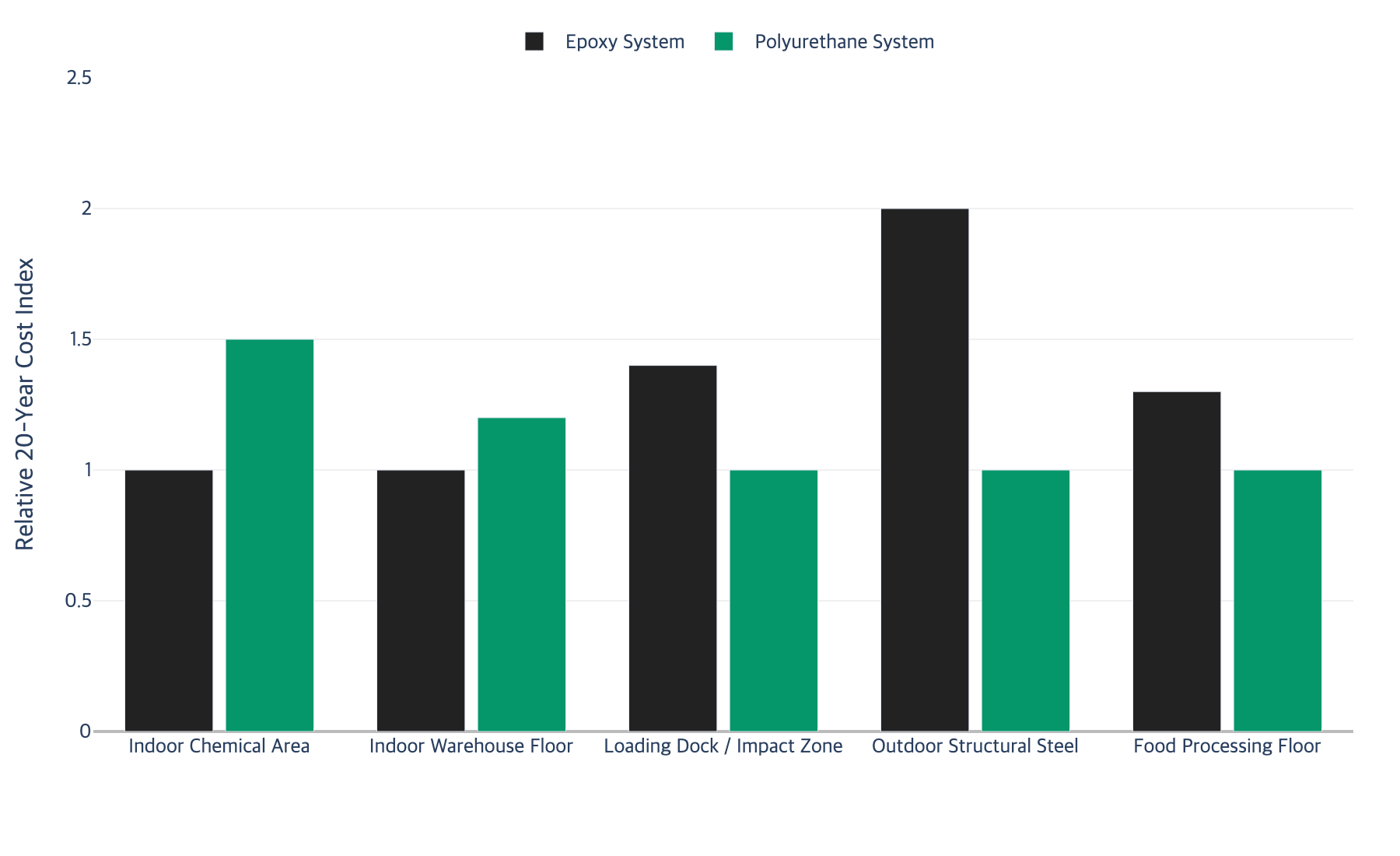
The chart reveals that the optimal system varies by environment. Epoxy is more cost-effective in indoor chemical areas where its chemical resistance advantage eliminates the need for premium polyurethane. Polyurethane delivers lower lifecycle costs in impact zones, outdoor structures, and food processing environments where its flexibility, UV stability, and organic acid resistance reduce recoating frequency.
VII. Application Environment Decision Framework
Selecting between epoxy and polyurethane is not a question of which is better overall, but which is better for the specific combination of chemical exposure, mechanical stress, UV exposure, and operating temperature at each application point. The following decision framework maps these variables to coating chemistry recommendations.
Chemical Processing Environments
Facilities with continuous or frequent chemical exposure (acid tanks, alkali processing, solvent storage areas) should specify epoxy as the primary protective coating. Novolac epoxy is required for concentrated acid or elevated temperature immersion service. Polyurethane is not suitable as a primary barrier coating in these environments.
Mechanical Wear and Impact Zones
Areas subject to impact (loading docks, assembly areas), abrasion (conveyor tracks, high foot traffic), or substrate movement (expansion joints, vibrating equipment) benefit from polyurethane's elastic energy absorption. Polyurethane is the preferred system for these applications, with the hardness grade selected based on the specific mechanical loading profile.
Outdoor and UV-Exposed Structures
Any coating system exposed to direct sunlight should incorporate an aliphatic polyurethane topcoat. The most effective approach is a dual-coat system: epoxy primer for substrate adhesion and corrosion protection, with a polyurethane topcoat for UV resistance and aesthetic durability. Using epoxy alone in outdoor service guarantees premature chalking and aesthetic failure.
Combined Exposure Environments
Many industrial applications involve multiple exposure types simultaneously. A chemical processing area with outdoor exposure requires a system that addresses both chemical resistance and UV stability. The epoxy primer plus polyurethane topcoat combination is the standard solution for these mixed-exposure environments, and it is the most commonly specified system for industrial structural steel protection worldwide.
Figure 5. Application Environment Decision Matrix
Application Environment | Primary Exposure | Recommended System | Rationale |
|---|---|---|---|
Chemical tank interior | Acid/alkali immersion | Novolac epoxy | Maximum chemical barrier |
Secondary containment | Chemical splash | Standard epoxy | Chemical resistance, cost-effective |
Indoor warehouse floor | Compressive loads, traffic | Epoxy | Hardness, chemical spot resistance |
Loading dock / impact zones | Impact, abrasion | Polyurethane | Energy absorption, crack bridging |
Outdoor structural steel | UV, rain, temperature cycling | Epoxy primer + PU topcoat | Combined chemical and UV protection |
Food processing floor | Organic acids, washdown | Polyurethane | Organic acid resistance, flexibility |
Vibrating equipment base | Mechanical stress, movement | Flexible polyurethane | High elongation, crack bridging |
Parking structure | UV, traffic, deicing salts | Polyurethane or dual system | UV stability, abrasion resistance |
The decision matrix confirms that coating selection must be driven by the dominant exposure condition at each specific location within a facility. A single facility may correctly specify three or four different coating systems across different areas based on the local service environment.
VIII. Key Takeaway
Epoxy's dense aromatic cross-linked network provides superior chemical resistance for acid, alkali, and solvent immersion service, but its rigidity makes it vulnerable to cracking under impact, thermal cycling, and substrate movement.
Polyurethane's segmented hard-soft domain structure delivers superior flexibility, impact resistance, and abrasion resistance, but its chemical barrier properties are insufficient for continuous immersion in aggressive chemicals.
Aliphatic polyurethane is the only appropriate topcoat chemistry for UV-exposed outdoor applications, as epoxy coatings chalk and degrade within 6-12 months of direct sunlight exposure.
Lifecycle cost analysis over a 20-year period consistently favors polyurethane in outdoor and mechanical-wear environments due to its longer service life and reduced recoating frequency, despite higher initial material costs.
The optimal industrial specification is environment-specific: chemical immersion zones require epoxy, mechanical wear zones require polyurethane, and outdoor structures benefit from a combined epoxy primer plus polyurethane topcoat system.
Lubinpla's cross-domain analysis engine can evaluate the specific combination of chemical exposure, mechanical loading, UV irradiance, and temperature cycling at each application point within your facility and recommend the coating system that minimizes total lifecycle cost while meeting all protection requirements.
IX. References
[1] ACS Applied Polymer Materials, "Structural Variation and Chemical Performance: Effects of Chemical Structure upon Epoxy Network Chemical Performance", 2021. https://pubs.acs.org/doi/10.1021/acsapm.1c00378
[2] SpecialChem, "Polyurethane Paint and Coatings: Uses, Chemistry, Process and Formulation", 2024. https://www.specialchem.com/coatings/guide/polyurethane-coatings
[3] Gallagher Corporation, "Polyurethane Abrasion Resistance", 2023. https://gallaghercorp.com/polyurethane-abrasion-resistance/
[4] KTA Engineering, "Expected Service Life and Cost Considerations for Maintenance Coatings", 2024. https://kta.com/expected-service-life-coatings/
[5] Imenpol, "Applications of Polyurethane Coatings vs Epoxy Coatings", 2024. https://imenpol.com/blog/en/educational/applications-of-polyurethane-coatings-vs-epoxy-coatings/
[6] MasterBond, "How Critical is the Crosslink Density in Epoxies for Optimizing Performance", 2024. https://www.masterbond.com/techtips/how-critical-crosslink-density-epoxies-optimizing-performance
[7] High Performance Coatings, "Overcoming UV Degradation in Epoxy Coating Systems", 2024. https://www.highperformancecoatings.org/resources/uv-resistant-epoxy
[8] AMPP Materials Performance, "Guide Helps Estimate Cost and Service Life for Protective Coatings", 2023. https://content.ampp.org/materials-performance/magazine-article/7665/Guide-Helps-Estimate-Cost-and-Service-Life-for
[9] ASTM International, "D6943 Standard Practice for Immersion Testing of Industrial Protective Coatings and Linings", 2023. https://www.astm.org/Standards/D6943.htm
[10] Elchemy, "Epoxy vs Polyurethane: Key Differences for Industrial Coatings and Adhesives", 2024. https://elchemy.com/blogs/chemical-market/epoxy-vs-polyurethane-key-differences-for-industrial-coatings-and-adhesives
[11] Coatings World, "Understanding Chemical Resistance in Epoxy Systems", 2024. https://www.coatingsworld.com/understanding-chemical-resistance-in-epoxy-system/
[12] ScienceDirect, "Recent Developments and Future Prospective of Polyurethane Coatings for Corrosion Protection", 2024. https://www.sciencedirect.com/science/article/abs/pii/S0014305724006827
[13] IntechOpen, "Erosive and Abrasive Wear Resistance of Polyurethane Liners", 2023. https://www.intechopen.com/chapters/55636
[14] Australian Steel Institute, "Life Cycle Costs of Industrial Protective Coating Systems", 2023. https://www.steel.org.au/getattachment/18008069-b317-484f-92d3-792c3320d650/Life-cycle-costs-of-industrial-protective-coating-systems_INGALSM3.pdf
Powered by Lubinpla
Discover how technical teams solve complex challenges faster with AI.