Extracting Insights from Cooling Water Chemistry Trends: Beyond Single-Point Readings
Summary: Individual cooling water chemistry readings tell you where the system is at a single moment, but correlated trends reveal what is happening and why. This article demonstrates how analyzing patterns across multiple parameters, such as rising conductivity with dropping pH and increasing iron, can identify specific system events like acid ingress, inhibitor depletion, or biological upset weeks before single-parameter alarms trigger. By applying simple trend analysis techniques to standard monitoring data, water treatment professionals can predict chemical consumption, optimize treatment timing, and intervene before problems develop into costly failures. The techniques covered here require no specialized software and can be implemented with standard spreadsheet tools and existing monitoring data.
Table of Contents
I. The Difference Between a Reading and a Trend
II. Key Parameter Relationships in Cooling Water Systems
III. Correlated Trend Patterns and What They Indicate
IV. Simple Trend Analysis Techniques for Field Application
V. Using Trends to Predict Chemical Consumption and Plan Interventions
VI. Building a Trend-Based Monitoring Program
VII. Key Takeaway
VIII. References
I. The Difference Between a Reading and a Trend
A water treatment technician records a conductivity reading of 2,800 microsiemens per centimeter in a cooling tower basin. The value is within the target range of 2,000 to 3,000 microsiemens. The report shows green. But what the single reading does not reveal is that conductivity has risen from 2,100 to 2,800 in three weeks, a rate of change that, if sustained, will breach the upper limit within 10 days and indicates either a blowdown controller malfunction or a significant increase in makeup water mineral content.
This scenario illustrates the fundamental limitation of single-point monitoring. Most cooling water treatment programs evaluate each parameter against a fixed alarm range. Values within range are acceptable, values outside range trigger corrective action. This approach is reactive by design. It detects problems only after they have already moved a parameter outside its operating envelope.
Trend analysis transforms the same data into a predictive tool. By tracking how parameters change over time and how changes in one parameter correlate with changes in others, water treatment professionals can identify developing system events, predict when interventions will be needed, and optimize chemical treatment before problems materialize. Industry data consistently shows that predictive maintenance approaches reduce maintenance costs by 18 to 25 percent and decrease equipment downtime by 50 percent or more compared to reactive strategies (Senseye/Siemens, 2024). In cooling water systems specifically, proactive monitoring has been documented preventing production interruptions valued at over one million dollars through early detection of developing chemistry issues (Genesis Water Technologies, 2025).
The distinction between a reading and a trend is not academic. It is the difference between discovering a heat exchanger has fouled and predicting that fouling will occur within two weeks unless the treatment program is adjusted. Every data point a technician collects already contains trend information. The challenge is extracting it systematically rather than treating each measurement as an isolated snapshot.
II. Key Parameter Relationships in Cooling Water Systems
Cooling water chemistry parameters are not independent variables. They are connected through the physical and chemical processes of evaporation, concentration, chemical treatment, and biological activity. Understanding these relationships is the foundation for correlated trend analysis. When one parameter shifts, the connected parameters will respond in predictable ways if the system is functioning normally, or in divergent ways if a specific upset condition is developing.
Conductivity and Cycles of Concentration
Conductivity is a proxy measurement for total dissolved solids (TDS) and serves as the primary indicator of concentration cycles. Cycles of concentration can be calculated by dividing the conductivity of the recirculating water by the conductivity of the makeup water (Guardian Chemical, 2024). As water evaporates from the cooling tower, dissolved minerals concentrate proportionally, and conductivity rises. The blowdown controller uses conductivity to trigger water discharge, maintaining the system at target cycles.
When conductivity trends upward beyond normal variation, it indicates either blowdown is insufficient, makeup water quality has changed, or the conductivity controller is malfunctioning. A stable conductivity trend with periodic blowdown events represents a well-controlled system. A continuously rising conductivity trend is an early warning of concentration control loss. Increasing cycles of concentration from three to six can reduce cooling tower makeup water needs by 20 percent and blowdown volume by 50 percent, making precise conductivity control both an operational and environmental priority (U.S. Department of Energy, 2024).
pH, Alkalinity, and Scale Potential
The relationship between pH and alkalinity determines the scale-forming tendency of cooling water. As evaporation concentrates makeup water, both calcium hardness and alkalinity increase, driving pH upward and increasing the Langelier Saturation Index (LSI). When pH rises above the target range while alkalinity increases proportionally, the system is following normal concentration behavior. When pH drops while alkalinity remains stable or increases, an acid source has been introduced to the system (Chardon Labs, 2024).
The LSI provides a quantitative measure of scale potential. Industrial cooling towers typically target an LSI between 0.0 and +0.5 to balance scale prevention against corrosion risk (Mantech, 2024). An LSI above +0.5 indicates a definite scaling tendency, while values below -0.3 indicate water aggressive enough to dissolve calcium carbonate from available surfaces, including protective films on metal piping. Trending LSI rather than pH alone gives a more complete picture of the system's corrosion-scale balance. A pH of 8.2 at one set of hardness and alkalinity conditions may produce a very different LSI than the same pH at different mineral concentrations, making the composite index essential for accurate system assessment.
Iron and Corrosion Rate
Iron concentration in recirculating water is a lagging indicator of ferrous metal corrosion. By the time iron levels rise significantly, corrosion has already consumed measurable amounts of pipe or heat exchanger material. However, the rate of iron increase, measured in ppm per day, provides a meaningful corrosion rate indicator. Field studies on industrial cooling water systems have measured mild steel corrosion rates of approximately 0.22 mm per year under poorly controlled conditions, compared to rates below 0.05 mm per year in well-treated systems (PMC, 2024). A sudden acceleration in iron generation rate often correlates with a specific chemistry event: inhibitor depletion, pH excursion, or microbiological contamination that has disrupted the protective film.
Copper concentration follows a similar pattern for systems with copper alloy heat exchangers. Tracking both iron and copper trends simultaneously reveals whether corrosion is attacking carbon steel piping, copper alloy tubes, or both, which narrows the root cause significantly.
ORP and Biocide Effectiveness
Oxidation-reduction potential (ORP) measures the oxidizing capacity of the recirculating water and serves as a real-time indicator of biocide activity. Cooling towers typically target ORP values between 550 and 750 millivolts for effective microbial control (ChemREADY, 2024). A declining ORP trend following biocide addition indicates either the biocide is being consumed faster than expected, organic contamination is increasing the oxidant demand, or the biocide feed system is underperforming. ORP values only deliver reliable information when interpreted alongside pH, because pH levels directly affect the oxidizing potential of chlorine-based biocides. A drop in ORP that coincides with a pH increase may reflect reduced biocide efficacy rather than reduced biocide concentration (Chem-Aqua, 2022).
Figure 1. Key Parameter Relationships in Cooling Water Systems
Parameter | Linked Parameters | Normal Correlation | Abnormal Signal |
|---|---|---|---|
Conductivity | TDS, cycles of concentration | Proportional to cycles | Rising without blowdown response |
pH | Alkalinity, LSI, treatment chemistry | Stable within 0.3 units | Dropping while alkalinity stable |
Alkalinity | pH, calcium hardness, scale index | Proportional to cycles | Diverging from conductivity trend |
Iron (Fe) | pH, inhibitor residual, ORP | Stable below 1 ppm | Accelerating rate of increase |
Phosphate (PO4) | Inhibitor dosage, calcium | Stable at treatment target | Declining without dosage change |
ORP | Biocide residual, pH, organic load | Stable 550-750 mV post-treatment | Rapid decay after biocide addition |
Biological count | pH, nutrients, biocide residual | Below 10,000 CFU/mL | Rapid increase post-biocide |
Each parameter pair has a predictable relationship under normal operating conditions. When the correlation breaks, that divergence itself is the diagnostic signal.
III. Correlated Trend Patterns and What They Indicate
Specific combinations of simultaneous parameter changes point to identifiable system events. Recognizing these multi-parameter signatures enables rapid root cause identification. The patterns described below represent the most common and consequential chemistry upsets encountered in recirculating cooling water systems. Each pattern produces a distinctive fingerprint when multiple parameters are plotted on the same timeline.
Pattern 1: Rising Conductivity + Dropping pH + Increasing Iron
This pattern indicates acid ingress or severe inhibitor depletion. The rising conductivity suggests the system is concentrating, but the dropping pH contradicts normal concentration behavior where pH should rise with alkalinity. The simultaneous iron increase confirms that the lower pH is accelerating corrosion. Common causes include acid overfeed from a malfunctioning pH controller, process leak introducing acidic contamination, or complete depletion of alkalinity-based buffering capacity.
The response priority is immediate: verify acid feed system operation, check for process contamination, and add supplemental alkalinity if needed. If the pH drop exceeds 0.5 units in 24 hours, the acid source is likely mechanical (pump malfunction, stuck valve) rather than gradual depletion. A gradual pH decline of 0.1 to 0.2 units per week, by contrast, typically points to changing makeup water quality or slow inhibitor consumption that can be corrected through dosage adjustment.
Figure 3. Correlated Parameter Trends Showing Acid Ingress Event (Pattern 1)
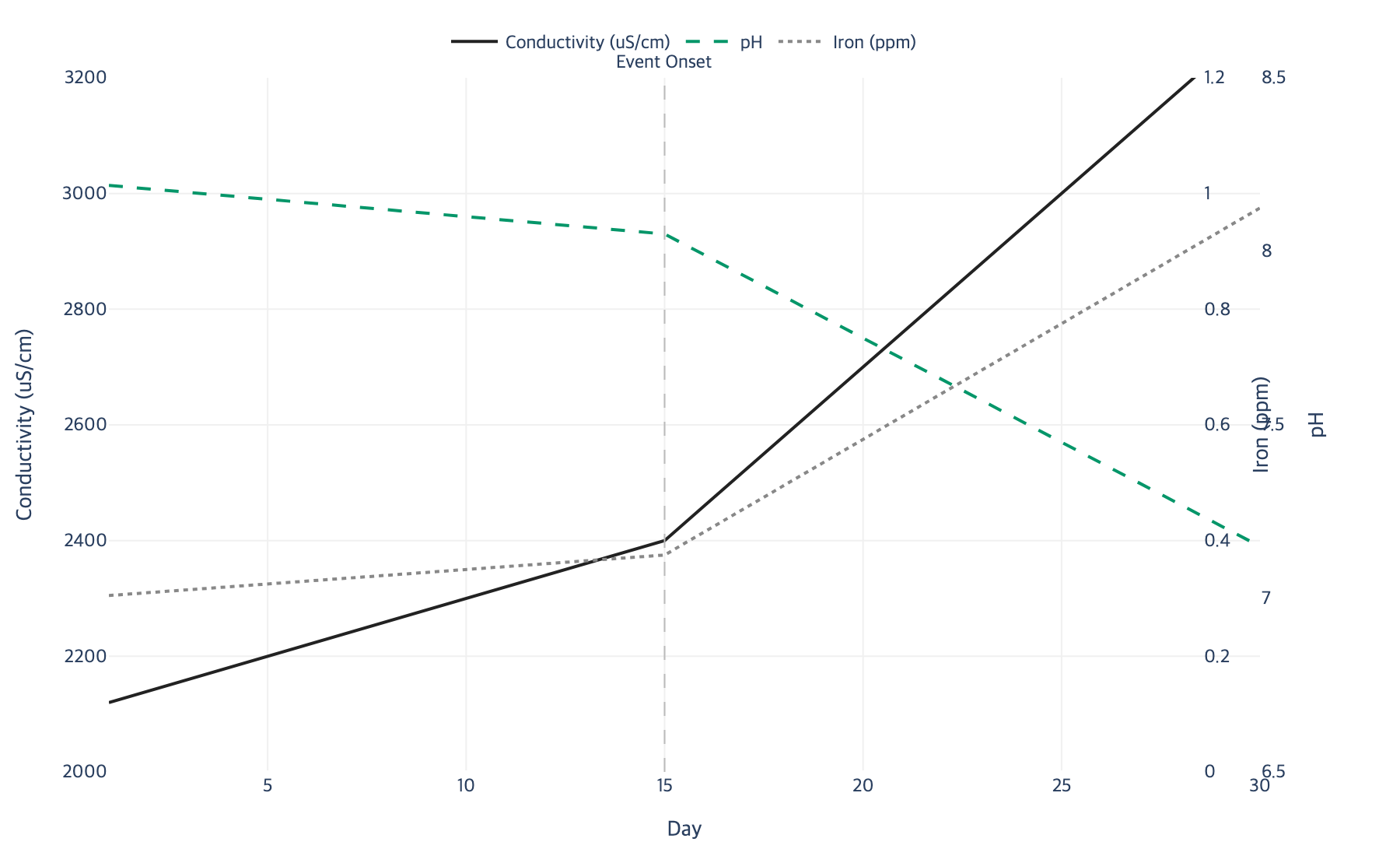
The chart illustrates how conductivity, pH, and iron trends diverge after an acid ingress event around day 15. Before the event, all three parameters follow stable patterns. After onset, conductivity rises abnormally while pH drops and iron accelerates, creating a distinctive three-parameter signature that is unmistakable when viewed as correlated trends but invisible in single-parameter monitoring.
Pattern 2: Stable Conductivity + Declining Phosphate + Stable Iron
This pattern indicates calcium phosphate scale formation. Phosphate inhibitor is being consumed by precipitation with calcium rather than remaining dissolved as a corrosion inhibitor. The stable iron confirms that corrosion has not yet accelerated, but the declining phosphate means the corrosion protection margin is shrinking. This pattern often precedes a corrosion event by 2 to 4 weeks.
The response involves checking calcium hardness levels, verifying whether cycles of concentration have increased, and adjusting the scale inhibitor dosage. Increasing phosphate feed without addressing the calcium precipitation mechanism will only accelerate scale formation in heat exchangers. The key diagnostic question is whether the phosphate decline correlates with increasing calcium levels or with stable calcium, because the two scenarios point to different root causes: scale deposition versus chemical consumption by another mechanism.
Pattern 3: Rising Conductivity + Rising Biological Counts + Declining ORP
This pattern indicates biological contamination is overwhelming the biocide program. The rising conductivity provides nutrients and organic carbon for microbial growth. When biological counts increase while ORP declines, the oxidant demand from microbial activity is consuming the biocide faster than it can maintain the target redox potential. Even a thin biofilm layer has dramatic consequences for heat transfer performance. A biofilm layer less than 0.2 mm thick can reduce heat exchanger efficiency by more than 10 percent, and a layer of just 100 microns on copper heat exchanger tubes can reduce heat transfer by as much as 98 percent in extreme cases (Glacier Labs, 2024). Systems with biofouling have been documented consuming 20 to 30 percent more energy to achieve the same cooling duty (QualiChem, 2024).
The response requires evaluating whether the biocide type, dosage, and frequency are adequate for the current contamination level. Slug dosing with a non-oxidizing biocide to penetrate existing biofilm, followed by adjustment of the oxidizing biocide program, is typically more effective than simply increasing the oxidizing biocide feed rate.
Pattern 4: Simultaneous Drop in All Dissolved Solids Parameters
When conductivity, calcium, alkalinity, and silica all decrease simultaneously, the system has experienced a major dilution event, either an uncontrolled makeup water influx or a blowdown controller malfunction that is over-discharging. This dilutes both contaminants and treatment chemicals proportionally, reducing corrosion inhibitor concentrations below effective levels. While the chemistry may appear cleaner, the system is actually less protected.
The urgency of this pattern depends on the magnitude of dilution. A 20 percent drop in conductivity reduces inhibitor concentration by a corresponding amount, potentially dropping phosphate residual below the minimum effective threshold. The corrective action is to identify and stop the dilution source, then re-establish the treatment chemical concentrations through supplemental dosing before the next full concentration cycle restores mineral levels naturally.
Pattern 5: Stable Chemistry + Increasing Differential Pressure Across Heat Exchanger
This pattern deserves mention because it highlights the limitation of chemistry-only monitoring. When all water chemistry parameters remain within range but the pressure drop across a heat exchanger increases steadily, the likely cause is physical fouling from suspended solids, debris accumulation, or scale formation in localized high-temperature zones that the bulk water chemistry does not reflect. Integrating operational parameters like differential pressure, approach temperature, and flow rate into the trend analysis framework provides a more complete picture of system health than chemistry data alone.
IV. Simple Trend Analysis Techniques for Field Application
Extracting predictive value from cooling water data does not require sophisticated software. Three fundamental techniques can be applied using standard spreadsheet tools. The key requirement is consistent data collection at regular intervals, which most facilities already perform as part of their routine monitoring programs.
Moving Average Smoothing
Raw daily readings contain measurement noise and sampling variation that obscure underlying trends. A 7-day moving average smooths these fluctuations and reveals the true direction of change. For cooling water parameters, the moving average should be calculated as the simple arithmetic mean of the most recent 7 readings. When the 7-day moving average crosses above or below the parameter target, it represents a sustained shift rather than a temporary fluctuation.
The practical application is straightforward. If the 7-day moving average of iron concentration has increased from 0.3 ppm to 0.6 ppm over the past month, the corrosion rate has doubled regardless of day-to-day variation in individual readings. This trend justifies an inhibitor dosage review even though individual readings may still fall within the alarm range. The moving average also filters out common sampling artifacts such as a single high reading caused by drawing sample water immediately after a blowdown event, which temporarily disturbs sediment in the basin.
Rate of Change Analysis
The rate at which a parameter is changing provides more actionable information than the parameter value itself. Calculate the rate of change as the difference between the current 7-day moving average and the previous 7-day moving average, divided by the time interval. A conductivity rate of change exceeding 50 microsiemens per centimeter per week indicates accelerating concentration that will breach the target range within a predictable timeframe.
Rate of change analysis also reveals seasonal patterns. Cooling water chemistry typically shifts during seasonal temperature transitions as heat load changes affect evaporation rates and concentration cycles. During summer months, evaporation rates can increase by 30 to 50 percent compared to spring conditions, compressing the time between blowdown events and accelerating chemical consumption. Recognizing these cyclical rate patterns allows treatment adjustments to be made proactively rather than reactively.
The most practical application of rate of change analysis is the time-to-breach calculation. If conductivity is currently at 2,500 microsiemens and rising at 100 microsiemens per week, the upper limit of 3,000 microsiemens will be reached in 5 weeks. If the rate suddenly doubles to 200 microsiemens per week, the breach timeline compresses to 2.5 weeks, and the cause of the acceleration warrants immediate investigation.
Cross-Parameter Correlation
The most powerful trend analysis technique examines whether changes in two or more parameters are correlated. Plotting pH against conductivity over time reveals whether the system is following normal concentration behavior (positive correlation) or experiencing a chemistry upset (negative correlation). Similarly, plotting phosphate residual against calcium hardness can reveal whether scale formation is consuming treatment chemical before it reaches the intended corrosion inhibition function.
A simple correlation matrix updated monthly provides a system health dashboard. Normal correlations confirm the treatment program is functioning as designed. Broken correlations pinpoint exactly which chemical mechanism is disrupted. The correlation does not need to be calculated mathematically for field use. A visual comparison of two parameter trends plotted on the same time axis is sufficient to identify whether they are moving together, moving apart, or showing no relationship. The direction of divergence indicates the type of upset.
Figure 2. Trend Analysis Technique Summary
Technique | Calculation | What It Reveals | Action Trigger |
|---|---|---|---|
7-day moving average | Mean of last 7 readings | Sustained direction of change | Moving average crosses target |
Rate of change | Delta moving average / time | Speed of parameter drift | Rate exceeds historical norm |
Cross-parameter correlation | Plot Parameter A vs B over time | Normal vs disrupted chemistry | Correlation direction reverses |
Time-to-breach projection | Current value + (rate x time) | When alarm will trigger | Projected breach within 2 weeks |
These techniques are complementary. Moving averages identify the direction, rate of change quantifies the urgency, and cross-parameter correlation diagnoses the cause.
V. Using Trends to Predict Chemical Consumption and Plan Interventions
Trend-based monitoring transforms chemical treatment from fixed-schedule dosing to demand-driven optimization, reducing both chemical consumption and system risk. The financial impact is significant: trend-based treatment optimization has been documented reducing chemical usage by 22 percent while simultaneously improving system protection in hospital and industrial cooling systems (Genesis Water Technologies, 2025).
Predicting Inhibitor Depletion
Corrosion inhibitor residual, whether phosphate, molybdate, or azole-based, follows a predictable depletion curve between treatments. By trending the residual concentration and calculating the daily consumption rate, the treatment team can predict when the next dosing event is required rather than dosing on a fixed schedule. This approach eliminates both under-dosing (which allows corrosion) and over-dosing (which wastes chemicals and may contribute to scale formation).
Figure 4. Phosphate Inhibitor Depletion Curve with Predictive Projection
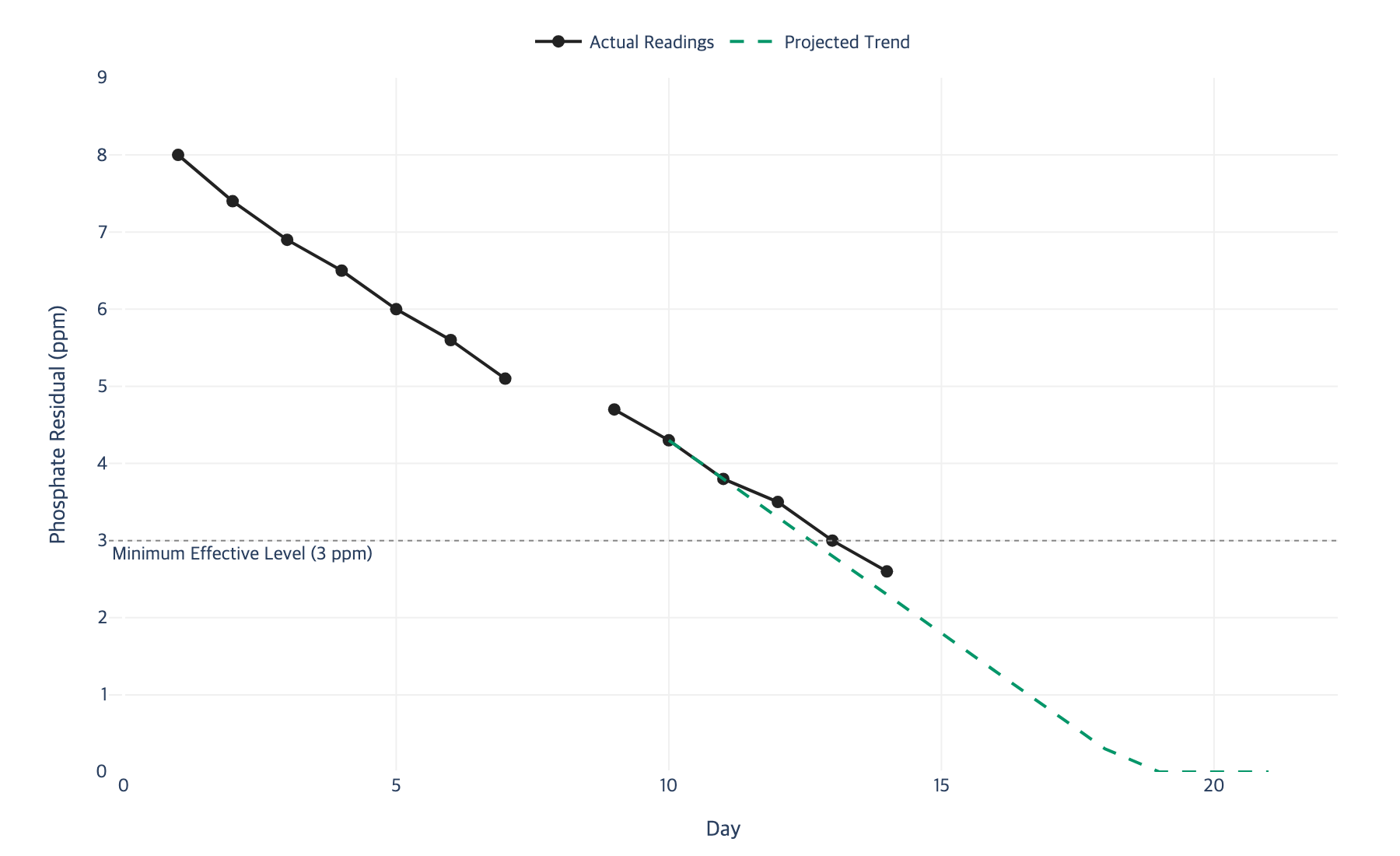
The chart shows actual phosphate residual readings declining over 14 days alongside a projected depletion trend. The projected line predicts when the residual will fall below the minimum effective concentration of 3 ppm, enabling proactive dosing before corrosion protection is compromised.
For example, if phosphate residual declines from 8 ppm to 5 ppm over 5 days under stable operating conditions, the daily consumption rate is 0.6 ppm per day. With a minimum effective concentration of 3 ppm, the next treatment must occur within 3.3 days. If the heat load increases during a summer peak, the consumption rate may accelerate to 1.0 ppm per day, requiring dosing every 2 days instead of every 5. Tracking these consumption rates over months builds a seasonal depletion profile that allows the treatment team to pre-adjust dosing schedules as ambient conditions change.
Seasonal Adjustment Planning
Cooling water chemistry follows seasonal patterns driven by ambient temperature, heat load, and makeup water quality variation. Trending the previous year's data by month reveals predictable seasonal shifts. Summer months typically require higher biocide dosing due to elevated biological activity, increased scale inhibitor dosing due to higher concentration cycles, and more frequent blowdown to maintain target conductivity.
By overlaying the current year's trends on the previous year's baseline, the treatment team can anticipate seasonal chemistry shifts 2 to 4 weeks in advance and pre-position chemical inventory and dosing schedules accordingly. This predictive approach eliminates the reactive scramble that occurs when summer heat load arrives faster than expected. It also provides a quantitative basis for chemical procurement planning, allowing facilities to negotiate bulk purchase agreements based on predicted seasonal consumption rather than reacting to spot market prices during peak demand periods.
Chemical Cost Optimization
Trend-based treatment optimization typically reduces chemical consumption by 10 to 20 percent compared to fixed-schedule dosing while maintaining or improving system protection. The savings come from three sources: eliminating over-dosing during low-demand periods, timing treatments precisely to depletion curves, and detecting chemistry upsets early before they require emergency treatment with premium-cost intervention chemicals.
The indirect cost savings often exceed the direct chemical savings. Early detection of a developing scale condition that would have fouled a heat exchanger avoids the energy penalty of operating with reduced thermal efficiency, the cost of chemical or mechanical cleaning, and the potential production downtime during cleaning. A single avoided cleaning event in a major heat exchanger can save more than an entire year of incremental chemical optimization.
VI. Building a Trend-Based Monitoring Program
Transitioning from single-point monitoring to trend analysis requires systematic data collection and a structured interpretation framework. The transition does not require new instrumentation or measurement capabilities in most cases. It requires a change in how existing data is organized, visualized, and acted upon.
Minimum Data Requirements
Effective trend analysis requires consistent, frequent data collection. The minimum sampling frequency for key parameters in cooling water systems is three times per week for conductivity, pH, and inhibitor residual, and weekly for iron, calcium, alkalinity, and biological counts. Parameters should be measured at the same time of day and the same sampling point to minimize variation from operational fluctuations.
Historical data of at least 3 months is needed to establish baseline trends and seasonal patterns. Facilities transitioning to trend-based monitoring should begin by collecting data at the recommended frequency for one full quarter before attempting to set trend-based alarm thresholds. During this baseline period, the focus should be on identifying the normal rate of change for each parameter under stable operating conditions, which becomes the reference against which future deviations are measured.
Setting Trend-Based Alarms
Traditional alarms trigger when a parameter exceeds a fixed value. Trend-based alarms trigger when the rate of change exceeds a threshold or when parameter correlations break. For example, a rate-of-change alarm for iron concentration might trigger when the 7-day moving average increases by more than 0.2 ppm per week, even if the absolute value remains below the fixed alarm limit of 1.0 ppm. This rate alarm would activate at 0.5 ppm (well within range) if the rate of increase suggested a breach was imminent.
Effective trend-based alarm systems use two tiers. The first tier is an advisory alert that flags an accelerating rate of change, prompting the technician to investigate and verify the trend. The second tier is an action alarm that triggers when the projected time-to-breach falls below a defined threshold, typically 2 weeks, requiring a specific corrective response. This two-tier approach prevents alarm fatigue from minor fluctuations while ensuring that genuine developing problems receive attention before they become urgent.
Integrating Trend Data with Operating Conditions
Chemistry trends must be interpreted alongside operating condition changes. A spike in conductivity following a production increase is expected and requires only verification that the blowdown controller has responded. The same conductivity spike during stable operations indicates a system issue. Logging production load, ambient temperature, and makeup water quality alongside chemistry data creates the context needed for accurate trend interpretation.
The most effective trend-based monitoring programs maintain a simple event log alongside chemistry data. Recording equipment startups, shutdowns, load changes, chemical additions, and maintenance activities on the same timeline as chemistry measurements transforms ambiguous data patterns into clear cause-and-effect relationships. A conductivity increase that coincides with a recorded makeup water source change has a very different meaning than the same increase during normal operations.
VII. Key Takeaway
Single-point chemistry readings identify where the system is, but correlated trends reveal what is happening and where it is heading
Multi-parameter pattern recognition (conductivity + pH + iron, or phosphate + calcium) identifies specific system events weeks before single-parameter alarms trigger
Three simple techniques, moving averages, rate of change, and cross-parameter correlation, extract predictive value from data already being collected
Trend-based chemical dosing reduces consumption by 10 to 20 percent while improving system protection by timing treatments to actual depletion curves
Seasonal trend overlays enable proactive chemistry adjustments 2 to 4 weeks ahead of predictable load changes
Even thin biofilm layers from undetected biological upsets can reduce heat exchanger efficiency by more than 10 percent, making early trend detection of microbial issues critical to energy performance
Lubinpla's AI-powered platform continuously analyzes your cooling water monitoring data to identify correlated trend patterns, calculate parameter depletion rates, and flag diverging correlations before they become system failures. Instead of manually plotting spreadsheets and comparing parameter columns, Lubinpla automates the cross-parameter analysis described in this article, delivering pattern-matched alerts and optimized treatment recommendations directly to your field team. Upload your historical monitoring data and let the platform build your facility-specific baseline, so every future reading is interpreted in context rather than in isolation.
VIII. References
[1] Veolia, "Water Handbook: Cooling Water Corrosion Control", 2024. https://www.watertechnologies.com/handbook/chapter-24-corrosion-control-cooling-systems
[2] Guardian Chemical, "What Are Cycles of Concentration in a Cooling Tower System?", 2024. https://guardianchem.com/articles/what-are-cycles-of-concentration-in-cooling-systems/
[3] Chardon Labs, "How to Optimize the pH Balance of Cooling Tower Water", 2024. https://www.chardonlabs.com/resources/how-to-optimize-cooling-tower-water-ph-balance/
[4] Alliance Chemical, "Cooling Tower Water Treatment Chemical Guide", 2024. https://alliancechemical.com/blogs/articles/cooling-tower-water-treatment-guide
[5] Chem-Aqua, "Understanding How ORP Is Used in Cooling Water Treatment", 2022. https://www.chemaqua.com/en-us/blog/2022/05/31/understanding-how-orp-is-used-in-cooling-water-treatment-chem-aqua/
[6] Sensorex, "The Effects of High Conductivity in Cooling Tower Water", 2024. https://sensorex.com/effects-high-conductivity-cooling-tower-water/
[7] U.S. Department of Energy, "Best Management Practice 10: Cooling Tower Management", 2024. https://www.energy.gov/cmei/femp/best-management-practice-10-cooling-tower-management
[8] Mantech, "Cooling Water Scaling Potential: Langelier Saturation Index (LSI)", 2024. https://mantech-inc.com/blog/cooling-water-scaling-potential-langlier-saturation-index-lsi/
[9] CED Engineering, "Cooling Water Problems and Solutions", 2024. https://www.cedengineering.com/userfiles/M05-009%20-%20Cooling%20Water%20Problems%20and%20Solutions%20-%20US.pdf
[10] Glacier Labs, "Understanding Biofilm's Impact on Cooling Tower Performance", 2024. https://glacierlabs.com/understanding-biofilms-impact-on-cooling-tower-performance/
[11] QualiChem, "Reducing and Controlling Cooling Tower Biofilm Formation", 2024. https://watertreatment.qualichem.com/reducing-and-controlling-cooling-tower-biofilm-formation/
[12] ChemREADY, "Understanding ORP in Cooling Towers: Importance, Monitoring, and Best Practices", 2024. https://www.getchemready.com/water-facts/understanding-orp-in-cooling-towers-importance-monitoring-and-best-practices/
[13] Senseye/Siemens, "The True Cost of Downtime 2024", 2024. https://assets.new.siemens.com/siemens/assets/api/uuid:1b43afb5-2d07-47f7-9eb7-893fe7d0bc59/TCOD-2024_original.pdf
[14] Genesis Water Technologies, "Cooling Tower Treatment: What Water/Wastewater Tech Teams Should Know in 2025", 2025. https://genesiswatertech.com/blog-post/cooling-tower-what-water-wastewater-tech-teams-should-know-in-2025/
[15] PMC, "Advanced Machine Learning Techniques for Corrosion Rate Estimation and Prediction in Industrial Cooling Water Pipelines", 2024. https://pmc.ncbi.nlm.nih.gov/articles/PMC11175261/
Powered by Lubinpla
Discover how technical teams solve complex challenges faster with AI.