How Silicone-Based vs Fluoropolymer Sealants Behave Under Thermal Cycling
Summary: Selecting between silicone-based and fluoropolymer sealants for thermal cycling applications is often based on data sheet comparisons of temperature ratings, which fail to capture the fundamentally different ways these materials respond to repeated heating and cooling cycles over their service life. This article examines the molecular structures that determine each material's thermal behavior, compares their performance across elastic recovery, compression set, adhesion retention, and chemical resistance from -40 degrees C to +250 degrees C, and provides a condition-based selection guide that maps the performance envelope of each type against application-specific requirements. Engineers can use this framework to select the right sealant based on the actual operating conditions rather than nominal specifications.
Table of Contents
I. Why Data Sheet Temperature Ratings Are Not Enough
II. Molecular Structure: Why Si-O and C-F Bonds Respond Differently to Heat
III. Performance Under Thermal Cycling: Five Critical Properties
IV. Condition Sensitivity: UV, Chemicals, and Humidity Over Time
V. The Selection Guide: When Silicone Wins vs When Fluoropolymer Is Required
VI. Field Cases: Selecting by Mechanism, Not by Data Sheet
VII. Key Takeaway
VIII. References
I. Why Data Sheet Temperature Ratings Are Not Enough
Sealant selection for thermal cycling applications is frequently reduced to a single comparison: the maximum continuous service temperature listed on the product data sheet. By this metric alone, both silicone and fluoropolymer sealants appear suitable for applications up to 200 to 260 degrees C, suggesting they are interchangeable. In practice, thermal cycling performance depends on how the material responds to repeated transitions between temperature extremes, not just its ability to survive at a static high temperature. A sealant that performs well at a constant 200 degrees C may lose adhesion, develop compression set, or crack after 500 thermal cycles between 20 degrees C and 200 degrees C.
The Gap Between Static Ratings and Cyclic Reality
Standard test methods such as ASTM D2000 measure properties after continuous heat aging at a fixed temperature for 70 or 168 hours. These tests capture thermal degradation under isothermal conditions but do not measure the mechanical fatigue imposed by repeated expansion and contraction. A flanged joint in an industrial oven may accumulate 1,500 to 3,000 thermal cycles per year. Two sealants with identical temperature ratings can exhibit dramatically different performance after 2,000 cycles, because the failure mechanism in thermal cycling is compression set accumulation and mechanical fatigue, not thermal decomposition.
The Cost of Wrong Selection
Joint failures from sealant degradation cause leaks ranging from nuisance-level drips to catastrophic losses of process fluids or hazardous chemicals. In petrochemical flange sealing, a sealant failure can cause an unplanned shutdown costing USD 50,000 to USD 500,000 per day (Durlon, 2023). In electronics enclosures, sealant degradation allows moisture ingress that destroys circuit boards valued at USD 5,000 to USD 50,000. Across the global industrial sector, unplanned downtime costs are estimated at USD 50 billion annually (Henkel, 2023). These consequences make mechanism-based sealant selection a high-value engineering practice.
II. Molecular Structure: Why Si-O and C-F Bonds Respond Differently to Heat
The thermal behavior of silicone and fluoropolymer sealants is determined by their molecular backbone structure. Understanding these structural differences explains why each material excels in specific conditions and fails in others.
Silicone: The Si-O Backbone Advantage
Silicone sealants are based on a polysiloxane backbone consisting of alternating silicon and oxygen atoms (Si-O-Si). This backbone differs from carbon-based polymers in three ways. First, the Si-O bond energy of 452 kJ/mol is significantly higher than the C-C bond energy of 348 kJ/mol, providing inherent thermal stability. Second, the Si-O-Si bond angle of approximately 143 degrees is wider than the C-C-C angle of 109 degrees, giving the backbone exceptional flexibility from -60 degrees C to +230 degrees C (Apple Rubber, 2023). Third, the partially ionic character of the Si-O bond provides resistance to ultraviolet radiation and ozone, which break carbon-carbon bonds through free radical mechanisms.
These properties are confirmed by long-term field data. In a 40-year outdoor weathering study at the Atlas Weathering Test Site in Miami, silicone sealants retained 100 percent elastic recovery after a 180-degree bend test even after four decades of continuous exposure, while polyurethane and acrylic alternatives showed significant stiffening and adhesion loss (Silicone for Building, 2025).
Fluoropolymer: The C-F Bond Shield
Fluoropolymer sealants, including fluorosilicone (FVMQ), fluoroelastomer (FKM), and perfluoroelastomer (FFKM), derive their distinctive properties from the carbon-fluorine bond. The C-F bond energy of 485 kJ/mol is the strongest single bond in organic chemistry, creating a dense electron shield around the carbon backbone that provides exceptional resistance to chemical attack. In fluoroelastomers (FKM), the fluorine content typically ranges from 66 to 70 percent by weight, creating a material that is nearly impervious to hydrocarbon fuels, oils, solvents, and concentrated acids that would rapidly degrade silicone (Marco Rubber, 2023).
The trade-off for this chemical resistance is reduced low-temperature flexibility. Standard FKM compounds become stiff and lose sealing capability below -20 degrees C, compared to silicone's -60 degrees C lower limit. This stiffening occurs because the dense fluorine shielding raises the glass transition temperature (Tg) to approximately -18 degrees C, meaning the material transitions from a rubbery to a glassy state near this temperature and cannot follow joint movement. This low-temperature limitation is a critical differentiator in applications that cycle between sub-zero and elevated temperatures.
Fluorosilicone: The Hybrid Approach
Fluorosilicone (FVMQ) combines a silicone backbone (Si-O-Si) with fluorinated side groups (typically trifluoropropyl groups). This hybrid architecture retains the low-temperature flexibility of silicone down to -60 degrees C while adding moderate resistance to fuels and oils. The result is a material that resists fuel vapor swelling to approximately 10 to 20 percent, compared to silicone's 80 to 100 percent swell, though it does not match FKM's less than 5 percent swell. This compromise makes FVMQ the material of choice when both low-temperature cycling and moderate fuel or oil exposure are present.
III. Performance Under Thermal Cycling: Five Critical Properties
Thermal cycling performance is not a single property but a combination of five measurable characteristics that determine whether a sealant will maintain its function over thousands of heating and cooling cycles.
Figure 1. Thermal Cycling Performance Comparison: Silicone vs Fluoropolymer
Property | Silicone (VMQ) | Fluorosilicone (FVMQ) | Fluoroelastomer (FKM) | FFKM |
|---|---|---|---|---|
Service temp range | -60 to +230 C | -60 to +200 C | -20 to +250 C | -25 to +325 C |
Elastic recovery after 1000 cycles | Excellent (> 90%) | Good (80-90%) | Good (80-85%) | Excellent (> 90%) |
Compression set at 200 C (70 hrs) | 30-50% | 25-40% | 15-30% | 10-20% |
Adhesion retention after thermal aging | Moderate (decreases with silicone oil migration) | Good | Good | Excellent |
Chemical resistance (fuels, oils, solvents) | Poor | Good | Excellent | Excellent |
No single material dominates all five categories. Silicone and FFKM share excellent elastic recovery, but silicone falls to last place in chemical resistance. FKM leads in chemical resistance and compression set but cannot match silicone or FVMQ at low temperatures. The selection decision must therefore be based on which properties are most critical for the specific application.
Figure 3. Sealant Property Comparison Radar: VMQ vs FVMQ vs FKM vs FFKM
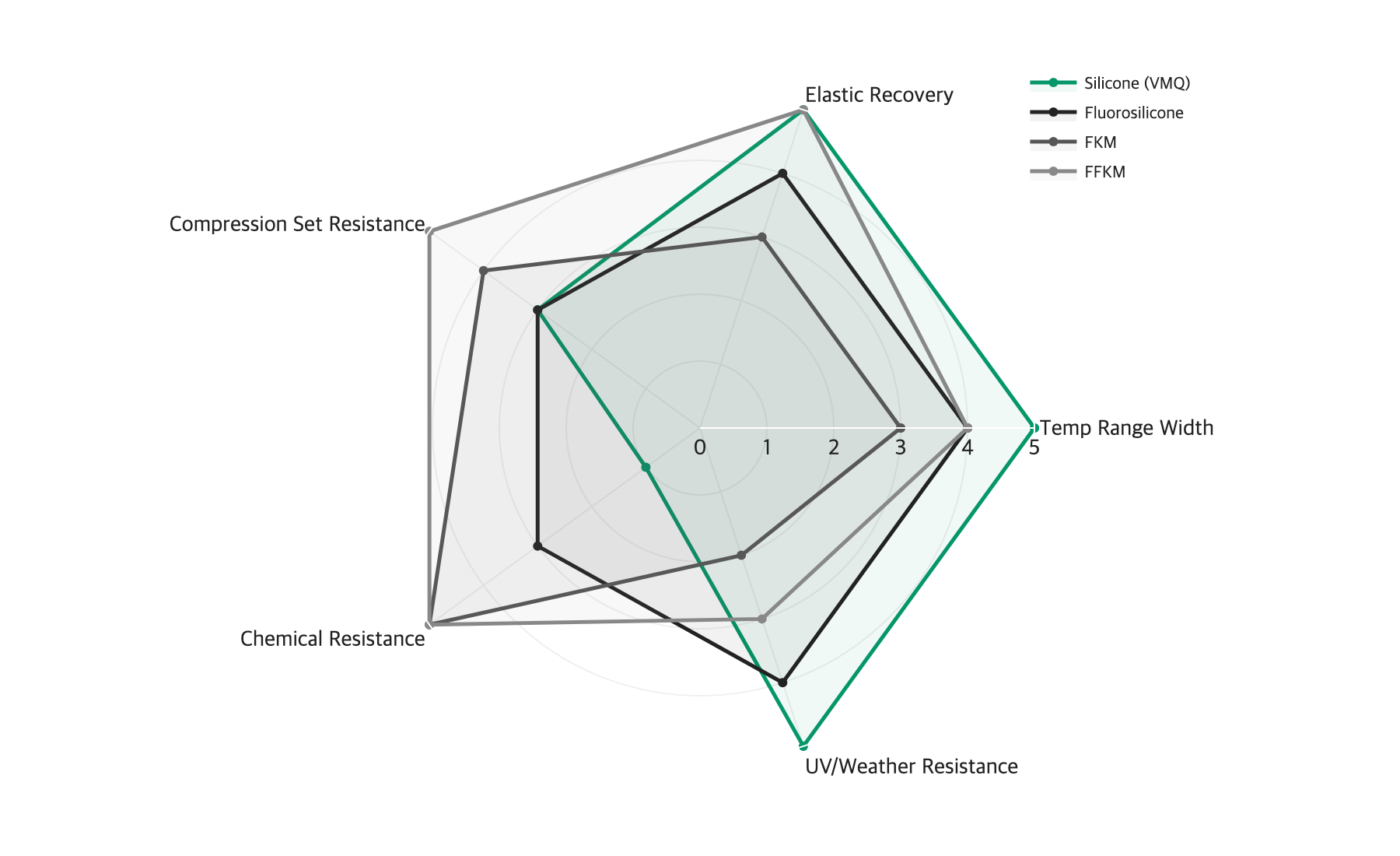
This radar chart visualizes the trade-off landscape. Silicone (VMQ) dominates in temperature range width, elastic recovery, and UV resistance, favoring thermal cycling and weathering applications. FKM dominates in chemical resistance. FFKM provides the most balanced profile but at a significant cost premium. FVMQ occupies the middle ground for applications requiring moderate chemical resistance and good thermal cycling performance.
Figure 4. Service Temperature Range Comparison by Material
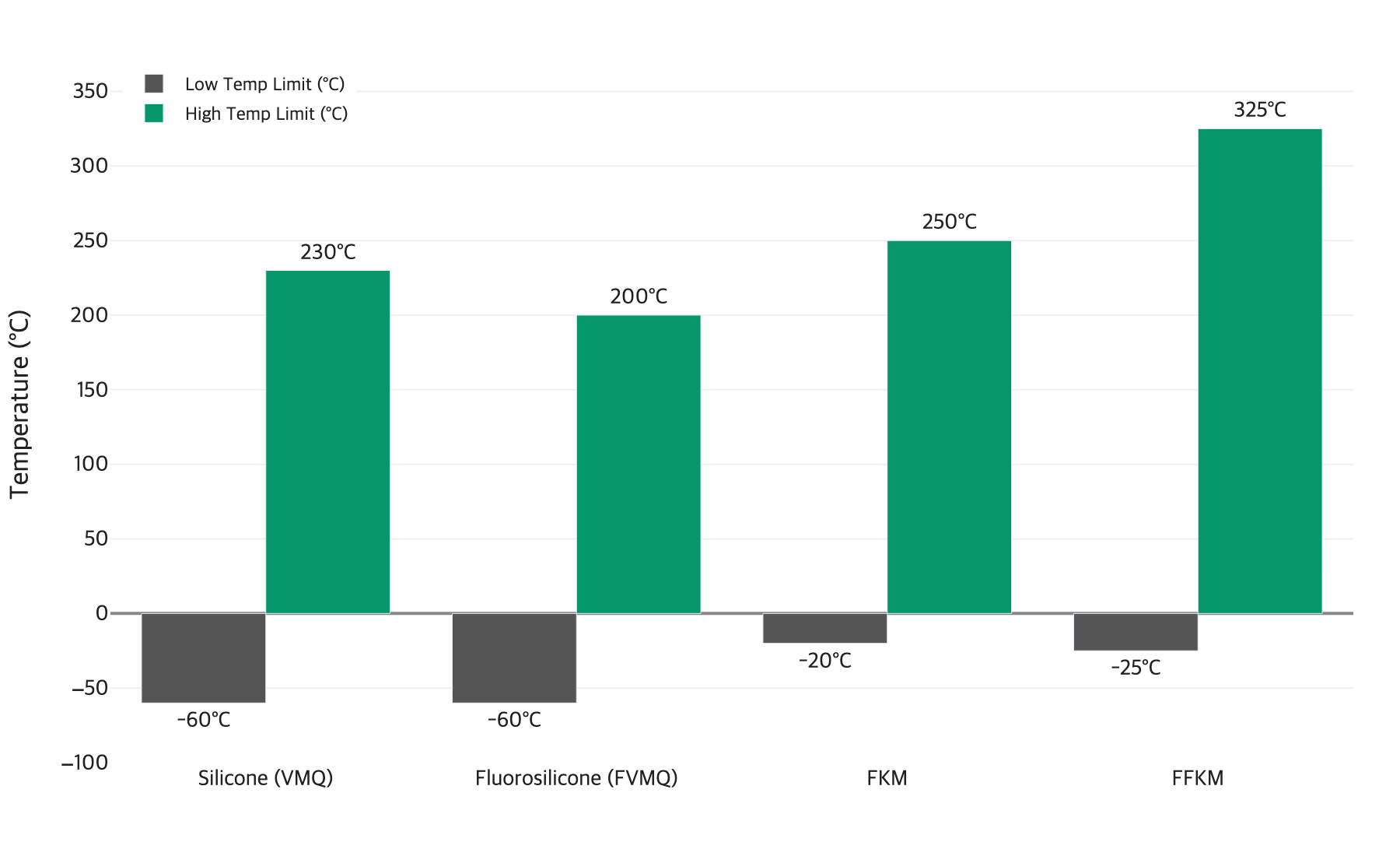
This bar chart highlights the critical low-temperature difference. While all four materials offer high-temperature capability above 200 degrees C, silicone and fluorosilicone maintain flexibility down to -60 degrees C while standard FKM stiffens at -20 degrees C, disqualifying it for sub-zero cycling regardless of chemical resistance.
Taken together, silicone leads in low-temperature flexibility and elastic recovery but is weakest in chemical resistance. FKM leads in chemical resistance and compression set but cannot match silicone's low-temperature capability. FFKM delivers the best overall performance but at a cost premium of 10x to 20x compared to standard FKM, limiting its use to critical applications where the cost of failure justifies the material investment (Wyatt Seal, 2023).
Elastic Recovery: Why It Matters for Thermal Cycling
Elastic recovery measures the sealant's ability to return to its original shape after being compressed at elevated temperature. In a flanged joint cycling between ambient and 200 degrees C, the joint gap opens and closes by 0.1 to 0.5 mm due to differential thermal expansion. A sealant with poor elastic recovery takes a permanent set during the high-temperature phase and cannot follow the gap opening during cooling, creating a leak path. Silicone's backbone flexibility gives it excellent elastic recovery through thousands of cycles, its primary advantage over FKM in pure thermal cycling applications.
In accelerated thermal cycling tests, silicone rubber seals show that compressive stress jumps during heating and relaxes at high temperature, then returns almost exactly to the previous cycle's value on cooling, indicating fully reversible load behavior (SIMTEC, 2023). The 40-year Atlas weathering study confirmed this at field scale: acetoxy silicone sealants showed near-instantaneous 100 percent elastic recovery even after decades of outdoor exposure (Silicone for Building, 2025).
Compression Set: The Long-Term Sealing Indicator
Compression set measures the permanent deformation after prolonged compression at elevated temperature. A compression set of 50 percent means the material has lost half of its original thickness recovery capability. In static sealing applications, compression set determines long-term sealing force. FKM and FFKM exhibit lower compression set than silicone above 150 degrees C, making them better choices for static high-temperature seals.
Compression set testing per ASTM D395 Method B provides the standardized comparison. For FKM compounds tested at 200 degrees C for 70 hours, compression set values range from 19 to 50 percent depending on formulation. Solvay's Tecnoflon FKM compounds show 37 to 41 percent under these conditions, while FFKM compounds achieve 10 to 20 percent (Solvay, 2018). Silicone compounds under the same conditions typically show 30 to 50 percent. However, in dynamic thermal cycling where the joint gap opens and closes repeatedly, elastic recovery becomes more important than compression set, shifting the advantage back to silicone.
Adhesion Retention: The Silicone Oil Migration Problem
One property rarely discussed in data sheet comparisons but frequently causing field failures is adhesion retention after thermal aging. Silicone sealants contain low-molecular-weight silicone oils that migrate to the bond interface over time, particularly at elevated temperatures, creating a weak boundary layer that reduces adhesion strength progressively. This silicone oil contamination can reduce bond strength by 50 percent or more and spread to surfaces never in direct contact with the sealant (NASA, 2012). FKM and FFKM do not exhibit this migration behavior, giving them superior long-term adhesion retention in permanently bonded joints.
IV. Condition Sensitivity: UV, Chemicals, and Humidity Over Time
Beyond temperature, three environmental factors differentially affect silicone and fluoropolymer sealants, often determining the correct selection even when temperature range alone would suggest either material could work.
UV and Weathering Exposure
Silicone demonstrates exceptional resistance to UV radiation, ozone, and atmospheric weathering. The Si-O backbone is not susceptible to the free radical chain scission that degrades carbon-based polymers under UV exposure. After 10 years of outdoor exposure, silicone sealants typically retain 80 percent or more of their original mechanical properties (Atlas Fibre, 2023). FKM sealants are more susceptible to UV degradation due to their carbon backbone. In outdoor applications with significant UV exposure, silicone is the clear choice regardless of the temperature rating comparison.
Chemical and Solvent Exposure
This is the domain where fluoropolymer sealants are unmatched. Silicone swells and degrades rapidly in the presence of hydrocarbon fuels, aromatic solvents, and many organic chemicals, with swelling of 100 percent or more in gasoline or toluene. FKM resists these same chemicals with less than 5 percent swell. For any application where the sealant contacts fuels, lubricating oils, hydraulic fluids, or organic solvents, fluoropolymer is the only viable option.
The mechanism behind this difference is rooted in polarity. Silicone's non-polar methyl side groups readily absorb non-polar organic solvents, causing the polymer network to expand. In continuous contact, the swelling weakens the crosslinked network and the sealant loses both mechanical strength and adhesion. FKM's dense fluorine shielding prevents solvent molecules from penetrating the polymer matrix, maintaining dimensional stability. FVMQ falls between the two: its fluorinated side groups provide partial resistance to fuel vapors and light hydrocarbons, but it cannot withstand prolonged immersion in concentrated solvents, making it suitable for intermittent rather than continuous chemical exposure.
Humidity and Moisture
Both silicone and fluoropolymer sealants resist liquid water effectively. However, silicone is permeable to water vapor, which can be either an advantage or a disadvantage depending on the application. In electronics enclosures, silicone's vapor permeability allows trapped moisture to escape, preventing condensation damage during thermal cycling when moisture in enclosed air condenses on circuit boards. In chemical containment applications, this same permeability could allow slow migration of dissolved gases or volatile chemicals through the sealant, making FKM the better choice for chemical barrier applications where zero permeation is required.
V. The Selection Guide: When Silicone Wins vs When Fluoropolymer Is Required
The selection decision is not a simple temperature comparison but a multi-factor assessment. The following decision matrix captures the primary application conditions and maps them to the optimal material choice.
Figure 2. Condition-Based Sealant Selection Decision Matrix
Application Condition | Silicone (VMQ) | Fluorosilicone (FVMQ) | FKM | FFKM |
|---|---|---|---|---|
Thermal cycling, no chemical exposure | Best choice | Good | Acceptable | Over-specified |
Thermal cycling + fuel/oil exposure | Not suitable | Good | Best choice | Best (if budget allows) |
Thermal cycling + outdoor UV | Best choice | Good | Acceptable | Over-specified |
Static high-temp seal (> 200 C) | Marginal | Not suitable | Good | Best choice |
Low-temp cycling (below -30 C) | Best choice | Good | Not suitable | Marginal |
Chemical containment (acids, solvents) | Not suitable | Marginal | Best choice | Best choice |
Food/pharma (FDA compliance) | Good (specific grades) | Not common | Good (specific grades) | Best choice |
Cost-sensitive, moderate conditions | Best choice | Good | Good | Not suitable |
This matrix captures the practical decision framework. Silicone is the optimal choice for pure thermal cycling and weathering applications, while FKM becomes necessary only when chemical exposure is a factor. The most common selection error is specifying FKM for applications where chemical exposure does not exist, paying a 3x to 5x cost premium for chemical resistance that will never be tested in service.
A Practical Decision Sequence for Field Engineers
For engineers making sealant selections under time pressure, three questions capture the essential decision logic. First, does the sealant contact fuels, oils, solvents, or aggressive chemicals? If yes, silicone is eliminated. Second, does the application cycle below -25 degrees C? If yes, standard FKM is eliminated. Third, is the application primarily static or dynamic? Static high-temperature seals favor FKM or FFKM for lower compression set, while dynamic thermal cycling favors silicone or FVMQ for elastic recovery. Most field applications can be resolved with these three questions.
VI. Field Cases: Selecting by Mechanism, Not by Data Sheet
The following two cases illustrate how mechanism-based selection produces better outcomes than data-sheet-based selection.
Case 1: Company A, Industrial Oven Door Gaskets
Company A operated 6 industrial curing ovens cycling between ambient temperature and 220 degrees C, with cycle times of 45 minutes. The oven door gaskets, specified as FKM based on the 220 degrees C operating temperature, required replacement every 8 to 12 months due to compression set and hardening. Each gasket replacement cost approximately USD 1,200 in materials and USD 800 in labor and production downtime, totaling approximately USD 14,400 annually across the 6 ovens. The actual failure mechanism was not thermal degradation but compression set from the 1,500 thermal cycles accumulated over 8 months. The environment inside the oven contained no chemicals, fuels, or solvents, only hot air.
A trial replacement with silicone gaskets (VMQ) was conducted on 2 ovens. The silicone's superior elastic recovery under thermal cycling extended gasket life to over 24 months. Annual gasket costs for those 2 ovens dropped from USD 4,800 to USD 1,600. The remaining 4 ovens were converted to silicone within the following quarter, saving approximately USD 9,600 annually while also reducing energy waste from heat leaks.
Case 2: Company B, Fuel System Flange Seals
Company B manufactured fuel handling equipment operating at temperatures cycling between -25 degrees C and +80 degrees C. The original design specified silicone sealant based on its thermal cycling performance and low-temperature flexibility. Within 6 months, multiple flange seals failed due to sealant swelling from fuel vapor exposure. The silicone swelled by approximately 80 percent, losing both adhesion and sealing compression. Each failure event required emergency maintenance at an average cost of USD 3,500, occurring 3 to 4 times annually.
Replacement with FKM sealant eliminated the swelling issue, but the standard FKM compound hardened at the -25 degrees C low end, causing cold-start leaks. The stiffening occurred because the standard FKM's glass transition temperature of approximately -18 degrees C was above the operating minimum. The solution was fluorosilicone (FVMQ), which combined acceptable fuel resistance with the low-temperature flexibility needed for -25 degrees C cycling. After switching to FVMQ, no seal failures occurred over 18 months. The material cost was approximately 2x the original silicone but eliminated USD 10,500 to USD 14,000 in annual failure costs.
VII. Key Takeaway
Silicone's Si-O backbone provides exceptional flexibility from -60 to +230 degrees C and superior elastic recovery under thermal cycling, making it the optimal choice for applications where chemical exposure is not a factor.
Fluoropolymer's C-F bond provides the chemical resistance that silicone lacks, making FKM or FFKM mandatory for any application involving fuels, oils, solvents, or concentrated chemicals, regardless of temperature range.
Compression set and elastic recovery are the critical performance indicators for thermal cycling. Silicone leads in elastic recovery (dynamic joints), while FKM and FFKM lead in compression set above 150 degrees C (static joints).
The most common selection error is specifying fluoropolymer for applications where chemical exposure does not exist, paying a 3x to 5x premium for a property that is never tested in service. Pure thermal cycling applications in clean environments should default to silicone.
When both thermal cycling and chemical exposure are present, fluorosilicone (FVMQ) provides the best compromise for moderate conditions, while FFKM provides the ultimate performance for extreme conditions at a cost premium of 10x to 20x over standard FKM.
Lubinpla's Assistant can analyze your thermal cycling profile, chemical exposure conditions, and cost constraints to recommend the optimal sealant material from the selection matrix. By inputting your cycling temperature range, cycle frequency, and chemical exposure list, the platform cross-references these variables against each material family's performance envelope and identifies the lowest-cost option that meets all operating requirements.
VIII. References
[1] Apple Rubber, "Fluorosilicone vs. Silicone: the Major Differences", 2023. https://www.applerubber.com/blog/fluorosilicone-vs-silicone-the-major-differences-you-need-to-know/
[2] Marco Rubber, "Why High-Temperature Matters When Choosing a Seal Material", 2023. https://www.marcorubber.com/blog/why-high-temperature-matters-when-choosing-a-seal-material/
[3] Atlas Fibre, "Understanding Silicone Chemical Compatibility", 2023. https://www.atlasfibre.com/understanding-silicone-chemical-compatibility-a-comprehensive-guide/
[4] Elastostar, "Fluorosilicone vs Silicone: Key Differences Explained", 2023. https://elastostar.com/fluorosilicone-vs-silicone-whats-the-difference/
[5] Mueller-Ahlhorn, "Silicone vs. PTFE: A Comparison as a Sealing Material", 2023. https://www.mueller-ahlhorn.com/en/Silicone-vs-PTFE-a-comparison-as-a-sealing-material/
[6] Interplas Insights, "Understanding the Differences Between Silicone and Fluorosilicone", 2023. https://interplasinsights.com/plastic-industry-insights/latest-plastics-industry-insights/understanding-the-differences-between-silicone-and-fluorosilicone/
[7] Precision Polymer Engineering, "High Temperature Elastomers", 2023. https://www.prepol.com/solutions/high-temperature-elastomers/
[8] Cannon Gasket, "What's the Difference Between Silicone and Fluorosilicone?", 2023. https://cannongasket.com/whats-the-difference-between-silicone-and-fluorosilicone/
[9] RD Rubber, "Fluorosilicone in Aerospace: High Performance Sealing", 2023. https://rdrubber.com/fluorosilicone-in-aerospace-high-peformance-sealing/
[10] ScienceDirect, "Fluorosilicone Overview", 2023. https://www.sciencedirect.com/topics/engineering/fluorosilicone
[11] Elastostar, "Why Heat Resistant Silicone Is A Popular Choice For Industries", 2023. https://elastostar.com/what-makes-heat-resistant-silicone-so-popular/
[12] SpecialChem, "Chemical-Resistant Adhesives: Types, Selection Tips, and Test Methods", 2023. https://www.specialchem.com/adhesives/guide/chemical-resistance
[13] Silicone for Building, "40 Years of Silicone Sealant Durability Testing at the Atlas Weathering Test Site", 2025. https://siliconeforbuilding.com/blog/40-years-of-outdoor-weathering-a-real-world-40-year-landmark-study-of-silicone-vs-alternative-chemistries
[14] Solvay, "Tecnoflon FKM/FFKM Fluoroelastomers and Perfluoroelastomers Materials Guide", 2018. https://www.solvay.com/sites/g/files/srpend616/files/2018-10/Tecnoflon-FKM-and-FFKM-Materials-Guide_EN-v3.2_0.pdf
[15] SIMTEC, "Thermal Stress in LSR Due to Temperature Cycling", 2023. https://www.simtec-silicone.com/blogs/thermal-stress-in-lsr-due-to-temperature-cycling/
[16] Henkel, "The Impact of Unplanned Downtime in Industrial Manufacturing", 2023. https://www.henkel-adhesives.com/us/en/applications/all-applications/industry-insights/the-impact-of-unplanned-downtime.html/1000.html
[17] Durlon, "Why Sealing Failures Lead to Downtime in Industrial Operations", 2023. https://www.durlon.com/why-sealing-failures-lead-to-downtime-in-industrial-operations/
[18] Wyatt Seal, "FKM vs FFKM: Making the Right Choice for Performance and Cost", 2023. https://www.wyattseal.com/blog/fkm-vs-ffkm-seal-materials
[19] NASA, "The Effects of Silicone Contamination on Bond Performance", 2012. https://ntrs.nasa.gov/api/citations/20120016452/downloads/20120016452.pdf
Powered by Lubinpla
Discover how technical teams solve complex challenges faster with AI.