How Water Treatment Biocides Work: Oxidizing vs Non-Oxidizing Mechanisms
Summary: Microbiological contamination in cooling towers, closed loops, and process water systems costs industrial facilities millions of dollars annually through biofilm-induced corrosion, fouling, and heat transfer losses. This article examines how oxidizing biocides (chlorine, bromine, chlorine dioxide) destroy microorganisms through cell membrane oxidation, and how non-oxidizing biocides (glutaraldehyde, isothiazolone, DBNPA) kill through intracellular enzyme inhibition and cross-linking. The critical insight is that biofilm organisms require 10 to 1,000 times higher biocide concentrations than planktonic bacteria, making biocide selection and dosing strategy as important as the chemistry itself. Engineers who understand these mechanisms can match the right biocide to the actual biological challenge and achieve effective control with lower total chemical consumption.
Table of Contents
I. The Microbiological Challenge in Industrial Water Systems
II. Oxidizing Biocides: Cell Membrane Disruption Through Oxidation
III. Non-Oxidizing Biocides: Intracellular Enzyme Inhibition and Cross-Linking
IV. Kill Spectrum Comparison: Planktonic vs Biofilm vs Algae vs Fungi
V. How pH, Temperature, and Organic Load Affect Biocide Efficacy
VI. Biocide Selection Guide by System Type and Problem Type
VII. Key Takeaway
VIII. References
I. The Microbiological Challenge in Industrial Water Systems
A plant engineer discovers that a cooling tower's heat exchange efficiency has dropped by 15 percent despite clean tube surfaces visible from the end caps. The problem is a thin but tenacious biofilm layer on the inner tube surfaces that acts as a thermal insulator, reducing heat transfer while remaining invisible to visual inspection. This scenario illustrates why microbiological control in industrial water systems requires understanding not just which organisms are present, but how different biocide mechanisms target them.
Industrial water systems provide ideal conditions for microbial growth: warm temperatures, dissolved nutrients, and large surface areas for colonization. Without effective biocide treatment, microbial populations can double every 20 to 30 minutes under optimal conditions, forming biofilms that cause under-deposit corrosion, reduce heat transfer efficiency, and plug distribution systems. The choice between oxidizing and non-oxidizing biocides, and the strategy for applying them, determines whether microbiological control is achieved efficiently or becomes a recurring source of operational problems.
Why Mechanism Understanding Matters for Biocide Selection
The two classes of biocides, oxidizing and non-oxidizing, kill microorganisms through fundamentally different pathways. This difference has practical consequences for dosing strategy, treatment frequency, system compatibility, and effectiveness against different organism types. An oxidizing biocide that works well against planktonic bacteria in the bulk water may be ineffective against established biofilms, while a non-oxidizing biocide that penetrates biofilms effectively may be incompatible with certain system metallurgies or other treatment chemicals. Understanding these mechanisms allows engineers to design biocide programs that address the actual biological challenge rather than applying generic treatment approaches.
II. Oxidizing Biocides: Cell Membrane Disruption Through Oxidation
Oxidizing biocides represent the most widely used class of microbiological control agents in industrial water treatment. They kill microorganisms by oxidizing critical cellular components, primarily the lipids and proteins that form the cell membrane. This oxidation disrupts the membrane's selective permeability, allowing uncontrolled ion exchange that leads to rapid cell death.
Chlorine Chemistry and the Hypochlorous Acid Mechanism
When chlorine gas or sodium hypochlorite is added to water, it forms hypochlorous acid (HOCl), which is the active biocidal species. HOCl is a small, uncharged molecule that can penetrate cell membranes readily. Once inside the cell, HOCl oxidizes sulfhydryl groups on enzymes involved in glucose metabolism, disrupting the cell's energy production and leading to death within minutes of exposure.
The biocidal effectiveness of chlorine is strongly pH-dependent because the equilibrium between HOCl and the hypochlorite ion (OCl-) shifts with pH. At pH 7.5, approximately 50 percent of the free chlorine exists as HOCl. At pH 8.5, this drops to approximately 10 percent. Since HOCl is 80 to 100 times more effective as a biocide than OCl-, this pH effect is the single most important factor in chlorine-based treatment program design. Systems operating above pH 8.5 require significantly higher chlorine dosages to achieve equivalent kill, which increases both chemical cost and corrosion risk.
Bromine Chemistry and Alkaline pH Advantage
Bromine-based biocides produce hypobromous acid (HOBr) as the active species. The critical advantage of bromine over chlorine is that HOBr remains the dominant species at higher pH values. At pH 8.5, approximately 83 percent of bromine exists as HOBr compared to only 10 percent of chlorine as HOCl (ChemTex, 2024). This makes bromine significantly more effective than chlorine in alkaline cooling water systems, which is why bromine-based programs have become the standard for many open recirculating cooling systems operating at pH 8.0 or above.
Bromine is typically delivered as stabilized sodium bromide activated with sodium hypochlorite, or as bromine-releasing compounds such as BCDMH (1-bromo-3-chloro-5,5-dimethylhydantoin). The stabilized delivery approach allows precise dosing control and reduces the safety concerns associated with handling elemental bromine.
Chlorine Dioxide: Selective Oxidation Without Chlorination Byproducts
Chlorine dioxide (ClO2) operates through a distinct mechanism from chlorine despite the similar name. ClO2 kills microorganisms primarily by disrupting protein synthesis and altering outer membrane permeability rather than through general oxidation of all organic matter (Acepsis, 2024). A single ClO2 molecule can accommodate up to five electrons in oxidation-reduction reactions, giving it 2.6 times the specific oxidative capacity of chlorine on a molar basis.
The selectivity of ClO2 is its primary advantage. Unlike chlorine, ClO2 does not react with ammonia to form chloramines, does not produce trihalomethanes (THMs) or haloacetic acids (HAAs), and maintains its biocidal activity across a broad pH range (pH 4 to 10). This makes ClO2 particularly valuable in systems where chlorination byproduct formation must be minimized or where pH control is difficult to maintain.
Figure 1. Oxidizing Biocide Active Species and pH Effectiveness
Biocide | Active Species | Optimal pH Range | Activity at pH 8.5 | Half-Life in System | Primary Limitation |
|---|---|---|---|---|---|
Chlorine (gas/NaOCl) | HOCl | 6.0-7.5 | 10% as HOCl | 4-8 hours | pH sensitive, THM formation |
Bromine (NaBr + NaOCl) | HOBr | 6.0-9.0 | 83% as HOBr | 2-6 hours | Higher cost than chlorine |
BCDMH (solid) | HOBr + HOCl | 6.0-8.5 | Moderate | 4-8 hours | Slower dissolution rate |
Chlorine dioxide | ClO2 | 4.0-10.0 | Full activity | 6-12 hours | On-site generation required |
Ozone | O3 | 6.0-9.0 | Full activity | Minutes | No residual, equipment cost |
This comparison reveals that no single oxidizing biocide is optimal across all conditions. Chlorine offers the lowest cost but loses effectiveness above pH 7.5. Bromine maintains performance in alkaline conditions but at higher chemical cost. ClO2 provides the broadest pH range and avoids byproduct concerns but requires on-site generation equipment.
III. Non-Oxidizing Biocides: Intracellular Enzyme Inhibition and Cross-Linking
Non-oxidizing biocides kill microorganisms through mechanisms that do not involve oxidation-reduction reactions. Instead, they penetrate the cell membrane and interfere with specific intracellular processes, primarily enzyme function and protein structure. This mechanistic difference gives non-oxidizing biocides unique advantages in biofilm penetration and organism-specific targeting.
Glutaraldehyde: Cross-Linking of Outer Cell Components
Glutaraldehyde is a dialdehyde that kills microorganisms by reacting with amino groups on cell surface proteins and lipoproteins, forming intermolecular cross-links that rigidify the cell envelope and prevent normal cellular functions. In gram-negative bacteria, glutaraldehyde interacts principally with outer membrane lipoproteins, creating a high degree of cross-linking that blocks nutrient transport and waste removal (PMC, 2020).
The cross-linking mechanism gives glutaraldehyde particular effectiveness against biofilms because the reactive aldehyde groups can penetrate the extracellular polymeric substance (EPS) matrix that protects biofilm organisms. Typical dosing for cooling water systems ranges from 50 to 150 ppm for slug treatment, with contact times of 4 to 6 hours. Glutaraldehyde is effective across a broad pH range (pH 6 to 9) and is compatible with most other water treatment chemicals, including scale inhibitors and corrosion inhibitors.
Isothiazolone: Rapid Enzyme Inhibition Through Thiol Reaction
Isothiazolone biocides, including the widely used combination of 5-chloro-2-methyl-4-isothiazolin-3-one (CMIT) and 2-methyl-4-isothiazolin-3-one (MIT), kill through a two-step mechanism. In the first step, occurring within minutes, the electrophilic sulfur atom in the isothiazolone ring reacts with nucleophilic thiol (sulfhydryl) groups on cysteine residues in critical metabolic enzymes, particularly dehydrogenases involved in cellular respiration (ResearchGate, 2012). This reaction rapidly inhibits growth, respiration, and energy generation.
In the second step, the initial enzyme inhibition leads to irreversible cell damage through accumulation of toxic metabolic intermediates and loss of membrane integrity. This two-step process means that organisms exposed to isothiazolone may stop growing almost immediately but take several hours to die completely.
Isothiazolone combinations are widely used in cooling tower and process water systems at concentrations of 1 to 5 ppm of active ingredient. They provide broad-spectrum activity against bacteria, fungi, and algae, making them effective as a general-purpose non-oxidizing treatment. However, isothiazolones are subject to increasing regulatory scrutiny due to skin sensitization concerns, which has driven development of alternative chemistries.
DBNPA: Fast-Acting Thiol Reaction with Rapid Degradation
DBNPA (2,2-dibromo-3-nitrilopropionamide) is a fast-acting non-oxidizing biocide that kills bacteria by reacting irreversibly with sulfur-containing cellular components, particularly glutathione and cysteine-containing enzymes (Wikipedia, 2024). The reaction disrupts redox balance and energy production within the cell, leading to death within 5 to 10 minutes of exposure at effective concentrations.
The distinguishing feature of DBNPA is its rapid hydrolysis in alkaline conditions. At pH 7.5, DBNPA has a half-life of approximately 2 hours, and at pH 8.5, the half-life drops to less than 30 minutes. This rapid degradation is both an advantage and a limitation. It means that DBNPA does not accumulate in the system and has minimal environmental persistence, making it suitable for systems with discharge restrictions. However, it also means that DBNPA provides no residual protection between doses and must be applied as frequent slug treatments rather than continuous feed.
IV. Kill Spectrum Comparison: Planktonic vs Biofilm vs Algae vs Fungi
The effectiveness of a biocide depends not only on its mechanism but also on the type of organism being targeted. Planktonic (free-floating) bacteria, biofilm communities, algae, and fungi each present different challenges for biocide treatment, and no single biocide type is equally effective against all four.
Planktonic Bacteria Control
Planktonic bacteria are the easiest organisms to control with biocides because they are directly exposed to the bulk water chemistry without the protection of biofilm or structural barriers. Both oxidizing and non-oxidizing biocides are effective against planktonic bacteria at their standard dosing concentrations. Oxidizing biocides typically achieve 99.9 percent kill of planktonic bacteria within 30 minutes at 0.5 to 2.0 ppm free residual. Non-oxidizing biocides require higher concentrations (typically 50 to 150 ppm) but provide longer-lasting effects because they are not consumed by reaction with organic matter in the water.
Biofilm: The 10x to 1,000x Challenge
Biofilm organisms are dramatically more resistant to biocide treatment than planktonic cells of the same species. Research has consistently demonstrated that biofilm bacteria require 10 to 1,000 times higher biocide concentrations for equivalent kill compared to their planktonic counterparts (Oxford Academic, 2018). This resistance arises from multiple protective mechanisms. The EPS matrix physically blocks biocide penetration, slowing diffusion of the active agent to the cells embedded within. Oxygen gradients within the biofilm create anaerobic zones where oxidizing biocides lose effectiveness. Nutrient-starved cells deep within the biofilm enter a dormant state with reduced metabolic activity, making them less susceptible to biocides that target active metabolic processes.
Non-oxidizing biocides generally show better biofilm penetration than oxidizing types because they are not consumed by reaction with the EPS matrix as they diffuse inward. Glutaraldehyde, in particular, can penetrate biofilm structures effectively because its cross-linking reaction with the EPS matrix does not fully inactivate the biocide molecules before they reach the embedded cells.
Algae and Fungi
Algae and fungi present different challenges from bacteria. Algae are photosynthetic organisms that colonize surfaces exposed to light, particularly cooling tower fill, distribution decks, and basin walls. Oxidizing biocides (especially chlorine and bromine) are generally effective against algae at the same concentrations used for bacterial control, provided that the biocide reaches the algae-colonized surfaces.
Fungi are more resistant to biocide treatment than bacteria because their cell walls contain chitin, a rigid polysaccharide that provides structural protection against chemical attack. Isothiazolone biocides show particular effectiveness against fungi because they can penetrate the cell wall and target intracellular enzymes regardless of the chitin barrier.
Figure 2. Biocide Effectiveness Matrix by Organism Type
Biocide | Planktonic Bacteria | Biofilm Bacteria | Algae | Fungi | Sulfate-Reducing Bacteria |
|---|---|---|---|---|---|
Chlorine | Excellent | Poor to moderate | Good | Moderate | Poor (anaerobic zones) |
Bromine | Excellent | Moderate | Good | Moderate | Poor (anaerobic zones) |
Chlorine dioxide | Excellent | Good | Good | Good | Moderate |
Glutaraldehyde | Good | Good to excellent | Moderate | Good | Good |
Isothiazolone | Good | Moderate | Good | Excellent | Good |
DBNPA | Excellent (fast) | Poor (rapid degradation) | Moderate | Moderate | Poor |
This matrix reveals that the biocide with the best planktonic bacteria performance (DBNPA) is among the worst for biofilm control due to its rapid degradation before it can penetrate the biofilm structure. Conversely, glutaraldehyde, which is not the fastest planktonic killer, provides the best biofilm penetration. This disconnect between planktonic and biofilm effectiveness is the most common source of biocide program failure in systems with established biofilm.
Figure 4. Planktonic vs Biofilm Kill Concentration Requirements
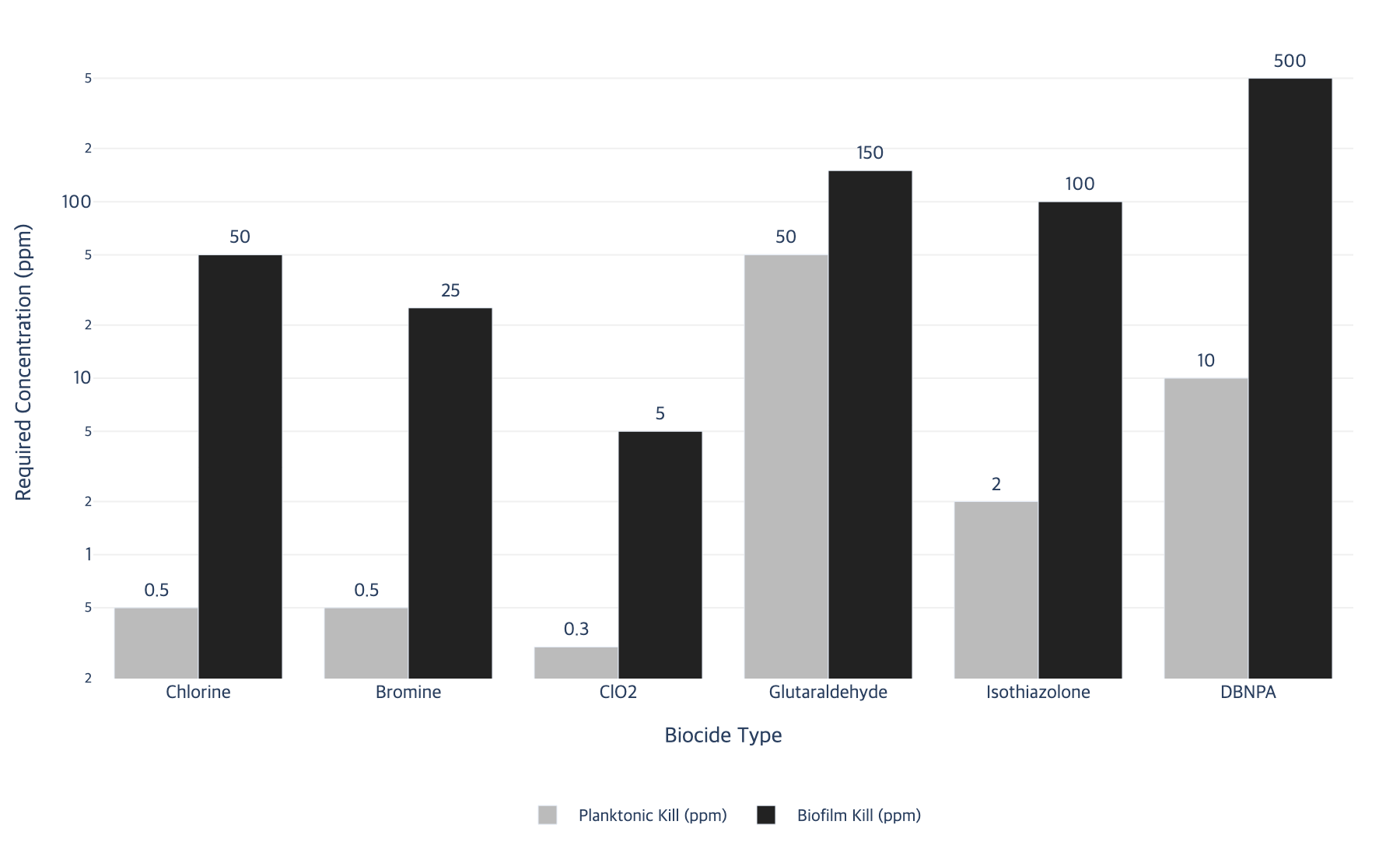
The logarithmic bar chart above dramatically illustrates the concentration gap between planktonic and biofilm kill requirements. Oxidizing biocides show the largest gap, requiring 50 to 100 times more chemical for biofilm kill compared to planktonic kill. Non-oxidizing biocides like glutaraldehyde show a narrower gap (3x), confirming their superior biofilm penetration capability.
V. How pH, Temperature, and Organic Load Affect Biocide Efficacy
Operating conditions significantly influence biocide performance, and the same biocide can show dramatically different effectiveness depending on the water chemistry and operating environment. Understanding these relationships is essential for designing treatment programs that work under actual field conditions rather than laboratory ideals.
pH Effects on Biocide Performance
pH affects oxidizing and non-oxidizing biocides through different mechanisms. For oxidizing biocides, pH determines the equilibrium between the active and inactive chemical species. Chlorine effectiveness drops by a factor of 10 between pH 7.0 and pH 8.5 due to the shift from HOCl to OCl-. Bromine shows much less pH sensitivity, maintaining over 80 percent of its activity up to pH 8.5.
For non-oxidizing biocides, pH primarily affects chemical stability rather than biocidal activity. DBNPA degrades rapidly above pH 8.0, reducing contact time and requiring higher dosing frequency. Glutaraldehyde is most stable between pH 3 and 8, with hydration and polymerization reactions reducing its activity above pH 9. Isothiazolone is relatively pH-stable between pH 6 and 9 but can be deactivated by reaction with nucleophilic compounds (amines, sulfites) that are more reactive at higher pH.
Temperature Effects
Temperature affects biocide performance through competing mechanisms. Higher temperatures increase the rate of biocidal reactions, improving kill speed. However, higher temperatures also accelerate biocide degradation, reducing the effective contact time. The net effect depends on the specific biocide.
For chlorine and bromine, temperatures above 40 degrees C increase both kill rate and decomposition rate, with the decomposition effect generally dominating above 50 degrees C. For non-oxidizing biocides, higher temperatures generally improve effectiveness up to the thermal decomposition point of the specific compound. Glutaraldehyde maintains activity up to approximately 65 degrees C, while DBNPA degrades rapidly above 40 degrees C.
Organic Load and Biocide Demand
The organic content of the water directly affects how much biocide is consumed by non-target reactions before it can reach and kill microorganisms. This biocide demand is particularly significant for oxidizing biocides, which react readily with any organic matter, not just microbial cells. High organic load from process leaks, airborne contamination, or biological growth consumes free oxidant before it can exert biocidal activity, requiring higher dosing to maintain effective residual levels.
Non-oxidizing biocides are generally less affected by organic load because they do not react indiscriminately with organic matter. However, specific contaminants can interact with non-oxidizing biocides. Sulfite-based oxygen scavengers rapidly deactivate isothiazolone. Reducing agents consume DBNPA through bromide displacement. These specific interactions must be identified and managed in the treatment program design.
Figure 3. pH Impact on Biocide Active Species Availability
pH | Chlorine (% as HOCl) | Bromine (% as HOBr) | ClO2 Activity | DBNPA Half-Life | Glutaraldehyde Stability |
|---|---|---|---|---|---|
6.0 | 97% | 100% | Full | >24 hours | Stable |
7.0 | 76% | 99% | Full | 12 hours | Stable |
7.5 | 50% | 97% | Full | 4 hours | Stable |
8.0 | 24% | 93% | Full | 2 hours | Stable |
8.5 | 10% | 83% | Full | <30 minutes | Moderate |
9.0 | 3% | 55% | Full | <10 minutes | Reduced |
This data demonstrates why system pH is the single most important variable in biocide program design. A chlorine-based program that works well at pH 7.0 may require 10 times the dosage at pH 8.5, while a bromine-based program would require only a modest increase. This pH sensitivity drives the recommendation to use bromine or ClO2 in systems operating above pH 8.0.
Figure 5. Chlorine vs Bromine Active Species Across pH Range
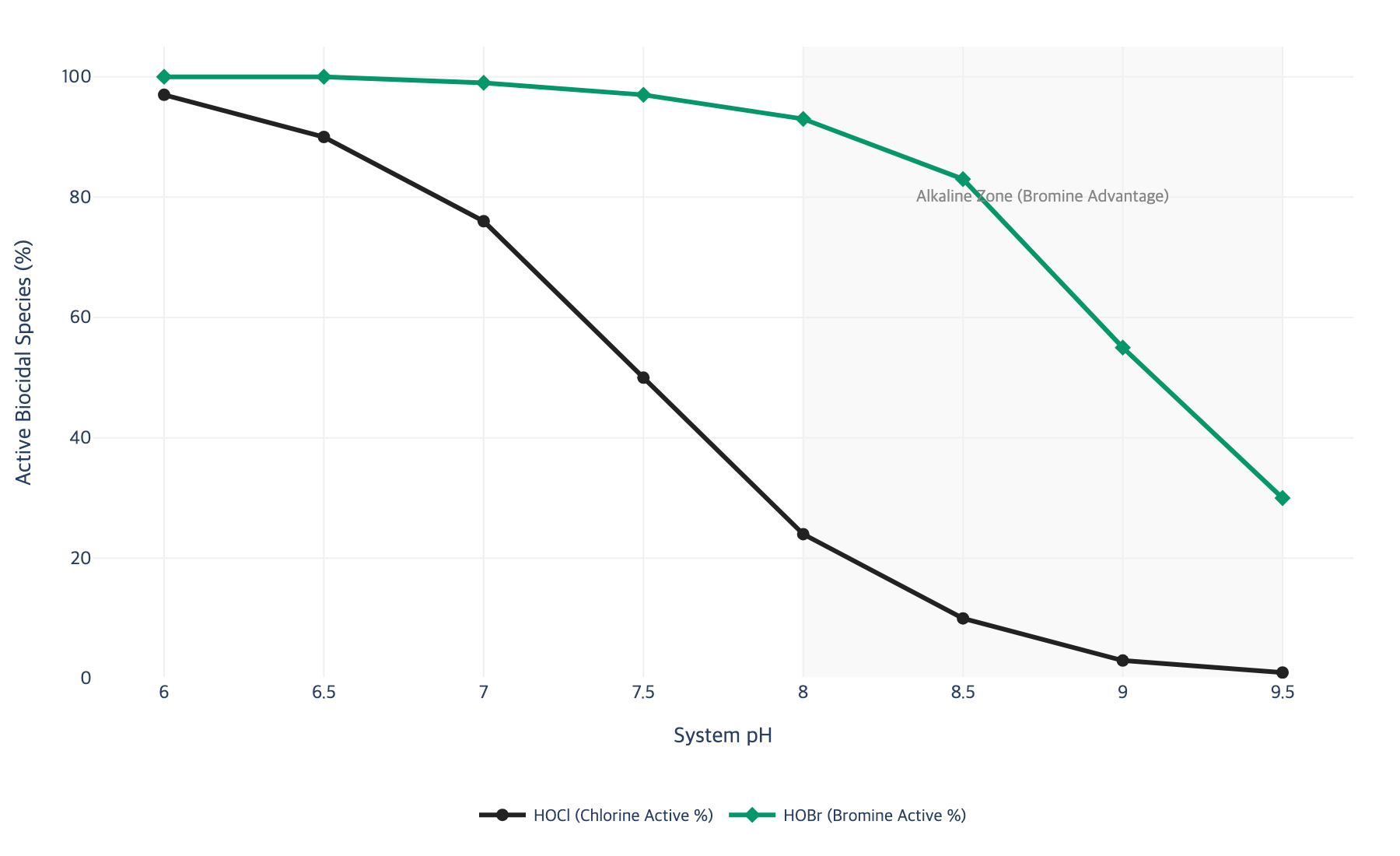
The scatter chart quantifies the divergence between chlorine and bromine effectiveness as pH increases. Below pH 7.0, both biocides maintain near-full activity. Above pH 8.0 (shaded zone), bromine retains over 80 percent active species while chlorine drops below 25 percent. This divergence is the primary technical reason why bromine-based programs dominate in alkaline cooling water systems.
VI. Biocide Selection Guide by System Type and Problem Type
Effective microbiological control requires matching the biocide mechanism to the specific system conditions and biological challenge. The following framework provides a structured approach to biocide selection that considers system type, organism type, pH conditions, and compatibility requirements.
Primary Selection by System Type
System Type | Primary Biocide | Supplemental Biocide | Dosing Strategy | Key Consideration |
|---|---|---|---|---|
Open cooling tower (pH <8.0) | Chlorine (continuous) | Glutaraldehyde (slug) | 0.3-0.5 ppm free Cl + quarterly slug | Cost-effective, pH must be controlled |
Open cooling tower (pH >8.0) | Bromine (continuous) | Isothiazolone (slug) | 0.3-0.5 ppm free Br + monthly slug | Bromine preferred at high pH |
Closed loop cooling | Isothiazolone or glutaraldehyde | None (single program) | 100-200 ppm slug at commissioning | No oxidant residual needed |
Process water (discharge) | DBNPA | None | 50-100 ppm slug as needed | Rapid degradation, low discharge impact |
Reverse osmosis membranes | DBNPA | None | 10-50 ppm periodic slug | Membrane-compatible, non-oxidizing |
Evaporative condensers | Bromine + glutaraldehyde | Biodispersant | Continuous + monthly slug | Biofilm removal critical for heat transfer |
Dual-Program Strategy: Oxidizing Plus Non-Oxidizing
The most effective microbiological control programs combine an oxidizing biocide for continuous planktonic control with periodic non-oxidizing biocide treatments for biofilm management. This dual approach addresses both the fast-reproducing planktonic population and the resistant sessile community that oxidizing biocides alone cannot adequately control.
The continuous oxidizing biocide maintains low planktonic counts, preventing new biofilm formation. The periodic non-oxidizing slug treatment penetrates and disrupts existing biofilm, releasing organisms into the bulk water where they are killed by the continuous oxidant. This synergistic approach typically achieves better overall microbiological control at lower total chemical cost than either biocide type used alone.
Integration with Other Water Treatment Chemicals
Biocide selection must consider compatibility with the complete treatment program, including scale inhibitors, corrosion inhibitors, and dispersants. Oxidizing biocides can degrade certain organic treatment chemicals, particularly phosphonate-based scale inhibitors and azole-based corrosion inhibitors (Academia, 2007). This degradation reduces the effectiveness of both the biocide (consumed by reaction with treatment chemicals) and the treatment chemical (partially destroyed by oxidation).
Non-oxidizing biocides generally show better compatibility with other treatment chemicals because they do not react indiscriminately with organic compounds. However, specific interactions must be verified. Isothiazolone can be deactivated by sulfite-based oxygen scavengers, and glutaraldehyde can react with amine-based corrosion inhibitors under certain conditions.
VII. Key Takeaway
Oxidizing biocides (chlorine, bromine, ClO2) kill through cell membrane oxidation and are most effective against planktonic bacteria, but their effectiveness is strongly influenced by pH, with bromine maintaining superior performance above pH 8.0.
Non-oxidizing biocides (glutaraldehyde, isothiazolone, DBNPA) kill through intracellular enzyme inhibition and cross-linking, offering better biofilm penetration but requiring higher dosing concentrations and specific contact times.
Biofilm organisms require 10 to 1,000 times higher biocide concentrations than planktonic bacteria, making biofilm the primary challenge in most industrial water systems and the key driver for including non-oxidizing treatments in the biocide program.
The optimal biocide program combines continuous oxidizing treatment for planktonic control with periodic non-oxidizing slug treatments for biofilm management, using the synergy between the two mechanisms for superior overall control.
System pH is the single most important variable in biocide program design, as it determines both the active species concentration of oxidizing biocides and the stability of non-oxidizing biocides.
Lubinpla's water treatment analysis module can evaluate your system conditions, current biological challenges, and treatment chemical compatibility to recommend the optimal biocide combination and dosing strategy for your specific operating environment.
VIII. References
[1] Alvim CleanTech, "Oxidizing and Non-Oxidizing Biocides", 2024. https://www.alvimcleantech.com/cms/en/about-biofilm/white-papers/oxidizing-and-non-oxidizing-biocides
[2] ChemTex, "Oxidizing Biocides: Chlorine vs Bromine", 2024. https://www.chemtexcorp.com/post/oxidizing-biocides-chlorine-vs-bromine
[3] Acepsis, "Chlorine Dioxide Questions and Answers", 2024. https://acepsis.com/wp-content/uploads/2024/02/Acepsis_ChlorineDioxde_FAQs_FactSheet_1.25.24-2.pdf
[4] ChemTreat, "Oxidizing Biocide Selection for Cooling Water Microbiological Control", 2024. https://www.chemtreat.com/oxidizing-biocide-selection-for-cooling-water-microbiological-control/
[5] PMC, "A Multi-Purpose Approach to the Mechanisms of Action of Two Biocides", 2022. https://pmc.ncbi.nlm.nih.gov/articles/PMC8894764/
[6] ResearchGate, "The Mechanism of Action of Isothiazolone Biocide", 2012. https://www.researchgate.net/publication/254546250_The_Mechanism_of_Action_of_Isothiazolone_Biocide
[7] Wikipedia, "DBNPA", 2024. https://en.wikipedia.org/wiki/DBNPA
[8] PMC, "The Control of Microbiological Problems", 2020. https://pmc.ncbi.nlm.nih.gov/articles/PMC7158184/
[9] Chem-Aqua, "Key Components of a Cooling Tower System Biocide Program", 2024. https://www.chemaqua.com/en-us/blog/2024/08/20/key-components-of-a-biocide-program/
[10] Oxford Academic, "Biofilm growth and control in cooling water industrial systems", 2018. https://academic.oup.com/femsec/article/94/5/fiy044/4935158
[11] IWA Publishing, "The application of non-oxidizing biocides to prevent biofouling in reverse osmosis membrane systems", 2022. https://iwaponline.com/aqua/article/71/2/261/86389/The-application-of-non-oxidizing-biocides-to
[12] Academia, "Degradation of Water Treatment Chemical Additives in the Presence of Oxidizing Biocides", 2007. https://www.academia.edu/3692639/Degradation_of_Water_Treatment_Chemical_Additives_in_the_Presence_of_Oxidizing_Biocides_Collateral_Damages_in_Industrial_Water_Systems
[13] Dober, "Cooling Tower Biocides", 2024. https://www.dober.com/water-treatment/cooling-tower-biocides
Powered by Lubinpla
Discover how technical teams solve complex challenges faster with AI.