Rapid Diagnosis: When Industrial Degreasing Leaves Residue or Haze on Precision Parts
Summary: Residue or haze on precision parts after degreasing is one of the most common quality rejections in metalworking, yet most troubleshooting approaches rely on trial-and-error chemical swaps rather than systematic diagnosis. This playbook provides a structured four-step diagnostic process: classify the residue type, check cleaner operating parameters, evaluate rinse water quality, and assess substrate-cleaner compatibility. Each step includes specific indicators, test methods, and corrective actions that enable engineers to identify the root cause and resolve the problem within hours rather than weeks.
Table of Contents
I. When Degreasing Creates More Problems Than It Solves
II. Step 1: Classify the Residue Type
III. Step 2: Check Cleaner Concentration, Temperature, and Bath Life
IV. Step 3: Evaluate Rinse Water Quality
V. Step 4: Assess Substrate-Cleaner Compatibility
VI. Industry Cleanliness Standards and Pass/Fail Criteria
VII. Key Takeaway
VIII. References
I. When Degreasing Creates More Problems Than It Solves
Precision parts cleaning is supposed to be a quality assurance step, not a quality risk. Yet field reports from machining, automotive components, and electronics manufacturing consistently identify post-cleaning residue or haze as a top-five cause of part rejection. The defect manifests in several ways: an oily film that transfers when touched, a white or gray haze visible under inspection lighting, water spots or mineral deposits after drying, or a sticky residue that interferes with downstream coating or bonding processes.
The Cost of Trial-and-Error Troubleshooting
When residue appears, the instinctive response is to change the cleaning chemistry. A maintenance team replaces the alkaline cleaner with a different brand. When the problem persists, they increase the concentration. When that fails, they raise the temperature. Each cycle consumes days of production time, generates chemical waste, and often introduces new variables that obscure the original root cause. This approach is expensive, time-consuming, and frequently unsuccessful because it addresses the assumed cause rather than the diagnosed cause.
A systematic diagnostic approach identifies the actual root cause first, then applies the targeted corrective action. In practice, field engineers who follow a structured diagnostic sequence resolve cleaning failures in one to three shifts, compared to the one to four weeks typically consumed by trial-and-error approaches. The playbook below follows that logic, starting with residue identification and progressing through process parameters, rinse water quality, and substrate compatibility.
II. Step 1: Classify the Residue Type
The first diagnostic step is to identify what the residue actually is. Different residue types have different causes and different solutions. Skipping this step and jumping directly to chemical changes is the single most common mistake in cleaning troubleshooting. Three broad categories cover the majority of industrial cleaning residue problems, and each category points the investigation in a distinct direction.
Organic Film (Redeposition)
Organic residue appears as a thin, sometimes invisible film that can be detected by water break test failure or by wiping the surface with a clean white cloth. The surface feels slightly oily or waxy. This type indicates that contaminants, including machining oils, coolant residues, or shop floor contaminants, were removed from the part surface during cleaning but redeposited during the process. Redeposition typically occurs from a contaminated cleaning bath where the accumulated oil load exceeds the surfactant capacity, or from inadequate rinsing where emulsified oils are carried to the part surface during the final rinse stage.
The chemical origin of organic redeposition traces back to the cleaning mechanism itself. Aqueous alkaline cleaners work by emulsifying oils through surfactant action: the hydrophobic tail of the surfactant molecule attaches to the oil droplet while the hydrophilic head faces the water phase, forming micelles that suspend the oil in solution. When the surfactant concentration falls below the critical micelle concentration (CMC), or when the oil load saturates the available micelles, the emulsion destabilizes. Free oil droplets then reattach to the nearest available surface, which is the part being cleaned. This redeposition mechanism explains why parts cleaned early in a bath cycle come out clean while parts cleaned later in the same bath show increasing residue levels.
Inorganic Haze (Mineral Deposits)
Inorganic haze appears as a white, gray, or chalky film, often with a crystalline pattern when viewed under magnification. This type indicates hard water mineral deposition from the rinse water, or precipitated cleaning agent residues from the cleaning bath itself. The haze is typically uniform across the part surface and resists removal by solvent wiping.
The chemistry behind inorganic haze involves several distinct precipitation pathways. The most common is calcium carbonate (CaCO3) deposition from hard rinse water. When water containing dissolved calcium bicarbonate evaporates from the part surface during drying, the equilibrium shifts and insoluble calcium carbonate precipitates as a white film. Magnesium hydroxide and calcium sulfate follow similar precipitation patterns. A second pathway involves silicate residues from the cleaning bath itself. Alkaline cleaners commonly contain sodium metasilicate as a corrosion inhibitor and builder. Sodium metasilicate possesses useful anticorrosive properties, but it deposits on metal surfaces as a grey-white coating when cleaning solutions exceed approximately 70 degrees Celsius or when rinse times are insufficient to remove the silicate film before it dries (Products Finishing, 2024). A third pathway involves phosphate precipitation: phosphate-based builders in the cleaner react with calcium and magnesium ions in hard water to form insoluble calcium phosphate and magnesium phosphate deposits.
Mixed Contamination
Mixed contamination shows both organic and inorganic characteristics: patchy, irregular deposits that combine oily feel with visible mineral haze. This type typically indicates multiple simultaneous issues, such as a degraded cleaning bath combined with poor rinse water quality. Mixed contamination is more common than most engineers expect. Field data suggests that roughly 30 to 40 percent of residue complaints involve both organic and inorganic components, which is why single-variable corrective actions often fail to fully resolve the problem.
The interaction between organic and inorganic contaminants creates a compounding effect. Organic films trap mineral particles against the surface, making them harder to remove in subsequent rinse stages. Mineral deposits, in turn, create nucleation sites where organic films preferentially adsorb. This synergy means that mixed contamination typically requires addressing both the cleaning bath condition and the rinse water quality simultaneously rather than sequentially.
Diagnostic Test Methods for Residue Classification
Accurate classification requires more than visual inspection. Three field-applicable test methods, used individually or in combination, enable reliable identification of the residue type within minutes.
The water break test, standardized as ASTM F22, is the fastest and most widely used method for detecting hydrophobic organic contamination. The procedure involves immersing or wetting the part surface with clean water and observing the drainage pattern. On a clean surface, water forms a continuous, unbroken sheet that drains uniformly. On a surface with organic contamination, the water film breaks into discrete droplets or streams within 1 to 2 seconds, revealing hydrophobic zones. ASTM F22 provides a go/no-go evaluation rather than a quantitative measurement, but its simplicity makes it the standard first-line screening tool in electroplating, painting, and adhesive bonding operations (ASTM International, 2021).
UV fluorescence inspection exploits the fact that many organic contaminants fluoresce when exposed to ultraviolet light at 365 nanometers wavelength. A handheld UV lamp in a darkened inspection area reveals residual oils, fingerprints, and machining fluid traces as glowing spots or films. The detection limit for most organic species is in the range of 1 to 10 milligrams per square meter, corresponding to a layer thickness of only a few nanometers (Fraunhofer IPM, 2024). UV fluorescence is particularly useful for mapping the distribution pattern of contamination across the part surface, which provides diagnostic clues about the contamination source. Concentrated residue at drain points suggests rinse water minerals, while uniform fluorescence across the surface suggests bath contamination. One important limitation to note: certain lubricant types, including perfluorinated lubricants and some unconjugated waxes, do not fluoresce under UV and require alternative detection methods.
Gravimetric analysis, specifically nonvolatile residue (NVR) measurement, provides a quantitative determination of total surface contamination. The method involves rinsing the part surface with a known volume of high-purity solvent, evaporating the solvent in a tared vessel, and weighing the residue on an analytical balance with microgram resolution. The result, expressed in milligrams per square meter or micrograms per square centimeter, enables direct comparison against specification limits. ASTM F331 and IEST-STD-CC1246E both reference gravimetric NVR determination as a standard cleanliness verification method (Precision Companies, 2024). The measurement requires laboratory equipment and takes 30 to 60 minutes to complete, so it serves as a confirmation or specification-compliance tool rather than a line-side screening method.
Figure 1. Residue Cause Distribution by Type
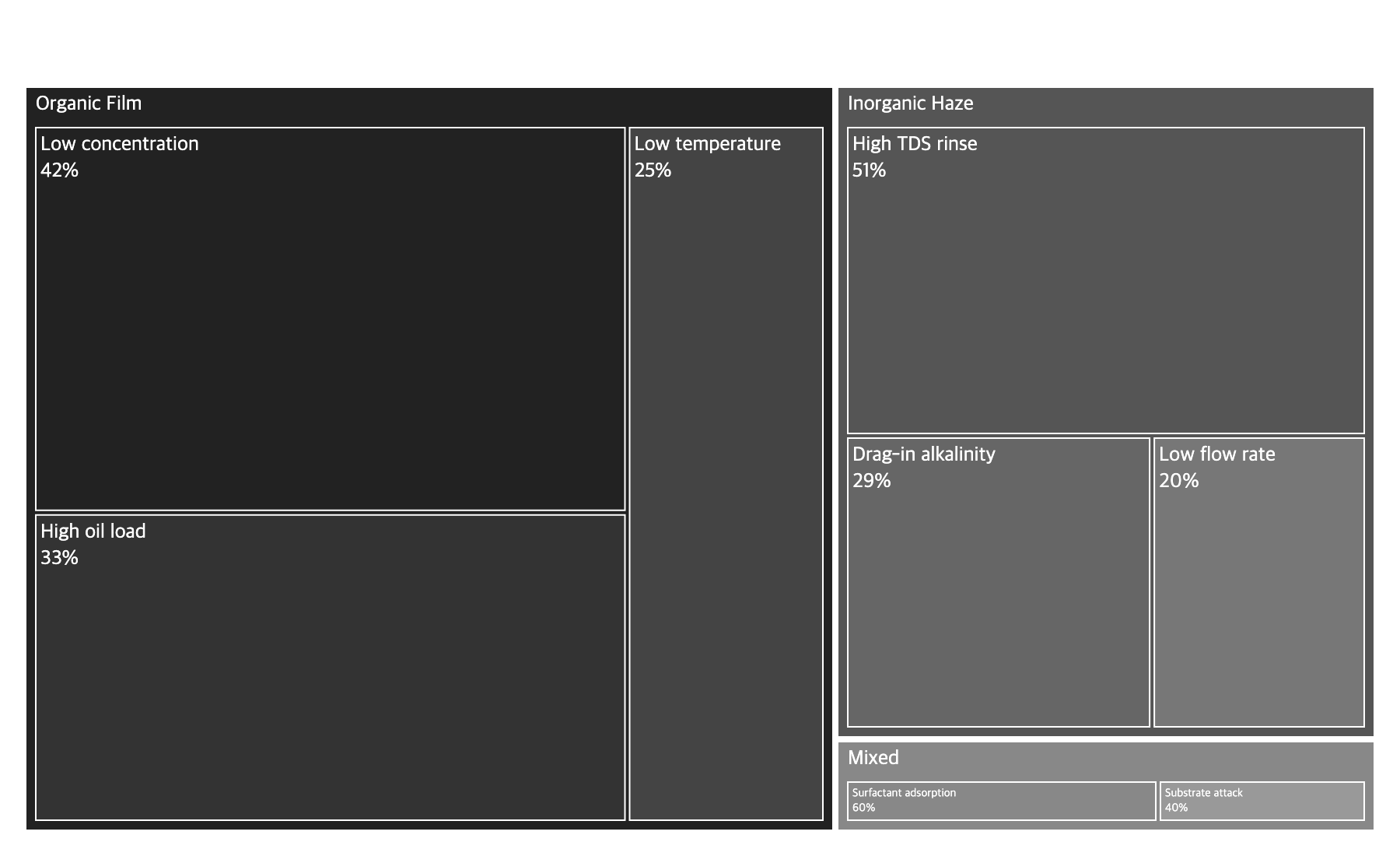
The treemap above illustrates the relative frequency of different residue root causes as observed in industrial cleaning operations. Bath contamination and rinse water quality together account for the majority of cases, reinforcing the importance of checking these variables before changing cleaning chemistry.
Figure 1b. Residue Classification Decision Tree
Observation | Test Method | If Positive | Likely Residue Type |
|---|---|---|---|
Surface feels oily or waxy | White cloth wipe test | Oil transfers to cloth | Organic (redeposition) |
Water beads on surface | Water break test (ASTM F22) | Water does not sheet evenly | Organic film present |
White/gray chalky film | Acid wipe (5% vinegar) | Film dissolves with fizzing | Inorganic (carbonate) |
White film, no fizzing with acid | Warm water soak at 60C | Film dissolves slowly | Inorganic (silicate) |
Film resists both | Solvent wipe (IPA) then acid | Partial removal by each | Mixed contamination |
Spots only at drain points | Visual pattern analysis | Residue follows gravity | Rinse water minerals |
Uniform fluorescence under UV | UV lamp at 365 nm | Entire surface glows | Bath-sourced organic film |
Start with the water break test. If water sheets evenly across the entire surface, organic contamination is unlikely and the investigation moves to inorganic or mineral causes. If water beads or breaks, organic contamination is present and the investigation focuses on cleaning bath effectiveness and rinse adequacy. The acid wipe test distinguishes between carbonate-type deposits, which dissolve with visible effervescence, and silicate-type deposits, which are acid-resistant but dissolve slowly in warm water.
III. Step 2: Check Cleaner Concentration, Temperature, and Bath Life
If the residue is classified as organic (redeposition), the cleaning bath is the primary investigation target. Three interrelated parameters govern the cleaning effectiveness of an aqueous alkaline degreasing bath: surfactant concentration relative to the critical micelle concentration, bath temperature within the effective cleaning window, and accumulated oil loading relative to the surfactant capacity. All three must be within specification simultaneously for effective cleaning.
Concentration Check
Alkaline cleaners lose concentration through drag-out (solution carried away on parts), evaporation, and chemical consumption. A cleaner formulated to operate at 5 percent concentration may drop to 2 percent over two weeks of continuous use, falling below the critical micelle concentration where surfactants can no longer effectively emulsify oils.
The critical micelle concentration is the threshold surfactant concentration above which micelles form spontaneously in solution. Below the CMC, surfactant molecules exist individually at the solution surface and cannot form the organized structures needed to encapsulate and suspend oil droplets. Industrial cleaning formulations are designed to operate well above the CMC to provide a safety margin, but as concentration drops through normal use, the working concentration can approach and eventually fall below this threshold. The relationship between concentration and cleaning performance is not linear: cleaning effectiveness remains relatively stable across a range above the CMC, then drops sharply once the CMC boundary is crossed. This threshold behavior explains why a bath can seem to work fine one day and produce residue the next, even though the concentration decline has been gradual.
Titration testing confirms the actual concentration. For alkaline cleaners, free alkalinity titration using a standard acid titrant (typically 0.1N hydrochloric acid or sulfuric acid) with a phenolphthalein endpoint provides the most common field measurement. The titration result, expressed in points or milliliters of titrant consumed, is compared against the cleaner manufacturer's specification chart to determine the effective concentration. If below specification, replenishment is the corrective action. Automated titration controllers that continuously monitor alkalinity and trigger chemical dosing pumps are available for high-volume applications and eliminate the concentration drift that causes intermittent residue problems.
Temperature Check
Cleaning effectiveness is strongly temperature-dependent. Most aqueous alkaline cleaners operate in a window of 50 to 65 degrees Celsius. Below the minimum, surfactant activity drops and oil emulsification is incomplete. The temperature dependence of CMC follows a non-linear pattern: CMC initially decreases as temperature rises (favoring micelle formation), reaches a minimum, then begins increasing at higher temperatures (Wikipedia, Critical Micelle Concentration). This behavior means there is an optimal temperature band for each formulation, not simply a "hotter is better" rule.
Above the maximum effective temperature, multiple problems emerge. Flash evaporation deposits surfactant residues on parts as the thin film of cleaning solution on the part surface evaporates faster than it can drain. Some cleaner components, particularly nonionic surfactants, exhibit cloud point behavior where they lose solubility and precipitate out of solution above a characteristic temperature. Silicate builders become increasingly prone to forming insoluble deposits above 70 degrees Celsius. Thermal decomposition of organic additives can generate breakdown products that themselves become contaminants.
Verify the actual bath temperature at the part immersion zone, not just the heater setpoint. Temperature stratification in large cleaning tanks is common: the temperature near the heating elements may be 10 to 15 degrees Celsius higher than the temperature at the part rack position, particularly in still baths without mechanical agitation. A calibrated thermocouple measurement at the actual cleaning zone, taken during a production cycle while parts and baskets are displacing solution, provides the operationally relevant temperature value.
Bath Life and Oil Loading
Every cleaning bath has a finite oil loading capacity. As accumulated oil concentration increases, the cleaning solution's ability to emulsify additional oil decreases. A bath that effectively cleaned parts on day one may leave residue on day fourteen because the accumulated oil load has exceeded the surfactant capacity.
The oil loading capacity of a cleaning bath depends on the surfactant type, concentration, temperature, and the degree of mechanical agitation. As a general guideline, most industrial alkaline cleaners begin to show reduced performance when the accumulated oil content exceeds 2 to 5 percent by volume of the bath. At higher oil loads, the emulsion may invert or break, releasing free oil that floats on the bath surface or redeposits on parts. Visual indicators of excessive oil loading include a persistent oil sheen on the bath surface, increased foaming, darkening of the solution color, and a rancid or sour odor from biological degradation of the accumulated organic material.
Oil skimming, coalescence filtration, and scheduled bath changes are the preventive measures. Oil skimming, either by belt skimmer, disk skimmer, or weir-type overflow, continuously removes free oil from the bath surface before it can redeposit on parts. Coalescence filtration passes the cleaning solution through media that causes emulsified oil droplets to merge into larger droplets that can then be separated by gravity. These oil removal systems extend bath life by a factor of 3 to 10 compared to unmanaged baths, depending on the incoming oil load and the removal efficiency.
Track bath oil loading by monitoring the cleaner's free alkalinity or surfactant activity over time. A declining free alkalinity reading at constant chemical replenishment indicates that the builder components are being consumed by reaction with incoming contaminants. Plotting alkalinity over time creates a bath degradation curve that enables predictive scheduling of bath changes rather than reactive changes after residue complaints.
IV. Step 3: Evaluate Rinse Water Quality
If the residue is classified as inorganic (mineral deposits), the rinse water is the primary suspect. Rinse water quality is often the most overlooked variable in precision cleaning processes, partly because it is the simplest step conceptually and partly because rinse water does not contain expensive chemicals. Yet rinse water is the last liquid to contact the part surface before drying, which means any contaminants in the rinse water are the contaminants that remain on the finished part.
Dissolved Solids and Water Hardness
Municipal water supplies contain dissolved minerals including calcium, magnesium, silica, and chlorides. The concentration of these minerals varies widely by geographic region: water supplies in limestone-rich areas commonly exceed 300 ppm total dissolved solids (TDS), while surface water supplies in granite regions may measure below 50 ppm. When rinse water evaporates from the part surface during drying, these minerals are deposited as a visible haze. The severity depends on the total dissolved solids concentration and the specific mineral composition.
Water with TDS above 200 ppm frequently causes visible mineral deposits on precision parts. For general industrial cleaning, rinse water with TDS below 100 ppm is acceptable. For precision applications such as optical components, medical devices, and electronics, deionized (DI) water with TDS below 10 ppm is required for the final rinse stage. For the most demanding aerospace and semiconductor applications, ultrapure water with resistivity of 18.2 megohm-cm (corresponding to TDS below 0.1 ppm) is specified (Best Technology, 2024).
Water hardness, expressed as the equivalent concentration of calcium carbonate, is a specific subset of TDS that directly predicts mineral deposit formation. Water is classified as soft below 60 ppm CaCO3, moderately hard from 60 to 120 ppm, hard from 120 to 180 ppm, and very hard above 180 ppm. At hardness levels above 120 ppm, visible water spots and mineral haze become increasingly likely on parts that are air-dried rather than blown dry or vacuum-dried.
Rinse Water pH and Chemical Drag-In
Rinse water pH affects both mineral solubility and substrate reactivity. If alkaline cleaning solution is carried over into the rinse tank (drag-in), the rinse water pH rises, which can precipitate dissolved minerals and create a combined organic-inorganic residue. Calcium carbonate solubility decreases sharply as pH increases above 8.0, meaning that alkaline drag-in simultaneously introduces cleaner residues and causes mineral precipitation from the rinse water itself. This double mechanism explains why rinse-related residue problems often appear suddenly after process changes that increase drag-in, such as faster conveyor speeds, reduced drain times, or increased cleaner concentration.
Monitor rinse water pH daily. It should remain within 1 pH unit of the incoming water supply. If the rinse water pH consistently rises above 8.5, increase the rinse water flow rate to dilute the drag-in, extend the drain time between the cleaning and rinsing stages, or install a conductivity-controlled dump-and-fill system that automatically refreshes the rinse tank when contamination levels exceed a setpoint.
Silicate drag-in deserves special attention. Sodium metasilicate from the cleaning bath forms a tenacious, glassy film on metal surfaces that becomes increasingly difficult to remove as it dries. Unlike carbonate deposits, silicate films are resistant to acid cleaning and may require alkaline or fluoride-based removal agents. Preventing silicate residue through adequate rinsing is far more effective than removing it after the fact.
Flow Rate and Renewal
Stagnant rinse water accumulates both cleaning solution drag-in and dissolved minerals. Counter-flow rinsing, where fresh water enters at the final rinse stage and cascades backward through intermediate stages, maintains rinse water quality at the critical final contact point while conserving water. A properly designed counter-flow rinse system uses 60 to 80 percent less water than a single-stage overflow rinse while maintaining better final rinse quality.
The minimum effective flow rate depends on the drag-in volume (determined by part geometry, rack density, and drain time), the incoming water TDS, and the required final rinse quality. A useful rule of thumb is that the rinse water volume turnover should be at least 3 to 5 times the drag-in volume per hour to maintain acceptable dilution. Insufficient flow rate is a common but easily correctable cause of rinse-related residue.
Rinse Stage Configuration
The number of rinse stages has a dramatic effect on final rinse quality. Each additional rinse stage reduces the carryover contamination by a factor of approximately 10 to 100, depending on the drag-out ratio. A single rinse stage after alkaline cleaning may leave 1 to 5 percent of the cleaner concentration on the part surface. A two-stage counter-flow rinse reduces this to 0.01 to 0.05 percent. A three-stage system achieves 0.001 percent or better.
For precision cleaning applications, a minimum of two rinse stages is standard practice, with the final stage using deionized water. Many automotive and aerospace specifications require three rinse stages. The cost of adding rinse stages is modest compared to the cost of residue-related rejections, particularly when counter-flow configuration minimizes water consumption.
Figure 2. Rinse Water Quality Impact on Surface Residue
Rinse Water TDS (ppm) | Application Suitability | Typical Residue Outcome |
|---|---|---|
Above 500 | General machine washing only | Heavy mineral deposits, visible spots |
200 to 500 | Non-critical industrial parts | Light to moderate mineral haze |
100 to 200 | Standard industrial cleaning | Occasional spots at drain points |
10 to 100 | Precision industrial parts | Minimal residue if properly dried |
1 to 10 | DI water, precision applications | No visible mineral residue |
Below 1 | Ultrapure, aerospace/semiconductor | Meets stringent NVR specifications |
This table provides general guidelines. The actual residue outcome depends on the interaction between TDS level, drying method, part geometry (which affects water retention in recesses), and the specific mineral composition of the water supply.
V. Step 4: Assess Substrate-Cleaner Compatibility
If the residue persists after addressing cleaner parameters and rinse water quality, the issue may be a fundamental incompatibility between the cleaning chemistry and the substrate material. This category accounts for a smaller fraction of total residue complaints but is the most difficult to resolve through parameter adjustment alone, because it requires changing the cleaning chemistry rather than optimizing operating conditions.
Surface Energy Changes
Some cleaning chemistries alter the substrate surface energy in ways that affect wettability and downstream processes. Surfactants, by design, are surface-active molecules that preferentially adsorb at interfaces. While most surfactant molecules desorb during rinsing, certain surfactant types form tenacious bonds with specific metal surfaces that resist removal.
For example, cationic surfactants can electrostatically bond to negatively charged metal oxide surfaces, creating a hydrophobic monolayer that causes water break test failure even on an otherwise clean surface. Nonionic surfactants with long-chain ethoxylate groups can physically entangle with surface oxide structures, particularly on aluminum and titanium, creating an adsorbed layer that requires extended rinsing or elevated rinse temperatures to remove. If the water break test fails consistently despite verified cleaner concentration and rinse quality, surfactant adsorption is a likely cause. Switching to a cleaner with a different surfactant system (nonionic to anionic, or vice versa) resolves this type of residue.
Passivation Layer Effects
On stainless steel, aluminum, and titanium, the natural passive oxide layer interacts with cleaning chemistry in substrate-specific ways. Alkaline cleaners can partially dissolve the passive layer on aluminum, leaving a reactive surface that oxidizes rapidly and appears as haze. This is a particularly common issue with 6xxx series aluminum alloys (Al-Mg-Si), where the magnesium component of the alloy is preferentially dissolved by alkaline solutions at pH above 10, leaving an enriched silicon surface that appears as a dark smut or haze.
Acidic cleaners can attack copper alloys, causing surface tarnishing that mimics organic residue. On stainless steel, highly oxidizing cleaners can alter the chromium-to-iron ratio in the passive layer, affecting its protective properties and surface appearance. Understanding these substrate-specific reactions requires knowledge of both the alloy metallurgy and the cleaner chemistry. The residue in these cases is not a deposited contaminant but a modification of the substrate surface itself, which is why wiping tests and solvent cleaning fail to remove it.
Material-Specific Cleaning Windows
Each substrate material has an optimal cleaning chemistry window defined by pH, temperature, and maximum exposure time. Operating outside this window creates surface damage that manifests as haze, discoloration, or pitting, all of which may be mistaken for simple residue but actually represent substrate attack.
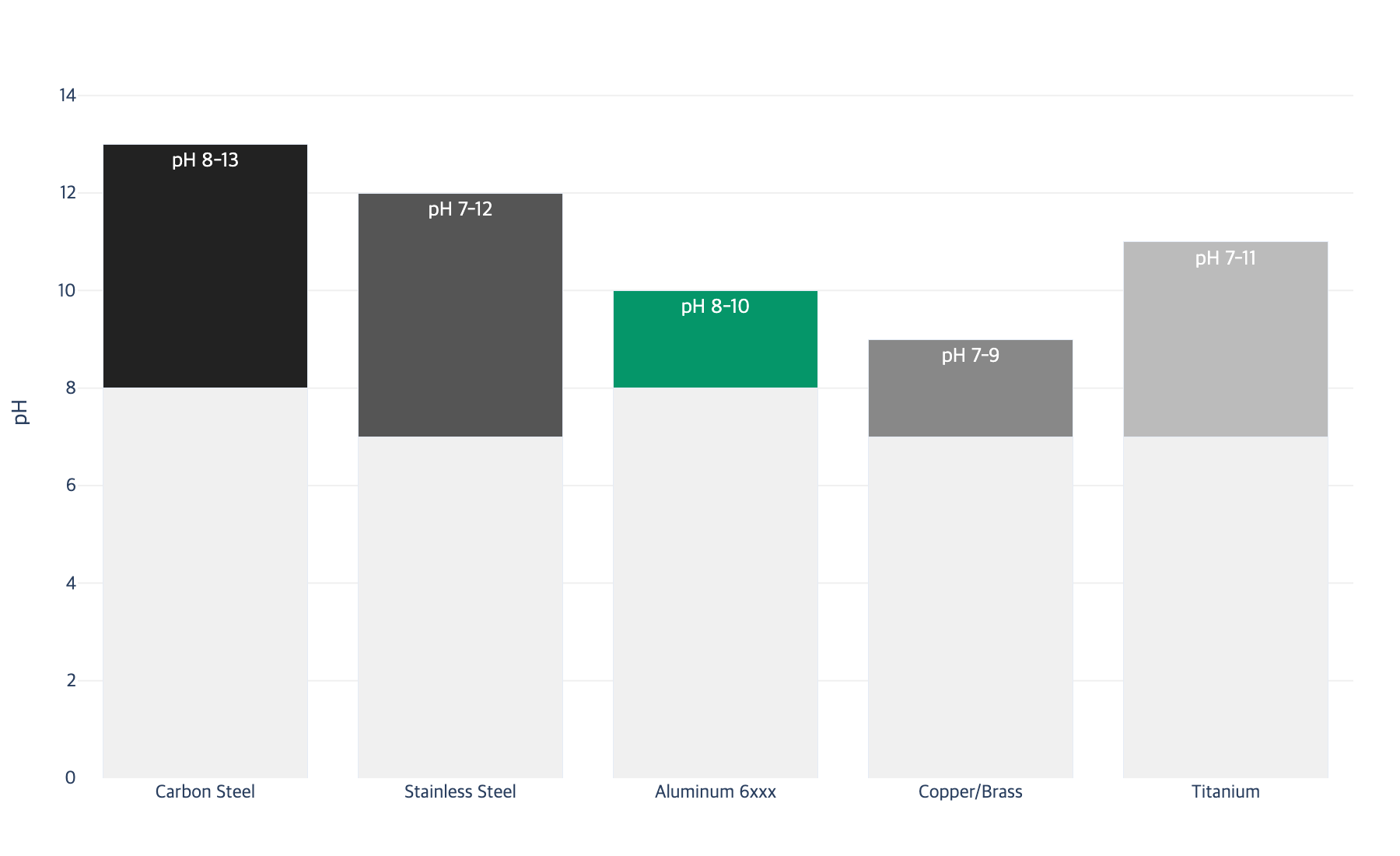
Figure 3. Substrate Safe pH Cleaning Ranges
Substrate | Safe pH Range | Maximum Temperature | Maximum Dwell | Key Sensitivity |
|---|---|---|---|---|
Carbon steel | 8-13 | 70C | 15 min | Minimal. Tolerates strong alkaline cleaners |
Stainless steel | 7-12 | 65C | 10 min | Chloride-containing cleaners cause pitting |
Aluminum (6xxx) | 8-10 | 55C | 5 min | Dissolves above pH 10 and below pH 4 |
Copper/Brass | 7-9 | 50C | 5 min | Tarnishes with oxidizing or ammonia-based cleaners |
Titanium | 7-11 | 60C | 10 min | Hydrogen embrittlement from strong acid exposure |
Zinc/Galvanized | 8-11 | 50C | 3 min | Dissolves rapidly below pH 5 and above pH 12 |
This table provides starting-point guidelines. Actual limits depend on the specific alloy grade, cleaner formulation, and cleanliness requirements. When operating near the boundary of a material's safe cleaning window, small process variations, such as a 5-degree temperature spike or a pH drift of 0.5 units, can cross the threshold from effective cleaning into surface attack. This is why materials with narrow safe windows, particularly aluminum and copper alloys, generate a disproportionate share of cleaning-related quality complaints.
Temperature and Concentration Optimization Strategy
Optimizing cleaning parameters requires balancing effectiveness against the risk of residue formation and substrate damage. The optimal operating point for any cleaning process sits within the overlap zone of three constraints: sufficient chemical activity to remove the target contaminants, temperatures within the substrate's safe range, and concentrations that do not generate cleaner-derived residues.
A practical optimization approach starts with the cleaner manufacturer's recommended operating window and then narrows it based on substrate sensitivity and the specific contaminant profile. For mixed-metal operations where aluminum and steel parts share the same cleaning line, the cleaning parameters must respect the most restrictive material (aluminum), which often means operating at pH 9 to 10 and temperature below 55 degrees Celsius. Verify the optimized parameters by running test coupons of each substrate material through the cleaning process and evaluating them with water break test, UV fluorescence, and visual inspection before committing to production runs.
VI. Industry Cleanliness Standards and Pass/Fail Criteria
Different industries define cleanliness requirements through different standards, and understanding which standard applies to a given application determines the inspection methods, acceptance criteria, and documentation requirements. Two dominant standards frameworks govern most industrial cleaning operations: VDA 19/ISO 16232 for automotive applications and IEST-STD-CC1246E for aerospace and defense applications.
Automotive: VDA 19 and ISO 16232
VDA 19, published by the German Association of the Automotive Industry (Verband der Automobilindustrie) in 2004, established a standardized methodology for measuring and specifying the particulate cleanliness of automotive components. ISO 16232, the corresponding international standard, covers the same framework and methods. These standards are now mandatory across the global automotive supply chain for components in fluid-carrying systems such as fuel injectors, brake hydraulics, transmission valve bodies, and turbocharger oil circuits (QA Group, 2024).
VDA 19/ISO 16232 specifies a cleanliness code that defines the maximum allowable number of particles in each size class. The method involves extracting particles from the component surface using a standardized procedure (pressure rinsing, ultrasonic cleaning, or agitation), filtering the extract through a membrane filter, and analyzing the particles by optical or electron microscopy. Particles are classified by size, typically in bins from 5 micrometers up to 1000 micrometers or larger, and counted. The cleanliness code expresses the maximum particle count per size bin as a letter-number combination.
For field engineers working with automotive cleaning processes, the practical implication is that particulate contamination below 100 micrometers is invisible to the naked eye but can cause catastrophic failures in hydraulic valves and fuel injection systems. Cleaning processes that produce visually acceptable parts may still fail VDA 19 inspection. This is why automotive cleanliness verification requires formal extraction and microscopy procedures rather than visual inspection alone.
Aerospace: IEST-STD-CC1246E
IEST-STD-CC1246E (formerly MIL-STD-1246C, which it replaced in 2002) defines cleanliness levels for contamination-critical aerospace, defense, and spacecraft hardware. The standard specifies both particulate cleanliness levels and nonvolatile residue (NVR) levels, providing a comprehensive framework for surface contamination control (IEST, 2013).
Particulate cleanliness levels under IEST-STD-CC1246E are classified by a single number that defines an allowable distribution of particle sizes. Lower numbers indicate stricter cleanliness. For example, a Level 100 specification permits significantly more particles than a Level 50 specification. NVR levels are designated separately using letter-number codes, with the NVR limit specified in milligrams per unit area. A typical specification for precision-cleaned aerospace hardware might read "Level 50, R1E," meaning the particulate cleanliness must meet Level 50 and the nonvolatile residue must not exceed 1 milligram per 0.1 square meter of surface area.
The verification methods under IEST-STD-CC1246E include solvent rinse extraction with particle counting, gravimetric NVR determination (as described in Section II), and optionally UV fluorescence inspection for organic contaminants. Aerospace precision cleaning facilities typically operate under controlled environmental conditions with filtered air, DI water systems, and documented cleaning procedures validated against these specification levels.
General Industrial Standards
Beyond automotive and aerospace, several other standards define cleanliness requirements for specific applications. ISO 12103 specifies test dust compositions for filter testing. ASTM F22, discussed earlier, provides the water break test methodology. ASTM B322 covers cleaning of metals prior to electroplating. ASTM G93 addresses cleaning of equipment for oxygen service, where hydrocarbon contamination presents an ignition hazard.
For plant maintenance professionals, the key insight is that the applicable cleanliness standard determines not only the pass/fail criteria but also the required inspection method. A process that passes visual inspection may fail water break testing. A process that passes water break testing may fail gravimetric NVR analysis. Matching the inspection method to the actual specification requirement avoids both false acceptance (shipping contaminated parts) and false rejection (scrapping parts that meet specification).
Figure 4. Industry Cleanliness Requirements Comparison
Industry | Governing Standard | Key Metric | Typical Requirement | Inspection Method |
|---|---|---|---|---|
Automotive (hydraulic) | VDA 19 / ISO 16232 | Particle count by size | Max particles per size bin per component | Extraction + microscopy |
Aerospace (general) | IEST-STD-CC1246E | Particle + NVR level | Level 100-300, NVR R1E-R1C | Rinse + gravimetric |
Aerospace (oxygen service) | ASTM G93 | NVR concentration | Below 1 mg per 0.1 m2 | Solvent rinse + gravimetric |
Electroplating prep | ASTM B322 | Surface wettability | Water break free | ASTM F22 water break test |
Medical devices | ISO 19227 | Bioburden + residue | Process-validated cleanliness | Multiple methods |
Electronics (PCB) | IPC-CH-65 | Ionic contamination | Below 1.56 micrograms NaCl eq per cm2 | ROSE test or ion chromatography |
Each standard reflects the failure modes that matter most in its industry. Automotive standards focus on hard particles that can jam valves. Aerospace standards include NVR because organic films can outgas in vacuum or ignite in oxygen systems. Electronics standards emphasize ionic contamination because dissolved salts cause electrochemical migration and short circuits.
VII. Key Takeaway
Always classify the residue type before changing chemistry: organic (redeposition), inorganic (mineral deposits), or mixed contamination, each requiring different corrective actions
Use the water break test (ASTM F22) as the first-line screening tool, supplemented by UV fluorescence and gravimetric NVR analysis when quantitative data is needed
The three most common causes of organic residue are cleaner concentration below the critical micelle concentration threshold, bath temperature outside the effective range, and oil loading exceeding surfactant capacity
Inorganic haze is almost always a rinse water quality issue: check TDS, pH, and flow rate before investigating cleaner chemistry, and consider adding a DI water final rinse stage for precision applications
Substrate-cleaner incompatibility should be investigated last, after process parameters and rinse quality are confirmed within specification, but it is the most likely cause when aluminum, copper, or zinc alloys are involved
Match your inspection method to the applicable industry standard: VDA 19/ISO 16232 for automotive, IEST-STD-CC1246E for aerospace, ASTM F22 for electroplating preparation
Implement routine monitoring of cleaner concentration (titration), rinse water TDS, and bath oil loading to prevent residue problems before they cause part rejections
The diagnostic sequence in this playbook, classify, check bath, check rinse, check compatibility, resolves the vast majority of cleaning residue problems. But in a production environment running multiple substrates, multiple cleaner formulations, and varying contamination loads, the number of interacting variables can overwhelm manual analysis. A single cleaning line processing six alloy types with three cleaner products generates eighteen substrate-cleaner combinations, each with its own optimal temperature, concentration, and pH window. Add rinse water variability, seasonal temperature changes, and production volume fluctuations, and the optimization problem becomes genuinely complex. This is the domain where AI-powered process optimization creates the most value: continuously monitoring all relevant parameters, detecting drift patterns before they cause rejections, and recommending targeted corrective actions based on the specific combination of conditions at that moment. The question is no longer whether your cleaning process can be optimized, but how much rejection cost and chemical waste you are accepting by not optimizing it systematically.
VIII. References
[1] Ecolink, "Precision Cleaning of Parts: Common Mistakes to Avoid", 2024. https://ecolink.com/info/precision-cleaning-of-parts/
[2] Reliance Specialty Products, "Industrial Parts Washing: Cleaning Machined Metal Parts", 2024. https://relspec.com/vapor-degreasing-blog/industrial-parts-cleaning
[3] Hogge Precision Parts, "What You Need to Know About Cleaning Precision Machined Parts", 2024. https://www.hoggeprecision.com/what-you-need-to-know-about-cleaning-precision-machined-parts/
[4] Products Finishing, "Alkaline Cleaning Guide", 2024. https://www.pfonline.com/articles/alkaline-cleaning-guide
[5] Pillen, "The Importance of Degreasing and Cleaning Precision Machined Components", 2024. https://www.pillen.eu/en/news/the-importance-of-post-processing-degreasing-and-cleaning-precision-machined-components-2/
[6] ASTM International, "F22-21 Standard Test Method for Hydrophobic Surface Films by the Water-Break Test", 2021. https://www.astm.org/Standards/F22.htm
[7] Fraunhofer IPM, "Cleanliness Inspection", 2024. https://www.ipm.fraunhofer.de/en/bu/production-control-inline-measurement-techniques/applications/cleanliness-inspection.html
[8] Precision Companies, "Cleanliness Verification and Validation Through Measurement of Particulate Contamination and Nonvolatile Residue", 2024. https://www.precgroup.com/cleanliness-verification-and-validation-through-measurement-of-particulate-contamination-and-nonvolatile-residue/
[9] QA Group, "VDA 19.1 and ISO 16232: Standards for Technical Cleanliness Verification", 2024. https://www.qa-group.com/en/glossary/vda-19-1-iso-16232/
[10] IEST, "IEST-STD-CC1246E: Product Cleanliness Levels, Applications, Requirements, and Determination", 2013. https://www.iest.org/Standards-RPs/Recommended-Practices/IEST-STD-CC1246
[11] Best Technology, "Total Dissolved Solids (TDS) in Water for Parts Cleaning", 2024. https://www.besttechnologyinc.com/ultrasonic-cleaning-systems/total-dissolved-solids-tds-water-parts-cleaning/
[12] Products Finishing, "VDA 19 and Its Impact on European Manufacturing and Cleaning", 2024. https://www.pfonline.com/articles/vda-19-and-its-impact-on-european-manufacturing-and-cleaning
[13] Products Finishing, "Aluminum Surface Finishing Corrosion Causes and Troubleshooting", 2024. https://www.pfonline.com/articles/aluminum-surface-finishing-corrosion-causes-and-troubleshooting
[14] Astro Pak, "Precision Cleaning Standards: IEST-STD-CC1246, MIL STD 1246, CGA G-4.1", 2024. https://astropak.com/precision-cleaning-standards/
[15] Wikipedia, "Critical Micelle Concentration", 2024. https://en.wikipedia.org/wiki/Critical_micelle_concentration
Powered by Lubinpla
Discover how technical teams solve complex challenges faster with AI.