Reducing Cleaning Cycle Time Without Compromising Cleanliness
Summary: Most industrial cleaning processes run with excessive safety margins, cycle times set during initial qualification and never re-optimized for current conditions. This article presents a systematic method for reducing cleaning cycle time by 20 to 40 percent using the Sinner Circle framework, where adjusting temperature, chemistry, or mechanical action compensates for reduced time while maintaining cleanliness standards. By applying cleanliness verification at each optimization step, technical teams can increase throughput without quality risk. The approach is grounded in chemical mechanism understanding and validated through field-proven measurement methods. Whether the cleaning step is aqueous spray, ultrasonic, or clean-in-place, the same four-variable logic applies, and the optimization protocol can be executed with existing equipment and minimal capital investment.
Table of Contents
I. The Hidden Cost of Over-Cleaning
II. The Sinner Circle: Understanding the Four-Variable Balance
III. How Each Variable Affects Cleaning at the Chemical Level
IV. Systematic Cycle Time Reduction Framework
V. Cleanliness Verification Methods
VI. Field Cases: Optimization in Practice
VII. Key Takeaway
VIII. References
I. The Hidden Cost of Over-Cleaning
A precision metal parts manufacturer runs a 12-minute aqueous cleaning cycle before surface treatment. The cycle time was established during process qualification three years ago, when the product mix included heavily contaminated machined parts. Today, 70 percent of throughput consists of lightly oiled stamped components, yet the same 12-minute cycle runs for every part. The cleaning station has become the production bottleneck.
This scenario is common across industrial manufacturing. Cleaning processes tend to be qualified once and left unchanged, even as product mixes shift and chemistry formulations improve. The result is systematic over-cleaning, where time, energy, and chemistry are consumed far beyond what is necessary. The world's 500 largest companies lose approximately USD 1.4 trillion annually through production interruptions, with cleaning-related bottlenecks contributing to throughput constraints in process-intensive industries (Siemens, 2024). The global industrial cleaning products market, valued at approximately USD 145.9 billion in 2024, reflects the scale at which cleaning chemistry is consumed across manufacturing sectors (GM Insights, 2024).
The cost of over-cleaning extends beyond wasted cycle time. Excessive exposure to cleaning chemistry can damage sensitive substrates, accelerate equipment wear, and increase wastewater treatment load. Each of these effects carries a measurable cost that compounds over thousands of production cycles per year. Extended soak times in alkaline baths can etch aluminum surfaces, reducing dimensional tolerances on precision components. Prolonged spray exposure wears nozzle tips and pump seals, shortening maintenance intervals. Higher chemical consumption means more spent bath solution to treat and discharge, adding to environmental compliance costs.
Why Cycle Times Rarely Get Re-Optimized
The primary reason is risk aversion. The cleaning process sits between manufacturing and quality-critical downstream steps such as coating, bonding, or assembly. Any cleanliness failure at this stage causes expensive rework or, worse, field failures that trace back to contamination. Engineers who qualified the original process built in safety margins, and subsequent operators inherit those margins without questioning them. In many facilities, the person who set the original parameters has moved to a different role or left the company entirely, and the institutional memory of why specific cycle times were chosen has been lost.
A second factor is the absence of routine cleanliness measurement. Without quantitative feedback on how clean parts actually are after each cycle, there is no data to support a reduction. Operators see "parts come out looking clean" and have no reason to change anything. The gap between actual cleanliness achieved and the cleanliness specification required is invisible, and that invisible gap represents recoverable throughput.
Without a systematic framework for adjusting parameters and verifying results, optimization feels like guesswork. The Sinner Circle provides exactly this framework, transforming cycle time reduction from an uncertain experiment into a structured engineering exercise.
II. The Sinner Circle: Understanding the Four-Variable Balance
The Sinner Circle, developed by German chemist Herbert Sinner in 1959 at Henkel, defines four interdependent variables that determine cleaning effectiveness: time, temperature, chemical action, and mechanical action (Sinner, 1959). The fundamental principle is that these four variables must sum to a constant cleaning effect. If one is reduced, one or more of the remaining three must increase proportionally. This model has been applied for over six decades across industries ranging from institutional laundry to pharmaceutical manufacturing, and it remains the most widely used conceptual framework for cleaning process design.
This reflects the physical chemistry of contaminant removal, where soil detachment requires sufficient energy input across thermal, chemical, and mechanical pathways sustained over adequate duration. The four variables are not independent levers that can be adjusted in isolation. They interact with each other in ways that are predictable when the underlying chemistry is understood.
Time refers to the contact duration between cleaning medium and contaminated surface. Longer contact time allows diffusion of cleaning agents into the contaminant layer and provides more opportunity for chemical reactions to proceed to completion. Temperature increases the kinetic energy of surfactant molecules and reduces soil viscosity. For every 10 degrees Celsius increase, reaction rates approximately double according to the Arrhenius relationship, though this rule of thumb applies most reliably to reactions with activation energies in the range of 50 to 100 kJ/mol (Chemistry LibreTexts, 2024). Chemical action encompasses the formulation's ability to dissolve, emulsify, or saponify contaminants through surfactant activity, pH adjustment, and solvent action. Mechanical action includes spray pressure, agitation, ultrasonics, and flow velocity that physically displace contaminants from the substrate surface.
Figure 1. Sinner Circle Variable Contribution by Cleaning Method
Cleaning Method | Time (%) | Temperature (%) | Chemistry (%) | Mechanical (%) |
|---|---|---|---|---|
Standard soak | 40 | 20 | 30 | 10 |
High-pressure spray | 15 | 15 | 20 | 50 |
Ultrasonic | 20 | 20 | 25 | 35 |
CIP system | 25 | 25 | 30 | 20 |
Manual wipe | 30 | 5 | 25 | 40 |
Figure 2. Sinner Circle Variable Distribution Across Cleaning Methods
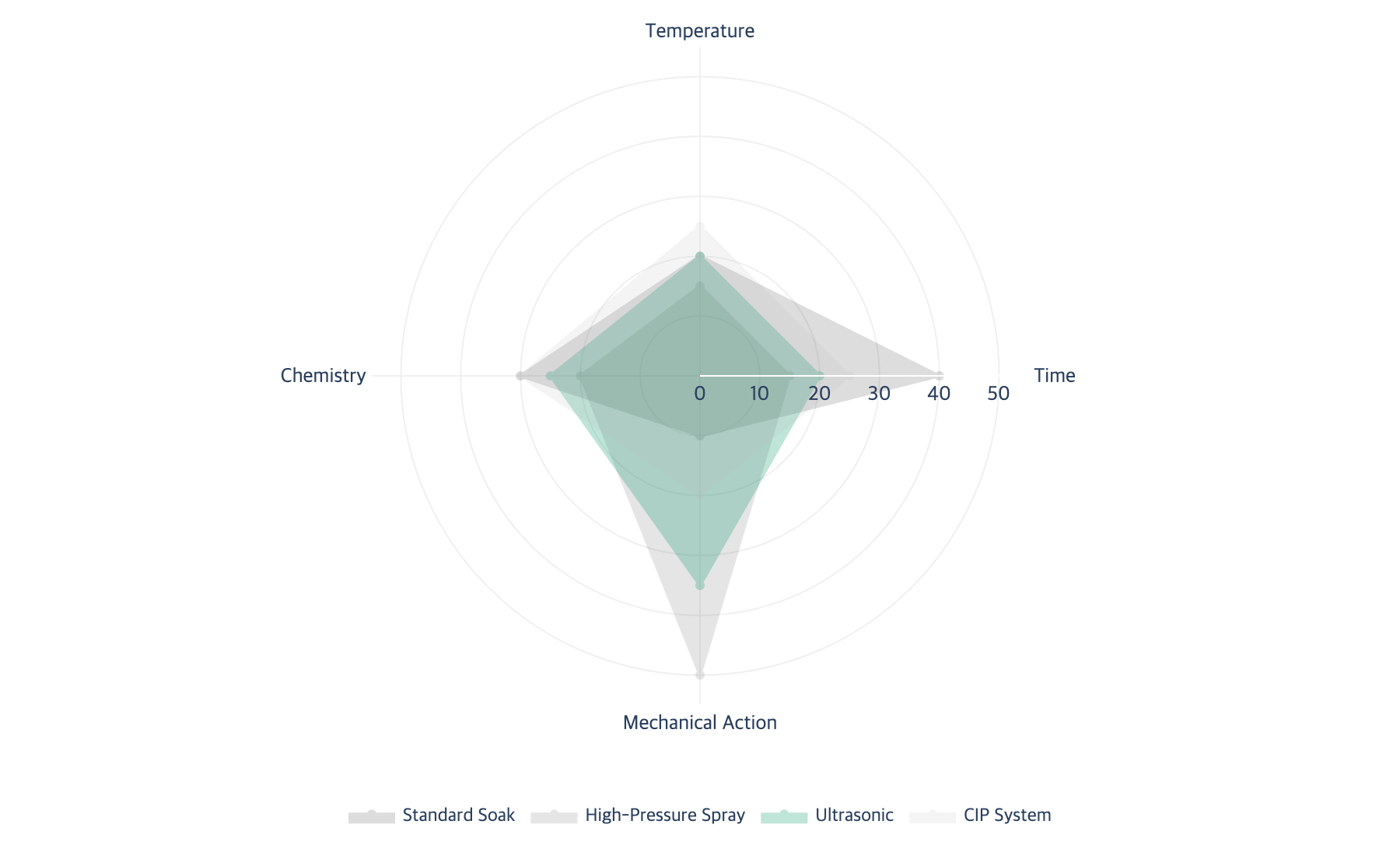
The distribution varies significantly by cleaning method. In soak cleaning, time dominates because mechanical action is minimal, and the primary mechanism is diffusion-driven dissolution. In high-pressure spray systems, mechanical action is the primary cleaning force, and cycle times can be much shorter because physical displacement of contaminants is faster than chemical dissolution. Ultrasonic systems operate somewhere in between, where cavitation provides intense localized mechanical action while temperature and chemistry work simultaneously to loosen soil bonds. Understanding the current distribution reveals which variables have the most room for adjustment and where cycle time reduction is most feasible with minimal risk.
The practical implication is that a cleaning engineer does not need to find a single parameter change that compensates entirely for reduced time. Small adjustments across two or three variables can collectively maintain the same cleaning effect while delivering a meaningful time reduction. For example, raising temperature by 5 degrees Celsius and increasing spray pressure by 0.5 bar together may compensate for a 20 percent time reduction that neither change could support individually.
III. How Each Variable Affects Cleaning at the Chemical Level
Understanding the chemical mechanisms behind each variable is essential for making informed adjustments rather than relying on trial-and-error. Each variable influences contaminant removal through distinct physical and chemical pathways, and the effectiveness of any adjustment depends on the type of soil being removed.
Temperature and Reaction Kinetics
Temperature affects cleaning through multiple pathways. For oily soils, higher temperature reduces oil viscosity, allowing surfactants to penetrate and emulsify the contaminant layer more quickly. A typical mineral oil has a viscosity of approximately 68 centistokes at 40 degrees Celsius but drops to roughly 8 centistokes at 100 degrees Celsius, meaning the oil film becomes significantly more fluid and easier to displace at elevated temperatures. The critical micelle concentration of most nonionic surfactants decreases with temperature, meaning the same concentration becomes more effective when heated. This occurs because rising temperature destroys hydrogen bonds between water molecules and the surfactant hydrophilic groups, promoting micelle formation at lower surfactant concentrations (Mohajeri, 2012).
For alkaline cleaners, temperature accelerates saponification of fatty acid-based soils. Raising the bath from 50 to 60 degrees Celsius can theoretically achieve the same result in half the time, based on Arrhenius kinetics for reactions with typical activation energies. However, higher temperatures increase energy consumption and can cause thermal damage to sensitive substrates, so the trade-off must be evaluated for each application. Polymeric components, certain rubber seals, and thin-walled precision parts may warp or degrade above specific temperature thresholds. The optimal temperature increase is the smallest increment that restores the desired cleaning result after a time reduction, not the maximum the substrate can tolerate.
Temperature also affects rinsing efficiency. Warmer rinse water has lower surface tension and lower viscosity, which means it flows more readily into recessed features and carries away loosened contaminants more effectively. This secondary benefit means that a temperature increase applied during the wash step often improves the rinse step as well, providing a compounding effect on overall cycle performance.
Chemistry and Concentration Effects
Increasing chemistry concentration provides more active molecules per unit volume. Above the critical micelle concentration, additional surfactant directly increases cleaning capacity by forming more micelles available to encapsulate and emulsify hydrophobic contaminants. The CMC for typical nonionic surfactants used in industrial cleaning falls in the range of 0.01 to 0.1 percent by weight, while most industrial cleaning baths operate at 2 to 5 percent concentration, well above the CMC. This means that at normal operating concentrations, the surfactant system has substantial emulsification capacity, and the rate-limiting step is usually diffusion of surfactant molecules to the soil-substrate interface, not the availability of micelles in the bulk solution.
For alkaline cleaners, higher concentration raises pH and enhances hydrolysis of organic soils. A pH increase from 10 to 11 represents a tenfold increase in hydroxide ion concentration, which directly accelerates saponification reactions with ester-based soils. The practical limit is determined by rinseability and substrate compatibility. Higher concentrations require more rinse water and time to achieve acceptable residue levels, which can partially offset the time saved during the wash step. There is also a cost consideration, as chemistry is typically the second-largest operating expense after energy in aqueous cleaning operations.
Mechanical Action and Physical Displacement
Mechanical action removes contaminants through physical displacement. The mechanism varies by equipment type. In spray cleaning, impact pressure at the part surface is determined by nozzle design, flow rate, and standoff distance. Increasing pump pressure from 2 to 4 bar can double the kinetic energy delivered to the surface, but the relationship between pressure and cleaning rate is not linear. Beyond a threshold that depends on the soil type and substrate geometry, additional pressure provides diminishing returns.
Ultrasonic cleaning generates cavitation bubbles that create localized high-pressure jets at the substrate surface. Lower frequencies (20 to 40 kHz) produce larger cavitation bubbles that implode more violently, creating aggressive cleaning action suitable for removing stubborn contaminants such as polishing compounds, heavy oils, and baked-on residues. Higher frequencies (80 to 130 kHz) produce smaller, more numerous bubbles with gentler implosion, making them appropriate for sensitive components such as semiconductor wafers or precision optical elements (Crest Ultrasonics, 2024). The 40 kHz frequency is considered the standard for general industrial parts cleaning and is used in over 90 percent of industrial ultrasonic systems (Omegasonics, 2024). Selecting the wrong frequency can either damage the substrate or fail to remove the contaminant, making frequency selection a critical parameter when mechanical action is the compensation variable.
In CIP systems, flow velocity is the primary mechanical variable. A target velocity of at least 1.5 meters per second is generally required for effective cleaning of pipe interiors and vessel walls (Process Navigation, 2024). Research has shown that increasing flow velocity from 0.2 to 0.5 meters per second can reduce cleaning time by up to 70 percent, with diminishing returns above 1.5 meters per second. This makes flow rate adjustment one of the most powerful levers for CIP cycle time optimization, often more cost-effective than increasing chemistry concentration or temperature.
IV. Systematic Cycle Time Reduction Framework
Cycle time reduction should follow a structured protocol rather than ad hoc parameter changes. The five-step framework below maintains cleanliness throughout the optimization process while providing a clear decision path at each stage. Each step generates data that informs the next, so the process is self-correcting and evidence-based.
Step 1: Baseline Measurement
Before any changes, measure current cleanliness using a quantitative method and record all process parameters including time, temperature, chemistry concentration, flow rate or spray pressure, and bath age. Run the measurement on at least 10 parts representing the current product mix. Calculate both the average and the range of cleanliness values. The gap between the average measured cleanliness and the specification limit is the available margin for optimization. If the average is already close to the specification, cycle time reduction may not be feasible without compensating parameter changes. If the average is well below the specification, with significant margin, there is room to reduce time before any compensation is needed.
Step 2: Identifying the Dominant Variable
Determine which Sinner Circle factor contributes most to the current cleaning effect and likely has the most safety margin. For soak cleaning processes with long dwell times and low agitation, time is almost certainly over-contributing. For spray processes running at moderate pressures, mechanical action may have room for increase. Review the original qualification documentation if available to understand what contamination levels the cycle was designed for, and compare those levels to current production conditions. In many cases, the contamination load has decreased since qualification due to changes in upstream machining fluids, forming lubricants, or handling practices.
Step 3: Reducing Time in Controlled Increments
Reduce time in 10 to 15 percent increments. After each reduction, measure cleanliness on at least 5 parts spanning the product mix. If cleanliness holds within specification, document the result and proceed with another reduction. If cleanliness degrades beyond the specification limit, stop and move to Step 4. It is important to test at the worst-case condition within each increment, meaning the parts with the heaviest contamination and the most challenging geometry. If those parts pass, the entire product mix will pass.
Step 4: Compensating with Non-Time Variables
Select the most cost-effective compensation based on the soil type and available equipment. The matrix below ranks the options by effectiveness, cost, and risk.
Figure 3. Compensation Priority Matrix for Cycle Time Reduction
Compensation Variable | Effectiveness | Cost Impact | Risk Level | Best For |
|---|---|---|---|---|
Temperature (+5 to 10C) | High | Low to moderate | Low | Oil and grease soils |
Mechanical action increase | High | Low | Low | Particulate soils |
Chemistry concentration (+10 to 20%) | Moderate | Moderate | Moderate | Mixed soils |
Chemistry formulation change | High | Variable | Moderate | Resistant soils |
Temperature increase is typically the most cost-effective compensation because energy costs are low compared to chemical costs and the effect is immediate with no consumable expense. The energy cost of raising a 500-liter cleaning bath by 10 degrees Celsius is approximately USD 0.50 to 1.50 per heating cycle depending on fuel type and heater efficiency. At 20 cycles per day, this amounts to USD 10 to 30 per day, far less than the throughput value of the time saved. Mechanical action increase, where feasible, is the next best option because it requires no consumable cost increase, only an adjustment to pump speed, nozzle configuration, or ultrasonic power setting.
Chemistry concentration increase should be considered last because it carries ongoing consumable cost, affects rinse water consumption, and increases wastewater treatment load. A 20 percent concentration increase translates directly to 20 percent higher chemistry cost per bath fill and may require an additional rinse step to maintain acceptable residue levels on parts.
Step 5: Validation and Documentation
After identifying the optimized parameter set, validate over an extended production run of at least 100 parts representing the full product mix. Document the new parameters and their valid operating envelope, including which product types and contamination levels were tested. Specify the boundary conditions under which the optimized cycle applies and define a reversion procedure for situations where contamination levels exceed the tested range, such as a new product introduction or a change in upstream lubricant. Include the measurement method and acceptance criteria used during validation so that future engineers can reproduce the verification.
This documentation step is critical because it prevents the optimized parameters from becoming another unquestioned legacy setting. By recording the rationale and evidence for the new cycle time, the organization creates a foundation for future re-optimization as conditions change again.
V. Cleanliness Verification Methods
Reliable optimization requires quantitative cleanliness measurement at each step. Visual inspection alone is insufficient because the human eye cannot detect organic contamination films thinner than approximately 1 micrometer, and many cleanliness specifications define limits at levels far below visual detectability. Four primary methods cover the range of industrial requirements, each with distinct strengths suited to different applications.
Gravimetric Analysis
Gravimetric analysis measures total contaminant mass by weighing extraction filters before and after a cleaning verification rinse. The part is rinsed with a controlled volume of clean solvent under defined conditions, the rinse liquid is filtered through a pre-weighed membrane filter, and the filter is dried and re-weighed. The mass difference represents the total particulate and organic residue removed from the part surface. A typical specification requires less than 1 mg of residue per part, though the actual limit varies by application from 0.1 mg for precision assemblies to 5 mg for general industrial components. The method is straightforward and inexpensive, requiring only an analytical balance accurate to 0.1 mg, membrane filters, and a controlled rinsing apparatus (Ecolink, 2024). The main limitation is that gravimetric analysis provides no information about particle size distribution or the nature of the contamination. A result of 0.5 mg could represent a single large particle or thousands of fine particles, and the functional risk of these two scenarios may be very different.
Particle Count Analysis
Particle count analysis under ISO 16232 provides detailed size distribution data through automated optical microscopy of extraction filters. After the extraction rinse, the filter is scanned by an automated microscope that counts, measures, and classifies every particle by size. Standard size classes range from 5 micrometers to over 1000 micrometers, reported using a Component Cleanliness Code that specifies maximum allowable counts in each size class (ISO, 2018). This method is essential for hydraulic and fuel system components where particle contamination directly affects functional performance. A single particle larger than 200 micrometers in a hydraulic valve can cause spool seizure and system failure. The method is more time-consuming and expensive than gravimetric analysis, requiring automated microscopy equipment and trained technicians, but it provides information that is directly traceable to functional risk.
Contact Angle Measurement
Contact angle measurement assesses surface wettability by measuring the angle of a water droplet on the cleaned surface. A contact angle below 30 degrees typically indicates adequate cleanliness for coating and bonding, as it demonstrates that the surface energy is high enough for good adhesion. Contaminated surfaces exhibit higher contact angles because organic films lower the surface energy. This method is fast, non-destructive, and particularly sensitive to organic contamination films that gravimetric analysis might miss (Biolin Scientific, 2024). The same surface forces that attract a water droplet to the surface are the forces that attract adhesives, coatings, and inks, making contact angle a direct predictor of downstream process success (Brighton Science, 2024). Modern automated contact angle instruments can measure multiple points on a part surface in seconds, making this method practical for in-line monitoring during optimization trials.
UV Fluorescence Inspection
UV fluorescence inspection detects the presence of organic contamination by illuminating the part surface with ultraviolet light. Many industrial oils, greases, and lubricants fluoresce under UV excitation, making residual contamination visible as bright spots or films against a dark background. The method is extremely fast and requires only a UV lamp and a darkened inspection area. However, it is qualitative rather than quantitative, and its sensitivity depends on the fluorescence characteristics of the specific contaminant. Some synthetic lubricants do not fluoresce, creating the risk of false negatives. UV fluorescence is best used as a quick screening tool during early optimization steps, with more quantitative methods applied for final validation.
Figure 4. Cleanliness Method Selection Guide
Method | Measures | Speed | Cost | Best Application |
|---|---|---|---|---|
Gravimetric | Total residue mass | Fast | Low | General manufacturing |
Particle count (ISO 16232) | Size distribution | Slow | High | Hydraulic, fuel systems |
Contact angle | Surface wettability | Very fast | Moderate | Coating, bonding prep |
UV fluorescence | Organic film presence | Very fast | Very low | Quick screening |
The choice of method should match the functional cleanliness requirement of the downstream process. For coating and bonding applications, contact angle is the most relevant measurement because it directly correlates with adhesion performance. For hydraulic components, particle count is necessary because the functional failure mode is particle-induced valve seizure or seal damage. For general manufacturing where the cleanliness specification is mass-based, gravimetric analysis provides a direct measurement against the specification. Using the wrong method, or no method at all, is the most common reason cleaning optimization efforts fail or are never attempted.
VI. Field Cases: Optimization in Practice
The following cases demonstrate systematic cycle time reduction using the Sinner Circle framework. Each case follows the five-step protocol described above and illustrates different compensation strategies suited to the specific cleaning method and soil type.
Case 1: Spray Cleaning of Stamped Automotive Components
Company A operates an aqueous spray cleaning line for stamped steel components used in suspension assemblies. The original cycle was 8 minutes at 55 degrees Celsius with 3 percent alkaline cleaner, established when the product mix included heavily oiled machined parts. After a product transition, 80 percent of parts carried only light stamping lubricant at approximately 2 g per square meter. The line processes 30 parts per batch with 2 batches per hour, and the cleaning station was the throughput bottleneck for the entire production line.
Baseline cleanliness measured 0.4 mg residue per part across 15 sample parts, well below the 1.5 mg specification. The gap between measured cleanliness and specification was 1.1 mg, indicating substantial margin for time reduction. The team reduced cycle time from 8 to 6 minutes with cleanliness at 0.6 mg, still well within specification. A further reduction to 4.5 minutes produced 1.8 mg, exceeding the 1.5 mg specification on 3 of 10 tested parts.
Rather than accepting the 6-minute result, the team applied Step 4 compensation. They raised temperature from 55 to 62 degrees Celsius, increasing the monthly energy cost by approximately USD 850. At 4.5 minutes and 62 degrees Celsius, cleanliness measured 0.9 mg across all tested parts. The validated cycle settled at 5 minutes, 62 degrees Celsius, consistently producing 0.7 to 0.9 mg residue across 120 validation parts with zero out-of-specification results.
The 37.5 percent cycle time reduction increased throughput from 240 to 384 parts per hour. The energy cost from the 7-degree temperature increase was approximately USD 850 per month, while the throughput gain eliminated a planned USD 180,000 investment in a second cleaning station. Chemistry consumption decreased by approximately 15 percent due to shorter exposure time and reduced drag-out, saving an additional USD 4,200 per year. Estimated annual net benefit was USD 165,000 after accounting for the additional energy cost.
Figure 5. Annual Cost Impact of Cleaning Cycle Time Optimization (Case 1)
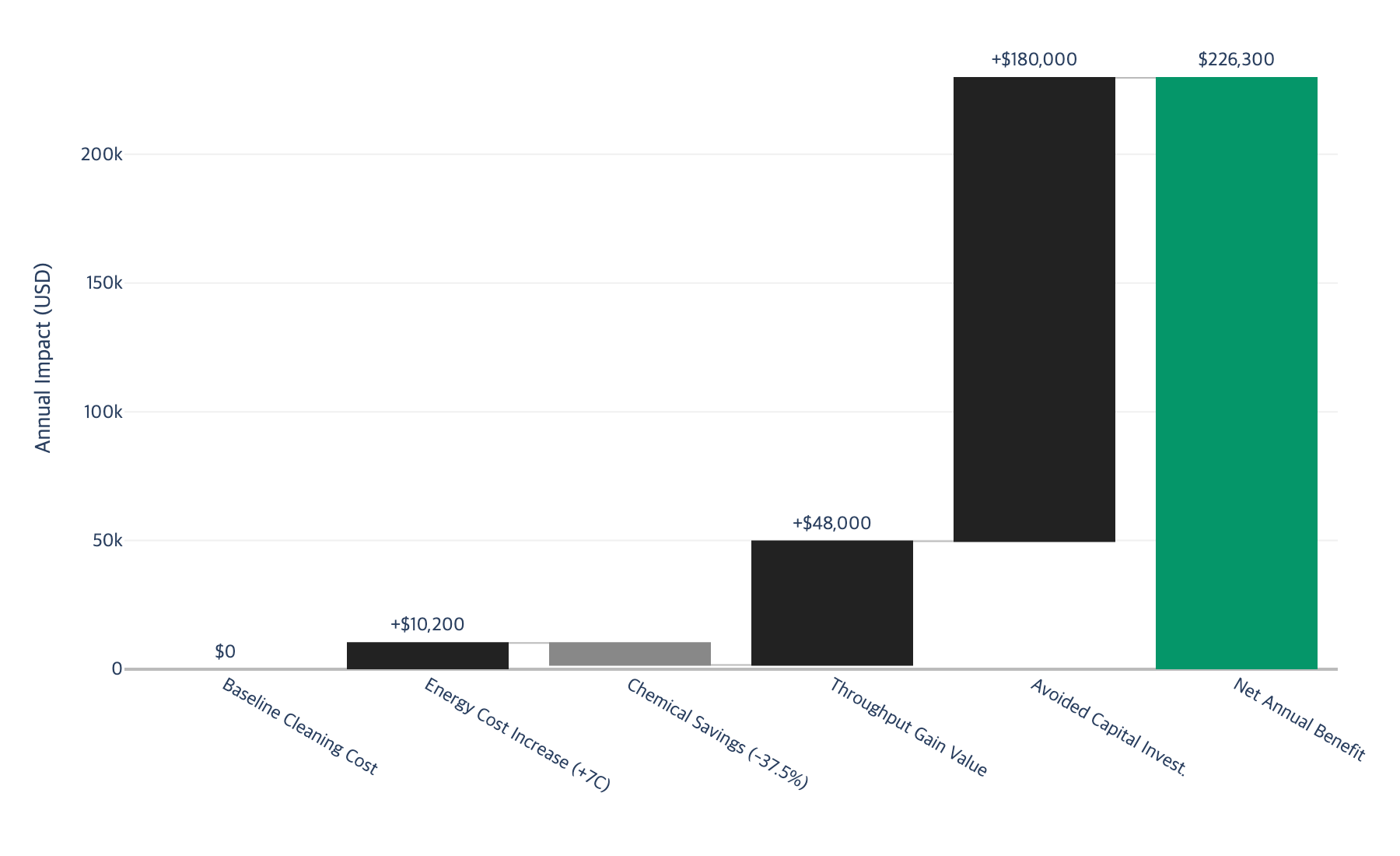
The waterfall chart illustrates how modest energy cost increases are far outweighed by chemical savings, throughput gains, and avoided capital expenditure. The net annual benefit demonstrates that systematic cycle time optimization delivers returns that extend well beyond direct time savings. What began as a process engineering exercise became a capital avoidance project, demonstrating that optimization of existing equipment should always be evaluated before investing in additional capacity.
Case 2: CIP Optimization in Chemical Processing
Company B operates a batch blending facility producing industrial specialty chemicals with CIP cycles of 45 minutes between product changeovers: 20-minute alkaline wash, 10-minute rinse, 10-minute acid wash, and 5-minute final rinse. With 6 changeovers daily, cleaning consumed 4.5 hours of production capacity, representing 19 percent of a 24-hour production day. The facility was evaluating a capital project to add a second blending vessel at a cost of approximately USD 350,000 to recover lost production capacity.
Analysis showed 60 percent of changeovers involved same-family products with low cross-contamination risk. The remaining 40 percent were full changeovers between incompatible product families requiring the complete 4-step protocol. For same-family transitions, the team reduced the alkaline wash from 20 to 10 minutes by increasing spray ball pressure from 2 to 3.5 bar and raising temperature from 65 to 75 degrees Celsius. The pressure increase was achieved by replacing the existing static spray ball with a rotary jet head that delivered higher impact force at the vessel wall. The acid wash was replaced by an extended rinse with conductivity verification below 50 microsiemens per centimeter, ensuring complete removal of alkaline residues without introducing a second chemistry step.
Same-family CIP time dropped from 45 to 22 minutes, a 51 percent reduction. Average daily cleaning time decreased from 4.5 to 2.9 hours, recovering 1.6 hours of production capacity per day. Over 12 months, zero cross-contamination incidents were recorded versus 3 in the prior year, an improvement attributed to replacing the time-based acid wash with a conductivity-verified rinse endpoint that provided objective evidence of cleanliness. The capital project for the second blending vessel was deferred, saving USD 350,000 in near-term capital expenditure. Annual water consumption for CIP decreased by 22 percent due to the elimination of the acid wash step in same-family changeovers.
Case 3: Ultrasonic Cleaning of Precision Machined Components
Company C manufactures precision hydraulic valve bodies requiring cleanliness certification to ISO 16232 with a maximum particle count of zero particles above 200 micrometers and fewer than 500 particles above 50 micrometers per component. The existing ultrasonic cleaning process ran for 15 minutes at 40 kHz, 55 degrees Celsius, with 4 percent semi-synthetic cleaner, followed by a 5-minute ultrasonic rinse and hot air drying. Total cycle time was 25 minutes per batch of 8 parts.
Baseline particle count analysis showed the process consistently achieved fewer than 50 particles above 50 micrometers, with the specification allowing up to 500. The team identified that the 15-minute wash time had been set during qualification with a machining fluid that produced heavy carbonaceous residues. A subsequent change in machining fluid to a lower-residue formulation had reduced the contamination challenge by approximately 60 percent, but the cleaning cycle was never re-evaluated.
The team reduced wash time from 15 to 10 minutes while maintaining all other parameters. Particle counts remained below 80 across 20 sample parts. A further reduction to 8 minutes produced counts between 90 and 180, still within specification but with less margin. The team chose to hold at 10 minutes with a safety factor. The 5-minute rinse was also reduced to 3 minutes after verification that rinse water conductivity reached below 20 microsiemens per centimeter within 2 minutes. Total cycle time decreased from 25 to 18 minutes, a 28 percent reduction. Daily throughput increased from 38 to 53 batches, enabling the facility to absorb a new product launch without adding a second cleaning line.
VII. Key Takeaway
Cleaning cycle times from initial qualification almost always contain excessive safety margins that can be systematically reduced through quantitative measurement and controlled parameter adjustment
The Sinner Circle provides a quantitative framework: reducing time requires increasing temperature, chemistry, or mechanical action proportionally, and small adjustments across multiple variables are often more effective than a large change in one
Always measure cleanliness quantitatively at each optimization step, never rely on visual inspection alone, and select the measurement method that matches the functional cleanliness requirement of the downstream process
Temperature increase is typically the most cost-effective time compensation, where a 10 degree Celsius rise approximately doubles reaction rates for most cleaning-relevant chemistries, and the energy cost is typically orders of magnitude lower than the throughput value recovered
Document optimized parameters with their valid operating envelope including product types, contamination levels tested, and reversion procedures, so the optimization is sustainable and repeatable rather than another unquestioned legacy setting
Lubinpla's AI assistant can analyze your specific cleaning parameters, contamination types, and downstream cleanliness requirements to recommend which Sinner Circle adjustments will deliver the greatest cycle time reduction with the lowest quality risk. By cross-referencing your operating conditions against cleaning mechanism knowledge across aqueous, solvent, and mechanical methods, Lubinpla identifies the compensation strategy that fits your existing equipment and process constraints.
VIII. References
[1] Siemens, "The True Cost of Downtime 2024", 2024. https://assets.new.siemens.com/siemens/assets/api/uuid:1b43afb5-2d07-47f7-9eb7-893fe7d0bc59/TCOD-2024_original.pdf
[2] DST Chemicals, "The Complete Guide to Sinner's Circle and Industrial Parts Cleaning Optimisation", 2024. https://dstchemicals.com/resources/knowledge/sinners-circle-industrial-parts-cleaning-optimisation
[3] Jenfab Cleaning Solutions, "Sinner's Circle and the 4 Factors of Cleaning", 2024. https://jenfab.com/blog/sinners-circle-the-4-factors-of-cleaning/
[4] Wikipedia, "Sinner's Circle", 2024. https://en.wikipedia.org/wiki/Sinner%27s_circle
[5] Ecolink, "What is Gravimetric Cleanliness Testing?", 2024. https://ecolink.com/info/what-is-gravimetric-cleanliness-testing/
[6] ISO, "ISO 16232:2018 Road Vehicles - Cleanliness of Components and Systems", 2018. https://www.iso.org/standard/71583.html
[7] Biolin Scientific, "How to Evaluate Surface Cleanliness Through Contact Angle Measurements", 2024. https://www.biolinscientific.com/blog/how-to-evaluate-surface-cleanliness-through-contact-angle-measurements
[8] Proceco, "Standards of Cleanliness", 2024. https://www.proceco.com/blogs/standards-of-cleanliness
[9] Kaercher, "The Basics of Cleaning: The Sinner's Circle", 2024. https://www.kaercher.com/int/home-garden/know-how/the-sinner-s-circle.html
[10] Ecoclean India, "Methods of Cleanliness Analysis", 2024. https://ecoclean-india.com/methods-of-cleanliness-analysis/
[11] ResearchGate, "Sinner's Circle Reloaded: A New Concept", 2024. https://www.researchgate.net/publication/390367069_SINNERS_CIRCLE_RELOADED
[12] Kingfisher, "How Poor Industrial Cleaning Contributes to Unplanned Downtime", 2024. https://www.kingfisher-ss.co.uk/how-poor-industrial-cleaning-contributes-to-unplanned-downtime-in-manufacturing/
[13] GM Insights, "Industrial Cleaning Products Market Size, Growth Forecasts 2034", 2024. https://www.gminsights.com/industry-analysis/industrial-cleaning-products-market
[14] Chemistry LibreTexts, "Arrhenius Equation", 2024. https://chem.libretexts.org/Bookshelves/Physical_and_Theoretical_Chemistry_Textbook_Maps/Supplemental_Modules_(Physical_and_Theoretical_Chemistry)/Kinetics/06:_Modeling_Reaction_Kinetics/6.02:_Temperature_Dependence_of_Reaction_Rates/6.2.03:_The_Arrhenius_Law/6.2.3.01:_Arrhenius_Equation
[15] Crest Ultrasonics, "Ultrasonic Cleaning Frequency - Choosing Correctly", 2024. https://crest-ultrasonics.com/choosing-the-right-ultrasonic-frequency-for-effective-industrial-cleaning/
[16] Omegasonics, "How Do Ultrasonic Cleaners Work?", 2024. https://www.omegasonics.com/knowledge-center/blog/how-do-ultrasonic-cleaners-work/
[17] Process Navigation, "Clean in Place System (CIP): How CIP Cleaning Works and Where It Is Used", 2024. https://processnavigation.com/insights/clean-in-place-system/
[18] Brighton Science, "Use Contact Angle to Inspect for Surface Cleanliness in Manufacturing", 2024. https://www.brighton-science.com/use-contact-angle-to-inspect-for-surface-cleanliness-eliminate-adhesion-issues
[19] Mohajeri, "Effect of Temperature on the Critical Micelle Concentration and Micellization Thermodynamic of Nonionic Surfactants", 2012. https://onlinelibrary.wiley.com/doi/10.1155/2012/961739
Powered by Lubinpla
Discover how technical teams solve complex challenges faster with AI.