Selecting Adhesives for Multi-Material Assemblies: Substrate Compatibility Decision Framework
Summary: Multi-material assemblies present the most challenging adhesive selection scenarios in industrial manufacturing because the adhesive must be compatible with two or more different substrates simultaneously while meeting mechanical load, temperature, and chemical resistance requirements. This article provides a substrate-pair decision framework that maps common material combinations (metal-metal, metal-plastic, plastic-plastic, composite joints) to compatible adhesive families. The framework integrates joint design requirements, cure speed considerations, and a validation testing protocol to narrow adhesive options from dozens of candidates to two or three validated choices for each specific application.
Table of Contents
I. Why Multi-Material Bonding Fails
II. Adhesive Families and Their Substrate Compatibility Profiles
III. Joint Design Requirements: Load Type and Environmental Exposure
IV. Substrate-Pair Selection Matrix
V. Validation Testing Protocol
VI. Key Takeaway
VII. References
I. Why Multi-Material Bonding Fails
An assembly engineer selects a high-strength epoxy to bond an aluminum bracket to a polycarbonate housing, reasoning that the strongest adhesive will produce the strongest joint. The initial bond strength is excellent, but after three months of service involving daily temperature cycling between 5 C and 65 C, the joint fails at the adhesive-polycarbonate interface. The failure is not a defect in the adhesive. It is a mismatch between the adhesive's rigid cured properties and the differential thermal expansion between aluminum and polycarbonate.
Multi-material adhesive failures stem from three root causes. First, substrate compatibility failure: the adhesive chemistry does not form adequate chemical or physical bonds with one or both substrate surfaces. Second, mechanical mismatch: the cured adhesive cannot accommodate the differential movement between dissimilar substrates under service loads. Third, surface preparation inadequacy: one or both substrates were not prepared to the level required for the adhesive chemistry to achieve its rated bond strength.
The scale of this challenge is growing. The global automotive adhesives market was valued at USD 8.0 billion in 2024 and is projected to reach USD 13.6 billion by 2030, growing at a CAGR of 9.3 percent (Grand View Research, 2024). This growth is driven largely by multi-material lightweight vehicle design, where manufacturers are replacing mechanical fasteners with adhesive bonds to join aluminum, high-strength steel, and carbon fiber reinforced plastics in a single body structure. The BMW 7 Series body-in-white, for example, uses approximately 130 meters of structural adhesive to join carbon fiber reinforced plastic, aluminum, and high-strength steel, reducing body weight by 40 kg compared to its predecessor (Polytontech, 2024). Every meter of that adhesive bond line must manage the CTE mismatch between three fundamentally different substrate materials.
Understanding these failure mechanisms reveals that adhesive selection for multi-material assemblies is not simply about choosing the strongest adhesive. It is about matching the adhesive's bonding mechanism, flexibility, and surface energy requirements to the specific substrate combination and service conditions.
II. Adhesive Families and Their Substrate Compatibility Profiles
Four major adhesive families cover the majority of industrial bonding applications. Each family has distinct bonding mechanisms, curing characteristics, and substrate compatibility ranges that determine where it excels and where it fails.
Epoxy Adhesives: Structural Metal Bonding
Epoxy adhesives cure through a cross-linking reaction between epoxide resin and amine or anhydride hardener, forming a rigid, densely cross-linked thermoset network. This network provides the highest shear strength among common structural adhesives, with lap shear values on steel substrates typically exceeding 20 MPa (EpoxySet, 2024).
Epoxy bonds well to metals (steel, aluminum, titanium, copper), glass, ceramics, and many thermoset composites. The bonding mechanism involves both mechanical interlocking with surface micro-roughness and chemical interaction with surface oxides and hydroxyl groups. Aluminum bonding with epoxy is particularly well-established, with decades of aerospace heritage demonstrating long-term durability when proper surface preparation (chromic acid etch, phosphoric acid anodize, or sol-gel treatment) is applied.
However, epoxy's rigid cured properties create limitations for multi-material joints. The thermal expansion coefficient mismatch between bonded substrates generates shear stress at the bond line during temperature cycling. For metal-to-plastic joints with large CTE differences, standard rigid epoxy may crack or delaminate under repeated thermal cycling. Toughened epoxy formulations with rubber or thermoplastic modifiers improve peel resistance and thermal cycling tolerance at the expense of some peak shear strength.
Epoxy also struggles with low surface energy plastics (polyethylene, polypropylene, PTFE) unless specialized surface treatments (plasma, corona, flame, or chemical etching) are applied to raise the surface energy above the adhesive's minimum wetting threshold. This limitation is not a minor footnote. In production environments where mixed-material assemblies are common, overlooking the surface energy gap between the epoxy and a low-energy substrate is one of the most frequent causes of field returns.
Cyanoacrylate Adhesives: Rapid Fixture Bonding
Cyanoacrylate (CA) adhesives are single-component, moisture-cure adhesives that polymerize rapidly upon contact with surface moisture, achieving handling strength in seconds to minutes. This rapid fixture capability makes CA adhesives valuable for production applications requiring fast turnaround.
CA adhesives bond well to metals, most plastics (ABS, PVC, nylon, acrylic), rubber, and ceramics. Their bonding mechanism relies on anionic polymerization initiated by trace surface moisture, forming a thin, rigid adhesive layer. Bond strength on smooth, close-fitting surfaces can be surprisingly high, with lap shear values on steel exceeding 15 MPa for structural-grade formulations.
Key limitations include poor gap-filling capability (CA adhesives are most effective at bond line thicknesses below 0.2 mm), sensitivity to surface contamination, limited temperature resistance (typically below 80 C for standard grades, up to 120 C for rubber-toughened variants), and poor resistance to impact and peel loading due to the brittle cured film. CA adhesives are also incompatible with certain plastics, notably polyethylene, polypropylene, and some polycarbonate grades, due to their low surface energy.
Polyurethane Adhesives: Flexible Joint Bonding
Polyurethane (PU) adhesives form through the reaction of isocyanate groups with polyol hydroxyl groups, creating a polymer network that can range from flexible to semi-rigid depending on formulation. PU adhesives are the preferred choice for joints requiring flexibility, vibration damping, or accommodation of differential thermal expansion between dissimilar substrates.
PU adhesives bond well to a broad range of substrates including metals, wood, many plastics, rubber, fabric, and painted surfaces. Their elongation at break typically ranges from 100-600 percent, allowing PU adhesive joints to absorb mechanical energy and accommodate substrate movement without failure. This flexibility advantage makes PU adhesives particularly effective for metal-to-plastic joints, automotive body panel bonding, and any application where the joint must tolerate vibration, impact, or thermal cycling.
PU adhesives cure more slowly than CA adhesives, typically requiring 6-24 hours for full strength development depending on formulation and ambient conditions. Moisture-cure single-component PU adhesives cure from exposure to atmospheric humidity, while two-component systems cure by mixing polyol and isocyanate components. PU adhesives also provide good sound and vibration damping properties, which is valuable in automotive and equipment applications. The polyurethane segment held approximately 41 percent of the global automotive adhesives and sealants market in 2024, reflecting its dominance in multi-material vehicle body construction where flexibility and broad substrate compatibility are non-negotiable requirements (Persistence Market Research, 2024).
Silicone Adhesives: Thermal and Environmental Resistance
Silicone adhesives form flexible, resilient bonds with excellent temperature resistance (typically minus 55 C to 200 C or higher for high-temperature grades) and outstanding resistance to UV, ozone, and weathering. The silicone polymer backbone (Si-O-Si) is inherently stable against thermal and photo-oxidative degradation.
Silicone bonds well to glass, ceramics, metals, and many plastics. However, silicone achieves lower shear strength compared to epoxy or PU adhesives, typically in the range of 1-5 MPa in lap shear. Silicone adhesives are therefore not suitable for structural load-bearing joints but excel in sealing, gasketing, and bonding applications where environmental resistance and flexibility are more important than absolute strength.
Silicone's unique advantage in multi-material assemblies is its ability to accommodate extreme differential thermal expansion without stress cracking, making it ideal for bonding dissimilar materials in environments with wide temperature swings, such as outdoor electronics enclosures, automotive lighting assemblies, and HVAC components.
Figure 1. Adhesive Family Comparison for Multi-Material Bonding
Property | Epoxy | Cyanoacrylate | Polyurethane | Silicone |
|---|---|---|---|---|
Lap shear strength (MPa, steel) | 20-35 | 15-25 | 8-20 | 1-5 |
Elongation at break (%) | 2-10 | 2-5 | 100-600 | 100-800 |
Temperature range (C) | -55 to 175 | -30 to 80 | -40 to 120 | -55 to 200+ |
Cure time to handling | 30 min to 24 hr | 5-30 sec | 1-24 hr | 30 min to 24 hr |
Gap filling capability | Good | Poor (below 0.2 mm) | Excellent | Good |
Chemical resistance | Excellent | Fair | Good | Excellent |
Metal bonding | Excellent | Good | Good | Fair |
Plastic bonding (high SE) | Good | Good | Good | Good |
Plastic bonding (low SE) | Poor (needs treatment) | Poor | Fair (with primer) | Fair |
Composite bonding | Excellent | Fair | Good | Fair |
The comparison table reveals the trade-off structure between adhesive families. High-strength options (epoxy, CA) sacrifice flexibility, while flexible options (PU, silicone) sacrifice peak strength. Multi-material assembly selection must balance these trade-offs against the specific requirements of each joint.
Figure 4. Adhesive Family Property Profile Comparison
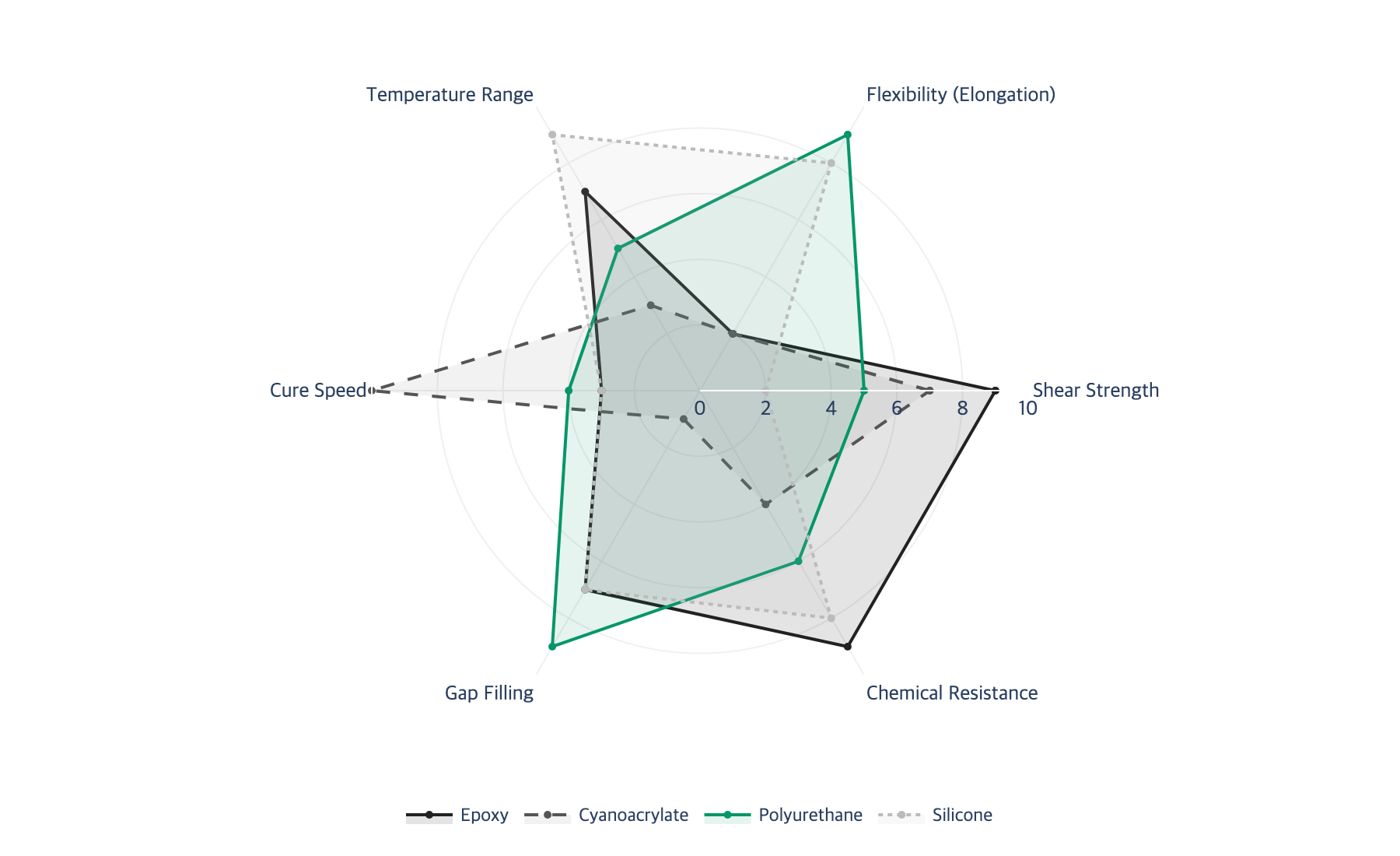
The radar chart visualizes the distinct performance profiles of each adhesive family. Epoxy dominates in shear strength and chemical resistance. Cyanoacrylate leads in cure speed. Polyurethane excels in flexibility and gap filling. Silicone stands out in temperature range and chemical resistance. The non-overlapping profiles confirm that each family occupies a distinct performance niche, and the optimal choice depends on which properties are most critical for the specific joint application.
III. Joint Design Requirements: Load Type and Environmental Exposure
The adhesive selection cannot be separated from the joint design. The type of mechanical load applied to the joint and the environmental conditions during service directly determine which adhesive properties are most critical.
Load Type Analysis
Adhesive joints experience four fundamental load types, each with different demands on the adhesive. Shear loading distributes stress across the bond area and is the most favorable loading mode for adhesive joints. Most adhesive strength data is reported as lap shear strength for this reason. Tensile (pull-apart) loading is moderately favorable if the load is uniformly distributed. Peel loading concentrates stress at the bond line edge and is the most challenging mode for brittle adhesives, which is why flexible adhesives (PU, silicone) are preferred for peel-loaded joints. Cleavage loading creates a stress concentration at one end of the joint, similar to opening a book, and requires tough adhesives that can resist crack propagation.
For multi-material assemblies, peel and cleavage loads are particularly critical because the CTE mismatch between dissimilar substrates generates peel stress at the bond edges during temperature cycling, even without external mechanical loading. Consider the numbers: steel has a CTE of approximately 10.4 ppm per degree C, while aluminum is 23 ppm per degree C, meaning aluminum expands at more than twice the rate of steel for the same temperature change (MasterBond, 2024). When these two metals are bonded and subjected to a 60 C temperature swing, the differential expansion across even a modest 100 mm bond line generates measurable shear displacement at the adhesive interface. If the adhesive cannot absorb that displacement through elastic deformation, the bond line cracks. This is why CTE-driven failure often appears months after installation, after enough thermal cycles have accumulated fatigue damage in a rigid adhesive that passed initial strength testing without issue.
Environmental Exposure Requirements
Service environment determines the minimum adhesive performance envelope. Indoor applications with controlled temperature require only basic temperature and humidity resistance. Outdoor applications demand UV stability, moisture resistance, and thermal cycling tolerance. Chemical exposure environments require specific chemical resistance matching. High-temperature applications require adhesive chemistry that maintains bond strength above the operating temperature.
Figure 2. Load Type and Environmental Requirements by Application
Application Example | Primary Load | Environmental Exposure | Critical Adhesive Property |
|---|---|---|---|
Structural bracket bonding | Shear + tensile | Indoor, controlled | High shear strength |
Automotive panel bonding | Shear + peel | Outdoor, thermal cycling | Flexibility, peel strength |
Electronics enclosure sealing | Low shear | Outdoor, UV, moisture | Environmental resistance |
Composite panel assembly | Shear + cleavage | Variable temperature | Toughness, thermal cycling |
Vibrating equipment mount | Dynamic shear | Indoor, vibration | Fatigue resistance, damping |
Window frame bonding | Peel + shear | Outdoor, UV, temperature | UV stability, flexibility |
The application-load-environment mapping directly narrows the adhesive family selection. High shear load with indoor exposure points to epoxy. Dynamic loading with thermal cycling points to polyurethane. Environmental sealing with temperature extremes points to silicone.
IV. Substrate-Pair Selection Matrix
The decision framework converges substrate compatibility, load requirements, and environmental exposure into a practical selection matrix.
Surface Energy and Bond Formation
Adhesive bonding requires the adhesive to wet the substrate surface, meaning the adhesive must spread across and make intimate contact with the surface at the molecular level. Surface energy determines wettability: substrates with high surface energy (metals, glass, ceramics, above 40 mN/m) are easily wetted by most adhesives. Substrates with low surface energy (polyethylene at 31 mN/m, polypropylene at 29 mN/m, PTFE at 18 mN/m) resist wetting and require surface treatment to raise their surface energy above the adhesive's contact angle threshold.
For multi-material assemblies, the substrate with the lower surface energy is typically the limiting factor in adhesive selection. If one substrate requires surface treatment, the treatment method must be compatible with the substrate material and the production process, including cost, speed, and equipment requirements. Plasma treatment, for instance, creates reactive functional groups (hydroxyl, carboxyl, carbonyl) on polymer surfaces through gas-phase bombardment, raising surface energy from below 30 mN/m to above 50 mN/m within seconds of exposure (Enercon Industries, 2024). Recent research has demonstrated that Bayesian optimization of plasma treatment parameters can achieve equivalent joint strength with 40 percent less process development budget compared to traditional trial-and-error approaches, with an 18 percent reduction in production costs (PMC, 2024). This type of data-driven surface treatment optimization is particularly relevant for multi-material assemblies where each substrate requires different preparation parameters.
Figure 3. Substrate-Pair Adhesive Selection Matrix
Substrate Combination | First Choice | Second Choice | Surface Prep Notes |
|---|---|---|---|
Steel to steel | Epoxy (structural) | PU (flexible joints) | Abrade + solvent clean |
Aluminum to aluminum | Epoxy (structural) | PU (flexible joints) | Chemical etch or abrade + solvent |
Steel to aluminum | Epoxy (toughened) | PU | Prep each substrate per material |
Metal to ABS/nylon/acrylic | Epoxy or PU | CA (rapid fixture) | Abrade plastic, clean metal |
Metal to polycarbonate | PU (recommended) | Toughened epoxy | Solvent clean PC, abrade metal |
Metal to polyethylene/PP | PU with primer | Specialized CA | Plasma/corona/flame treat plastic |
ABS to ABS | CA or epoxy | PU | Solvent clean (avoid stress cracking) |
Polycarbonate to polycarbonate | PU or silicone | CA (structural grade) | Isopropanol clean only |
Composite to metal | Epoxy (structural) | PU (flexible) | Light abrade composite, prep metal |
Composite to composite | Epoxy | Methacrylate | Light abrade both surfaces |
Glass to metal | Silicone or UV epoxy | PU | Clean glass, prep metal |
Dissimilar plastics | PU | Specialized CA | Treat lower-SE substrate |
The substrate-pair matrix narrows the adhesive selection from dozens of candidates to two or three options for each material combination. The surface preparation notes highlight the critical substrate-specific treatments that must be applied for reliable bond formation.
Figure 5. Substrate-Pair Compatibility Heatmap by Adhesive Family
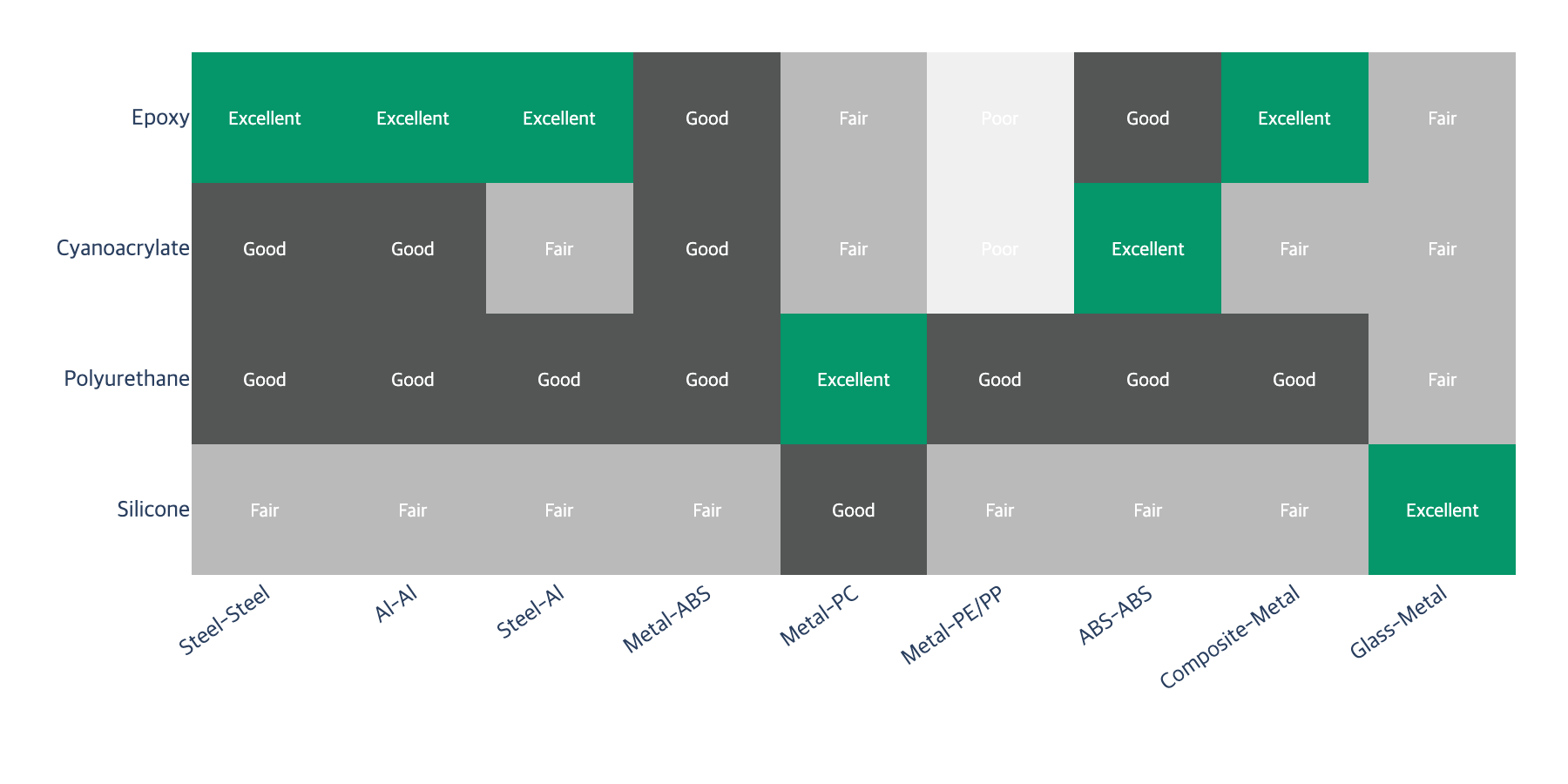
The heatmap visualizes the compatibility landscape across adhesive families and substrate combinations. Darker shading (accent green) indicates excellent compatibility, while lighter shading indicates limited compatibility. The pattern clearly shows that epoxy dominates metal-to-metal bonding, polyurethane provides the broadest compatibility across dissimilar materials, and silicone is uniquely suited for glass-to-metal applications.
Low Surface Energy Substrate Solutions
Bonding polyethylene (PE), polypropylene (PP), and PTFE substrates requires raising their surface energy through pre-treatment. Plasma treatment (atmospheric or vacuum) creates reactive functional groups on the polymer surface, raising surface energy from below 30 mN/m to above 50 mN/m. Corona discharge treatment provides a faster, inline option for film and sheet materials. Flame treatment is effective for three-dimensional parts. Chemical primers designed for polyolefin bonding can also achieve adequate adhesion without equipment-intensive surface treatment.
The choice of surface treatment depends on production volume, part geometry, and cost constraints. High-volume inline production favors corona or atmospheric plasma. Low-volume or batch applications may use chemical primers or manual flame treatment.
V. Validation Testing Protocol
Every adhesive selection for a multi-material assembly should be validated through structured testing before production deployment.
Lap Shear Testing (ASTM D1002 / D3163 / D5868)
Lap shear testing measures the shear strength of the adhesive bond under controlled conditions. ASTM D1002 covers metal-to-metal joints, ASTM D3163 covers plastic-to-plastic joints, and ASTM D5868 covers fiber-reinforced plastic joints (MasterBond, 2024). Test specimens should use the actual production substrates with the intended surface preparation method.
The recommended specimen geometry consists of coupons 25.4 mm wide with a 12.7 mm overlap length and a metal substrate thickness of 1.62 mm, pulled at a crosshead speed of 1.3 mm per minute until rupture (ASTM, 2019). A minimum of five specimens per adherend and adhesive combination is required to ensure statistical validity.
Minimum acceptable lap shear strength depends on the application requirements. A useful benchmark is that the adhesive joint should achieve at least 50 percent of the rated adhesive strength on the specific substrate combination. Lower values indicate surface preparation issues or substrate incompatibility. It is important to recognize that ASTM D1002 results are primarily comparative in nature. The performance of an adhesive in a controlled single-lap-joint test cannot be directly correlated to real-world joint performance where complex load paths, environmental exposure, and manufacturing variability all contribute to the actual bond durability. This is precisely why the validation protocol described here includes environmental aging and thermal cycling tests beyond the baseline lap shear measurement.
Temperature Cycling Testing
For multi-material assemblies, temperature cycling testing is critical because CTE mismatch generates stress during thermal excursions. Test specimens should be cycled between the minimum and maximum expected service temperatures for a minimum of 100 cycles, followed by lap shear testing to assess strength retention. Acceptable strength retention after cycling should exceed 80 percent of the initial bond strength.
Aging and Environmental Exposure
Long-term bond durability is assessed through aging tests at elevated temperature and humidity (typically 85 C, 85% RH for 1,000 hours) and through immersion in relevant chemicals (cleaning solvents, lubricants, fuels as applicable). Post-exposure lap shear testing quantifies the durability of the adhesive bond under service conditions.
Substrate Preparation Optimization
Validation testing should include a surface preparation study comparing at least three preparation methods for each substrate to identify the method that provides the best balance of bond strength, consistency, and production practicality. Document the optimal preparation method as part of the production specification to ensure consistent bond quality.
VI. Key Takeaway
Select adhesives based on substrate-pair compatibility first, not on adhesive strength ratings alone, because the adhesive must form adequate bonds with both substrates in a multi-material assembly.
For joints between substrates with large CTE differences (metal-to-plastic, metal-to-composite), prioritize flexible adhesives (polyurethane, silicone) that can accommodate differential thermal expansion without cracking.
Low surface energy plastics (polyethylene, polypropylene, PTFE) require surface pre-treatment (plasma, corona, flame, or chemical primer) regardless of the adhesive selected, as no adhesive can reliably wet untreated polyolefin surfaces.
Use the substrate-pair selection matrix to narrow candidates to two or three adhesive families, then validate through lap shear testing on actual production substrates with the intended surface preparation method.
Temperature cycling testing is mandatory for multi-material assemblies because CTE mismatch generates bond stress that is not captured in standard room-temperature lap shear testing.
Selecting the right adhesive for a multi-material joint involves navigating substrate surface energy, CTE differentials, load type interactions, cure process constraints, and surface treatment compatibility simultaneously. Lubinpla's cross-domain analysis engine can evaluate your specific substrate combination, load profile, temperature range, and chemical exposure conditions to recommend adhesive families and surface preparation methods optimized for your joint requirements, drawing on performance data across bonding, sealing, and surface treatment domains. Instead of iterating through adhesive data sheets one by one, you can input your joint parameters and receive a narrowed shortlist with the reasoning behind each recommendation, the same framework described in this article, applied to your exact conditions in seconds.
VII. References
[1] EpoxySet, "Different Types of Structural Adhesives", 2024. https://epoxysetinc.com/uncategorized/types-of-structural-adhesives/
[2] MasterBond, "Lap Shear Testing of Adhesives", 2024. https://www.masterbond.com/articles/lap-shear-testing-adhesives
[3] SkyGeek, "A Deep Dive into Aerospace Adhesives: Comparing Epoxy, Cyanoacrylate, Polyurethane and Silicone", 2024. https://skygeek.com/blog/a-deep-dive-into-aerospace-adhesives-comparing-epoxy-cyanoacrylate-polyurethane-and-silicone/
[4] Permabond, "Strong Adhesives for Bonding Metal, Glass and Plastic", 2024. https://permabond.com/strongest-adhesive/
[5] GlueSpec, "Plastic Bonding Adhesives Q and A", 2024. https://www.gluespec.com/blog/plastic-bonding-with-adhesives-considerations-q-a
[6] Intertek, "Lap Shear Strength of Adhesively Bonded Metal Specimens ASTM D1002", 2024. https://www.intertek.com/shear-testing/d1002/
[7] Intertek, "Lap Shear ASTM D3163 and ASTM D5868 Tests", 2024. https://www.intertek.com/shear-testing/d3163-d5868/
[8] MasterBond, "Lap Shear Strength of Adhesives for ABS", 2024. https://www.masterbond.com/articles/lap-shear-strength-adhesives-abs
[9] Xometry, "Lap Shear: How It Is Conducted, Applications, and Calculation", 2024. https://www.xometry.com/resources/materials/lap-shear/
[10] Eplus Chemical, "How to Choose the Best Acrylic Adhesive for Your Application", 2024. https://www.epluschemical.com/blog/how-to-choose-the-best-acrylic-adhesive-for-your-needs563
[11] EliteMoldTech, "How Is Lap Shear Testing Conducted, Applied, and Calculated", 2024. https://elitemoldtech.com/lap-shear-testing/
[12] AZoM, "Lap Shear Testing of Adhesives", 2024. https://www.azom.com/article.aspx?ArticleID=13725
[13] Grand View Research, "Automotive Adhesives Market Size, Industry Report, 2030", 2024. https://www.grandviewresearch.com/industry-analysis/automotive-adhesives-market
[14] Polytontech, "Automotive Body Panel Adhesive Solutions for Multi-Material Vehicles", 2024. https://www.polytontech.com/industry/automotive-body-panel-adhesive-solutions-for-multi-material-body-structures.html
[15] Persistence Market Research, "Automotive Adhesives and Sealants Market Size and Future Growth, 2032", 2024. https://www.persistencemarketresearch.com/market-research/automotive-adhesives-and-sealants-market.asp
[16] MasterBond, "How to Manage Stresses Caused By CTE Mismatches", 2024. https://www.masterbond.com/techtips/how-manage-stresses-caused-cte-mismatches
[17] Enercon Industries, "Better Adhesive Bonding Begins with Ensuring Material Surface Energy", 2024. https://www.enerconind.com/plasma-treating/library-resource/better-adhesive-bonding-begins-with-ensuring-material-surface-energy/
[18] ASTM International, "D1002 Standard Test Method for Apparent Shear Strength of Single-Lap-Joint Adhesively Bonded Metal Specimens", 2019. https://store.astm.org/d1002-10r19.html
Powered by Lubinpla
Discover how technical teams solve complex challenges faster with AI.