Solvent-Based vs Aqueous Cleaning: When Each Chemistry Wins
Summary: Choosing between solvent-based and aqueous cleaning is one of the most consequential process decisions in manufacturing, yet it is frequently made based on habit or vendor preference rather than contaminant chemistry. This article provides a mechanism-level comparison of how solvents dissolve contaminants through like-dissolves-like principles versus how aqueous systems remove soils through surfactant micelle formation, saponification, and emulsification. The analysis demonstrates that neither approach is universally superior, and that optimal selection depends on the specific contaminant type, substrate material, part geometry, required cleanliness level, and total cost of ownership including waste disposal and regulatory compliance. Engineers can use the contaminant-substrate decision matrix presented here to select the right cleaning chemistry with confidence and avoid the costly trial-and-error of switching processes without mechanism understanding.
Table of Contents
I. The Chemistry Selection Problem in Industrial Cleaning
II. Solvent Cleaning Mechanisms: Dissolution and the Like-Dissolves-Like Principle
III. Aqueous Cleaning Mechanisms: Surfactants, Saponification, and Emulsification
IV. Performance Comparison by Contaminant Type
V. Operating Condition Impact: Substrate, Geometry, and Speed
VI. Total Cost of Ownership: Chemical, Waste, Energy, and Compliance
VII. Contaminant-Substrate Decision Framework
VIII. Key Takeaway
IX. References
I. The Chemistry Selection Problem in Industrial Cleaning
Industrial parts cleaning sits at the intersection of chemistry, manufacturing efficiency, and regulatory compliance. A cleaning process that works perfectly for removing machining oils from steel components may fail entirely when applied to flux residues on electronic assemblies or wax-based drawing compounds on aluminum stampings. The difference is not about cleaning harder or longer. It is about matching the cleaning mechanism to the contaminant's molecular structure.
The fundamental divide in industrial cleaning chemistry is between solvent-based systems, which dissolve contaminants through molecular affinity, and aqueous systems, which remove contaminants through a combination of surfactant action, chemical reaction, and mechanical energy. Each approach operates through distinct mechanisms that determine its effectiveness on specific soil types, substrates, and part geometries.
This article breaks down the chemical mechanisms behind both cleaning approaches, compares their performance under matched industrial conditions, and provides a contaminant-substrate decision matrix that replaces guesswork with mechanism-based selection.
II. Solvent Cleaning Mechanisms: Dissolution and the Like-Dissolves-Like Principle
Solvent cleaning operates on the thermodynamic principle that substances with similar molecular polarity and intermolecular forces tend to be mutually soluble. This "like-dissolves-like" principle explains why nonpolar hydrocarbon solvents excel at removing nonpolar contaminants such as mineral oils, greases, and waxes, while polar solvents target polar residues.
Solvency Power and the Kauri-Butanol Value
The cleaning effectiveness of a solvent is quantified by its Kauri-Butanol (Kb) value, an internationally standardized measure governed by ASTM D1133. The test measures the volume of hydrocarbon solvent that can be added to a kauri resin-butanol solution before cloudiness appears. Higher Kb values indicate stronger solvency power (Best Technology, 2024).
Typical Kb values range from 25 to 30 for mild aliphatic solvents such as mineral spirits, through 90 to 105 for moderate solvents like toluene, to over 120 for aggressive chlorinated solvents such as trichloroethylene (TechSpray, 2024). This scale provides a first-order screening tool for solvent selection, though it has limitations. The Kb test cannot evaluate solvents that are infinitely soluble in the test solution, including ketones like acetone and glycol ethers. Additionally, Kb values tend to overestimate solvency for some contaminant types, making real-world cleaning validation essential (BFK Solutions, 2023).
For more precise solvent selection, the Hansen Solubility Parameter (HSP) system provides three-dimensional characterization through dispersion forces, polar forces, and hydrogen bonding forces. When the HSP values of a solvent closely match those of a contaminant, dissolution is thermodynamically favorable and cleaning is effective. This approach is more accurate than Kb values when comparing solvents across different chemical families.
Vapor Degreasing: The Solvent Process Advantage
Vapor degreasing represents the most efficient application of solvent cleaning chemistry. In this process, solvent is heated to its boiling point in a sump, generating a vapor zone. Parts lowered into this zone cause vapor to condense on their cooler surfaces, dissolving contaminants and dripping away as contaminated liquid. The condensation mechanism means that every surface contact involves fresh, uncontaminated solvent, providing consistently high cleaning performance regardless of soil loading (Techspray, 2024).
This self-purifying mechanism is particularly valuable for complex geometries such as blind holes, internal passages, and tight tolerances where mechanical agitation is impossible. Vapor degreasing also eliminates the drying step entirely, as parts emerge hot and dry from the vapor zone. For precision cleaning applications in aerospace, medical devices, and electronics, this combination of cleaning effectiveness and no-rinse drying is difficult to replicate with aqueous systems.
Modern Solvent Options and Regulatory Landscape
The solvent cleaning landscape has shifted significantly due to environmental and health regulations. Traditional workhorses like trichloroethylene (TCE) and n-propyl bromide (nPB) face increasing restrictions. The U.S. EPA proposed a final regulation for nPB under the Toxic Substances Control Act (TSCA) in July 2024, requiring enhanced worker protections for continued use in vapor degreasing (Reliance Specialty Products, 2024).
Modern alternatives include modified alcohols, hydrofluoroethers (HFEs), and engineered solvent blends designed to deliver adequate solvency with lower toxicity, zero ozone depletion potential, and reduced volatile organic compound (VOC) emissions. However, these alternatives generally have lower Kb values than traditional chlorinated solvents, meaning they may require process modifications or supplemental cleaning steps to achieve equivalent results.
Figure 1. Solvent Cleaning Power Comparison by Kauri-Butanol Value
Solvent Category | Typical Kb Value | Cleaning Strength | Regulatory Status |
|---|---|---|---|
Mineral spirits (aliphatic) | 25-35 | Mild | Generally compliant |
Naphtha (aromatic blend) | 55-70 | Moderate | VOC-regulated |
Toluene | 90-105 | Strong | VOC and health regulated |
Trichloroethylene (TCE) | 124-130 | Very strong | Heavily restricted |
n-Propyl bromide (nPB) | 125 | Very strong | TSCA regulation pending |
Modified alcohol | 40-60 | Moderate | Generally compliant |
Hydrofluoroether (HFE) | 10-30 | Mild | Generally compliant |
The table illustrates the inverse relationship between regulatory acceptability and solvency power that characterizes the modern solvent landscape. The most effective traditional solvents face the heaviest restrictions, while environmentally preferable alternatives offer significantly lower cleaning power, creating a performance gap that process engineers must manage through equipment optimization or hybrid approaches.
III. Aqueous Cleaning Mechanisms: Surfactants, Saponification, and Emulsification
Aqueous cleaning employs water as the primary carrier combined with chemical additives that enable multiple soil removal mechanisms simultaneously. Unlike solvent cleaning, which relies on a single dissolution mechanism, aqueous systems attack contaminants through several parallel pathways.
Surfactant Action and Micelle Formation
Surfactants are amphiphilic molecules with a hydrophilic (water-loving) head group and a hydrophobic (water-repelling) tail. At concentrations above the critical micelle concentration (CMC), surfactant molecules spontaneously assemble into spherical structures called micelles, with hydrophobic tails pointing inward and hydrophilic heads facing the surrounding water (ACS Langmuir, 2008).
This micelle structure is the engine of aqueous cleaning. When micelles contact an oily contaminant, the hydrophobic tails penetrate the oil layer while the hydrophilic heads remain in the water phase. The oil is progressively incorporated into the micelle interior, effectively solubilizing nonpolar contaminants in an aqueous medium. This process is called emulsification, and it allows aqueous systems to remove hydrocarbon-based soils that are otherwise immiscible with water (Elchemy, 2024).
The effectiveness of surfactant cleaning depends critically on operating above the CMC. Below this threshold, individual surfactant molecules can reduce surface tension and improve wetting, but they cannot form the micelle structures needed for bulk oil removal. Temperature, pH, and water hardness all affect CMC values, making process control essential for consistent aqueous cleaning performance.
Saponification: Converting Fats to Water-Soluble Soaps
Saponification is a chemical reaction specific to aqueous alkaline cleaning where hydroxide ions break the ester bonds in triglyceride-based contaminants (animal fats, vegetable oils, and certain synthetic esters), converting them into water-soluble fatty acid salts (soaps) and glycerol (Hubbard-Hall, 2024). This reaction permanently converts insoluble contaminants into soluble products, providing irreversible soil removal.
Saponification is highly effective for contaminants containing ester bonds but has no effect on mineral oils, petroleum greases, or synthetic hydrocarbons that lack ester linkages. This selectivity means that aqueous cleaners formulated for saponifiable soils will underperform when the actual contaminant is a nonsaponifiable mineral oil, a common source of cleaning failures when contaminant identification is inadequate.
Displacement, Wetting, and Mechanical Energy
Beyond emulsification and saponification, aqueous cleaners rely on wetting agents that reduce the interfacial tension between the cleaning solution and the substrate surface. This allows the cleaner to penetrate beneath contaminant films and lift them from the surface through displacement. Chelating agents such as EDTA and gluconate sequester metal ions in hard water that would otherwise interfere with surfactant performance, maintaining cleaning effectiveness across varying water quality conditions (Cannon Industrial Plastics, 2024).
Mechanical energy plays a larger role in aqueous cleaning than in solvent cleaning. Spray impingement, ultrasonic agitation, and turbulent flow are frequently required to achieve cleaning results that solvents deliver through chemical dissolution alone. Ultrasonic cleaning generates cavitation bubbles that implode at substrate surfaces, creating localized pressure waves exceeding 1,000 atmospheres that dislodge particles and films from complex geometries. This mechanical energy requirement has implications for equipment design, cycle time, and energy consumption.
Figure 2. Aqueous Cleaning Mechanism Comparison
Mechanism | Target Contaminant | Chemical Requirement | Reversibility |
|---|---|---|---|
Emulsification (micelle) | Mineral oils, greases, hydrocarbons | Surfactant above CMC | Reversible (oil can re-deposit) |
Saponification | Vegetable oils, animal fats, esters | Alkaline pH (10-13) | Irreversible (chemical conversion) |
Displacement/wetting | Surface films, light residues | Wetting agents, low surface tension | Depends on rinse quality |
Chelation | Hard water mineral deposits | EDTA, gluconate, phosphonate | Depends on complex stability |
Oxidation | Organic stains, discoloration | Oxidizing agents (peroxide, hypochlorite) | Irreversible (chemical breakdown) |
The table shows that aqueous cleaning effectiveness depends on matching the correct mechanism to the specific contaminant type. A cleaner formulated for saponification will not effectively remove mineral oils, and an emulsifying cleaner may not address mineral scale. This multi-mechanism complexity is both the strength and the challenge of aqueous cleaning, as it requires accurate contaminant identification to select the right formulation.
IV. Performance Comparison by Contaminant Type
The practical effectiveness of solvent versus aqueous cleaning varies dramatically depending on the specific contaminant being removed. This section compares cleaning performance on the five most common industrial soil categories under matched process conditions.
Mineral Oil and Petroleum-Based Greases
Solvent cleaning dominates this category. Hydrocarbon solvents dissolve mineral oils through direct molecular affinity, achieving rapid and complete removal without mechanical assistance. Vapor degreasing removes heavy petroleum greases in cycle times of 3 to 5 minutes, including drying.
Aqueous cleaning can remove mineral oils through surfactant emulsification, but requires higher temperatures (55 to 70 C), longer cycle times (10 to 20 minutes for wash plus rinse plus dry), and adequate mechanical energy. Emulsified oils remain in the cleaning bath, gradually reducing cleaning effectiveness and requiring bath monitoring and maintenance. For heavily loaded applications, aqueous systems may need oil skimmers or coalescers to extend bath life.
Synthetic Coolants and Water-Soluble Fluids
Aqueous cleaning has a clear advantage for water-soluble and semi-synthetic metalworking fluids. These contaminants are designed to be miscible with water, making aqueous rinsing inherently effective. Mild alkaline cleaners at 45 to 55 C remove synthetic coolant residues efficiently, and the water-based waste stream integrates readily with existing wastewater treatment systems.
Solvent cleaning of water-soluble contaminants is chemically inefficient. Hydrocarbon solvents have limited affinity for the polar and ionic components of synthetic coolants, leaving residues on surfaces. While co-solvent systems can address this limitation, they add cost and complexity without offering a fundamental advantage over aqueous cleaning for these soil types.
Wax and Drawing Compounds
Heavy wax-based drawing compounds and stamping lubricants present challenges for both approaches. Solvents dissolve wax effectively at room temperature but may require multiple immersion cycles for heavily loaded parts. High-Kb solvents such as TCE handle wax removal in a single vapor degreasing cycle, but the regulatory restrictions on these solvents have reduced their availability.
Aqueous cleaning removes wax through a combination of high-temperature emulsification (65 to 80 C) and alkaline saponification (for ester-based waxes). The process is slower but generates less hazardous waste. Semi-aqueous cleaning, which uses a solvent-based wash followed by an aqueous rinse, offers a compromise approach that combines the dissolving power of solvents with the rinsability of water.
Flux Residues (Electronics)
Post-solder flux removal requires precision cleaning that addresses both organic rosin components and ionic activator residues. Rosin-based fluxes contain abietic acid and related compounds that are soluble in specific solvents (isopropanol, engineered solvent blends) but resist simple aqueous surfactant cleaning.
Modern aqueous defluxing agents use engineered surfactant packages combined with mild alkaline chemistry to saponify rosin acids and emulsify synthetic flux vehicles. These formulations have largely replaced CFC and HCFC solvents that were historically used for electronics cleaning. However, for no-clean flux residues and under low-standoff components where access is limited, solvent-based or semi-aqueous processes may still deliver superior results.
Particulate Contamination
Particulate removal (metal fines, abrasive residues, dust) is primarily a mechanical process rather than a chemical one. Aqueous cleaning with ultrasonic agitation or high-pressure spray is generally more effective than solvent immersion for particle removal, as the mechanical energy dislodges particles while the aqueous solution suspends and transports them away from the surface.
Solvent vapor degreasing can remove particles through condensation flooding, but lacks the sustained mechanical energy of aqueous spray systems. For applications requiring validated particulate cleanliness levels (per ISO 16232 or VDA 19), aqueous systems with inline filtration provide more consistent and measurable results (Leading Edge Only, 2024).
Figure 3. Cleaning Effectiveness Comparison by Contaminant Type
Contaminant | Solvent Cleaning | Aqueous Cleaning | Preferred Approach |
|---|---|---|---|
Mineral oil/petroleum grease | Excellent (direct dissolution) | Good (emulsification, needs heat and time) | Solvent |
Synthetic coolant (water-soluble) | Poor (polarity mismatch) | Excellent (water miscibility) | Aqueous |
Wax/drawing compound | Very good (Kb-dependent) | Good (needs high temperature) | Solvent or semi-aqueous |
Solder flux (rosin-based) | Very good (specific solvents) | Good (engineered formulations) | Application-dependent |
Particulate (metal fines, dust) | Moderate (limited mechanical energy) | Very good (ultrasonic/spray) | Aqueous |
Vegetable oil/animal fat | Good (dissolution) | Excellent (saponification) | Aqueous |
Fingerprints/light organic film | Good | Good | Either (aqueous lower cost) |
The comparison reveals that neither cleaning chemistry is universally superior. Solvent cleaning excels for nonpolar organic contaminants where direct dissolution is the most efficient removal mechanism. Aqueous cleaning excels for water-soluble soils, saponifiable fats, and particulate contamination where multiple removal mechanisms work synergistically. The most common selection errors occur when teams assume one approach works for all soil types.
V. Operating Condition Impact: Substrate, Geometry, and Speed
Beyond contaminant type, three operating factors significantly influence the solvent-versus-aqueous decision: substrate material compatibility, part geometry, and production speed requirements.
Substrate Material Compatibility
Aqueous cleaning with alkaline chemistry can cause discoloration or etching on reactive metals. Aluminum alloys are particularly sensitive to high-pH cleaners, with surface attack becoming significant above pH 10.5. Magnesium and zinc die castings are even more susceptible, requiring neutral to mildly alkaline formulations (pH 7 to 9) that limit cleaning aggressiveness.
Solvent cleaning is generally substrate-neutral for metals but can damage certain polymers, elastomers, and coated surfaces. Chlorinated solvents cause swelling and dissolution of polycarbonate, ABS, and acrylic plastics. Modified alcohols and HFEs offer broader material compatibility but at lower solvency. For multi-material assemblies (metal-plastic combinations), material compatibility testing is essential regardless of the cleaning approach.
Part Geometry and Access
Complex geometries favor solvent cleaning, particularly vapor degreasing. Vapor condenses uniformly on all surfaces regardless of geometry, reaching blind holes, internal passages, and tight clearances that spray-based aqueous systems cannot access. The condensation mechanism provides fresh solvent to every surface without relying on flow dynamics or spray angle.
Aqueous cleaning requires direct fluid access to contaminated surfaces. Parts with narrow channels, deep blind holes, or overlapping surfaces may trap cleaning solution and resist rinsing, creating corrosion risks from residual chemistry. Ultrasonic agitation can improve access in some geometries, but cavitation effectiveness decreases in very narrow gaps and long channels.
For flat or simple-geometry parts processed in high volumes, aqueous spray washing is typically more cost-effective than vapor degreasing, as the equipment is simpler and the cleaning chemistry is less expensive.
Production Speed and Throughput
Solvent vapor degreasing offers inherently fast cycle times because the condensation, dissolution, and drying steps occur simultaneously. Total cycle times of 3 to 8 minutes are typical for vapor degreasing, including complete drying.
Aqueous cleaning requires separate wash, rinse, and dry stages, with total cycle times of 10 to 30 minutes depending on part mass, geometry, and required cleanliness level. Drying is often the bottleneck, requiring heated air, vacuum, or centrifugal systems that add equipment cost and energy consumption.
For high-volume, fast-cycle production lines, solvent vapor degreasing may be the only chemistry that meets throughput requirements without adding cleaning stations. For lower-volume or batch operations, the longer cycle time of aqueous cleaning is less impactful.
Figure 4. Operating Factor Impact Matrix
Factor | Solvent Advantage | Aqueous Advantage |
|---|---|---|
Reactive metals (Al, Mg, Zn) | pH-neutral, no etching risk | Requires careful pH control |
Plastic/elastomer substrates | Risk of swelling (chlorinated) | Generally compatible |
Complex geometry (blind holes) | Excellent vapor access | Limited access without ultrasonic |
Simple flat parts (high volume) | Fast but equipment cost higher | Cost-effective spray washing |
Cycle time | 3-8 minutes (with drying) | 10-30 minutes (wash+rinse+dry) |
Drying requirement | None (vapor process) | Separate drying stage required |
Multi-material assemblies | Compatibility testing needed | Compatibility testing needed |
This matrix shows that operating conditions often narrow the choice more than contaminant type alone. A facility cleaning aluminum stampings with tight geometries faces a different optimization problem than one cleaning steel housings with open geometry, even if both are removing the same mineral oil contaminant.
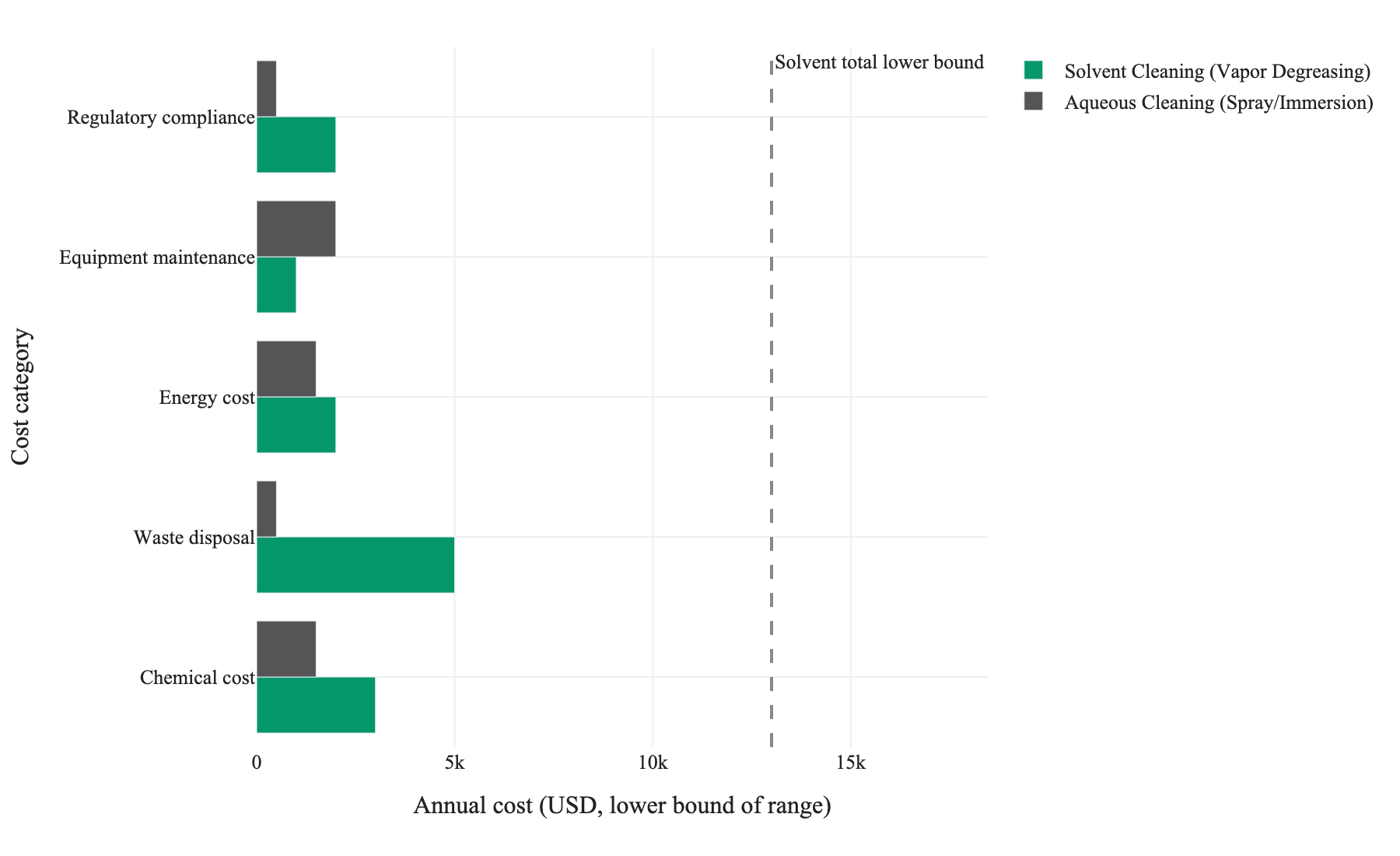
VI. Total Cost of Ownership: Chemical, Waste, Energy, and Compliance
The true cost of a cleaning process extends far beyond chemical purchase price. A comprehensive total cost of ownership (TCO) analysis must include chemical consumption, waste generation and disposal, energy consumption, equipment and maintenance, labor, and regulatory compliance costs.
Chemical Cost
Solvent costs per liter are typically 3 to 10 times higher than aqueous cleaner concentrates. However, solvent consumption rates are lower because vapor degreasing systems continuously recover and recycle solvent through distillation. A well-maintained vapor degreaser may consume only 5 to 15 liters of makeup solvent per month, while an aqueous system processing the same throughput may use 200 to 500 liters of diluted cleaning solution that requires periodic replacement.
On a per-part basis, the chemical cost comparison is highly application-dependent. Low-volume, high-precision cleaning tends to favor solvents due to their self-purifying properties. High-volume, moderate-cleanliness applications tend to favor aqueous cleaning due to lower chemical unit costs.
Waste Disposal
Waste disposal is frequently the largest cost differentiator. Spent solvent, particularly chlorinated or brominated solvent, is classified as hazardous waste in most jurisdictions. Disposal costs range from USD 200 to USD 800 per drum (approximately 200 liters) depending on solvent type and local regulations (DTSC California, 2024). Hazardous waste generator status also triggers regulatory reporting requirements, facility inspections, and manifesting obligations that add administrative burden.
Aqueous cleaning waste is often non-hazardous, reducing disposal costs to USD 30 to USD 100 per drum for oil-contaminated wastewater. Many facilities can treat aqueous cleaning waste through their existing wastewater treatment systems, eliminating external disposal entirely. However, aqueous waste that contains heavy metals, cyanide, or concentrated surfactants may still require hazardous waste management.
Energy Consumption
Vapor degreasing consumes significant energy to heat solvent to its boiling point and maintain the vapor zone. Boiling points range from 40 C for low-boiling HFEs to 174 C for perchloroethylene. Refrigerated freeboard coils that prevent vapor escape add to energy consumption. However, no separate drying energy is required.
Aqueous cleaning typically requires heating to 45 to 70 C, which consumes less energy than solvent boiling. The additional energy for pump circulation, spray pressure, and forced-air drying partially offsets this advantage. Overall energy consumption is comparable between the two approaches for most applications, with the balance depending on specific temperatures, throughput, and equipment efficiency.
Regulatory Compliance Cost
VOC emission limits, hazardous air pollutant (HAP) regulations, and workplace exposure limits impose compliance costs on solvent cleaning operations. Facilities using chlorinated solvents may require air emission controls, personal exposure monitoring, medical surveillance, and specialized training programs. The cumulative compliance cost can exceed the chemical cost itself.
Aqueous cleaning faces fewer air quality regulations but may trigger wastewater discharge permit requirements. Facilities must ensure that spent aqueous cleaning solutions meet local discharge limits for pH, oil and grease, biochemical oxygen demand (BOD), and specific contaminants.
Figure 5. Total Cost of Ownership Breakdown
Cost Category | Solvent Cleaning (Vapor Degreasing) | Aqueous Cleaning (Spray/Immersion) |
|---|---|---|
Chemical cost per year (typical) | USD 3,000-8,000 (low volume, high unit cost) | USD 1,500-4,000 (high volume, low unit cost) |
Waste disposal per year | USD 5,000-15,000 (hazardous waste) | USD 500-3,000 (non-hazardous waste) |
Energy cost per year | USD 2,000-5,000 (heating + refrigeration) | USD 1,500-4,000 (heating + drying) |
Equipment maintenance per year | USD 1,000-3,000 | USD 2,000-5,000 (pumps, filters, heaters) |
Regulatory compliance per year | USD 2,000-8,000 (monitoring, reporting, PPE) | USD 500-2,000 (wastewater permits) |
Total estimated annual cost | USD 13,000-39,000 | USD 6,000-18,000 |
The TCO comparison shows that aqueous cleaning is typically 40 to 60 percent less expensive than solvent cleaning on a total cost basis, primarily driven by lower waste disposal and regulatory compliance costs. However, this analysis assumes equivalent cleaning performance. If an aqueous process requires longer cycle times, additional labor, or rework due to inadequate cleaning, the effective cost gap narrows or reverses. The lowest-cost solution is always the one that cleans correctly the first time.
VII. Contaminant-Substrate Decision Framework
Selecting the right cleaning chemistry requires systematic evaluation of the contaminant, substrate, geometry, cleanliness requirement, and cost constraints. The following decision framework provides a structured approach.
Step 1: Identify the Primary Contaminant
Accurate contaminant identification is the most critical step. Many cleaning failures trace back to assumptions about soil composition that prove incorrect. For example, a "cutting oil" may actually be a semi-synthetic emulsion with both hydrocarbon and water-soluble components. FTIR analysis of the contaminant provides definitive identification when the soil composition is uncertain.
Step 2: Match Contaminant to Cleaning Mechanism
Use the contaminant-mechanism matrix to identify which cleaning approach addresses the soil's molecular structure. Nonpolar hydrocarbon soils point toward solvent cleaning. Water-soluble or saponifiable soils point toward aqueous cleaning. Mixed soils may require semi-aqueous or sequential cleaning processes.
Step 3: Check Substrate Constraints
Verify material compatibility between the cleaning chemistry and all substrate materials present on the part. Reactive metals narrow the aqueous pH range. Sensitive polymers restrict solvent options. Multi-material assemblies may eliminate certain chemistries entirely.
Step 4: Evaluate Geometry and Access
Assess whether the part geometry allows adequate fluid access for the selected cleaning method. Complex internals favor vapor degreasing. Open geometries are compatible with either approach.
Step 5: Apply Cleanliness Standard
Match the required cleanliness level to the cleaning process capability. Precision applications (medical, aerospace, electronics) may require specific validated processes. General industrial cleaning allows more flexibility in process selection.
Figure 6. Contaminant-Substrate Decision Matrix
Contaminant Type | Steel/Iron | Aluminum Alloy | Copper/Brass | Plastics/Composites | Complex Geometry |
|---|---|---|---|---|---|
Heavy mineral oil | Solvent (VD) | Solvent (VD) | Solvent (VD) | Aqueous (check compatibility) | Solvent (VD) |
Synthetic coolant | Aqueous | Aqueous (mild pH) | Aqueous (mild pH) | Aqueous | Aqueous + ultrasonic |
Wax/drawing compound | Semi-aqueous | Semi-aqueous | Semi-aqueous | Aqueous (if compatible) | Solvent (VD) |
Solder flux | Engineered solvent | N/A | Aqueous defluxer | Aqueous defluxer | Solvent (VD) |
Particulate only | Aqueous (spray) | Aqueous (spray) | Aqueous (spray) | Aqueous (spray) | Aqueous + ultrasonic |
Vegetable/animal fat | Aqueous (alkaline) | Aqueous (mild alkaline) | Aqueous (neutral) | Aqueous | Aqueous + ultrasonic |
The decision matrix cross-references contaminant type with substrate material to narrow the cleaning chemistry selection. "VD" indicates vapor degreasing as the preferred solvent application method. Entries marked with pH qualifiers indicate that the aqueous formulation must be selected within the specified pH range to prevent substrate damage. This matrix provides starting-point recommendations that should be validated through cleaning trials under actual production conditions.
VIII. Key Takeaway
Solvent cleaning works by dissolving contaminants through molecular affinity (like-dissolves-like), making it most effective for nonpolar hydrocarbon soils, heavy greases, and wax compounds where direct dissolution is the fastest removal mechanism.
Aqueous cleaning employs multiple parallel mechanisms (surfactant emulsification, saponification, displacement, chelation) that are collectively effective for water-soluble fluids, saponifiable fats, and particulate contamination.
Neither approach is universally superior. The optimal choice depends on matching the cleaning mechanism to the contaminant's molecular structure, the substrate material's chemical sensitivity, and the part geometry's accessibility requirements.
Total cost of ownership analysis typically favors aqueous cleaning by 40 to 60 percent, but this advantage applies only when the aqueous process achieves the required cleanliness level. Inadequate cleaning performance erases cost savings through rework, rejects, and downstream failures.
When contaminant identification is uncertain, invest in FTIR or GC/MS analysis before committing to a cleaning chemistry. The cost of analytical testing is negligible compared to the cost of implementing the wrong cleaning process.
Lubinpla's AI platform can cross-reference contaminant chemistry with substrate compatibility data and cleaning mechanism databases to recommend the most effective cleaning process for specific application conditions, reducing the trial-and-error cycles that typically accompany cleaning chemistry transitions.
IX. References
[1] Best Technology, "Understanding Kauri-Butanol Value: A Key Indicator in Solvent Cleaning", 2024. https://www.besttechnologyinc.com/bestsolv/understanding-kauri-butanol-value-solvent-cleaning/
[2] TechSpray, "Kauri-Butanol (Kb) Values and Solubility Parameters", 2024. https://www.techspray.com/kauri-butanol-kb-values-and-solubility-parameters
[3] BFK Solutions, "The Kauri-Butanol Number: Unconventional Wisdom", 2023. https://bfksolutions.com/the-kauri-butanol-number-unconventional-wisdom/
[4] Techspray, "Vapor Degreasing: The Quick Guide", 2024. https://www.techspray.com/vapor-degreasing-the-quick-guide
[5] Reliance Specialty Products, "What's Going On with nPB (1-BP)?", 2024. https://relspec.com/vapor-degreasing-blog/what-is-going-on-with-npb
[6] ACS Langmuir, "Mechanism of Surfactant Micelle Formation", 2008. https://pubs.acs.org/doi/10.1021/la801705y
[7] Elchemy, "Role of Surfactants: How They Work in Cleaning, Personal Care, and Industry", 2024. https://elchemy.com/blogs/chemical-market/role-of-surfactants-how-they-work-in-cleaning-personal-care-and-industry
[8] Hubbard-Hall, "Aqueous Cleaning", 2024. https://www.hubbardhall.com/applications/surface-cleaning-chemistry/aqueous-cleaning
[9] Cannon Industrial Plastics, "Alkaline Cleaners Guide for Metal Finishing and Electroplating", 2024. https://cannonindustrialplastics.com/blog/alkaline-cleaners-guide-industrial-cleaning-chelating-agents/
[10] Better Engineering, "Solvent vs. Aqueous Cleaners Explained", 2024. https://www.betterengineering.com/blog/solvent-vs-aqueous-cleaners/
[11] DTSC California, "Solvent Recycling Fact Sheet", 2024. https://dtsc.ca.gov/wp-content/uploads/sites/31/2024/05/TD_FS_SolventRecycling_accessible.pdf
[12] Leading Edge Only, "What is Millipore Test? Industrial Component Parts Cleanliness", 2024. https://www.leadingedgeonly.com/article/what-is-millipore-test-industrial-component-parts-cleanliness
[13] Crystal Clean, "Aqueous Vs Solvent Chemistries: Which is Best for You", 2024. https://www.crystal-clean.com/aqueous-vs-solvent-chemistries-which-is-best-for-you/
[14] Zerust, "The Ultimate Guide to Aqueous Parts Washers", 2025. https://www.zerust.com/blog/2025/02/19/the-ultimate-guide-to-aqueous-parts-washers-efficiency-sustainability-and-performance/
Powered by Lubinpla
Discover how technical teams solve complex challenges faster with AI.