Step-by-Step: Diagnosing Cooling Water Treatment Failures
Summary: Cooling water treatment failures are commonly misdiagnosed because corrosion, scale, and biological fouling share overlapping symptoms, and the instinctive response of adding more treatment chemical without proper diagnosis often makes the problem worse. This article provides a systematic 5-step diagnostic sequence that any field engineer can follow to accurately identify the root cause, along with a corrective action matrix that matches the right treatment response to each failure mechanism. A misdiagnosed cooling water problem typically costs 2x to 5x more to resolve than a correctly diagnosed one, and scale deposits as thin as 1/32 inch can increase energy consumption by 10 to 15 percent. By replacing trial-and-error with structured diagnosis, engineers can reduce resolution time from days to hours and eliminate the chemical waste that comes from treating the wrong problem.
Table of Contents
I. Why Trial-and-Error Diagnosis Fails
II. The Three Failure Mechanisms and Their Field Symptoms
III. The 5-Step Diagnostic Sequence
IV. Corrective Action Matrix by Root Cause
V. Common Pitfalls: When Treatment Makes Things Worse
VI. Field Case: When the Obvious Diagnosis Was Wrong
VII. Key Takeaway
VIII. References
I. Why Trial-and-Error Diagnosis Fails
When a cooling water system shows signs of trouble, the most common response is to increase the dosage of the existing treatment chemical. If corrosion coupons show elevated rates, the operator adds more inhibitor. If scale appears on heat exchanger tubes, the operator increases the scale inhibitor feed. If the tower basin shows biofilm growth, the operator shocks with biocide. This approach fails when the diagnosis is wrong, which happens more frequently than most operators realize because the three primary failure mechanisms, corrosion, scale, and biological fouling, often produce similar visible symptoms.
The Cost of Misdiagnosis
A misdiagnosed cooling water problem typically costs 2x to 5x more to resolve than a correctly diagnosed one because the initial wrong treatment wastes chemicals, delays resolution, and can actively worsen the underlying condition (Chardon Labs, 2023). For example, increasing scale inhibitor dosage when the actual problem is microbiological fouling does nothing to address the biofilm and may provide additional nutrients for bacterial growth. Adding acid to reduce the Langelier Saturation Index (LSI) when the actual problem is under-deposit corrosion beneath biofilm can accelerate the corrosion by lowering pH at the metal surface. These misdiagnosis scenarios are avoidable with a structured diagnostic approach.
The financial consequences extend well beyond wasted chemicals. According to NACE International, corrosion costs the United States approximately 276 billion dollars annually, roughly 3 percent of GDP, and cooling systems are among the primary contributors due to their constant exposure to corrosive conditions (NACE, 2016). On the energy side, the U.S. Department of Energy estimates that scale buildup of just 1/32 of an inch on condenser tubes increases energy consumption by 10 to 15 percent (DOE, 2023). For a mid-sized industrial facility running a 500-ton chiller, that translates to thousands of dollars per month in excess electricity costs. When the wrong treatment allows scale to persist for weeks or months, the cumulative energy penalty alone can exceed the cost of the chemicals by an order of magnitude.
Why Symptoms Overlap
The fundamental challenge in cooling water diagnosis is that the three failure mechanisms do not present in isolation. Biofilm traps suspended solids and mineral deposits, creating a composite fouling layer that visually resembles pure scale. Corrosion products, particularly iron oxide, deposit on surfaces and are frequently mistaken for biological fouling because both can appear as reddish-brown accumulations. Scale deposits create sheltered zones beneath which localized corrosion accelerates, producing symptoms that suggest general corrosion when the root cause is actually mineral deposition. This overlap is not an edge case. It is the norm in most industrial cooling systems, which is precisely why a structured diagnostic sequence is necessary to separate the mechanisms and identify the primary driver.
II. The Three Failure Mechanisms and Their Field Symptoms
Accurate diagnosis begins with understanding what each failure mechanism looks like in the field. While laboratory analysis provides definitive confirmation, visual and tactile assessment provides the first-pass differentiation that directs subsequent testing. The following breakdown covers the three primary mechanisms, their chemical drivers, and the field-observable symptoms that distinguish each.
Corrosion
Corrosion in cooling water systems is an electrochemical process in which the metal surface loses material to the surrounding water. The two most common forms are general corrosion, which removes material uniformly across the surface, and pitting corrosion, which penetrates deeply at localized points while leaving the surrounding surface relatively intact. Pitting is far more dangerous because it can perforate a tube wall while the average corrosion rate measured by coupons still appears acceptable.
The Association of Water Technologies (AWT) defines acceptable corrosion rates for open recirculating cooling water systems as follows: carbon steel should remain below 1.0 mils per year (mpy) for moderate performance and below 0.5 mpy for good performance, while copper alloys should stay below 0.5 mpy for moderate and below 0.25 mpy for good performance (AWT, 2023). Rates exceeding these thresholds indicate that the treatment program requires immediate investigation and adjustment.
Key field indicators of corrosion include red-brown deposits (iron oxide from carbon steel), blue-green deposits (copper corrosion products), pitted or roughened metal surfaces, and increasing iron or copper concentrations in the circulating water. Low pH, high chloride levels, and low inhibitor residuals are the most common chemical conditions that drive accelerated corrosion.
Scale
Scale forms when dissolved minerals in the cooling water exceed their solubility limits and precipitate onto heat transfer surfaces. The most common scale types in cooling systems are calcium carbonate (CaCO3), calcium sulfate (CaSO4), and silica (SiO2). Each has different formation conditions and, critically, different removal methods, which makes correct identification essential before any cleaning or treatment adjustment.
Calcium carbonate is the most frequently encountered scale type. It forms when the LSI is positive, meaning the water is supersaturated with respect to calcium carbonate. The LSI is calculated from pH, calcium hardness, alkalinity, total dissolved solids, and temperature. An LSI above +0.5 indicates a significant scaling tendency, while values above +2.0 indicate aggressive scale formation that will coat heat transfer surfaces rapidly (Lenntech, 2023). However, the LSI only predicts calcium carbonate scaling tendency. It provides no information about calcium sulfate or silica scaling, which require separate evaluation of sulfate and silica concentrations respectively.
The defining field characteristic of scale is its hard, crystalline texture and its preferential formation on the hottest surfaces in the system, particularly heat exchanger tube walls. Scale acts as a thermal insulator, and even thin deposits have significant consequences. A 1/32-inch layer of calcium carbonate scale on condenser tubes can increase energy consumption by 10 to 15 percent, while organic-type fouling deposits of the same thickness can reduce heat transfer efficiency by up to 33 percent (U.S. DOE, 2023). Unlike corrosion and biological deposits, scale deposits are firmly adhered and cannot be wiped off with a finger. They require chemical dissolution or mechanical removal.
Biological Fouling
Biological fouling encompasses planktonic bacteria suspended in the water and sessile bacteria attached to surfaces as biofilm. The distinction matters because planktonic bacteria are relatively easy to kill with oxidizing biocides, while biofilm bacteria are protected by an extracellular polymeric substance (EPS) matrix that oxidizing biocides cannot fully penetrate. This is why a system can show acceptable planktonic bacteria counts on dip slides while harboring a substantial biofilm on internal surfaces.
Microbiologically influenced corrosion (MIC) accounts for approximately 20 percent of all corrosion damage in industrial systems (FEMS Microbiology Reviews, 2023). In cooling water specifically, sulfate-reducing bacteria (SRB) are among the most destructive organisms. SRB thrive in the anaerobic conditions found beneath biofilm and beneath deposits, reducing sulfate ions to hydrogen sulfide (H2S), which is directly corrosive to carbon steel and promotes the formation of iron sulfide deposits. Corrosion rates in systems with active SRB populations can be 2 to 10 times higher than in systems without them (Chem-Aqua, 2023). The characteristic black deposits and rotten-egg odor of hydrogen sulfide are telltale signs of SRB activity, but these signs often appear only after significant damage has already occurred.
Beyond equipment damage, biological contamination in cooling towers carries a public health dimension. Legionella pneumophila, the bacterium responsible for Legionnaires' disease, thrives in water temperatures between 25 and 42 degrees Celsius, which encompasses the typical operating range of many cooling tower basins. ANSI/ASHRAE Standard 188-2021 requires building owners and facility managers to develop and implement water management programs specifically addressing Legionella risk in cooling tower systems (ASHRAE, 2021). Any diagnostic investigation that reveals elevated biological activity must include a Legionella risk assessment as part of the corrective action plan.
Figure 1. Field Symptom Differentiation by Failure Mechanism
Symptom | Corrosion | Scale | Biological Fouling |
|---|---|---|---|
Deposit color | Red-brown (iron), blue-green (copper) | White, gray, or tan | Green, black, or slimy brown |
Deposit texture | Powdery or pitted surface | Hard, crystalline, adhered | Soft, gelatinous, easily wiped |
Deposit location | Low-flow zones, crevices, under deposits | Hottest surfaces, tube walls | Basin walls, fill media, dead legs |
Water clarity | May be clear or slightly turbid | Usually clear | Turbid, may have odor |
pH trend | May be low (acid corrosion) or normal | Usually elevated (> 8.5) | Dropping (acid-producing bacteria) |
Conductivity | May show iron pickup | Stable or rising with cycles | Variable |
Corrosion coupon | Elevated rate, pitting visible | Normal rate, possible scale overlay | Elevated rate under biofilm |
This table enables a first-pass identification within minutes of visual inspection. The most common confusion is between corrosion and biological fouling, because biofilm-induced corrosion produces iron oxide deposits that look identical to general corrosion. The key differentiator is the presence of a soft, slimy layer beneath the rust-colored deposit. If wiping the deposit reveals a gel-like biofilm layer, the primary mechanism is biological, not chemical. A second common confusion is between scale and corrosion product deposits, because both can appear as hard accumulations on tube surfaces. The acid dissolution test described in Step 3 of the diagnostic sequence resolves this ambiguity.
III. The 5-Step Diagnostic Sequence
The following sequence provides a structured path from symptom observation to root cause identification. Each step narrows the diagnostic space and prevents the premature conclusions that lead to misdiagnosis. The process is designed so that Steps 1 through 3 can be completed within a single site visit, Step 4 requires analysis and interpretation, and Step 5 serves as confirmation over a 7 to 14 day monitoring period.
Figure 3. The 5-Step Diagnostic Funnel: From Symptoms to Confirmed Root Cause
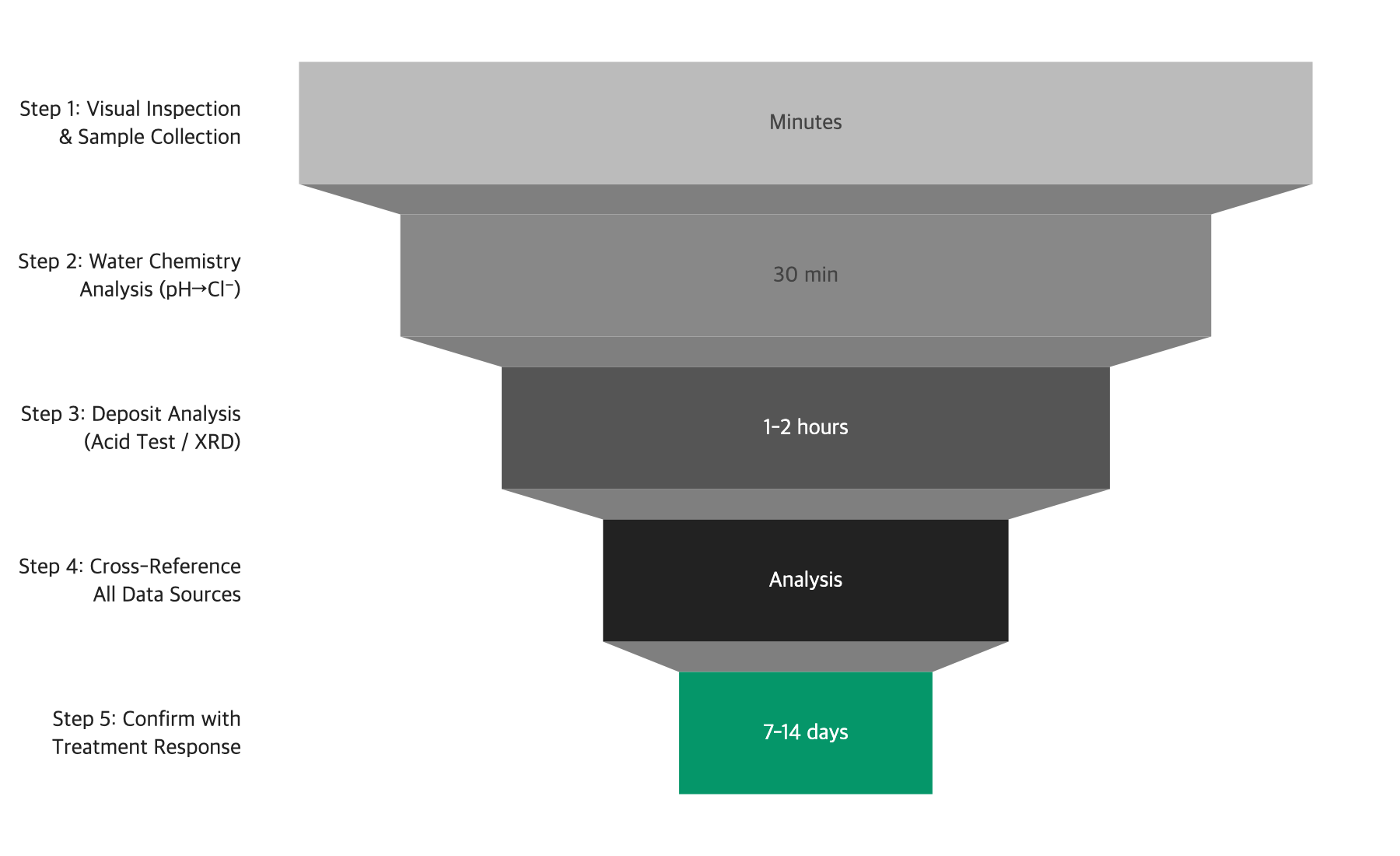
This funnel visualizes the diagnostic sequence from broad initial observation to specific confirmed diagnosis. Each step narrows the diagnostic space, with the time investment increasing at each stage but the certainty of diagnosis increasing proportionally. The process is designed so that the majority of cases are resolved by Step 4, with Step 5 serving as confirmation for ambiguous cases.
Step 1: Visual Inspection and Sample Collection
Inspect the system at three locations: the cooling tower basin, the heat exchanger tubes or tube sheet, and the most restricted flow point in the system. These three locations are selected because they represent the most common sites where each failure mechanism first becomes visible. The basin collects biological growth and sediment. The heat exchanger presents the highest heat flux where scale preferentially forms. Restricted flow points create the low-velocity conditions that promote both deposition and under-deposit corrosion.
Collect a water sample from the return line, after the heat exchanger and before the tower, for chemistry analysis. This location provides the most representative sample of the water condition that the heat exchanger and process equipment actually experience. Collect a deposit sample from the most affected surface for physical and chemical examination. Use a clean spatula or scraper and place the sample in a sealed container to prevent contamination or drying. Document deposit color, texture, location, and coverage pattern using the differentiation table above to form an initial hypothesis.
Photograph all deposits before disturbing them. The spatial distribution of deposits often provides diagnostic information that is lost once samples are collected. A deposit pattern concentrated on the hot side of heat exchanger tubes suggests scale, while deposits concentrated in dead legs and low-flow zones suggest biological fouling. A uniform deposit pattern across all surfaces is more consistent with general corrosion or high suspended solids loading.
Step 2: Water Chemistry Analysis Sequence
Analyze the water sample in the following order, with each result informing the interpretation of the next.
First, measure pH. A value below 7.0 suggests acid corrosion or acid-producing bacteria. A value above 8.5 suggests scaling conditions. For cooling systems using sulfuric acid for pH control, verify that the acid feed system is functioning correctly. A sudden pH drop below 6.5 can cause rapid generalized corrosion across the entire system within hours, making pH the single most critical parameter to evaluate first.
Second, measure conductivity and compare to the expected value based on cycles of concentration. A significant upward deviation indicates that cycles are running higher than intended, which concentrates all dissolved species and increases both scaling and corrosion risk. A downward deviation suggests unexpected dilution from leaks, rain ingress, or excessive makeup water flow. Calculate the actual cycles of concentration by dividing the conductivity of the recirculating water by the conductivity of the makeup water, and compare to the target cycles for the system.
Third, measure calcium hardness and M-alkalinity. Calculate the Langelier Saturation Index. A positive LSI confirms scaling tendency. A strongly negative LSI, below -1.0, confirms corrosive tendency. The ideal operating range for most cooling systems is an LSI between -0.5 and +0.5, providing a buffer against both scale formation and corrosion (Lenntech, 2023). Remember that LSI applies only to calcium carbonate. If calcium sulfate or silica scale is suspected, evaluate sulfate concentration against the calcium sulfate solubility limit, typically around 2,000 ppm as CaSO4, and dissolved silica against the silica solubility limit, generally maintained below 150 ppm as SiO2.
Fourth, measure chloride concentration. Chloride above 250 ppm in systems with stainless steel or copper alloys indicates pitting corrosion risk. Chloride is particularly aggressive because it penetrates passive oxide films on stainless steel, initiating pitting at specific points rather than causing uniform corrosion. In systems with high chloride, also check for the presence of galvanic couples between dissimilar metals, which accelerate localized attack.
Fifth, perform a bacteria count using dip slides or adenosine triphosphate (ATP) testing. Traditional dip slides require 24 to 48 hours of incubation to provide colony-forming unit (CFU) counts, making them less useful for immediate diagnostic decisions. ATP testing provides results in less than 15 minutes by measuring the energy molecule present in all living cells, giving a real-time indication of total biological activity (Promega, 2023). Counts above 10,000 CFU/mL indicate biological activity requiring treatment. Counts above 100,000 CFU/mL indicate severe biological contamination that demands immediate biocide intervention. The Cooling Technology Institute (CTI) recommends that total planktonic counts in open cooling systems should not exceed 10,000 CFU/mL as a routine operating target.
Step 3: Deposit Analysis
If deposits were collected in Step 1, perform a simple acid dissolution test. Apply 10 percent hydrochloric acid (HCl) to the deposit. Vigorous fizzing indicates calcium carbonate scale, as the acid reacts with CaCO3 to release carbon dioxide gas. No reaction suggests calcium sulfate, silica, or biological material. If the deposit dissolves partially and leaves a residue, the deposit is mixed, which is common in systems where multiple mechanisms are active simultaneously.
For field-level differentiation between biological and inorganic residues, apply a small amount of household bleach (sodium hypochlorite) to the portion that did not dissolve in acid. If the residue softens, disperses, or produces a color change, biological material is present. If the residue remains hard and unaffected by both acid and bleach, silica or calcium sulfate is the likely constituent.
For definitive identification, submit the deposit for laboratory X-ray diffraction (XRD) analysis, which identifies the precise mineral phases and distinguishes between scale types, corrosion products, and biological deposits. While XRD results typically require 3 to 5 business days, the field-level acid and bleach tests described above provide sufficient information to begin corrective action in most cases. The laboratory result then serves to confirm or refine the initial diagnosis.
An additional field indicator is the odor of the deposit. A sulfurous or rotten-egg smell strongly suggests the presence of sulfate-reducing bacteria, which produce hydrogen sulfide as a metabolic byproduct. Black deposits beneath a biofilm layer, particularly those that stain copper or silver surfaces, are characteristic of SRB activity and indicate that the corrosion mechanism is microbiologically driven rather than purely electrochemical.
Step 4: Cross-Reference Chemistry with Symptoms
Compare the water chemistry results from Step 2 with the visual observations from Step 1 and the deposit analysis from Step 3. The diagnosis is confirmed when all three data sources point to the same mechanism. The following cross-referencing logic resolves the most common diagnostic ambiguities.
If visual inspection shows hard, white deposits on heat exchanger tubes, the LSI is positive, and the acid dissolution test produces vigorous fizzing, the diagnosis is calcium carbonate scale. No ambiguity exists, and the corrective action from the matrix in Section IV can be applied with confidence.
If visual inspection shows red-brown deposits, corrosion coupon rates are elevated, but the bacteria count also exceeds 10,000 CFU/mL, the likely scenario is microbiologically influenced corrosion. The biofilm is the primary mechanism, and the elevated corrosion is a consequence of the biological activity, not an independent failure. Treating this as a pure corrosion problem by adding more inhibitor will fail because the inhibitor cannot penetrate the biofilm to reach the metal surface.
If the data sources conflict in ways that do not fit the common patterns above, the most likely explanation is that multiple mechanisms are active. This is not unusual. Many cooling water problems involve two or all three mechanisms operating simultaneously, with one serving as the primary driver and the others as secondary effects. Prioritize the mechanism that poses the greatest immediate risk to equipment integrity, which is typically corrosion if pitting is present or biological fouling if Legionella risk exists.
Step 5: Confirm with Treatment Response
Implement the corrective action for the diagnosed mechanism from the matrix in Section IV. Monitor the system daily for 7 to 14 days using the specific monitoring indicators listed in the matrix for each root cause. This confirmation period is essential because it validates the diagnosis through the most definitive test available: whether the treatment actually resolves the problem.
If the problem resolves within the monitoring period, the diagnosis was correct, and the corrective action should be incorporated into the ongoing treatment program. If no improvement is seen within 7 days, re-evaluate by returning to Step 1 with the additional information gained from the failed treatment response. The fact that a specific treatment did not work is itself diagnostic information. It eliminates one mechanism from consideration and narrows the remaining possibilities.
Document the entire diagnostic sequence, including the initial hypothesis, the chemistry and deposit analysis results, the cross-referencing logic, and the treatment response outcome. This documentation creates a site-specific diagnostic history that accelerates future troubleshooting by revealing patterns such as seasonal biological activity, scale formation during high-load periods, or corrosion events correlated with specific makeup water chemistry changes.
IV. Corrective Action Matrix by Root Cause
Once the root cause is identified through the diagnostic sequence, the corrective action must match the specific mechanism. Applying the wrong corrective action is the most common source of treatment failure escalation. The matrix below provides the primary and secondary actions for each diagnosed root cause, along with the specific monitoring indicators that confirm whether the treatment is working.
Figure 2. Corrective Action Matrix by Diagnosed Root Cause
Root Cause | Primary Action | Secondary Action | Monitoring Indicator |
|---|---|---|---|
Calcium carbonate scale | Increase scale inhibitor, reduce pH to lower LSI, increase blowdown | Clean with 5-10% HCl circulation | LSI trending, calcium hardness |
Calcium sulfate scale | Reduce cycles of concentration, add specific CaSO4 inhibitor | Mechanical cleaning (acid ineffective) | Sulfate concentration, cycles |
Silica scale | Reduce cycles to keep SiO2 below 150 ppm, add silica dispersant | Hot alkaline soak (5% NaOH, 80C) | Dissolved silica, pH |
General corrosion | Increase corrosion inhibitor, adjust pH to 7.5-8.5 range | Check inhibitor feed system calibration | Corrosion coupon rates, iron in water |
Pitting corrosion | Reduce chloride by increasing blowdown, add pitting inhibitor | Inspect and replace affected components | Chloride levels, pitting index |
Under-deposit corrosion | Remove deposits first, then treat corrosion | Clean system before increasing inhibitor | Deposit surveys, iron trending |
Planktonic bacteria | Oxidizing biocide (chlorine/bromine) shock treatment | Adjust pH to biocide-effective range | ATP or dip slide counts |
Biofilm | Non-oxidizing biocide (glutaraldehyde/isothiazolone) + biodispersant | Mechanical cleaning of accessible surfaces | Biofilm monitoring coupons |
Legionella risk | Thermal or chemical disinfection per local regulations | System-wide risk assessment per ASHRAE 188 | Legionella-specific testing |
The matrix highlights several critical principles that are frequently violated in practice.
First, under-deposit corrosion must be treated by removing deposits before increasing corrosion inhibitor, because the inhibitor cannot penetrate the deposit to reach the metal surface. Adding more inhibitor without cleaning is the most common and most expensive misdiagnosis error. The correct sequence is always clean first, then optimize inhibitor dosage.
Second, biofilm requires non-oxidizing biocide because oxidizing biocides such as chlorine react with the outer layer of the biofilm matrix and are consumed before penetrating to the living bacteria within. The EPS matrix that protects biofilm bacteria reacts with and neutralizes oxidizing biocides at the surface, creating a demand that can consume the entire applied dose without ever reaching the bacteria. A biodispersant applied before or alongside the non-oxidizing biocide breaks up the EPS matrix and exposes the bacteria to the biocide.
Third, calcium sulfate scale cannot be removed with acid. Unlike calcium carbonate, calcium sulfate has very low solubility in acid solutions, and attempting acid cleaning on a calcium sulfate deposit wastes time and chemicals while potentially damaging the equipment. Mechanical cleaning or specialized chemical formulations designed for sulfate deposits are required.
Fourth, silica scale requires alkaline conditions for removal, which is the opposite of the acid cleaning used for calcium carbonate. Applying the wrong cleaning chemistry based on an incorrect deposit identification damages the equipment and may make the scale harder to remove by altering the deposit surface chemistry.
V. Common Pitfalls: When Treatment Makes Things Worse
Understanding the most frequent diagnostic errors helps engineers avoid the costly cycle of misdiagnosis and escalation that plagues many cooling water programs. The following pitfalls are drawn from the most commonly observed failure patterns in industrial cooling systems.
Pitfall 1: Treating Symptoms Instead of Root Causes
The most common error is increasing chemical dosage without diagnosing the underlying problem. Adding more corrosion inhibitor when the actual issue is microbiological fouling is ineffective because the corrosion is occurring beneath a biofilm that the inhibitor cannot penetrate. The correct sequence is to eliminate the biofilm first with appropriate biocide and biodispersant treatment, then address any residual corrosion with inhibitor optimization. Similarly, adding more scale inhibitor when the actual problem is insufficient blowdown merely increases chemical costs without addressing the supersaturation condition that drives scale formation. The scale inhibitor can delay precipitation, but if the water is far above its saturation limit due to excessive cycles of concentration, no amount of inhibitor will prevent scale entirely.
Pitfall 2: Acid Feed Without Monitoring
Adding acid to reduce pH and control scale tendency is effective when properly controlled but dangerous when the acid feed system malfunctions or overshoots. A sudden pH drop below 6.5 can cause rapid general corrosion that damages the entire system within hours. The rate of corrosion on carbon steel approximately doubles for every unit decrease in pH below 7.0, meaning a pH excursion from 7.0 to 5.0 can increase the corrosion rate by a factor of four or more. Acid feed systems require continuous pH monitoring with automatic shutoff alarms and should never be adjusted based on grab samples alone. The grab sample shows pH at a single point in time, while pH can fluctuate significantly between samples due to load changes, chemical feed cycles, and biological activity. Facilities that rely on daily grab samples for acid feed control are particularly vulnerable to overnight pH excursions that cause extensive corrosion damage before the next sample is taken.
Pitfall 3: Ignoring Interactions Between Mechanisms
Cooling water problems rarely involve a single mechanism in isolation. Scale deposits create sheltered zones where corrosion accelerates because the dissolved oxygen concentration beneath the deposit differs from the bulk water, establishing a differential aeration cell. Biofilm traps scale-forming minerals and creates anaerobic pockets that promote sulfate-reducing bacteria and aggressive localized corrosion. SRB produce hydrogen sulfide that is directly corrosive to carbon steel and can accelerate corrosion rates by 2 to 10 times compared to abiotic conditions (Chem-Aqua, 2023). High chloride levels promote both pitting corrosion and reduced biocide effectiveness, because chlorine-based biocides form less effective chloramine compounds in the presence of high chloride and ammonia. The diagnostic sequence in Section III addresses this by requiring cross-referencing of all data sources to identify the primary mechanism and any secondary mechanisms that must also be addressed.
Pitfall 4: Misinterpreting Corrosion Coupon Data
Corrosion coupons measure average weight loss over the exposure period, expressed as mils per year. This measurement captures general corrosion effectively but can be misleading in two important ways. First, a coupon that has been heavily scaled may show a low corrosion rate because the scale has protected the metal surface, while the actual system piping is corroding at a higher rate in areas where scale coverage is incomplete. Second, pitting corrosion concentrates metal loss at specific points, and a coupon with severe pitting can show an average corrosion rate in the "good" range while the maximum pit depth is already at a level that threatens tube wall integrity. Always inspect coupons visually for pitting in addition to calculating the average weight loss rate. The AWT guidelines classify pitting on coupons separately from general corrosion rates, and the presence of any pitting on a coupon warrants investigation regardless of the calculated average rate.
Pitfall 5: Biocide Dosing Without pH Verification
The effectiveness of oxidizing biocides is highly pH-dependent. Chlorine-based biocides exist as hypochlorous acid (HOCl) below pH 7.5 and as hypochlorite ion (OCl-) above pH 7.5. Hypochlorous acid is approximately 80 to 100 times more effective as a biocide than hypochlorite ion. This means that a system running at pH 8.5 requires significantly more chlorine to achieve the same kill rate as a system running at pH 7.0. Engineers who add more chlorine to combat biological growth without checking the pH first waste chemical and risk creating elevated disinfection byproduct levels. Bromine-based biocides are less pH-sensitive and maintain effectiveness across a broader pH range, making them a better choice for systems that operate consistently above pH 8.0.
VI. Field Case: When the Obvious Diagnosis Was Wrong
The following case illustrates how the diagnostic sequence prevents a common misdiagnosis pattern. It uses anonymized data from a representative industrial scenario following conditions frequently observed in practice.
Case Background
Company A operates a 400-ton open recirculating cooling system serving a process heat exchanger at a chemical manufacturing facility. The system runs at 3.5 cycles of concentration with sulfuric acid feed for pH control and a phosphonate-based scale and corrosion inhibitor program. Makeup water is municipal supply with moderate hardness, approximately 180 ppm as CaCO3.
The facility reported increasing approach temperature on the heat exchanger, with the temperature differential between the process side outlet and the cooling water inlet rising from the design value of 5 degrees Celsius to 9 degrees Celsius over a period of 8 weeks. Corrosion coupons retrieved at the end of the period showed a rate of 1.8 mpy on carbon steel, well above the 1.0 mpy threshold for moderate performance.
Initial (Incorrect) Diagnosis
The operating team concluded that the problem was corrosion, based on the elevated coupon rate and the presence of red-brown deposits on the tube sheet. They increased the corrosion inhibitor dosage by 50 percent. After three weeks, the coupon rate remained elevated at 1.6 mpy, and the approach temperature continued to increase.
Structured Diagnostic Findings
Applying the 5-step sequence revealed a different picture. Visual inspection (Step 1) confirmed the red-brown deposits but also found a soft, gelatinous layer beneath them that could be wiped with a finger. Water chemistry analysis (Step 2) showed pH at 7.8 (acceptable), calcium hardness at 630 ppm (elevated, reflecting 3.5 cycles), LSI at +0.8 (mild scaling tendency), and ATP testing at 85,000 relative light units (RLU), indicating heavy biological activity. Deposit analysis (Step 3) showed partial dissolution in acid, with fizzing (indicating some calcium carbonate) and a significant organic residue that dispersed in bleach (indicating biological material). The deposits were mixed.
Cross-referencing (Step 4) identified the primary mechanism as biological fouling with secondary calcium carbonate scale. The biofilm had established first, creating an insulating layer that raised the tube surface temperature. The higher surface temperature then pushed the local water chemistry past the calcium carbonate saturation point, causing scale to precipitate within and on top of the biofilm layer. The corrosion was a tertiary effect, occurring beneath the composite deposit through differential aeration and possible SRB activity.
Corrective Action and Outcome
The corrective action followed the matrix sequence: non-oxidizing biocide (isothiazolone) with biodispersant applied first to eliminate the biofilm, followed by acid cleaning with 5 percent HCl to remove the calcium carbonate scale, and finally corrosion inhibitor optimization. Within 10 days of the biocide and cleaning treatment, the approach temperature returned to 5.5 degrees Celsius, and the next coupon retrieval showed a corrosion rate of 0.4 mpy. The total cost of the structured diagnostic approach, including the biocide, biodispersant, and acid cleaning, was approximately 40 percent of what the facility had already spent on the three weeks of increased inhibitor dosing that produced no improvement.
This case demonstrates why "add more inhibitor" is rarely the correct first response and why the 5-step diagnostic sequence consistently outperforms trial-and-error adjustment.
VII. Key Takeaway
The three cooling water failure mechanisms, corrosion, scale, and biological fouling, produce overlapping symptoms that lead to frequent misdiagnosis. Visual inspection using the color, texture, and location differentiation table provides a reliable first-pass identification, but must be confirmed through chemistry and deposit analysis.
The 5-step diagnostic sequence of visual inspection, water chemistry analysis, deposit analysis, cross-referencing, and treatment response confirmation replaces trial-and-error with structured problem-solving that resolves issues in hours rather than days.
The corrective action matrix matches specific treatments to specific mechanisms. The most critical rule is that under-deposit corrosion requires deposit removal before inhibitor optimization, and biofilm requires non-oxidizing biocide before general disinfection.
Adding more treatment chemical without diagnosis is the most expensive common error. The correct response to any cooling water problem is to diagnose first, then treat the identified mechanism with the matched corrective action.
Field cases consistently show that the "obvious" diagnosis is wrong approximately half the time when multiple mechanisms overlap. The structured diagnostic approach prevents the 2x to 5x cost multiplier that results from treating the wrong root cause.
Lubinpla's Assistant can analyze your cooling water chemistry data, corrosion coupon results, biological monitoring trends, and system operating conditions simultaneously to identify whether corrosion, scale, or biological fouling is the primary mechanism, detect multi-mechanism interactions that field inspection alone may miss, and recommend the specific corrective action sequence matched to your system configuration and water chemistry.
VIII. References
[1] Chardon Labs, "Top Cooling Tower Water Treatment Problems", 2023. https://www.chardonlabs.com/resources/top-cooling-tower-water-treatment-problems/
[2] Chem-Aqua, "Understanding Cooling System Tests and Critical Parameters", 2023. https://www.chemaqua.com/en-us/blog/2019/08/13/understanding-cooling-system-tests-and-critical-parameters/
[3] SAMCO Technologies, "Common Cooling Tower Water Treatment Problems and How to Solve Them", 2023. https://samcotech.com/common-cooling-tower-water-treatment-problems-solutions/
[4] SAMCO Technologies, "Treated vs. Untreated Cooling Tower Water: Risks for Your Plant", 2023. https://samcotech.com/treated-vs-untreated-cooling-tower-water-risks-problems/
[5] CED Engineering, "Cooling Water Problems and Solutions", 2023. https://www.cedengineering.com/userfiles/M05-009%20-%20Cooling%20Water%20Problems%20and%20Solutions%20-%20US.pdf
[6] Walchem, "Water Quality Issues in Cooling Towers and How to Address Them", 2023. https://www.walchem.com/common-water-quality-issues-in-cooling-towers/
[7] Lenntech, "Langelier Saturation Index Calculator", 2023. https://www.lenntech.com/calculators/langelier/index/langelier.htm
[8] Association of Water Technologies (AWT), "Standards for Corrosion Rates", 2023. https://bondwater.com/docs/techpapers/corrosion_rates.pdf
[9] NACE International, "International Measures of Prevention, Application and Economics of Corrosion Technology (IMPACT)", 2016. https://impact.nace.org/
[10] ASHRAE, "ANSI/ASHRAE Standard 188-2021, Legionellosis: Risk Management for Building Water Systems", 2021. https://www.ashrae.org/technical-resources/bookstore/ansi-ashrae-standard-188-2021-legionellosis-risk-management-for-building-water-systems
[11] Promega, "ATP Water Testing for Industrial Water Quality Monitoring", 2023. https://www.promega.com/applications/applied-sciences/water-testing/
[12] Chem-Aqua, "Controlling Sulfate-Reducing Bacteria (SRB)", 2023. https://www.chemaqua.com/en-ca/wp-content/uploads/sites/4/2024/07/TB2-028.pdf
[13] FEMS Microbiology Reviews, "Microbiologically Influenced Corrosion: More Than Just Microorganisms", 2023. https://academic.oup.com/femsre/article/47/5/fuad041/7223462
[14] U.S. Department of Energy, "Best Practices for Energy-Efficient Cooling Systems", 2023. https://www.energy.gov/
[15] AP Tech Group, "Scale Formation and Deposits in Cooling Systems", 2023. https://www.aptechgroup.com/water-treatment-conditions-treated/scale/
Powered by Lubinpla
Discover how technical teams solve complex challenges faster with AI.