Synthetic vs Mineral Hydraulic Fluids: Performance Analysis Under Extreme Conditions
Summary: The choice between synthetic and mineral hydraulic fluids is often reduced to a simple cost comparison that ignores the total impact on system performance, component life, and energy efficiency. This article examines the molecular-level differences between polyalphaolefin (PAO) synthetics and mineral oils to explain why they behave differently under extreme temperature, pressure, and contamination conditions. Synthetic PAO fluids deliver 2 to 4 times longer drain intervals, 5 to 10 percent energy savings, and measurably reduced component wear, but at 3 to 5 times the initial fluid cost. The critical question is not which fluid is better, but under which operating conditions the total cost of ownership calculation favors synthetic over mineral, and when mineral oil remains the rational choice.
Table of Contents
I. Why Molecular Structure Determines Hydraulic Fluid Performance
II. Mineral Oil: Molecular Weight Distribution and Natural Characteristics
III. Synthetic PAO: Uniform Molecular Structure and Engineered Properties
IV. Viscosity-Temperature Behavior from Minus 30C to Plus 120C
V. Oxidation Stability and Service Life Under Thermal Stress
VI. System Pressure, Compressibility, and Air Release Performance
VII. Total Cost of Ownership: When Synthetic Delivers Clear ROI
VIII. Key Takeaway
IX. References
I. Why Molecular Structure Determines Hydraulic Fluid Performance
A maintenance team operating injection molding machines in a facility with ambient temperatures ranging from minus 10 degrees C in winter to plus 40 degrees C in summer finds that their mineral hydraulic oil performs well during spring and autumn but causes sluggish startup in winter and runs hot in summer, requiring seasonal oil changes or supplemental heating and cooling. Switching to a synthetic PAO fluid eliminates both problems with a single grade. The reason lies in the fundamental difference between how mineral and synthetic molecules respond to temperature changes.
Hydraulic fluid performance is determined by molecular properties: viscosity-temperature relationship, oxidation resistance, compressibility, and air release behavior. These properties are not arbitrary but arise directly from the molecular structure of the base oil. Mineral oils and synthetic PAOs have fundamentally different molecular architectures, and these differences explain every observable performance gap between the two fluid types.
The Molecular Architecture Divide
Mineral hydraulic oils are refined from crude petroleum through distillation and solvent extraction processes that separate desired hydrocarbon fractions but cannot eliminate the inherent molecular diversity of crude oil. The resulting base oil contains hundreds of different molecular species with varying chain lengths, branching patterns, and ring structures (Machinery Lubrication, 2024).
Synthetic PAO hydraulic fluids are manufactured through controlled polymerization of alpha-olefin monomers (typically 1-decene) to produce molecules with precise, uniform structures. This manufacturing control allows engineers to design molecular properties rather than accept whatever nature provides in crude oil.
II. Mineral Oil: Molecular Weight Distribution and Natural Characteristics
Mineral oil hydraulic fluids are based on API Group I, II, or III base stocks, each representing a different level of refining that progressively improves base oil properties. Understanding the molecular characteristics of mineral oils explains both their adequate performance in many applications and their limitations under extreme conditions.
Molecular Diversity and Its Consequences
A typical mineral hydraulic oil base stock contains paraffinic (straight and branched chain), naphthenic (cyclic), and aromatic (ring) hydrocarbon molecules in varying proportions depending on the crude source and refining process. This molecular diversity has direct performance implications.
Paraffinic molecules provide the best viscosity-temperature behavior and oxidation resistance, making high-paraffinic base stocks preferred for hydraulic applications. Naphthenic molecules provide good solvency for additives and seal compatibility but have lower viscosity indices and poorer oxidation stability than paraffinics. Aromatic molecules, present in small quantities in refined base stocks, are the most vulnerable to oxidation and contribute to deposit formation at high temperatures.
The viscosity index (VI) of mineral hydraulic oils, a measure of how much viscosity changes with temperature, typically ranges from 90 to 110 for Group I and II base stocks and can reach 120 or above for Group III base stocks with severe hydroprocessing. This VI limitation means that mineral oils experience more significant viscosity changes across the operating temperature range than synthetic alternatives.
Wax Content and Low-Temperature Limitations
Mineral oils inherently contain waxy hydrocarbons (long straight-chain paraffins) that crystallize at low temperatures, causing the oil to lose fluidity. The pour point of untreated mineral base oil is typically minus 10 to minus 15 degrees C. Pour point depressant additives can lower this to minus 25 to minus 30 degrees C by modifying wax crystal structure, but the wax crystals still form and increase viscosity even before the pour point is reached.
In hydraulic systems, high viscosity at low temperatures creates several problems. Pump cavitation occurs when the fluid cannot flow fast enough to fill the pump chambers, creating vacuum conditions that damage pump components. Sluggish response results from increased flow resistance through valves and orifices. Increased energy consumption occurs because the pump must work harder to move the thicker fluid through the system.
Thermal and Oxidative Limitations
The molecular diversity of mineral oil means that the least stable molecules (aromatics, molecules with double bonds) oxidize first, producing acids, varnish, and sludge that degrade the bulk oil properties. At continuous operating temperatures above 80 degrees C, mineral oil oxidation rates increase significantly, with a general rule that oil life halves for every 10 degrees C increase above 60 degrees C.
III. Synthetic PAO: Uniform Molecular Structure and Engineered Properties
Polyalphaolefin (PAO) base fluids represent the most widely used synthetic chemistry for hydraulic applications. Their performance advantages arise directly from the controlled, uniform molecular structure achieved through synthetic manufacturing.
Controlled Polymerization and Molecular Uniformity
PAO is manufactured by oligomerizing (linking together) alpha-olefin monomers, typically 1-decene (C10), using a metallocene or BF3 catalyst. The resulting molecules are highly branched isoparaffinic hydrocarbons with precise molecular weight and structure (Chevron Phillips, 2024). Unlike mineral oil, PAO contains no aromatic rings, no double bonds, no sulfur or nitrogen compounds, and no waxy straight-chain paraffins.
This molecular uniformity provides several direct performance advantages. Every molecule in the fluid has similar viscosity-temperature behavior, so the bulk fluid VI is determined by the inherent properties of the designed molecule rather than being an average of diverse molecular species. Typical PAO hydraulic fluids achieve viscosity indices of 130 to 150 without VI improver additives, compared to 90 to 110 for mineral oils.
Engineered Viscosity Grades
PAO base stocks are available in discrete viscosity grades (2, 4, 6, 8, 10, 40, 100 cSt at 100 degrees C) that can be blended to produce any desired viscosity for hydraulic applications. The most common PAO hydraulic fluids use PAO 6 or PAO 8 base stocks, providing ISO VG 32 to 68 viscosity grades that match the requirements of most industrial hydraulic systems.
The absence of wax in PAO gives it naturally low pour points, typically minus 50 to minus 60 degrees C without pour point depressant additives. This means PAO hydraulic fluids maintain fluidity at temperatures where mineral oils would be completely solidified, making them essential for outdoor hydraulic equipment operating in cold climates.
Performance Characteristics Comparison
Property | Mineral Oil (Group II) | Synthetic PAO | Advantage Factor |
|---|---|---|---|
Viscosity Index | 95-110 | 130-150 | PAO 1.3-1.5x higher |
Pour point | -15 to -30C (with PPD) | -50 to -60C (natural) | PAO 20-30C lower |
Flash point | 200-230C | 250-280C | PAO 50C higher |
Oxidation stability (RPVOT, min) | 150-300 | 500-1,200 | PAO 2-4x longer |
Volatility (Noack, %) | 10-20 | 3-8 | PAO 2-3x lower |
Thermal conductivity | Baseline | 5-10% lower | Mineral slightly better |
Additive solvency | Good | Poor (requires co-solvents) | Mineral better |
This comparison reveals that PAO's advantages are concentrated in temperature-related properties (VI, pour point, flash point) and longevity (oxidation stability, volatility). Mineral oil maintains advantages in thermal conductivity and additive solvency, which is why PAO formulations typically require ester co-solvents to achieve adequate additive solubility and seal compatibility.
IV. Viscosity-Temperature Behavior from Minus 30C to Plus 120C
The most operationally significant difference between mineral and synthetic hydraulic fluids is their viscosity-temperature behavior across the full range of conditions that hydraulic systems encounter in practice. This single property affects pump efficiency, system response speed, energy consumption, and component wear.
Viscosity Window Concept
Every hydraulic system has an optimal viscosity window defined by the pump manufacturer, typically 16 to 36 cSt for most vane and piston pumps. Operating below the minimum viscosity causes internal leakage, reduced volumetric efficiency, and accelerated wear due to inadequate lubrication film thickness. Operating above the maximum viscosity causes cavitation, sluggish response, and excessive energy consumption.
The challenge is that viscosity changes with temperature, and the operating temperature of a hydraulic system can vary from ambient startup temperature to steady-state operating temperature (typically 40 to 80 degrees C, but sometimes higher in demanding applications). The fluid must maintain viscosity within the optimal window across this entire temperature range.
Temperature Range Coverage
A mineral ISO VG 46 hydraulic oil with a VI of 100 has a viscosity of approximately 46 cSt at 40 degrees C but increases to over 800 cSt at minus 20 degrees C and drops to approximately 7 cSt at 100 degrees C. A synthetic PAO-based ISO VG 46 with a VI of 140 has the same 46 cSt at 40 degrees C but only approximately 300 cSt at minus 20 degrees C and approximately 10 cSt at 100 degrees C.
This difference means that the PAO fluid stays within the optimal viscosity window across a much wider temperature range. At minus 20 degrees C, the mineral oil is far above the maximum viscosity for most pumps, causing cavitation and potential pump damage during cold startup. The PAO fluid, while thicker than optimal, is still within a manageable range for most pump designs.
Practical Implications for Multi-Season Operation
For hydraulic equipment operating across seasonal temperature variations, the wider viscosity-temperature range of synthetic fluids eliminates the need for seasonal oil changes. A single PAO-based ISO VG 46 fluid can typically cover the operating range from minus 30 degrees C to plus 90 degrees C that would require two or three mineral oil grades (winter, summer, and possibly a transitional grade).
The economic value of this single-grade capability extends beyond the fluid cost to include reduced downtime for oil changes, lower inventory costs (one fluid instead of two or three), and elimination of the risk of using the wrong seasonal grade after a temperature shift.
Figure 1. Viscosity-Temperature Curves: Mineral Oil vs Synthetic PAO (ISO VG 46)
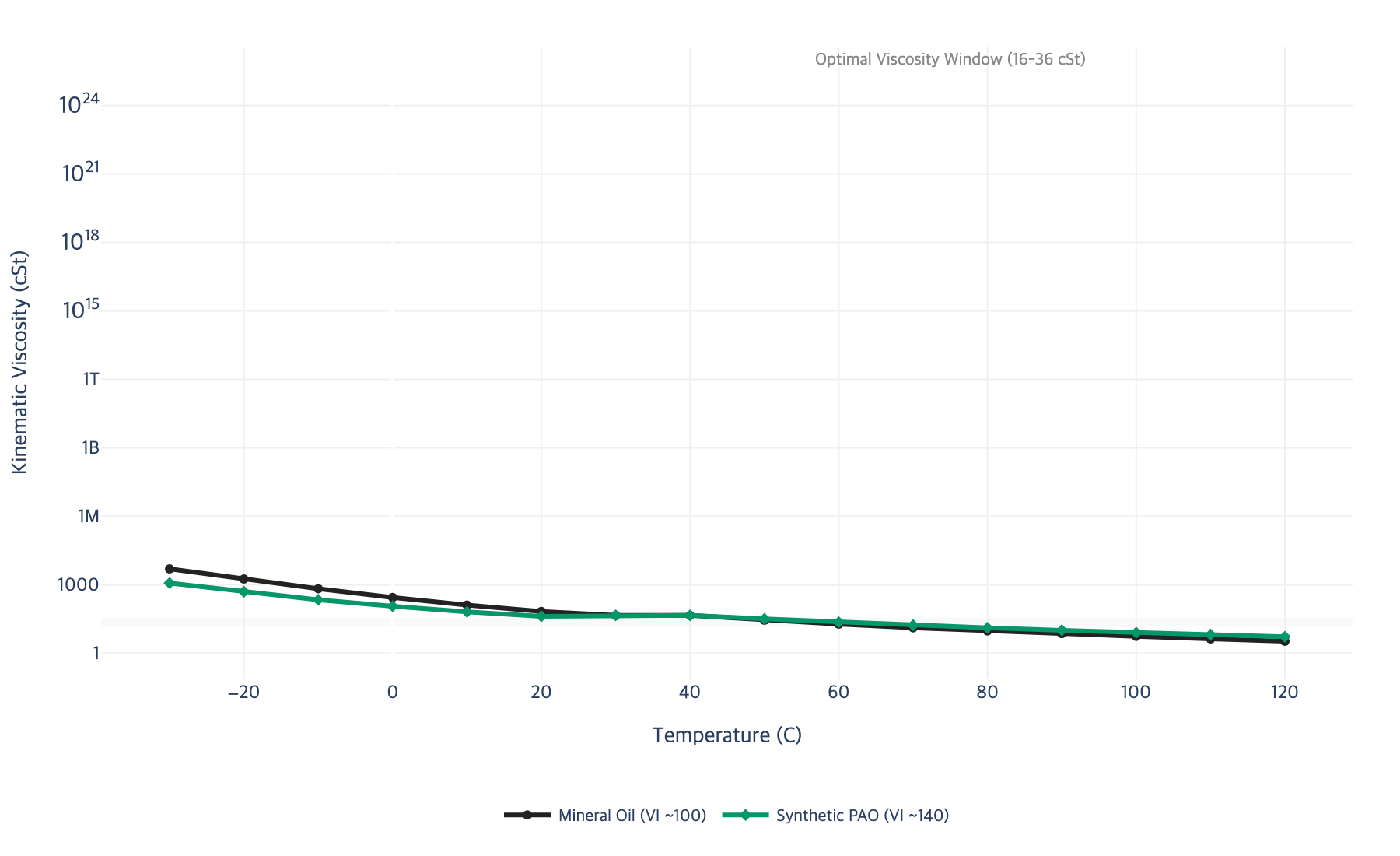
The logarithmic viscosity-temperature chart above illustrates the fundamental advantage of PAO's higher viscosity index. The shaded band represents the optimal viscosity window (16 to 36 cSt). PAO maintains viscosity within this window across approximately 60 degrees C of temperature range, while mineral oil stays within the window across only approximately 35 degrees C. At minus 20 degrees C, mineral oil viscosity exceeds 1,800 cSt (severe cavitation risk), while PAO remains at approximately 500 cSt (still thick but manageable for most pumps).
V. Oxidation Stability and Service Life Under Thermal Stress
Oxidation is the primary degradation mechanism for hydraulic fluids, and the difference in oxidation resistance between mineral and synthetic fluids directly determines service life and drain interval capability.
Oxidation Mechanism Differences
Mineral oil oxidation follows a free-radical chain reaction that is initiated by heat, oxygen, and catalytic metals (copper, iron). The reaction progresses through initiation (radical formation), propagation (chain reaction producing hydroperoxides), and termination (radical combination). The rate-limiting step is initiation, which depends on the stability of the weakest bonds in the molecular population. In mineral oil, aromatic and naphthenic molecules with tertiary carbon-hydrogen bonds provide the weakest points for initiation, meaning that oxidation begins at the least stable molecules and progressively attacks more stable species.
PAO molecules lack aromatic rings and contain far fewer tertiary C-H bonds, making radical initiation significantly more difficult. The Rotating Pressure Vessel Oxidation Test (RPVOT, ASTM D2272) quantifies this difference. Typical mineral hydraulic oils achieve RPVOT values of 150 to 300 minutes, while PAO-based hydraulic fluids achieve 500 to 1,200 minutes, representing a 2 to 4 times improvement in oxidation resistance (Machinery Lubrication, 2024).
Drain Interval Extension
The practical translation of superior oxidation stability is extended drain intervals. Mineral hydraulic fluids in typical industrial applications are changed every 2,000 to 4,000 operating hours or annually, whichever comes first. PAO-based synthetic hydraulic fluids can typically achieve 6,000 to 12,000 operating hours between changes, representing a 2 to 4 times extension.
This drain interval extension has compound economic benefits. Fluid purchase volume decreases proportionally. Downtime for oil changes decreases by the same factor. Used oil disposal costs decrease. Filter change frequency may also decrease because slower oxidation means less sludge and varnish to capture.
Varnish and Deposit Formation
Varnish formation is one of the most costly consequences of hydraulic fluid oxidation. Oxidation products polymerize on hot metal surfaces, particularly servo valve spools and proportional valve orifices, creating a thin but hard deposit that interferes with precise valve movement. Servo valve stiction caused by varnish deposits can shut down entire production lines because the valve cannot respond to control signals.
PAO's superior oxidation stability directly reduces varnish formation potential. In systems where varnish has been a recurring problem with mineral oils, switching to PAO-based fluid often eliminates the issue entirely by reducing the oxidation product generation rate below the level where varnish accumulates.
VI. System Pressure, Compressibility, and Air Release Performance
Hydraulic system performance depends not only on viscosity and oxidation resistance but also on the fluid's behavior under pressure. Compressibility and air release properties affect system responsiveness, energy efficiency, and component life in ways that are often overlooked in fluid selection.
Compressibility Under Pressure
All hydraulic fluids are slightly compressible, with typical compression of 0.4 to 0.5 percent per 1,000 psi (Q8Oils, 2024). This compressibility directly affects system efficiency because some of the pump's energy goes into compressing the fluid rather than moving the actuator. In high-pressure systems operating above 3,000 psi, fluid compressibility can reduce volumetric efficiency by 1.5 to 2.0 percent.
The compressibility of mineral oils and PAO synthetics is similar at the same temperature and pressure because both are hydrocarbon-based fluids with comparable molecular packing density. The practical difference arises from temperature effects on compressibility. Because PAO maintains a more consistent viscosity across temperatures, its compressibility behavior is also more consistent, providing more predictable system response across operating conditions.
Air Release and Cavitation Resistance
Entrained air in hydraulic fluid dramatically increases compressibility and can cause cavitation damage to pumps and valves. As little as 1 percent entrained air by volume can reduce the fluid's effective bulk modulus to 25 percent of its air-free value (Machinery Lubrication, 2024). The fluid's ability to release entrained air quickly is therefore a critical performance property.
PAO base stocks generally have faster air release properties than mineral oils of the same viscosity because their uniform molecular structure creates a more consistent surface tension that facilitates bubble coalescence and release. Foaming tendency is also generally lower with PAO fluids, although specific formulation differences (additive package, contaminant level) can override the base stock effect.
Contamination Tolerance
Hydraulic system contamination, primarily solid particles and water, affects mineral and synthetic fluids differently. Both fluid types require the same cleanliness levels for pump and valve protection (typically ISO 4406 code 16/14/11 or cleaner for servo-hydraulic systems). However, synthetic fluids offer an advantage in water tolerance because their superior oxidation stability means that the catalytic effect of water on oxidation is less damaging.
Water contamination accelerates mineral oil oxidation significantly, with as little as 0.1 percent water increasing oxidation rate by a factor of 2 to 3 in some studies. PAO fluids, while still affected by water contamination, show less acceleration of oxidation because the base molecules are inherently more oxidation-resistant.
VII. Total Cost of Ownership: When Synthetic Delivers Clear ROI
The decision between synthetic and mineral hydraulic fluid should be based on total cost of ownership (TCO) analysis rather than initial fluid cost comparison. The TCO calculation includes fluid purchase, drain interval impact, energy efficiency, component wear, downtime, and disposal costs.
TCO Calculation Framework
Cost Category | Mineral (Annual) | Synthetic PAO (Annual) | Net Difference |
|---|---|---|---|
Fluid purchase (100-gal system) | USD 1,200 (2 fills) | USD 2,400 (0.5 fills) | Synthetic -USD 600 lower |
Filter replacement | USD 800 (4x/year) | USD 400 (2x/year) | Synthetic -USD 400 lower |
Downtime for oil changes | USD 3,000 (2 events) | USD 1,500 (0.5 events) | Synthetic -USD 1,500 lower |
Energy cost (5% savings) | USD 15,000 baseline | USD 14,250 | Synthetic -USD 750 lower |
Component replacement | USD 5,000 (pump, seals) | USD 3,000 (extended life) | Synthetic -USD 2,000 lower |
Used oil disposal | USD 400 | USD 200 | Synthetic -USD 200 lower |
Total annual cost | USD 25,400 | USD 21,750 | Synthetic saves USD 3,650 |
This example illustrates that for a demanding application with a 100-gallon system, synthetic PAO delivers approximately 14 percent lower total annual cost despite a higher per-gallon fluid price. The savings come primarily from reduced downtime, extended component life, and energy efficiency improvements.
Figure 2. Annual Total Cost of Ownership Breakdown by Category
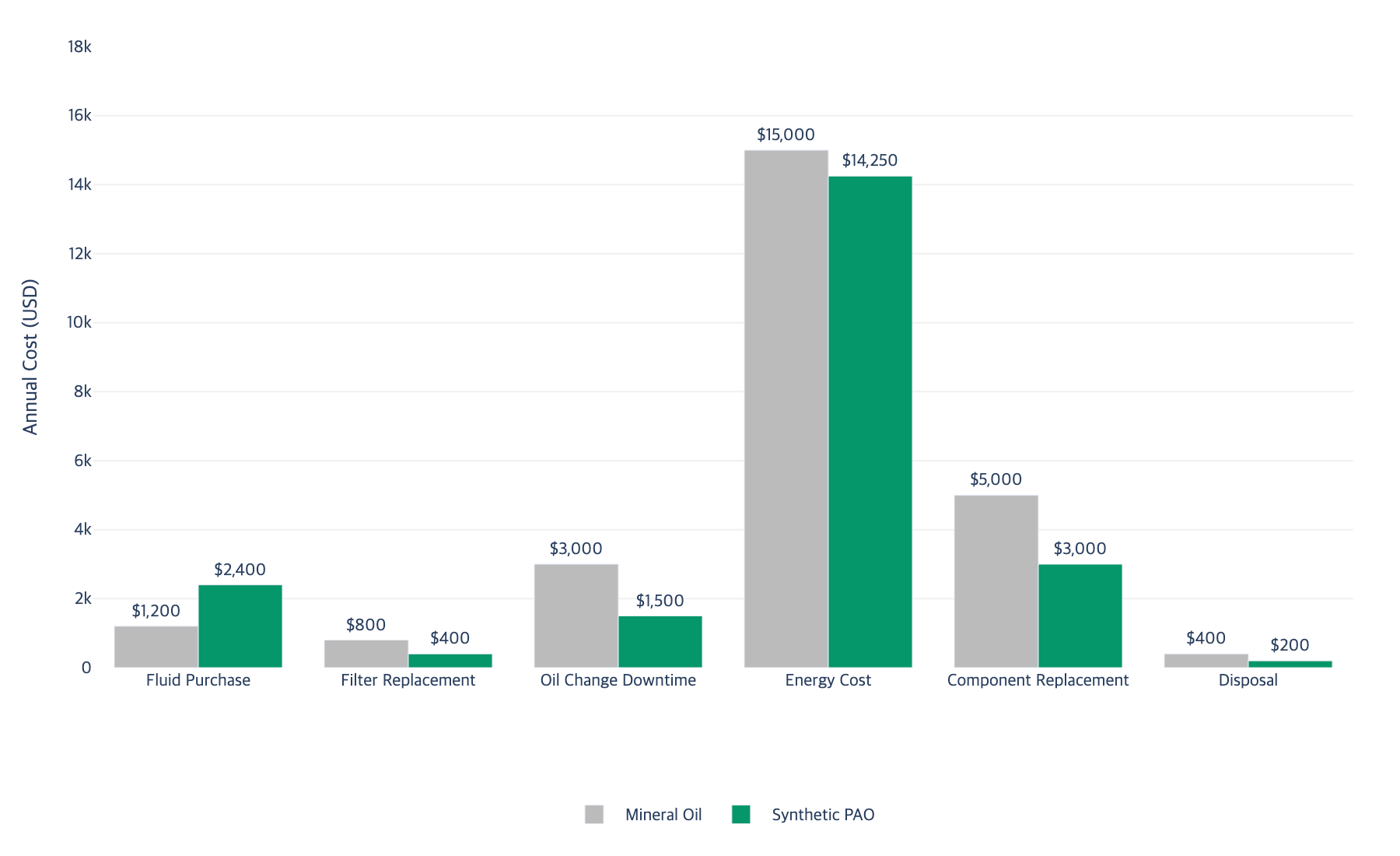
The grouped bar chart reveals an important pattern in the cost comparison. Synthetic PAO has a higher fluid purchase cost (the only category where it is more expensive) but delivers savings in every other cost category. Energy cost savings alone (USD 750/year) offset a significant portion of the higher fluid cost. When downtime and component replacement savings are included, the total annual advantage of synthetic reaches approximately USD 3,650 for this example system.
When Synthetic Delivers Clear ROI
Synthetic hydraulic fluids deliver the strongest ROI in applications that combine one or more of the following conditions. High operating temperature (continuous sump temperature above 60 degrees C) accelerates mineral oil degradation and magnifies the oxidation stability advantage of PAO. Wide temperature range operation (outdoor equipment, seasonal temperature variation) eliminates the need for seasonal oil changes. High-pressure, high-duty-cycle operation (injection molding, metal stamping, hydraulic presses) benefits from PAO's energy efficiency advantage and extended component life. Servo-hydraulic systems (CNC machines, robotics) benefit from reduced varnish formation and more consistent viscosity for precise control.
When Mineral Oil Is the Rational Choice
Mineral hydraulic oil remains the rational choice in several scenarios. Moderate operating conditions (indoor systems, 30 to 50 degrees C continuous, standard duty cycle) do not generate sufficient oxidation stress to justify the higher fluid cost of synthetic. Low-criticality applications where downtime for an oil change does not significantly impact production economics reduce the value of extended drain intervals. Seal compatibility concerns in older systems with elastomer seals that were designed for mineral oil may cause seal swelling or shrinkage issues when exposed to PAO without ester co-solvents. Large-volume systems (reservoirs above 500 gallons) amplify the initial fluid cost difference and may take several years to achieve TCO parity with synthetic.
Decision Matrix by Operating Conditions
Operating Condition | Sump Temp | Pressure | Duty Cycle | Recommended Fluid | Primary Benefit |
|---|---|---|---|---|---|
Indoor standard hydraulics | 40-55C | <2500 psi | 8-16 hr/day | Mineral (Group II) | Lowest initial cost |
Indoor demanding hydraulics | 55-70C | 2500-4000 psi | 16-24 hr/day | PAO synthetic | Extended life, energy savings |
Outdoor year-round | Variable -20 to +40C | Variable | Variable | PAO synthetic | Single-grade capability |
Mobile equipment (cold climate) | Variable -30 to +50C | >3000 psi | Intermittent | PAO synthetic | Cold start protection |
Servo-hydraulic (CNC) | 45-65C | 2000-3500 psi | Continuous | PAO synthetic | Varnish prevention, precision |
Low-criticality auxiliary | 30-50C | <2000 psi | Intermittent | Mineral (Group I/II) | Lowest total cost |
This matrix demonstrates that the recommendation is not binary but condition-dependent. The more extreme the operating conditions (temperature, pressure, duty cycle, precision requirements), the stronger the case for synthetic PAO. For moderate conditions with limited thermal stress, high-quality mineral oil delivers adequate performance at lower cost.
VIII. Key Takeaway
PAO synthetic hydraulic fluids achieve viscosity indices of 130 to 150 compared to 95 to 110 for mineral oils, enabling single-grade operation across temperature ranges from minus 30 to plus 120 degrees C that would require two or three mineral oil grades.
Oxidation stability of PAO (500 to 1,200 minutes RPVOT) is 2 to 4 times greater than mineral oil (150 to 300 minutes), directly translating to 2 to 4 times longer drain intervals and significantly reduced varnish formation.
Total cost of ownership analysis typically shows 10 to 20 percent savings with synthetic PAO in demanding applications when extended drain intervals, energy efficiency gains, and reduced component wear are included in the calculation.
Mineral oil remains the rational choice for moderate-temperature, standard-duty indoor hydraulic systems where the performance advantages of synthetic fluids do not translate into measurable cost savings.
The decision between synthetic and mineral should be driven by a TCO calculation specific to the application's operating conditions, not by initial fluid price comparison alone.
Lubinpla's lubrication analysis module can model the total cost of ownership for your specific hydraulic system based on operating temperature profile, pressure and duty cycle data, and maintenance records to determine whether synthetic PAO delivers a positive ROI for your application.
IX. References
[1] Machinery Lubrication, "Polyalphaolefin (PAO) Lubricants Explained", 2024. https://www.machinerylubrication.com/Read/31106/polyalphaolefin-pao-lubricants
[2] Chevron Phillips Chemical, "Polyalphaolefins FAQ", 2024. https://www.cpchem.com/what-we-do/solutions/polyalphaolefins/faq
[3] Lubchem, "What Are Polyalphaolefin Lubricants?", 2024. https://lubchem.com/blog/updates/what-are-polyalphaolefin-lubricants/
[4] Power Magazine, "Understanding PAG- and PAO-Based Lubricants", 2024. https://www.powermag.com/understanding-pag-and-pao-based-lubricants/
[5] Rumanza Lubricants, "Synthetic vs. Mineral Hydraulic Oil: Which is Best for Your Operation?", 2024. https://www.rumanza.com/synthetic-vs-mineral-hydraulic-oil-in-uae-which-is-best-for-your-operation
[6] Q8Oils, "Hydraulic oil compressibility: what is it and what are the risks?", 2024. https://www.q8oils.com/general-industry/hydraulic-oil-compressibility-what-is-it-and-what-are-the-risks/
[7] Machinery Lubrication, "In Search of the Perfect Hydraulic Fluid", 2024. https://www.machinerylubrication.com/Read/1314/hydraulic-fluid-perfect
[8] Quaker Houghton, "Mineral Oil and Synthetic Hydraulic Fluids", 2024. https://home.quakerhoughton.com/product-lines/hydraulic-fluids/
[9] Wikipedia, "Synthetic oil", 2024. https://en.wikipedia.org/wiki/Synthetic_oil
[10] ChemCeed, "Polyalphaolefin Oils (PAOs): What They Are, and What They Can Do", 2024. https://chemceed.com/product-news/polyalphaolefin-oils-paos-what-they-are-and-what-they-can-do/
[11] Completely Hydraulic, "Hydraulic Oil Guide: Types, Life Span and Maintenance", 2024. https://comphydraulic.com/hydraulic-oil-guide-types-life-span-maintenance/
[12] Skidsteers.com, "Types of Hydraulic Fluid: Everything You Need to Know", 2024. https://www.skidsteers.com/blog/types-of-hydraulic-fluid/
[13] Wikipedia, "Hydraulic fluid", 2024. https://en.wikipedia.org/wiki/Hydraulic_fluid
Powered by Lubinpla
Discover how technical teams solve complex challenges faster with AI.