The Chemistry Behind Corrosion Inhibitors: How Film-Forming vs Passivating Types Actually Work
Summary: Corrosion inhibitors are among the most widely used chemical treatments in industrial water systems, yet their selection is often based on habit rather than mechanism-level understanding. This article dissects how film-forming inhibitors and passivating inhibitors protect metal surfaces through fundamentally different chemical pathways. It reveals why under-dosing a passivating inhibitor does not simply reduce protection but actively accelerates localized corrosion, a failure mode that has caused millions of dollars in unplanned equipment replacement. Engineers who understand these mechanisms can match inhibitor chemistry to system conditions with precision, avoid dangerous dosing errors, and reduce total treatment cost.
Table of Contents
I. The Two Families of Corrosion Inhibitors
II. How Film-Forming Inhibitors Build a Hydrophobic Barrier
III. How Passivating Inhibitors Modify the Oxide Layer
IV. Protection Efficiency Across Operating Conditions
V. The Under-Dosing Danger: Why Less Is Worse Than None
VI. Inhibitor Selection Framework by System Conditions
VII. Key Takeaway
VIII. References
I. The Two Families of Corrosion Inhibitors
Corrosion inhibitors fall into two broad mechanistic categories that protect metal surfaces through entirely different chemical pathways. Understanding these pathways is essential for selecting the right inhibitor type, setting the correct dosage, and avoiding the dangerous failure modes that arise when inhibitors are misapplied. The distinction between film-forming and passivating inhibitors is not merely academic. It determines how the inhibitor interacts with the metal surface, how it responds to changes in water chemistry, and what happens when concentration drops below the effective threshold.
The Mechanistic Divide
Film-forming inhibitors work by physically adsorbing onto the metal surface and creating a hydrophobic barrier that blocks corrosive species from reaching the metal. Their protection depends on continuous molecular coverage across the surface. Passivating inhibitors, by contrast, work by electrochemically shifting the metal surface into a passive state, promoting the formation or stabilization of a protective oxide layer. Their protection depends on maintaining the electrochemical conditions that keep the oxide intact.
This fundamental difference has practical consequences at every level of system design and operation. Film-forming inhibitors are relatively forgiving of concentration fluctuations because partial surface coverage still provides partial protection. Passivating inhibitors are far less forgiving. If concentration drops below a critical threshold, the partially passivated surface becomes more vulnerable to localized attack than an untreated surface would be.
Common Types in Industrial Practice
Inhibitor Category | Common Examples | Primary Mechanism | Typical Applications |
|---|---|---|---|
Film-Forming (Organic) | Amines, imidazolines, fatty acid derivatives | Surface adsorption, hydrophobic barrier | Oil and gas pipelines, steam cycles, closed loops |
Passivating (Anodic) | Chromates, molybdates, nitrites, phosphates | Oxide layer formation, potential shift | Cooling water, closed loops, process water |
Mixed/Synergistic | Phosphonate-zinc blends, molybdate-phosphate | Combined barrier and oxide stabilization | Open recirculating cooling systems |
The table above summarizes the primary categories, but in practice most industrial treatment programs use blended formulations that combine elements of both mechanisms. The key is understanding which mechanism dominates in each formulation so that dosing strategy and monitoring can be aligned accordingly.
II. How Film-Forming Inhibitors Build a Hydrophobic Barrier
Film-forming inhibitors represent the largest class of organic corrosion inhibitors used in industrial applications. Their mechanism relies on the physical and chemical adsorption of organic molecules onto the metal surface, creating a molecular film that acts as a barrier between the metal and the corrosive environment. The effectiveness of this film depends on molecular structure, surface coverage, and the stability of the adsorbed layer under operating conditions.
Molecular Architecture of Imidazolines
Imidazoline-based corrosion inhibitors are among the most effective film-forming agents used in oil and gas production and industrial water treatment. Their molecular structure contains three critical components that work together to provide corrosion protection (npj Materials Degradation, 2024). The five-membered imidazoline ring contains two nitrogen atoms that provide electron density for bonding to the metal surface. The pendant aminoethyl chain provides additional nitrogen-based anchoring points and enhances water solubility. The long hydrocarbon tail, typically C12 to C18, extends away from the surface and creates a hydrophobic barrier.
When imidazoline molecules encounter a metal surface in an aqueous environment, the nitrogen-containing head group adsorbs onto the metal through a combination of electrostatic attraction and chemisorption. In acidic conditions below pH 5, the molecule becomes protonated and carries a positive charge, which enhances adsorption onto the negatively charged metal surface where chloride ions have already accumulated. This charge-driven adsorption is particularly effective in CO2-saturated brines commonly found in oil and gas production systems.
Film Formation and Coverage Dynamics
The process of film formation follows a concentration-dependent pattern. At very low concentrations, individual molecules adsorb in a disordered arrangement with the hydrocarbon tails lying relatively flat against the surface. As concentration increases toward the critical micelle concentration (CMC), typically around 10 ppm for common imidazolines, the molecules begin to orient vertically with the head group anchored to the metal and the tail extending outward (ScienceDirect, 2021). This vertical orientation maximizes surface coverage and creates a dense hydrophobic layer.
The critical micelle concentration represents a transition point. Below the CMC, increasing concentration leads to proportionally better surface coverage and protection. Above the CMC, additional inhibitor molecules form micelles in solution rather than adsorbing to the surface, and the marginal improvement in protection diminishes. Understanding this relationship allows engineers to optimize dosage for maximum protection without wasting chemical.
Amine-Based Film Formers in Steam Systems
Film-forming amines (FFA) such as octadecylamine (ODA) represent a specialized class of film-forming inhibitors designed for steam and condensate systems. ODA molecules create a monomolecular hydrophobic film on metal surfaces that prevents contact between the metal and moisture containing dissolved CO2 or oxygen (VTT Research, 2014). Unlike neutralizing amines that raise condensate pH, FFAs provide protection through a physical barrier mechanism.
The thermal stability of FFAs is a critical consideration. Research has demonstrated that ODA provides approximately 98% corrosion inhibition in the steam phase at 220 degrees C, but effectiveness drops to approximately 60% in the liquid water phase at the same temperature (Energy Science and Engineering, 2024). This difference arises because the hydrophobic film is more stable when the surface is exposed to steam than when it is submerged in liquid water. In practical terms, this means FFA treatment is most effective in condensate return lines and steam distribution systems, and less effective in areas where surfaces are continuously wetted.
III. How Passivating Inhibitors Modify the Oxide Layer
Passivating inhibitors work through a fundamentally different mechanism than film-forming types. Rather than creating an organic barrier over the metal surface, passivating inhibitors promote or stabilize a thin, adherent oxide layer on the metal itself. This oxide layer is the actual protective barrier, and the inhibitor's role is to ensure that the oxide remains intact and self-healing under operating conditions. The distinction is critical because it means the inhibitor must maintain specific electrochemical conditions at the metal surface to sustain protection.
Electrochemical Potential Shift
The core mechanism of passivating inhibitors involves shifting the corrosion potential of the metal in the noble direction, past the primary passivation potential and into the passive region of the anodic polarization curve. In this passive state, the anodic dissolution rate drops by several orders of magnitude because the oxide film acts as a solid-state barrier to ion transport (IntechOpen, 2018). The metal surface effectively stops dissolving even though it remains in contact with a corrosive electrolyte.
Chromate passivation provides the clearest illustration of this mechanism. When chromate ions (CrO4 2-) contact a steel surface, they oxidize ferrous hydroxide to gamma-Fe2O3 while the chromate itself is reduced to Cr2O3. The resulting passive film consists of approximately 75% gamma-Fe2O3 and 25% Cr2O3, creating a mixed oxide that is significantly more resistant to breakdown than the native iron oxide alone. However, environmental and health concerns have driven the industry to replace chromates with less toxic alternatives.
Molybdate as a Modern Alternative
Sodium molybdate has emerged as the primary replacement for chromate in many industrial applications. Molybdate ions stabilize the passive oxide film by incorporating into the oxide layer structure, enhancing its resistance to chloride-induced breakdown (Clearwater Systems, 2023). The mechanism involves the adsorption of MoO4 2- ions at active sites on the metal surface where the oxide film is thin or damaged, effectively plugging defects before they can develop into active corrosion sites.
In closed cooling systems, molybdate is typically maintained at 50 to 100 ppm as sodium molybdate to achieve equivalent protection to 800 ppm or more of sodium nitrite (Association of Water Technologies, 2005). This concentration advantage, combined with lower toxicity and easier monitoring, has made molybdate the inhibitor of choice in many modern treatment programs. However, the higher unit cost of molybdate compared to nitrite means that total program cost must be evaluated on a case-by-case basis.
Phosphate-Based Passivation
Orthophosphate inhibitors work through a slightly different passivation mechanism. Rather than modifying the existing oxide layer, phosphates form a separate precipitation film of metal phosphate on the surface. When iron dissolves at anodic sites, the released Fe2+ ions react with phosphate to form insoluble iron phosphate (vivianite) that precipitates at the dissolution site and blocks further attack (Suez Water Handbook, 2023). In systems containing calcium, calcium phosphate films provide additional barrier protection.
Phosphate-based programs are widely used in potable water distribution systems where toxicity concerns limit the use of other inhibitor types. Typical dosages range from 1 to 5 ppm as PO4 for corrosion control, with the specific dose depending on water chemistry, particularly pH, alkalinity, and calcium hardness. The effectiveness of phosphate programs depends heavily on maintaining appropriate pH, generally between 6.8 and 7.5 for optimal film formation.
IV. Protection Efficiency Across Operating Conditions
The practical effectiveness of any corrosion inhibitor depends on the interaction between its chemical mechanism and the operating conditions of the system. pH, temperature, flow velocity, and water chemistry all influence how well an inhibitor performs its protective function. Understanding these relationships allows engineers to predict where protection will be strongest, where it will be weakest, and where supplemental measures may be needed.
pH Sensitivity by Inhibitor Type
The pH of the system water fundamentally affects both the metal surface chemistry and the inhibitor's ability to function. Film-forming inhibitors based on amines and imidazolines generally perform best in acidic to neutral conditions (pH 3 to 7) where the protonated form of the molecule has the strongest electrostatic attraction to the metal surface. As pH increases above 7, the degree of protonation decreases and adsorption weakens. Passivating inhibitors typically perform best in neutral to mildly alkaline conditions (pH 7 to 9.5) where the oxide film is thermodynamically stable and the inhibitor anions can interact effectively with the oxide surface.
Inhibitor Type | Optimal pH Range | Performance at Low pH (below 5) | Performance at High pH (above 9) |
|---|---|---|---|
Imidazolines | 3.5 to 6.5 | Strong adsorption, high efficiency | Reduced protonation, weaker film |
Film-forming amines | 8.0 to 9.5 | Decomposition risk, reduced stability | Effective, stable film |
Molybdate | 7.0 to 9.5 | Poor oxide stability, ineffective | Good performance, stable oxide |
Phosphate | 6.8 to 7.5 | Solubility issues, poor film | Scale formation risk at high Ca |
Nitrite | 7.0 to 9.0 | Rapid consumption, poor stability | Good performance |
The table reveals a critical insight for multi-metal systems. No single inhibitor type provides optimal protection across the full range of conditions that might exist within a complex industrial system. Copper alloys, for example, are vulnerable to corrosion at pH values above 9.0 where steel protection is generally good, which is why azole-based inhibitors (benzotriazole, tolyltriazole) are added specifically for copper protection in mixed-metallurgy systems.
Figure 1. Inhibitor Performance Profile Comparison Across Operating Conditions
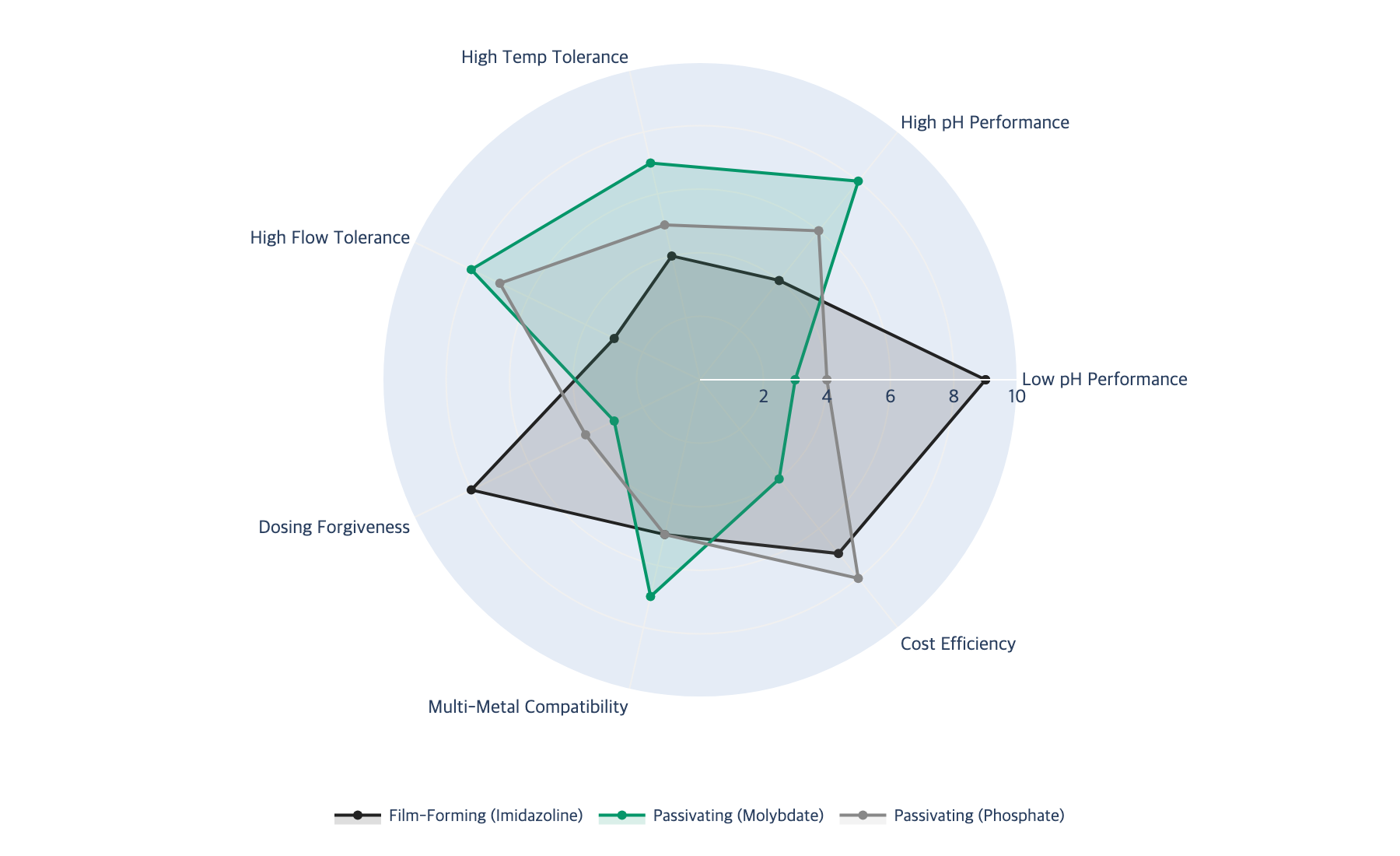
The radar chart illustrates the relative strengths and weaknesses of three major inhibitor types across seven critical operating parameters. Film-forming imidazolines excel in low pH environments and offer greater dosing tolerance, while molybdate-based passivating inhibitors deliver superior performance at neutral to high pH and in mixed-metal systems. Phosphate-based passivation falls between the two across most parameters. This visual comparison highlights why no single inhibitor type dominates all conditions, and why the selection decision must be grounded in specific system characteristics.
Temperature Effects on Protection Mechanisms
Temperature affects film-forming and passivating inhibitors through different pathways. For film-forming inhibitors, increasing temperature accelerates the desorption of adsorbed molecules from the metal surface, reducing the equilibrium surface coverage and lowering protection efficiency. Research on imidazoline inhibitors shows that protection efficiency can drop from over 95% at 25 degrees C to below 70% at 80 degrees C in CO2-saturated brine systems, unless concentration is increased to compensate.
For passivating inhibitors, the relationship with temperature is more complex. Moderate temperature increases can actually improve passivation by accelerating oxide growth kinetics, but higher temperatures increase the rate of chloride attack on the passive film. In cooling water systems operating above 60 degrees C, molybdate dosages may need to be increased by 30 to 50% compared to systems operating below 40 degrees C.
Flow Velocity Considerations
Flow velocity affects corrosion inhibitor performance through two competing mechanisms. Higher flow velocity increases the transport rate of inhibitor molecules to the metal surface, which should improve protection. However, high flow velocity also increases shear stress on the protective film, which can strip away film-forming inhibitors or erode passive oxide layers. The net effect depends on the specific inhibitor type and the severity of the flow conditions.
For film-forming inhibitors in pipeline applications, protection efficiency is generally maintained up to flow velocities of 3 to 5 meters per second. Above this range, the hydrodynamic shear begins to exceed the adsorption strength of the molecular film, and erosion-corrosion becomes the dominant failure mechanism. Passivating inhibitors are somewhat more resistant to flow effects because the oxide layer is metallurgically bonded to the substrate, but erosion-corrosion can still occur at very high velocities or in areas of turbulent flow such as elbows and tees.
V. The Under-Dosing Danger: Why Less Is Worse Than None
The most dangerous misconception in corrosion inhibitor application is that reducing the dose of a passivating inhibitor will simply provide proportionally less protection. In reality, under-dosing a passivating inhibitor can create conditions that are significantly more corrosive than no treatment at all. This phenomenon is well documented in corrosion engineering literature and has been responsible for catastrophic equipment failures in cooling systems, boilers, and process water circuits (Suez Water Handbook, 2023).
The Mechanism of Accelerated Attack
When a passivating inhibitor is present at sufficient concentration, it maintains a uniform passive film across the entire metal surface. If the concentration drops below the critical threshold, the passive film breaks down at scattered locations where the oxide is thinnest or where local conditions (chloride concentration, temperature, flow disruption) are most aggressive. The key problem is that the passive film remains intact over most of the surface, creating a large cathodic area surrounding the small exposed anodic areas where the film has broken down.
This large cathode-to-anode area ratio dramatically accelerates the corrosion rate at the exposed sites. The corrosion current that was previously distributed across the entire surface is now concentrated at a few small points, producing deep pitting that penetrates far faster than uniform corrosion would. A system that might experience uniform corrosion at 2 mils per year (mpy) without any inhibitor could develop pitting rates of 20 to 50 mpy at the same locations when passivating inhibitor is under-dosed.
Critical Concentration Thresholds
Each passivating inhibitor has a critical minimum concentration below which the transition from protective to aggressive behavior occurs. This threshold depends on the specific inhibitor, the aggressiveness of the environment (particularly chloride level), and the metallurgy of the system.
Inhibitor | Minimum Effective Concentration | Risk Below Threshold | Typical Monitoring Frequency |
|---|---|---|---|
Sodium molybdate | 50 ppm as Na2MoO4 | Pitting at oxide defects | Weekly, colorimetric |
Sodium nitrite | 800 ppm as NaNO2 | Rapid pitting, MIC risk | Weekly, titration |
Sodium chromate | 400 ppm as Na2CrO4 | Severe pitting | Weekly (legacy systems) |
Orthophosphate | 1 ppm as PO4 | Incomplete film, tuberculation | Weekly to biweekly |
These thresholds are not absolute values but depend on system-specific factors. Higher chloride levels raise the minimum effective concentration. Higher temperatures increase the rate of oxide breakdown. Lower pH destabilizes the passive film. Engineers must account for all these factors when setting target concentrations and alarm limits for their monitoring programs.
Figure 2. Corrosion Rate Comparison: No Inhibitor vs Under-Dosed vs Properly Dosed
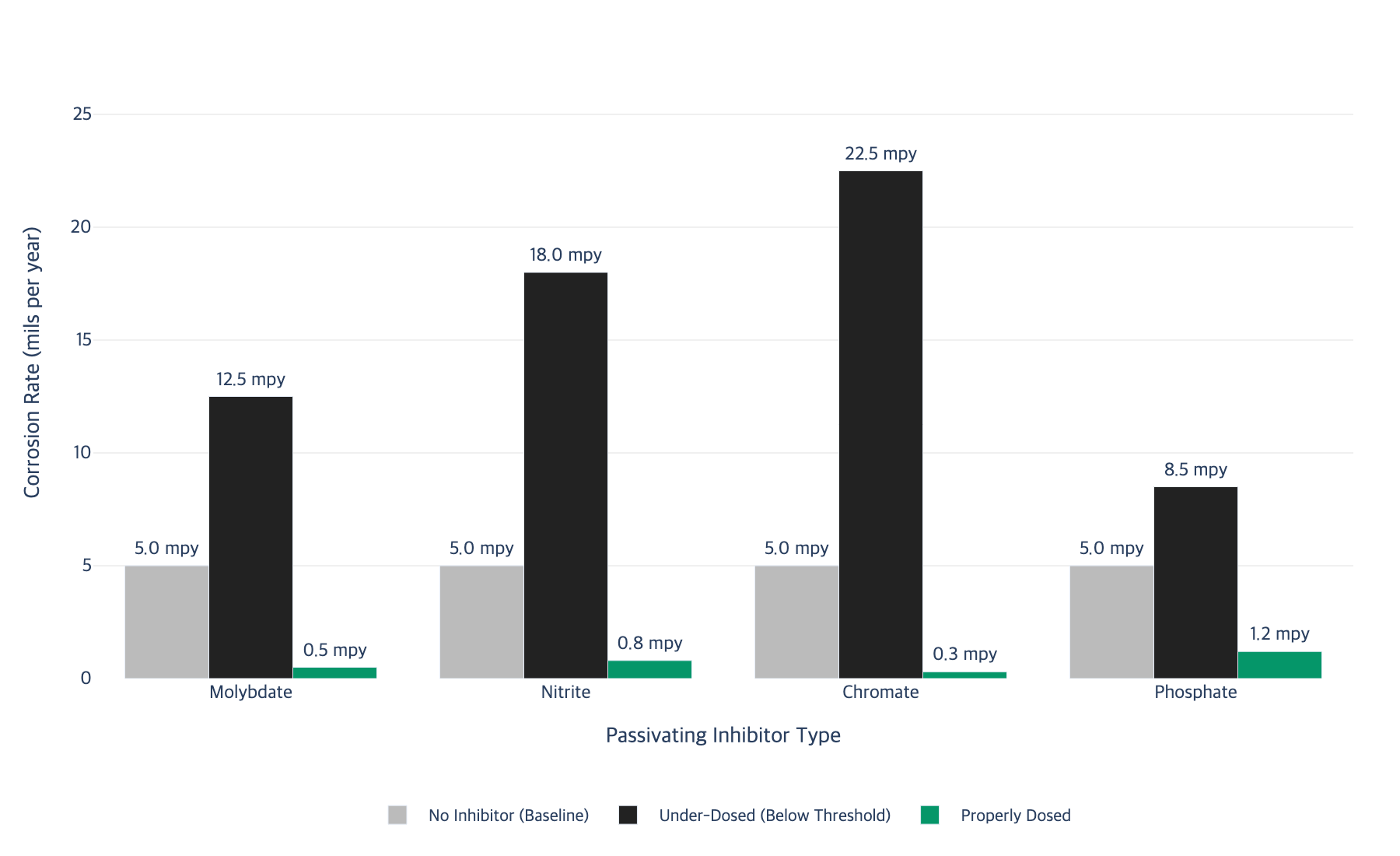
The grouped bar chart quantifies the under-dosing risk for four common passivating inhibitors. The green bars (under-dosed) consistently exceed the gray bars (no inhibitor), demonstrating that insufficient passivating inhibitor concentration produces higher corrosion rates than no treatment at all. Chromate shows the most dramatic difference, with under-dosed corrosion rates reaching 4.5 times the untreated rate. This data underscores why passivating inhibitor programs demand reliable chemical feed systems and frequent concentration monitoring.
Field Consequences of Concentration Fluctuations
In real operating systems, inhibitor concentration fluctuates due to blowdown, makeup water dilution, chemical feed pump failures, and changes in system load. The critical question is how quickly the concentration drops below the threshold and how long it remains there. Brief excursions below the threshold, lasting less than a few hours, may not cause permanent damage if the inhibitor concentration is restored promptly. Extended periods of under-dosing, lasting days or weeks, can initiate pitting that continues to propagate even after proper dosing is restored, because the chemistry inside an active pit is self-sustaining.
This is why passivating inhibitor programs require reliable chemical feed systems, redundant monitoring, and well-defined alarm procedures. The cost of a feed pump failure that goes undetected for a weekend can far exceed the cost of the treatment chemical itself when pitting damage requires tube replacement or equipment shutdown.
VI. Inhibitor Selection Framework by System Conditions
Selecting the right corrosion inhibitor requires matching the inhibitor mechanism to the specific combination of metallurgy, water chemistry, and operating conditions in the system. No single inhibitor type is universally optimal, and the best choice depends on balancing protection effectiveness, safety, environmental compliance, cost, and monitoring requirements.
Decision Matrix by System Type
System Type | Primary Metallurgy | Recommended Inhibitor Approach | Key Considerations |
|---|---|---|---|
Open recirculating cooling | Carbon steel, copper alloys | Phosphonate-zinc or molybdate-phosphate blend | Mixed metals require azoles for copper, phosphate discharge limits may apply |
Closed loop cooling | Carbon steel | Molybdate, nitrite, or molybdate-nitrite blend | Monitor concentration closely, avoid under-dosing |
Steam condensate | Carbon steel | Film-forming amines (ODA, OLDA) | Thermal stability limits, FDA restrictions in food industry |
Oil and gas production | Carbon steel | Imidazolines, quaternary ammonium | High chloride, CO2/H2S environment, batch or continuous application |
Potable water distribution | Ductile iron, copper | Orthophosphate or polyphosphate-orthophosphate blend | Regulatory limits on phosphate discharge, lead and copper rule compliance |
The table provides starting points, but the final selection must account for site-specific factors including local discharge regulations, budget constraints, monitoring capabilities, and the consequences of treatment interruption.
Cost-Effectiveness Analysis
The true cost of corrosion inhibitor treatment extends far beyond the chemical purchase price. A complete cost analysis must include chemical cost per unit volume treated, monitoring and testing labor, equipment maintenance and replacement attributable to corrosion, and the risk-weighted cost of treatment failure. In many systems, the inhibitor chemical cost represents less than 20% of the total corrosion management cost, with monitoring, maintenance, and failure consequences accounting for the remainder.
For example, a molybdate program may have a chemical cost 3 to 4 times higher than a nitrite program for the same closed loop system. However, molybdate is effective at lower concentrations, is easier to monitor (colorimetric test kits versus titration), and is less susceptible to biological degradation. When monitoring labor and biological treatment costs are included, the total program cost may be comparable.
Monitoring Requirements by Inhibitor Type
Effective corrosion inhibitor programs require monitoring that matches the specific risks of the chosen inhibitor type. Passivating inhibitors demand more frequent concentration monitoring because the consequences of under-dosing are more severe. Film-forming inhibitors can tolerate somewhat less frequent monitoring because their failure mode (gradual film loss, increasing uniform corrosion) is less catastrophic than the pitting associated with passivating inhibitor failure.
Parameter | Film-Forming Programs | Passivating Programs | Combined Programs |
|---|---|---|---|
Inhibitor concentration | Biweekly to monthly | Weekly to biweekly | Weekly |
Corrosion rate (coupon or probe) | Monthly | Monthly | Monthly |
pH | Weekly | Weekly | Weekly |
Microbiological activity | Monthly | Weekly (nitrite programs) | Monthly |
System inspection | Quarterly | Quarterly | Quarterly |
These monitoring frequencies represent minimum recommendations for stable, well-controlled systems. New installations, systems with a history of problems, or systems operating near the limits of the treatment program's capability may require more frequent monitoring.
VII. Key Takeaway
Film-forming inhibitors protect through physical adsorption and hydrophobic barrier formation. Their effectiveness depends on molecular structure, concentration relative to the CMC, and the balance between adsorption and desorption rates at operating temperature.
Passivating inhibitors protect by stabilizing or creating a passive oxide layer through electrochemical potential shift. They require strict concentration control because under-dosing creates large cathode-to-small anode conditions that accelerate pitting.
Never reduce passivating inhibitor dosage below the critical threshold. Insufficient concentration is worse than no treatment because it converts uniform corrosion into localized pitting with penetration rates 10 to 25 times higher.
Match inhibitor type to system conditions using a structured decision framework that considers metallurgy, water chemistry, operating temperature, flow conditions, and monitoring capability.
Total treatment cost includes chemical, monitoring, maintenance, and failure risk. A more expensive inhibitor with easier monitoring and lower failure risk often delivers lower total cost of corrosion management.
Lubinpla's Assistant can cross-reference your specific system conditions, metallurgy, and water chemistry against corrosion inhibitor performance data across thousands of documented scenarios to recommend the optimal inhibitor type and dosage range for your operating environment.
VIII. References
[1] Nature, "Film-forming amines as corrosion inhibitors: a state-of-the-art review", 2024. https://www.nature.com/articles/s41529-024-00523-0
[2] ScienceDirect, "Hydrolysis of imidazoline based corrosion inhibitor and effects on inhibition performance of X65 steel in CO2 saturated brine", 2021. https://www.sciencedirect.com/science/article/abs/pii/S0920410521008883
[3] IntechOpen, "Corrosion Inhibitors: Principles, Mechanisms and Applications", 2018. https://cdn.intechopen.com/pdfs/46243.pdf
[4] PMC, "Current and emerging trends of inorganic, organic and eco-friendly corrosion inhibitors", 2024. https://pmc.ncbi.nlm.nih.gov/articles/PMC11460216/
[5] Suez Water Technologies, "Corrosion inhibitors in water treatment", 2023. https://www.suezwaterhandbook.com/water-and-generalities/corrosion-in-metal-and-concrete/protection-against-corrosion/corrosion-inhibitors
[6] Clearwater Systems, "Nitrite vs. Molybdate vs. Organic as Corrosion Inhibitors", 2023. https://clearwatershelton.com/corrosion-inhibitors/
[7] Veolia Water Technologies, "Cooling Water Corrosion Control", 2024. https://www.watertechnologies.com/handbook/chapter-24-corrosion-control-cooling-systems
[8] VTT Research, "Film-Forming Amines in Steam/Water Cycles", 2014. https://publications.vtt.fi/julkaisut/muut/2014/VTT-R-03234-14.pdf
[9] Energy Science and Engineering, "Thermal stability of film forming amines-based corrosion inhibitors", 2024. https://scijournals.onlinelibrary.wiley.com/doi/full/10.1002/ese3.1625
[10] Association of Water Technologies, "Molybdate and Non-Molybdate Options for Closed Systems", 2005. https://www.natcoll.com/wp-content/uploads/Molybdate-and-Non-Molybdate-Options-for-Closed-Systems.pdf
[11] ChemTreat, "Film-Forming Amines: Innovative Boiler Treatment Technology", 2024. https://www.chemtreat.com/resource/film-forming-amines-innovative-boiler-treatment-technology-for-the-refining-industry/
[12] MDPI Technologies, "Recent Development of Corrosion Inhibitors: Types, Mechanisms, Electrochemical Behavior, Efficiency", 2025. https://www.mdpi.com/2227-7080/13/3/103
Powered by Lubinpla
Discover how technical teams solve complex challenges faster with AI.