Understanding Dispersant Chemistry in Engine and Industrial Lubricants
Summary: Dispersants are among the most critical additives in lubricant formulations, yet their working mechanism and depletion behavior are often poorly understood by field engineers. This article examines the molecular architecture of polyisobutylene succinimide (PIBSI) and Mannich base dispersants, explains how their polar head groups adsorb onto contaminant particles while their non-polar tails maintain oil solubility, and reveals the saturation point phenomenon where dispersant capacity is overwhelmed by contaminant load. Engineers who understand dispersant chemistry can interpret used oil analysis data more effectively, particularly pentane and toluene insolubles per ASTM D893, to assess remaining dispersant capacity and optimize drain intervals based on actual condition rather than arbitrary schedules.
Table of Contents
I. The Role of Dispersants in Lubricant Performance
II. Molecular Architecture: Succinimide and Mannich Base Dispersants
III. Dispersancy Mechanism: How Contaminants Stay Suspended
IV. The Saturation Point: When Dispersant Capacity Is Overwhelmed
V. Operating Conditions That Accelerate Dispersant Depletion
VI. Interpreting Used Oil Analysis for Dispersant Health
VII. Application Mapping: Dispersant Selection by Operating Environment
VIII. Key Takeaway
IX. References
I. The Role of Dispersants in Lubricant Performance
A maintenance engineer notices that two identical diesel engines running the same oil brand show dramatically different oil condition at the same drain interval. One engine's oil remains fluid and dark, while the other's oil has thickened noticeably and shows visible sludge on the dipstick. The difference is not in the oil itself but in the combustion conditions that determine how quickly the dispersant additive is consumed.
Dispersants are the lubricant additives responsible for keeping insoluble contaminants, primarily soot, oxidation products, and combustion byproducts, suspended as fine particles in the oil rather than allowing them to agglomerate into sludge and deposits. Without effective dispersant chemistry, even high-quality base oils would rapidly accumulate deposits on piston rings, valve train components, and oil passages, leading to accelerated wear and potential engine failure.
Why Dispersant Chemistry Matters for Drain Interval Decisions
The conventional approach to oil drain intervals relies on time or mileage-based schedules that do not account for actual dispersant condition. An engine operating under light load in moderate temperatures may retain adequate dispersant capacity for significantly longer than the scheduled interval, while an engine operating under heavy load with poor fuel quality may exhaust its dispersant capacity well before the next scheduled drain. Understanding how dispersants work at the molecular level, and how to measure their remaining capacity through oil analysis, allows engineers to make drain interval decisions based on actual oil condition rather than conservative generalizations.
II. Molecular Architecture: Succinimide and Mannich Base Dispersants
Modern lubricant dispersants are classified as ashless dispersants because they do not contribute metallic ash to the oil, unlike metallic detergents. The two dominant families are polyisobutylene succinimide (PIBSI) dispersants and Mannich base dispersants, each with distinct molecular architecture that determines their performance characteristics.
Polyisobutylene Succinimide (PIBSI) Structure
PIBSI dispersants are the most widely used dispersant chemistry in modern engine oils. Their molecular structure consists of three functional components that work together to provide contaminant control (MDPI Polymers, 2025). The polyisobutylene (PIB) tail, typically with a molecular weight of 1,000 to 2,300 g/mol, provides oil solubility and creates steric hindrance around suspended particles. The succinimide linkage connects the polar head group to the PIB tail through a cyclic imide structure formed by the reaction of polyisobutenyl succinic anhydride (PIBSA) with a polyamine. The polyamine head group, typically diethylenetriamine (DETA), triethylenetetramine (TETA), or tetraethylenepentamine (TEPA), provides the polar functionality that binds to contaminant surfaces through hydrogen bonding and acid-base interactions.
The number of nitrogen atoms in the polyamine chain directly affects dispersant performance. Longer polyamine chains provide more binding sites per molecule, increasing the strength and durability of the dispersant-contaminant interaction. However, longer chains also increase the polarity of the molecule, which can reduce oil solubility if the PIB tail is not proportionally larger. The optimal balance between head group activity and oil solubility is a key formulation challenge.
Mannich Base Dispersant Structure
Mannich base dispersants represent an alternative molecular architecture that offers advantages in specific applications. They are synthesized through a three-component condensation reaction between an alkylphenol (providing the oil-soluble backbone), formaldehyde (providing the methylene bridge), and a polyamine (providing the polar head group). The resulting structure has the polyamine linked to the alkylphenol through a methylene bridge, with the long alkyl chain of the phenol providing oil solubility.
Mannich dispersants offer distinct advantages in certain formulation scenarios. Their phenolic structure provides inherent antioxidant functionality through hydrogen donation, giving them dual dispersant-antioxidant capability. They also show superior performance in controlling varnish-type deposits compared to PIBSI dispersants because the phenolic group interacts more strongly with oxidation precursors. However, Mannich dispersants are generally less effective than PIBSI types at handling high soot loads in diesel applications because their molecular geometry provides less steric stabilization of soot particle suspensions.
Figure 1. Dispersant Molecular Architecture Comparison
Feature | PIBSI (Succinimide) | Mannich Base |
|---|---|---|
Oil-soluble component | Polyisobutylene (PIB), MW 1000-2300 | Long-chain alkylphenol |
Polar head group | Polyamine (DETA, TETA, TEPA) | Polyamine via methylene bridge |
Linkage chemistry | Cyclic imide (succinimide) | Methylene bridge (CH2) |
Key nitrogen count | 3-5 per molecule | 3-5 per molecule |
Soot handling | Excellent (strong steric effect) | Moderate |
Varnish control | Good | Excellent (phenolic antioxidant) |
Thermal stability | Good up to 150C | Good up to 130C |
Primary application | Diesel engine oils | Gasoline engine oils, industrial |
This comparison highlights that the choice between PIBSI and Mannich dispersants is driven by the dominant contaminant type in the application. Diesel engines generate high soot loads that require the superior steric stabilization of PIBSI chemistry, while gasoline engines and industrial applications generate more oxidation products where Mannich chemistry's dual dispersant-antioxidant functionality provides advantages.
III. Dispersancy Mechanism: How Contaminants Stay Suspended
The dispersancy mechanism operates through a three-step process: recognition, adsorption, and stabilization. Each step depends on specific molecular interactions between the dispersant and the contaminant particle. Understanding this sequence reveals why dispersant performance is not simply a matter of concentration, but depends on the match between dispersant chemistry and contaminant characteristics.
Step 1: Recognition and Migration
When contaminant particles form in the oil, either through combustion (soot), oxidation (varnish precursors), or chemical reaction (acid byproducts), the dispersant molecules must first migrate to the particle surface. This migration is driven by the concentration gradient between the bulk oil, where dispersant concentration is highest, and the particle surface, where dispersant has been consumed. The migration rate depends on oil viscosity, temperature, and the diffusion coefficient of the dispersant molecule, which is inversely related to its molecular weight.
At higher temperatures, both migration rate and contaminant generation rate increase simultaneously. The net effect depends on which rate increases faster. In most engine applications, contaminant generation rate accelerates faster than dispersant migration with increasing temperature, which is why high-temperature operation depletes dispersant capacity more rapidly than low-temperature operation.
Step 2: Adsorption onto Contaminant Surfaces
Once a dispersant molecule reaches a contaminant particle, the polar head group adsorbs onto the particle surface through multiple interaction mechanisms. Hydrogen bonding between the amine nitrogen atoms and polar groups on the contaminant surface (hydroxyl, carboxyl, carbonyl groups on oxidation products, or oxygen-containing functional groups on soot surfaces) provides the primary binding force. Acid-base interactions occur when the basic amine groups neutralize acidic contaminants such as sulfuric acid from fuel sulfur combustion or organic acids from oil oxidation. Van der Waals forces provide additional non-specific attraction between the dispersant head group and the contaminant surface.
The strength of adsorption determines how effectively the dispersant can maintain control over the particle. PIBSI dispersants with TEPA head groups (5 nitrogen atoms) show approximately 40 percent stronger adsorption to carbonaceous soot surfaces than those with DETA head groups (3 nitrogen atoms), measured by thermogravimetric desorption analysis (ScienceDirect, 1999). This difference translates directly into better soot handling capacity per unit of dispersant concentration.
Step 3: Steric Stabilization
After adsorption, the PIB or alkyl tails of the dispersant molecules extend into the surrounding oil, creating a steric barrier around the contaminant particle. This barrier prevents particles from approaching each other closely enough for van der Waals attraction to cause agglomeration. The thickness and density of this steric layer determine the stability of the suspension.
For effective steric stabilization, the PIB tail must be long enough to create an adequate barrier thickness, typically requiring a molecular weight above 1,000 g/mol. Tails that are too short provide insufficient steric repulsion and allow particles to agglomerate despite the dispersant coating. Conversely, very long tails (above 2,500 g/mol) can reduce the dispersant's affinity for the particle surface because the bulky tail sterically hinders access of the head group to the contaminant surface.
The practical consequence of this steric stabilization is that soot particles in well-dispersed oil remain at a size of 0.02 to 0.2 micrometers (Afton Chemical, 2024). When dispersant is depleted, soot particles agglomerate to sizes of 2 micrometers or larger, at which point they act as abrasive particles that accelerate wear of piston rings, cylinder liners, and bearing surfaces.
IV. The Saturation Point: When Dispersant Capacity Is Overwhelmed
Every dispersant system has a finite capacity to handle contaminants. When the total contaminant load exceeds the dispersant's ability to maintain particles in suspension, the system reaches its saturation point. This transition is not gradual but relatively abrupt, making it one of the most critical thresholds in lubricant condition monitoring.
The Saturation Phenomenon
Below the saturation point, the dispersant maintains effective control over contaminant particles, and oil properties (viscosity, deposit formation tendency) remain acceptable. As contaminant load increases toward the saturation threshold, the dispersant's effectiveness begins to decline because fewer free dispersant molecules are available to coat newly formed particles. At the saturation point itself, the available dispersant molecules are fully consumed, and any additional contaminants formed after this point agglomerate freely (Machinery Lubrication, 2024).
The abrupt nature of the saturation transition creates a monitoring challenge. Oil viscosity, which is the most commonly monitored parameter, may show only modest increases as the system approaches saturation, then increases sharply once saturation is exceeded. This means that a viscosity measurement taken just before the saturation point may indicate acceptable condition, while the next measurement taken shortly after could reveal a dramatic deterioration. The window between acceptable and critical condition can be surprisingly narrow.
Soot Loading Thresholds
In diesel engine applications, soot is typically the contaminant that drives dispersant saturation. Modern heavy-duty diesel engine oils with API CK-4 or FA-4 specifications typically contain 6 to 8 percent dispersant by weight, providing sufficient capacity to handle soot loads up to approximately 3 to 4 percent by weight under normal operating conditions. When soot concentration exceeds this threshold, the dispersant becomes saturated and soot agglomeration begins.
The soot threshold is not fixed but depends on the specific dispersant chemistry, the dispersant treat rate, and the presence of other additives that interact with the dispersant. Higher-quality PIBSI dispersants with longer polyamine chains can handle higher soot loads per unit concentration than shorter-chain alternatives, which is why additive suppliers offer multiple dispersant grades for different performance tiers.
Figure 2. Soot Level vs Viscosity Increase and Particle Size Growth
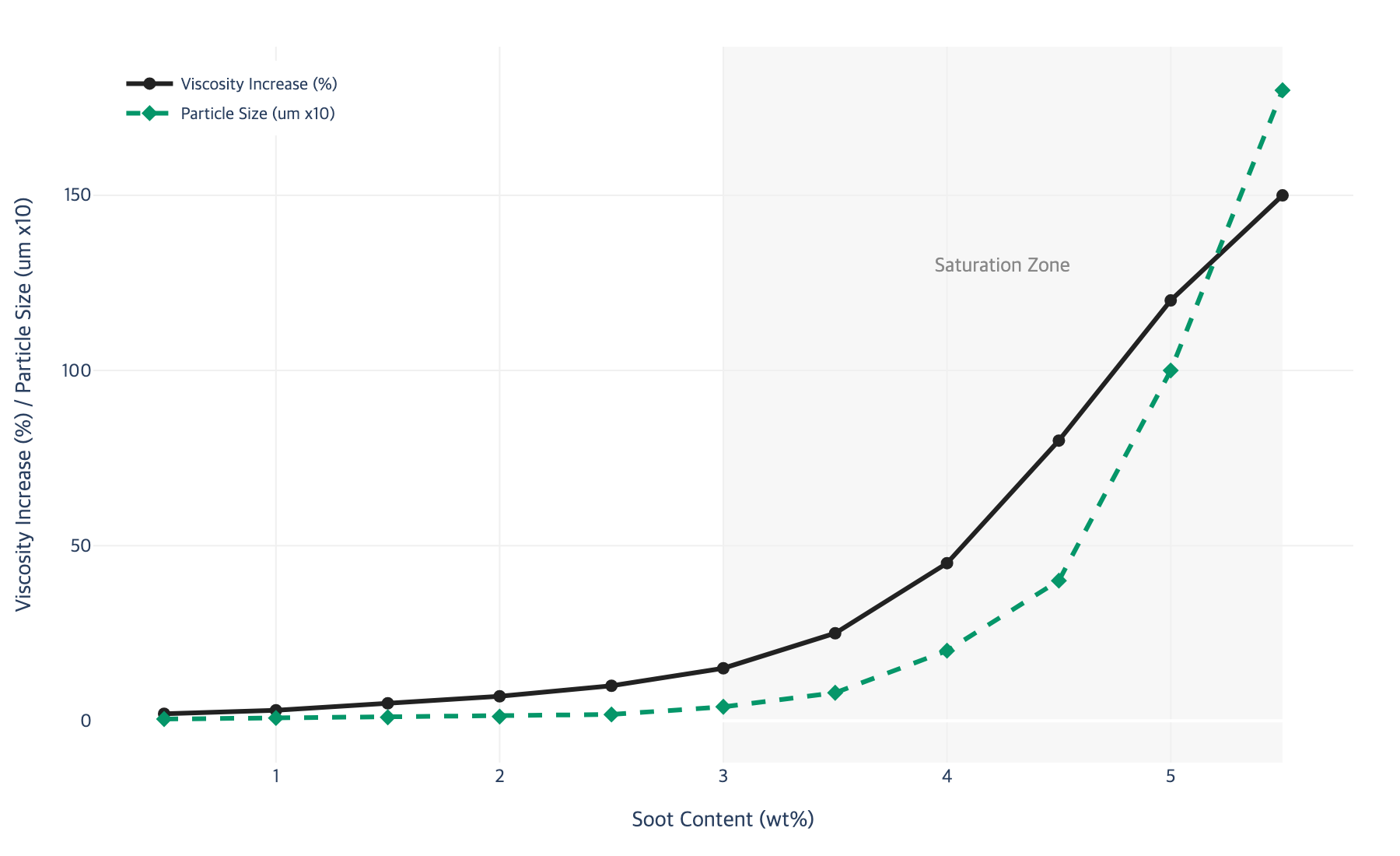
The scatter chart above reveals the non-linear relationship between soot content and two critical oil condition indicators. Both viscosity increase and particle size remain relatively flat below 2.5 percent soot, then accelerate dramatically as dispersant capacity is overwhelmed. The shaded saturation zone marks the region where dispersant control is lost and soot agglomeration begins in earnest.
Figure 3. Dispersant Saturation Impact on Oil Viscosity and Soot Agglomeration
Soot Level (wt%) | Viscosity Change (%) | Particle Size (um) | Dispersant Status | Oil Condition |
|---|---|---|---|---|
0.5 | +2 | 0.02-0.1 | Fully active | Normal |
1.5 | +5 | 0.05-0.15 | Active | Normal |
2.5 | +10 | 0.1-0.2 | Partially depleted | Monitor closely |
3.5 | +25 | 0.5-1.0 | Near saturation | Schedule drain |
4.5 | +80 | 2.0-5.0 | Saturated | Drain immediately |
5.5 | +150 | 5.0-20.0 | Exhausted | Critical, risk of damage |
This table illustrates the non-linear relationship between soot loading and oil condition. The transition from 2.5 percent to 4.5 percent soot represents a shift from manageable condition to critical failure risk, driven primarily by the loss of dispersant control over soot particle size. This narrow window underscores the importance of trending soot levels over time rather than relying on single-point measurements.
V. Operating Conditions That Accelerate Dispersant Depletion
Dispersant depletion rate is not constant but varies significantly with operating conditions. Understanding which conditions accelerate depletion allows engineers to adjust monitoring frequency and drain intervals based on actual service severity rather than generic schedules.
Fuel Quality and Combustion Efficiency
Fuel quality directly affects the rate of soot and acid byproduct generation, which in turn determines how quickly dispersant is consumed. Higher sulfur content in fuel produces more sulfuric acid in the combustion products, which consumes dispersant through acid-base neutralization. Poor fuel atomization from worn or clogged injectors increases incomplete combustion and soot formation, accelerating dispersant loading. Biodiesel blends above 20 percent (B20) can increase oxidation byproduct formation rates due to the higher reactivity of fatty acid methyl esters, placing additional demand on dispersant capacity.
The practical impact is significant. An engine running on high-sulfur fuel (above 500 ppm sulfur) may deplete its dispersant capacity 2 to 3 times faster than the same engine running on ultra-low sulfur diesel (15 ppm sulfur), all other conditions being equal. This is why fuel quality must be considered when setting drain interval guidelines, particularly in markets where fuel sulfur content varies significantly between suppliers.
Operating Temperature Profiles
Temperature affects dispersant depletion through multiple pathways. High operating temperatures (above 120 degrees C oil sump temperature) accelerate base oil oxidation, generating more oxidation products that consume dispersant capacity. At the same time, high temperatures increase the rate of thermal degradation of the dispersant molecules themselves, reducing their functional effectiveness even before they are consumed by contaminants.
Low operating temperatures create a different but equally important problem. Engines that operate predominantly at low temperatures, such as urban delivery vehicles with frequent starts and stops, generate more condensation and fuel dilution in the oil. Water and unburned fuel in the oil promote sludge formation through emulsion and acid accumulation, consuming dispersant capacity through a different mechanism than the soot-driven depletion seen in high-temperature, high-load operation.
Exhaust Gas Recirculation (EGR) Impact
Modern emission control systems, particularly Exhaust Gas Recirculation (EGR), significantly increase the contaminant load on lubricant dispersants. EGR introduces combustion products, including soot, nitrogen oxides, and acidic gases, back into the intake stream, where they increase soot formation rates by 2 to 5 times compared to non-EGR engines. This higher soot loading means that dispersant capacity is consumed proportionally faster, requiring either higher dispersant treat rates in the formulation, shorter drain intervals, or both.
The interaction between EGR and fuel quality creates a compounding effect. High EGR rates combined with marginal fuel quality can produce soot generation rates that exceed the design capacity of the dispersant package, even in premium-tier lubricants. This is a common source of unexpected oil thickening and deposit formation in heavy-duty truck fleets that operate in regions with variable fuel quality.
Figure 4. Dispersant Depletion Rate Severity by Operating Condition
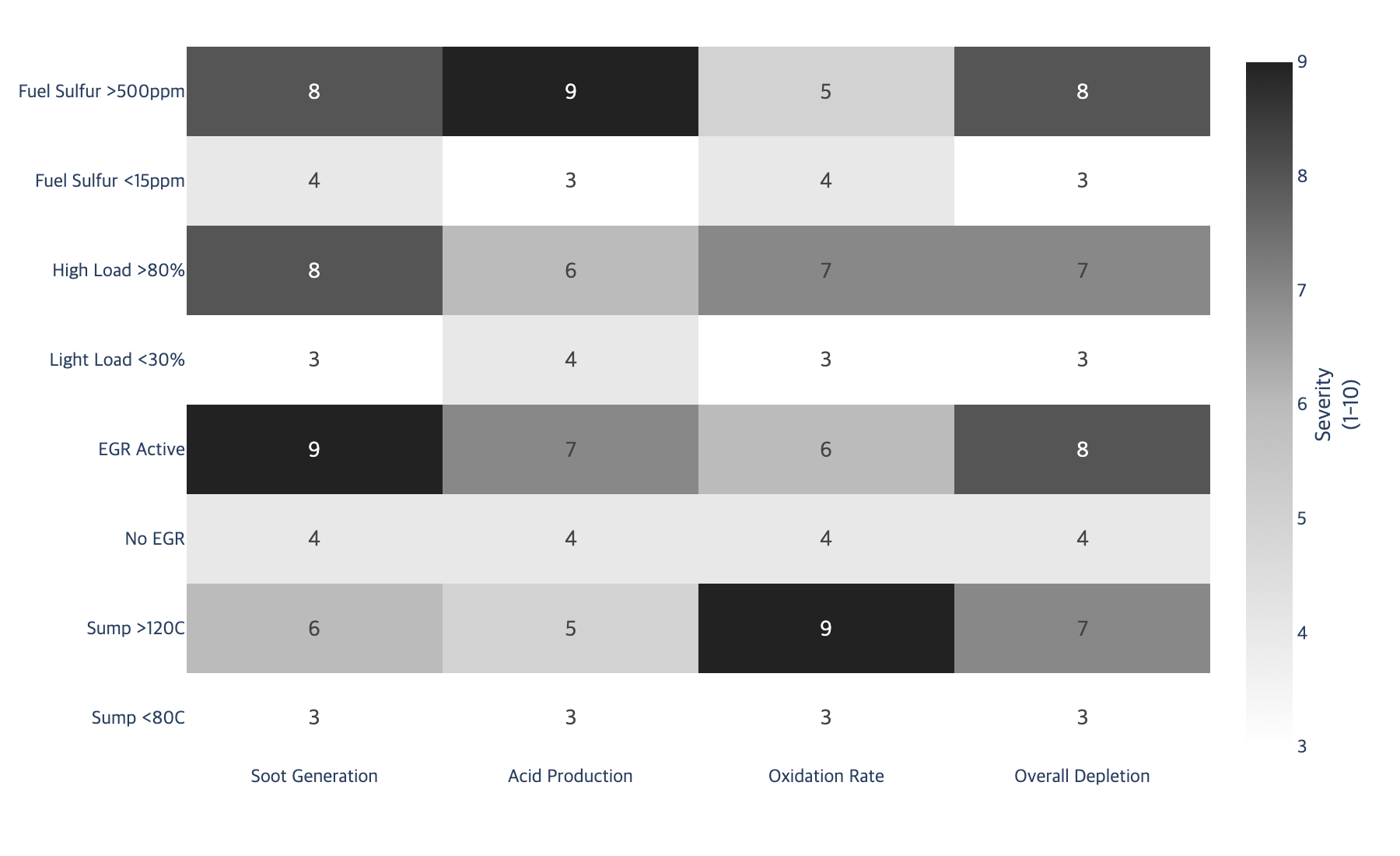
The heatmap quantifies how different operating conditions affect the four primary dispersant depletion pathways. EGR-equipped engines with high-sulfur fuel face the most severe combined depletion, scoring 8 or above across soot generation and overall depletion rate. Conversely, low-load, low-temperature operation with clean fuel creates minimal dispersant stress. This visualization helps maintenance teams prioritize monitoring frequency based on their specific operating profile.
VI. Interpreting Used Oil Analysis for Dispersant Health
Used oil analysis provides the most reliable tool for assessing dispersant condition and optimizing drain intervals. However, interpreting the data requires understanding what each test parameter reveals about dispersant function and what it does not.
Pentane and Toluene Insolubles (ASTM D893)
The ASTM D893 test method measures two types of insolubles that together provide insight into dispersant performance. Pentane insolubles represent the total amount of material that is not soluble in pentane, including soot, wear metals, oxidation products, and resinous materials from additive degradation. Toluene insolubles represent a subset of pentane insolubles, specifically the portion that is not soluble in toluene, which includes primarily hard contaminants such as wear metals, external dirt, and carbonized fuel residues.
The difference between pentane insolubles and toluene insolubles represents the organic insolubles, primarily oxidation products and resinous matter. This difference is the most direct indicator of dispersant loading. When dispersant is functioning effectively, organic insolubles remain suspended as fine particles that contribute to pentane insolubles but dissolve in the stronger toluene solvent. As dispersant capacity is consumed, these materials begin to agglomerate and some may shift from the pentane-insoluble to the toluene-insoluble fraction.
Blotter Spot Test for Dispersancy
The blotter spot test (ASTM D7899) provides a simple, rapid assessment of dispersant condition. A drop of used oil is placed on chromatography paper and allowed to wick outward. The resulting pattern reveals dispersant status through the distribution of soot in the oil spot. Well-dispersed oil produces a uniform dark spot with soot distributed evenly to the edges. Oil with depleted dispersant shows a dark center surrounded by a lighter ring, indicating that soot particles are too large to migrate through the paper fibers.
Condition-Based Drain Interval Decision Framework
Analysis Parameter | Normal Range | Watch Limit | Action Limit | What It Indicates |
|---|---|---|---|---|
Soot content (wt%) | 0-2.0 | 2.5-3.5 | Above 4.0 | Dispersant loading level |
Pentane insolubles (wt%) | 0-1.5 | 1.5-3.0 | Above 3.0 | Total contaminant load |
Toluene insolubles (wt%) | 0-0.5 | 0.5-1.0 | Above 1.0 | Hard contaminant level |
Viscosity increase (%) | 0-10 | 10-25 | Above 25 | Soot agglomeration indicator |
Total Base Number (TBN) | Above 50% of new | 25-50% of new | Below 25% of new | Acid neutralization reserve |
Blotter spot test | Uniform dark spot | Slight ring formation | Dark center, clear ring | Visual dispersancy status |
This framework enables condition-based drain decisions that consider dispersant health alongside traditional oil analysis parameters. The key principle is that multiple parameters should be trended together rather than relying on any single test. A low soot reading combined with high pentane insolubles, for example, may indicate that soot is agglomerating into larger particles that are not captured by the soot measurement method, which should trigger further investigation even though the soot value appears normal.
VII. Application Mapping: Dispersant Selection by Operating Environment
Different operating environments place different demands on dispersant chemistry, and the optimal dispersant type varies by application. The following mapping connects dispersant chemistry selection to specific operating conditions and contaminant profiles.
High-Temperature Engine Environments
Diesel and gasoline engines represent the most demanding applications for dispersant chemistry because they generate high levels of soot, oxidation products, and acid byproducts simultaneously. In these applications, PIBSI dispersants with high-molecular-weight PIB tails (1,800 to 2,300 g/mol) and long polyamine chains (TEPA or pentaethylenehexamine) provide the best combination of soot handling capacity and thermal stability. The dispersant treat rate in modern engine oils typically ranges from 5 to 10 percent by weight, with higher treat rates used in formulations designed for extended drain intervals.
Turbocharged and supercharged engines present an additional challenge because higher combustion temperatures and pressures increase both soot formation rate and the severity of oxidation. In these applications, borated PIBSI dispersants, which incorporate boron into the dispersant molecule, provide improved high-temperature deposit control compared to non-borated alternatives. The boron functionality enhances the dispersant's ability to prevent varnish and lacquer deposits on hot surfaces such as piston ring grooves and turbocharger bearings.
Low-Temperature Industrial Environments
Industrial gearbox, hydraulic, and circulating oil systems operate at significantly lower temperatures than engines and generate minimal soot. The primary contaminants in these systems are water, oxidation products, and external contamination (dirt, process fluids). Dispersant requirements are correspondingly different. Mannich base dispersants or low-treat-rate PIBSI dispersants (1 to 3 percent) are typically used to prevent water-induced sludge formation and keep oxidation products suspended rather than depositing on gear teeth and bearing surfaces.
In industrial applications, the most important dispersant function is often water handling rather than soot control. Dispersant molecules can surround water droplets and prevent them from coalescing into pools that would cause corrosion at gear tooth contacts and bearing surfaces. This emulsion-promoting behavior is desirable in applications where water contamination is intermittent and cannot be avoided, but undesirable in applications where water separation by gravity settling is the primary removal strategy.
Application Selection Summary
Operating Environment | Temperature Range | Primary Contaminants | Recommended Dispersant | Typical Treat Rate |
|---|---|---|---|---|
Heavy-duty diesel | 100-150C sump | Soot, acids, oxidation | PIBSI (high MW, TEPA) | 7-10 wt% |
Light-duty gasoline | 80-120C sump | Oxidation, varnish | PIBSI or Mannich blend | 4-7 wt% |
Turbocharged engines | 120-160C sump | Soot, high-temp deposits | Borated PIBSI | 8-10 wt% |
Industrial gearbox | 40-80C | Water, oxidation | Mannich base or low-PIBSI | 1-3 wt% |
Hydraulic systems | 40-60C | Water, particulate | Low-PIBSI or none | 0.5-2 wt% |
Gas engine (natural gas) | 90-130C sump | Nitration, oxidation | Mannich-PIBSI blend | 5-8 wt% |
This mapping demonstrates that dispersant selection is driven primarily by the dominant contaminant type and the operating temperature range. High-soot, high-temperature applications demand high-performance PIBSI chemistry at high treat rates, while low-temperature industrial applications can often achieve adequate performance with simpler dispersant systems at lower concentrations.
VIII. Key Takeaway
Dispersants work through a three-step mechanism of recognition, adsorption, and steric stabilization, where the polar head group binds to contaminant particles and the non-polar tail maintains oil solubility and prevents particle agglomeration.
PIBSI dispersants excel at soot handling in engine applications due to superior steric stabilization, while Mannich base dispersants offer dual dispersant-antioxidant functionality better suited to oxidation-dominated industrial environments.
The saturation point represents a critical threshold where dispersant capacity is overwhelmed, causing an abrupt transition from controlled suspension to rapid agglomeration, viscosity increase, and deposit formation.
Used oil analysis, particularly the combination of pentane/toluene insolubles (ASTM D893), soot content, viscosity trending, and blotter spot testing, provides the data needed for condition-based drain interval decisions.
Drain intervals should be based on actual dispersant condition rather than fixed schedules, with monitoring frequency adjusted for operating severity factors including fuel quality, temperature profile, and EGR loading.
Lubinpla's lubricant analysis module can cross-reference your used oil analysis data with dispersant depletion models specific to your engine type and operating conditions, identifying the optimal drain interval that maximizes oil life without risking dispersant saturation.
IX. References
[1] MDPI Polymers, "The Role of Polyisobutylene-Bis-Succinimide (PIBSI) Dispersants in Lubricant Oils on the Deposit Control Mechanism", 2025. https://www.mdpi.com/2073-4360/17/8/1041
[2] ScienceDirect, "Adsorption properties of succinimide dispersants on carbonaceous substrates", 1999. https://www.sciencedirect.com/science/article/abs/pii/S0008622399000871
[3] Infineum Insight, "The art of dispersant design", 2024. https://www.infineuminsight.com/en-gb/articles/the-art-of-dispersant-design/
[4] Machinery Lubrication, "Understanding Oil's Saturation Point", 2024. https://www.machinerylubrication.com/Read/30848/oil-saturation-point
[5] Machinery Lubrication, "Dispersancy Testing", 2024. https://www.machinerylubrication.com/Read/32320/dispersancy-testing
[6] Afton Chemical, "Dispersants and Emulsifiers", 2024. https://www.aftonchemical.com/products/lubricant-components/dispersants-emulsifiers/
[7] Allan Chemical Corporation, "Dispersants vs. Detergents in Lubricants", 2024. https://allanchem.com/dispersants-vs-detergents-lubricants/
[8] Precision Lubrication, "Defoamants, Dispersants, and Detergents in Lubricants: A Complete Guide", 2024. https://precisionlubrication.com/articles/defoamants-dispersants-detergents/
[9] Learn Oil Analysis, "What happens in an engine oil to cause sludges?", 2024. https://learnoilanalysis.com/lube-oil-test-analysis-lab-lubrication-reliability-maintenance/what-happens-in-an-engine-oil-to-cause-sludges/
[10] FS Cooperatives, "Soot in Diesel Engines", 2024. https://fscooperatives.com/learning-hub/lubricants/soot-in-diesel-engines
[11] ASTM International, "D893 Standard Test Method for Insolubles in Used Lubricating Oils", 2018. https://www.astm.org/Standards/D893.htm
[12] Machinery Lubrication, "Lubricant Additives: A Practical Guide", 2024. https://www.machinerylubrication.com/Read/31107/oil-lubricant-additives
[13] Machinery Lubrication, "Discovery in Engine Oil Soot Testing Teaches Lesson", 2024. https://www.machinerylubrication.com/Read/651/soot-testing-oil
Powered by Lubinpla
Discover how technical teams solve complex challenges faster with AI.