What Really Causes Emulsion Instability in Metalworking Fluids
Summary: Metalworking fluid emulsions that break down unpredictably, with phase separation, bacterial growth, and rancid odor appearing despite following the manufacturer's maintenance guidelines, are among the most common and costly problems in machining operations. This article explains the chemistry behind emulsion stability, how the Hydrophilic-Lipophilic Balance (HLB) of the surfactant system maintains the oil-water interface, and how the three primary destabilizers, tramp oil contamination, hard water ions, and biocide depletion, interact to create a tipping point beyond which recovery becomes impossible. Engineers who understand these mechanisms can implement a predictive monitoring protocol that detects instability 2 to 3 weeks before visible breakdown, extending fluid life by 30 to 50 percent and preventing the cascading quality issues that degraded fluid causes.
Table of Contents
I. When Emulsions Fail Despite Following the Rules
II. Emulsion Chemistry: How Oil and Water Stay Mixed
III. The Three Destabilizers and Their Mechanisms
IV. The Tipping Point: How Destabilizers Interact
V. Predictive Monitoring Protocol for Early Detection
VI. Field Cases: Catching Instability Before Collapse
VII. Key Takeaway
VIII. References
I. When Emulsions Fail Despite Following the Rules
Metalworking fluid management seems straightforward: mix the concentrate at the specified ratio, monitor concentration weekly, add biocide on schedule, and skim tramp oil when it accumulates on the surface. Yet facilities following these guidelines still experience sudden emulsion failures that require complete sump dumps, costing USD 2,000 to USD 15,000 per machine in fluid, disposal, cleaning, and lost production (Production Machining, 2023). Across a facility with 20 to 50 machines, annual metalworking fluid costs often exceed USD 200,000, with 30 to 40 percent of that cost attributable to premature fluid replacement from stability failures.
The Hidden Cost Structure
The direct cost of a sump dump, fluid concentrate, disposal fees, and cleaning chemicals, represents only a fraction of the total impact. Disposal alone can range from USD 0.25 to USD 3.00 per gallon depending on local regulations, and a facility hauling 6,000 gallons of spent fluid per month faces significant annual disposal costs before counting the replacement fluid (Master Fluids, 2022). The larger cost driver is production downtime. Each sump cleanout on a high-utilization CNC machine typically requires 3 to 6 hours, during which the machine generates zero revenue. For a machine with a billing rate of USD 150 to USD 300 per hour, the downtime cost per dump exceeds the fluid cost by a factor of 2 to 4. Across a multi-machine facility, metalworking fluid instability often ranks among the top five controllable cost categories, yet it receives far less management attention than tooling or energy costs.
The Pattern of Unpredictable Failure
The typical failure progression follows a deceptive pattern. The fluid appears stable for weeks or months, with concentration, pH, and appearance all within acceptable ranges. Then, over a period of 3 to 7 days, the emulsion deteriorates rapidly. The fluid develops a foul odor indicating bacterial proliferation. Phase separation becomes visible as free oil floating on the surface. Corrosion appears on workpieces and machine surfaces. Surface finish quality degrades. By the time these symptoms are visible, the emulsion has passed the point of recovery, and a complete fluid change is the only option. The challenge is that the destabilizing factors were accumulating long before the visible symptoms appeared, and the standard monitoring parameters were not sensitive enough to detect them in time.
II. Emulsion Chemistry: How Oil and Water Stay Mixed
Understanding why emulsions fail requires first understanding what holds them together. A metalworking fluid emulsion is a thermodynamically unstable system of oil droplets suspended in water, maintained in a metastable state by a surfactant system at the oil-water interface. Without surfactants, the oil and water would separate within minutes. The surfactant system is therefore the critical structural element of the emulsion, and any factor that compromises it directly threatens fluid stability.
The HLB Balance
Surfactant molecules have a dual nature: one end is hydrophilic (water-attracting) and the other is lipophilic (oil-attracting). The Hydrophilic-Lipophilic Balance (HLB) is a numerical measure of this dual character, typically ranging from 0 to 20, with higher values indicating greater water affinity (Sea-Land Chemical, 2023). For oil-in-water emulsions used in metalworking, surfactants with HLB values of 8 to 16 are typically employed. The emulsion is most stable when the surfactant system is equally attracted to both phases. If the balance is tipped in either direction, the surfactant molecules lose contact with the phase to which they are less attracted, and the emulsion destabilizes. This balance can be disrupted by changes in temperature, pH, water hardness, or contamination with foreign oils that have different polarity characteristics than the base oil in the concentrate.
The Protective Barrier
At the oil-water interface, surfactant molecules form an oriented monolayer with hydrophilic heads extending into the water phase and lipophilic tails extending into the oil droplet. This monolayer creates an electrostatic and steric barrier that prevents adjacent oil droplets from merging. The strength of this barrier depends on the surfactant concentration at the interface, the charge density of the hydrophilic heads, and the thickness of the hydration layer surrounding each droplet. When any of these factors is reduced below a critical threshold, droplets begin to coalesce, and the emulsion enters a cascade of instability that progresses through distinct stages. Creaming occurs first, as density differences cause oil droplets to rise toward the surface under gravity. Creaming is reversible because individual droplets retain their identity and can be redispersed by agitation. If the surfactant barrier continues to weaken, flocculation follows, where droplets aggregate into three-dimensional clusters that separate out more rapidly than individual droplets due to their larger effective size. Flocculation is still partially reversible with mechanical energy and surfactant replenishment. The final stage, coalescence, is irreversible. Droplets merge as the interfacial film between them ruptures, forming progressively larger oil masses that can no longer be re-emulsified by the remaining surfactant. Once coalescence begins, the emulsion has entered terminal decline.
III. The Three Destabilizers and Their Mechanisms
Three primary factors drive emulsion instability in metalworking systems. Each operates through a distinct chemical mechanism, but their effects converge on the same target: the surfactant barrier at the oil-water interface.
Destabilizer 1: Tramp Oil Contamination
Tramp oil, the collective term for hydraulic oil, way oil, spindle oil, and other lubricants that leak into the metalworking fluid sump, is the most common destabilizer in practice. Its mechanism of action is both direct and indirect. Directly, tramp oil introduces hydrocarbons with different polarity and molecular weight than the base oil in the metalworking fluid concentrate. These foreign hydrocarbons compete for surfactant coverage at the oil-water interface, effectively diluting the surfactant concentration available for the emulsion's own oil droplets. When tramp oil exceeds approximately 2 percent of the total fluid volume, the surfactant system becomes overwhelmed and can no longer maintain the emulsion structure (Twin Specialties, 2023). Indirectly, tramp oil that accumulates on the sump surface creates an anaerobic layer that promotes the growth of anaerobic bacteria, which produce hydrogen sulfide gas responsible for the characteristic rancid odor of degraded metalworking fluids.
Destabilizer 2: Hard Water Ions
Water hardness, primarily calcium and magnesium ions, destabilizes emulsions by reacting with anionic surfactants to form insoluble metallic soaps. These insoluble soaps precipitate out of the emulsion, physically removing surfactant molecules from the oil-water interface and reducing the protective barrier. The effect is dose-dependent: water hardness above 300 ppm as CaCO3 begins to measurably affect emulsion stability, and hardness above 500 ppm can cause rapid destabilization of emulsions formulated for soft water conditions (Modern Machine Shop, 2023). The hard water effect is amplified during top-ups and concentration adjustments. Each time water evaporates from the sump and is replaced with fresh hard water, the dissolved mineral content increases incrementally. Over weeks and months, the effective hardness in the sump can reach 2 to 3 times the incoming water hardness, even if the makeup water appears to be within specification.
Destabilizer 3: Biocide Depletion and Microbial Attack
Biocides in metalworking fluids prevent the growth of bacteria and fungi that degrade the fluid's functional additives. When biocide concentration drops below the minimum inhibitory concentration (MIC), microbial populations double every 20 to 30 minutes under favorable conditions (Intertek, 2023). Bacteria, particularly Pseudomonas species, metabolize the surfactant molecules as a carbon source, directly depleting the emulsifier system. Pseudomonas is the most frequently recovered genus in contaminated metalworking fluids, a gram-negative organism that thrives in the nutrient-rich sump environment (Mattsby-Baltzer et al., 2012). Research has identified Chryseomonas luteola, Ochrobactrum anthropi, and Alcaligenes faecalis as particularly efficient degraders of metalworking fluid emulsifiers, targeting the fatty acids, fatty acid amides, and fatty alcohol ethoxylates that maintain the oil-water interface (Koch et al., 2021). Compounding this problem, some Pseudomonas species develop resistance to multiple biocide classes, meaning that repeated use of the same biocide type can select for resistant populations that accelerate surfactant degradation even when biocide is present at nominal concentrations.
Additionally, bacterial metabolism produces organic acids that lower the pH, which shifts the ionization state of anionic surfactants and reduces their effectiveness. A pH drop from the normal operating range of 8.5 to 9.2 down to below 8.0 can reduce emulsifier effectiveness by 30 to 50 percent even without any change in surfactant concentration. The combination of direct surfactant consumption by bacteria and indirect surfactant deactivation by pH shift creates a double attack on emulsion stability that progresses rapidly once microbial growth begins.
IV. The Tipping Point: How Destabilizers Interact
The three destabilizers do not operate independently. They interact in a cascading fashion where each factor amplifies the others, creating a positive feedback loop that accelerates toward emulsion collapse once a critical threshold is crossed.
Figure 3. Emulsion Degradation Timeline: pH and Bacterial Growth Correlation
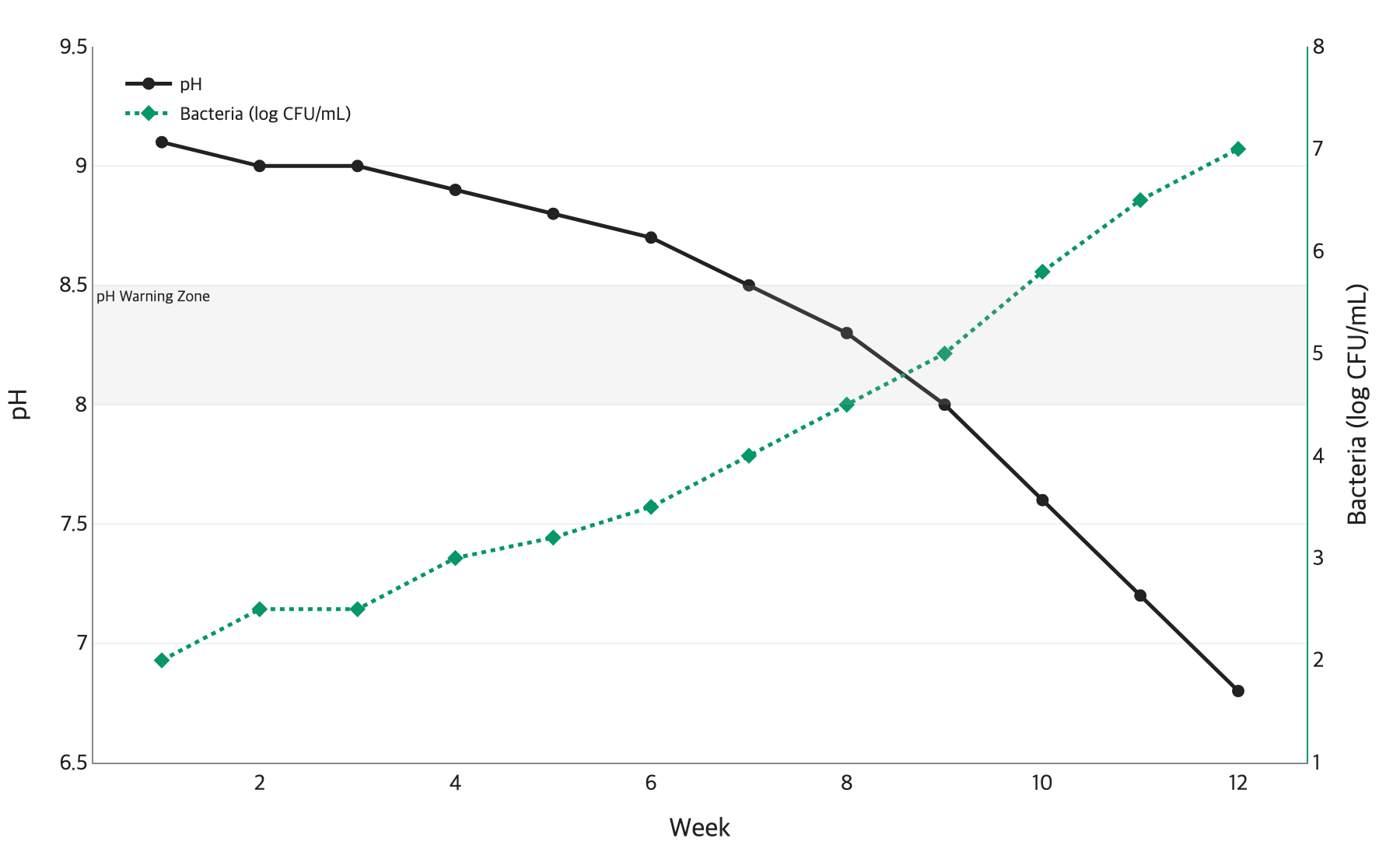
This dual-axis chart shows the characteristic pattern of emulsion collapse. pH remains stable for the first 5 to 6 weeks while bacterial growth is controlled, creating a false sense of stability. Once biocide depletes and bacteria proliferate past 10^4 CFU/mL, pH begins a rapid decline as bacterial acids accumulate. The warning zone between pH 8.0 and 8.5 represents the last intervention window before irreversible destabilization.
Figure 4. Destabilizer Interaction Severity Matrix: Tramp Oil vs Water Hardness
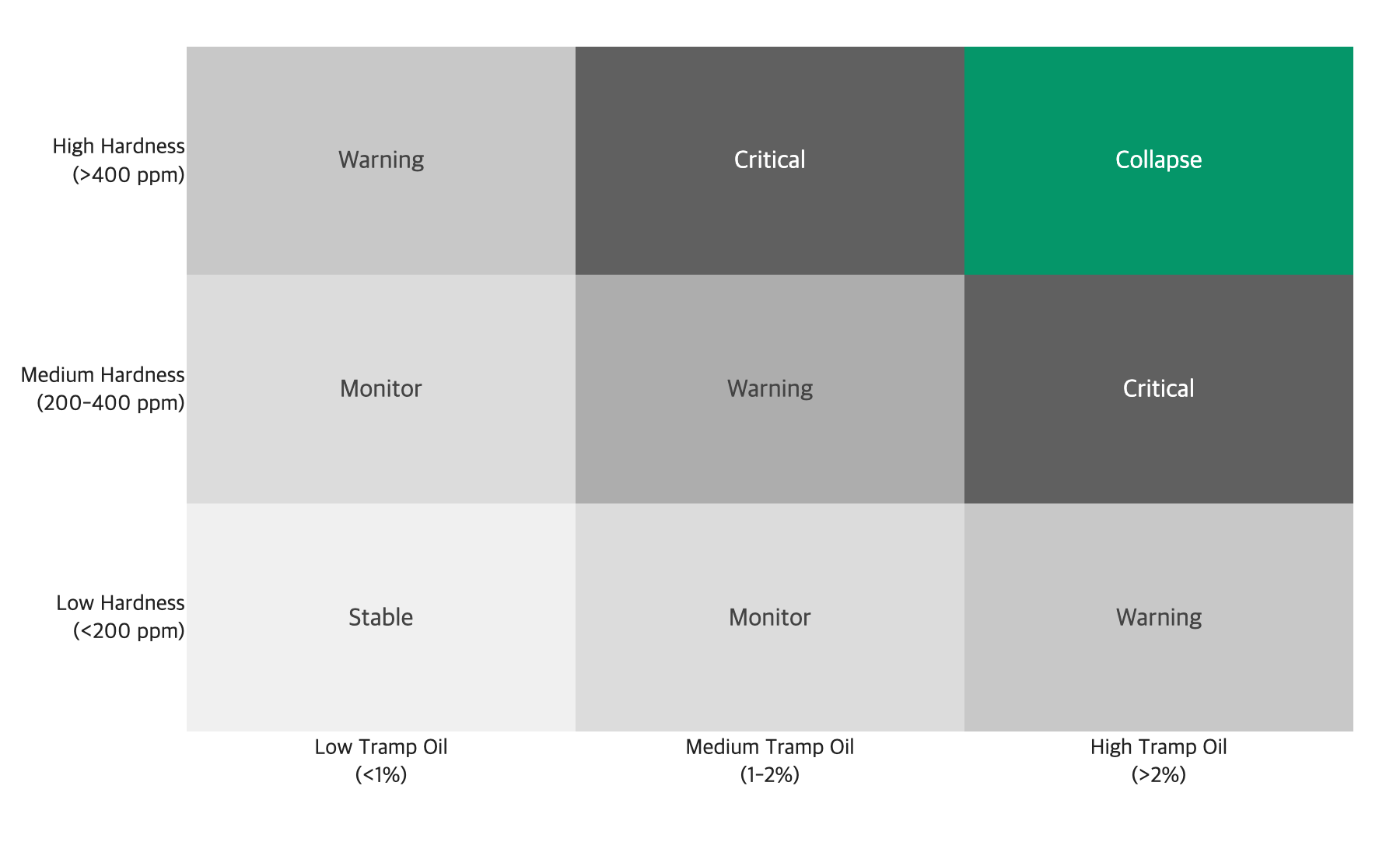
This heatmap illustrates how the combined effect of tramp oil and water hardness determines emulsion risk level. Either factor alone at moderate levels produces only a "Monitor" condition, but the combination of high tramp oil and high hardness drives the system directly to "Collapse" status. This interaction effect explains why facilities with marginal water quality experience sudden failures when a hydraulic leak introduces a tramp oil spike.
The Cascade Sequence
The typical cascade begins with tramp oil accumulation creating an anaerobic surface layer that promotes bacterial growth. Bacterial proliferation depletes biocide faster than the maintenance schedule replenishes it. Once biocide falls below MIC, bacteria begin consuming surfactant molecules as a carbon source, reducing the protective barrier. Simultaneously, bacterial acid production lowers pH, further reducing surfactant effectiveness. As the weakened emulsion loses its ability to reject tramp oil, more tramp oil becomes emulsified rather than floating free, further diluting the surfactant system. If hard water concentration has been building through evaporative top-ups, the surfactant loss from bacterial consumption and hard water precipitation compounds, and the emulsion collapses rapidly.
Figure 1. Emulsion Stability Monitoring Parameters and Threshold Values
Parameter | Optimal Range | Warning Threshold | Critical Threshold | Test Method |
|---|---|---|---|---|
Concentration | Manufacturer spec (typically 5-8%) | Below spec by 1% | Below spec by 2% | Refractometer |
pH | 8.5-9.2 | 8.0-8.5 | Below 8.0 | pH meter |
Tramp oil | < 1% | 1-2% | > 2% | Visual / tramp oil disc |
Bacteria count | < 10^3 CFU/mL | 10^3-10^5 CFU/mL | > 10^5 CFU/mL | Dip slide |
Conductivity | Stable baseline | > 20% above baseline | > 40% above baseline | Conductivity meter |
Water hardness (sump) | < 300 ppm CaCO3 | 300-500 ppm | > 500 ppm | Test strip or titration |
This monitoring table provides the early warning system that enables intervention before the cascade reaches the irreversible tipping point. The key insight is that no single parameter predicts collapse reliably on its own. It is the combination of two or more parameters approaching warning thresholds simultaneously that indicates the cascade is developing. Monitoring all six parameters weekly provides a 2 to 3 week advance warning window before visible symptoms appear.
V. Predictive Monitoring Protocol for Early Detection
The transition from reactive fluid management, where fluid is changed after it fails, to predictive management, where intervention occurs before the tipping point, requires a structured monitoring protocol that tracks the leading indicators of instability.
Weekly Monitoring Routine
The recommended weekly protocol takes approximately 15 minutes per machine and covers the six parameters in the table above. Concentration is measured by refractometer and adjusted to the center of the manufacturer's range. pH is measured and trended against the baseline for that specific fluid. A sustained downward trend of 0.3 units or more per week triggers investigation regardless of whether the absolute value is below the warning threshold. Tramp oil is assessed visually and removed by skimmer or tramp oil separator. Bacteria count is measured by dip slide and recorded. Conductivity is measured and compared to the baseline value established when fresh fluid was charged. A rising conductivity trend indicates mineral accumulation from evaporative top-ups and warns of impending hard water destabilization.
Intervention Triggers
When two or more parameters simultaneously reach the warning threshold, immediate corrective action is required. The specific action depends on which parameters are triggered. High tramp oil plus rising bacteria count indicates that the tramp oil is feeding bacterial growth, requiring aggressive skimming combined with biocide addition. Falling pH plus rising bacteria count indicates active microbial attack, requiring biocide shock treatment followed by pH adjustment with alkaline reserve additive. Rising conductivity plus falling pH indicates mineral accumulation combined with acid production, requiring partial fluid replacement with soft water to dilute both the mineral load and the acid content. Taking action at the warning stage, rather than waiting for the critical threshold, preserves the emulsion structure and extends fluid life by the 30 to 50 percent that predictive management delivers compared to reactive management.
VI. Field Cases: Catching Instability Before Collapse
Case 1: Company A, Automotive Parts Machining Facility
Company A operated 32 CNC machining centers producing aluminum automotive components, each with a 500-liter central sump running a semi-synthetic metalworking fluid at 7 percent concentration. The facility experienced an average of 6 complete sump dumps per month across the 32 machines, at a total monthly cost of approximately USD 48,000 including fluid, disposal, cleaning labor, and production downtime of 4 hours per dump. The maintenance team followed the manufacturer's recommended protocol: weekly concentration checks, biocide addition every 2 weeks, and tramp oil skimming when visible.
Investigation revealed the root cause was a hard water cascade that the standard monitoring missed. The facility's water supply averaged 280 ppm hardness as CaCO3, within the fluid manufacturer's specification of "below 300 ppm." However, evaporative losses in the machining centers averaged 15 percent per week, and top-ups with the same 280 ppm water progressively increased sump hardness. After 8 weeks of operation, measured sump hardness reached 520 to 680 ppm, well above the critical threshold. At these hardness levels, calcium ions were precipitating the anionic emulsifiers, weakening the emulsion structure and making it vulnerable to rapid collapse when any additional stress, such as a tramp oil spike from a hydraulic leak, was applied.
The corrective program addressed the hard water accumulation through two actions. First, a reverse osmosis (RO) unit producing water at less than 20 ppm hardness was installed for all metalworking fluid makeup at a capital cost of USD 12,000. Second, the weekly monitoring protocol was expanded to include sump conductivity measurement as a proxy for mineral accumulation, with a trigger for partial sump replacement when conductivity exceeded 150 percent of the fresh-fluid baseline. After implementation, sump dumps decreased from 6 per month to 0.8 per month. Average fluid life extended from 8 weeks to over 20 weeks. Monthly metalworking fluid costs dropped from USD 48,000 to approximately USD 11,000. The RO unit investment achieved payback in less than 4 weeks.
Case 2: Company B, Aerospace Precision Grinding Operation
Company B operated a precision grinding line with 8 machines processing nickel-based superalloy components, using a high-performance emulsion at 6 percent concentration in individual 300-liter sumps. The critical quality requirement was surface finish below Ra 0.4 micrometers, which degraded to Ra 0.8 or worse when fluid stability declined. Surface finish rejections averaging 3.5 percent per month were traced to fluid instability, costing approximately USD 28,000 per month in rework and scrap on components valued at USD 800 to USD 3,500 each.
The root cause was a biocide depletion cascade masked by adequate concentration readings. The grinding operation generated fine metal particles, including nickel and chromium, that were not fully removed by the magnetic separator. These dissolved metal particles acted as nutrients for Pseudomonas bacteria, accelerating biocide consumption. The standard 2-week biocide addition interval was insufficient; biocide levels dropped below MIC within 5 to 7 days. Bacteria consumed surfactant as a carbon source, reducing emulsion stability and allowing fine abrasive particles to agglomerate rather than remaining in suspension, directly causing the surface finish degradation.
The solution involved three coordinated changes. First, the biocide addition frequency was increased from biweekly to twice weekly based on dip slide monitoring showing bacterial counts exceeding 10^4 CFU/mL by day 5. Second, a centrifugal separator was added to each sump to remove fine metal particles below 5 micrometers that the magnetic separator missed, reducing the nutrient source for bacterial growth. Third, weekly pH and conductivity trending was implemented with a rule that any pH drop exceeding 0.2 units in a single week triggered immediate biocide treatment regardless of the scheduled interval. Surface finish rejections dropped from 3.5 percent to 0.4 percent within 6 weeks. Monthly rework and scrap costs decreased from USD 28,000 to approximately USD 3,200. Average fluid life extended from 6 weeks to 14 weeks. The centrifugal separator investment of USD 8,500 per machine achieved payback in under 3 months based on reduced scrap alone.
VII. Key Takeaway
Metalworking fluid emulsion stability depends on the surfactant barrier at the oil-water interface. Three destabilizers, tramp oil, hard water ions, and microbial attack, all converge on this same barrier, and their effects multiply rather than add when they occur simultaneously.
Tramp oil above 2 percent overwhelms the surfactant system, hard water above 500 ppm precipitates anionic emulsifiers, and bacterial counts above 10^5 CFU/mL consume surfactant as a carbon source while producing acids that deactivate remaining emulsifier. Any two of these factors reaching warning thresholds simultaneously indicates the emulsion is approaching the irreversible tipping point.
Standard monitoring of concentration alone misses the leading indicators of instability. A six-parameter weekly protocol covering concentration, pH, tramp oil, bacteria, conductivity, and sump hardness provides 2 to 3 weeks of advance warning before visible emulsion breakdown.
Evaporative top-ups with hard water progressively increase sump mineral content even when the incoming water meets specification. Conductivity trending is the simplest and most reliable indicator of this hidden accumulation effect.
Predictive monitoring with intervention at warning thresholds extends metalworking fluid life by 30 to 50 percent and reduces fluid-related quality defects by 80 percent or more compared to reactive management.
The interaction between these destabilizers is highly specific to each operation. The same fluid formulation behaves differently depending on water hardness, machine type, tramp oil sources, ambient temperature, and production intensity. A monitoring protocol that works in one facility may miss the leading indicator in another. Lubinpla's Assistant can cross-reference your metalworking fluid's specific emulsifier chemistry, whether anionic, nonionic, or a blended system, with your water quality data, contamination profile, and historical pH and conductivity trends to identify which destabilizer poses the greatest risk in your operating environment. Rather than applying a generic monitoring schedule, Lubinpla analyzes the interaction pattern between your conditions and recommends targeted intervention triggers, biocide rotation strategies to prevent bacterial resistance, and monitoring frequency calibrated to your facility's evaporation rate and water hardness level.
VIII. References
[1] Production Machining, "Metalworking Fluid Management and Best Practices", 2023. https://www.productionmachining.com/articles/metalworking-fluid-management-and-best-bractices
[2] Sea-Land Chemical, "What is an HLB Value?", 2023. https://sealandchem.com/blog/what-is-an-hlb-value
[3] Twin Specialties, "How to Manage your Metalworking Fluids", 2023. https://www.twinoils.com/news/how-manage-your-metalworking-fluids/
[4] Modern Machine Shop, "The Right Water Chemistry: Understanding The Aqueous Influence Upon Metalworking", 2023. https://www.mmsonline.com/articles/the-right-water-chemistry-understanding-the-aqueous-influence-upon-metalworking
[5] Intertek, "Metalworking Fluids (MWF) Testing", 2023. https://www.intertek.com/ocm/mwf/
[6] AMSOIL Industrial, "Lubrication Logic: Metalworking Fluid Troubleshooting", 2025. https://blog.amsoilindustrial.com/2025/03/21/lubrication-logic-metalworking-fluid-troubleshooting/
[7] Fuchs, "Cutting Fluids Monitoring and Maintenance", 2023. https://www.fuchs.com/fileadmin/schmierstoffe/Prospekte/FTI/Cutting-Fluids-Monitoring-and-Maintenance.pdf
[8] Q8Oils, "Engineers Guide to Using Metalworking Fluids", 2023. https://www.q8oils.com/wp-content/uploads/2020/06/Pocket-Guide-Metalworking-Fluids-English.pdf
[9] Master Fluids, "Debunking Myths: Are You Over-Maintaining or Under-Maintaining Your Fluid System?", 2025. https://www.masterfluids.com/blog/2025/08/22/debunking-myths-are-you-over-maintaining-or-under-maintaining-your-fluid-system/
[10] Bureau Veritas, "Metalworking Fluids Testing and Analysis", 2023. https://oil-testing.com/application/metalworking-fluids/
[11] Lube Media, "Control and Maintenance of Metalworking Fluids", 2023. http://www.lube-media.com/wp-content/uploads/2017/11/Lube-Tech073-Controlandmaintenanceofmetalworkingfluids.pdf
[12] AOCS, "Emulsions: Making Oil and Water Mix", 2023. https://www.aocs.org/stay-informed/inform-magazine/featured-articles/emulsions-making-oil-and-water-mix-april-2014?SSO=True
[13] Advanced Chemistry Solutions, "Metalworking Fluid Definitions", 2023. https://www.advchems.com/technical-terms.php
[14] ROCOL, "How to Test Your Metalworking Fluid Using Dip Slides", 2023. https://www.rocol.com/knowledge-centre/rocol_expert/how-to-test-your-metalworking-fluid-using-dip-slides
[15] Master Fluids, "The Cost Savings of Cutting Fluid Recycling Systems vs Disposal", 2022. https://www.masterfluids.com/blog/2022/12/13/the-cost-savings-of-cutting-fluid-recycling-systems-vs-disposal/
[16] Mattsby-Baltzer et al., "The Microbiology of Metalworking Fluids", Applied Microbiology and Biotechnology, 2012. https://link.springer.com/article/10.1007/s00253-012-4055-7
[17] Koch et al., "Ways to Improve Biocides for Metalworking Fluid", PMC, 2021. https://pmc.ncbi.nlm.nih.gov/articles/PMC7921375/
Powered by Lubinpla
Discover how technical teams solve complex challenges faster with AI.