When to Recoat and When to Switch: Reading the Signs of Coating System Degradation
Summary: Coating systems degrade through predictable stages, and each observable warning sign reveals a specific mechanism at work. Yet most maintenance decisions default to recoating with the same product without assessing whether the original chemistry is appropriate for the environment. This article maps five observable degradation signs to their underlying mechanisms, establishes decision criteria for when spot repair is sufficient versus when a full system change is needed, and provides a practical assessment framework linking field observations to product chemistry decisions.
Table of Contents
I. The Hidden Cost of Defaulting to Recoat
II. Five Warning Signs and Their Degradation Mechanisms
III. How Degradation Progresses Through Predictable Stages
IV. Field Assessment: Connecting Observations to Root Causes
V. Decision Framework: Repair, Recoat, or Reselect
VI. Coating Chemistry Selection by Environment
VII. Key Takeaway
VIII. References
I. The Hidden Cost of Defaulting to Recoat
When a coating system shows visible degradation, the default response at most facilities is to recoat with the same product. This assumes the original coating selection was correct and that the failure is simply a matter of age. In many cases, that assumption is wrong. A coating that chalks and loses gloss within three years in a coastal environment is not aging normally, it is chemically incompatible with the UV and chloride exposure level. Recoating with the same product restarts the same failure cycle.
The cost difference between a correct and incorrect maintenance decision is substantial. A recoat that lasts the expected service life costs approximately USD 15 to 25 per square meter when amortized. A recoat that fails prematurely and requires a second intervention within two to three years effectively doubles the per-square-meter cost while adding production downtime for each additional shutdown (Sherwin-Williams, 2023). With the global cost of corrosion exceeding USD 2.5 trillion annually (NACE International, 2016), the key to breaking the cycle is reading the degradation signs correctly and understanding what each sign reveals about the coating's compatibility with its service environment.
Why the Degradation Pattern Matters More Than the Degradation Itself
Two coating systems can both show degradation at the five-year mark, but the pattern tells entirely different stories. Uniform chalking with no blistering indicates UV breakdown of the topcoat binder while the barrier function remains intact. Localized blistering with rust staining indicates moisture ingress and adhesion loss at the substrate interface.
These patterns lead to opposite maintenance decisions. The chalking system needs a more UV-resistant topcoat over the existing primer, a low-cost intervention. The blistering system needs removal to the substrate and potentially a different primer chemistry, a high-cost intervention. Applying the wrong response to either situation wastes money and time.
II. Five Warning Signs and Their Degradation Mechanisms
Each observable warning sign on a coating surface connects to a specific degradation mechanism. Understanding this connection is what separates informed maintenance decisions from expensive guesswork.
Chalking
Chalking appears as a powdery residue on the coating surface that transfers to the hand when wiped. It results from UV-induced photodegradation of the organic binder, which breaks polymer chains and releases pigment particles no longer bound to the film matrix (Sherwin-Williams, 2023). Alkyd and unmodified epoxy systems chalk more rapidly than acrylic polyurethane or fluoropolymer topcoats.
The rate of chalking is the diagnostic indicator, not merely its presence. A polyurethane topcoat showing light chalking at year eight is performing within expectations. The same topcoat showing heavy chalking at year three indicates either inadequate UV stabilizer loading or an exposure condition more severe than anticipated. Chalking severity can be quantified using ASTM D4214, which provides a numerical scale from 0 (no chalking) to 10 (severe chalking).
Gloss Loss
Gloss loss precedes chalking and represents the earliest visible stage of UV degradation. As the binder surface roughens at a microscopic level, it loses its ability to reflect light uniformly. Gloss is measured in gloss units at a 60-degree angle per ASTM D523, and the rate of decline provides quantitative early warning before chalking becomes visible.
Gloss loss alone does not indicate a threat to protective function, but its rate is diagnostic. A coating losing more than 50 percent of its original gloss within two years suggests the binder is not UV-stable enough for the exposure level. Fluoropolymer topcoats typically retain more than 80 percent of original gloss after 15 years, while standard acrylic polyurethanes may retain only 50 to 60 percent over the same period (AMPP, 2023). Tracking gloss retention over successive inspections creates a trend line that predicts when chalking will begin and when topcoat maintenance will be needed.
Color Change
Color change, including yellowing, darkening, or fading, reflects chemical changes in the binder or pigment system. Yellowing in alkyds is caused by oxidation of unsaturated fatty acid chains in the resin (ScienceDirect, 2023). Fading or bleaching indicates pigment degradation or leaching. In epoxy systems, color change often manifests as ambering, a yellow-brown discoloration caused by breakdown of the aromatic amine curing agent under UV exposure.
Color change patterns that appear unevenly across a structure often indicate localized differences in UV exposure or chemical contact. A storage tank that yellows on its south-facing surface but remains unchanged on the north side is demonstrating UV-driven binder degradation with a clear directional pattern, ruling out substrate-related causes. Color change is also significant in facilities where color coding serves a safety function, as a coating that shifts color may need replacement for compliance reasons even if its protective barrier remains intact.
Blistering
Blistering indicates moisture, solvent, or gas trapped beneath the coating film, creating dome-shaped defects. Osmotic blistering occurs when water migrates through the film toward soluble salts at the coating-substrate interface (Marvel Coatings, 2023). The location of blisters is diagnostic: blisters at the topcoat-intermediate interface suggest intercoat adhesion failure, while blisters at the primer-substrate interface suggest surface preparation deficiency or contamination.
ASTM D714 classifies blisters by size (from 2, the largest, to 8, the smallest) and frequency. Large, isolated blisters often indicate localized contamination such as soluble salt deposits or oil spots not removed during surface preparation. Small, densely distributed blisters are more characteristic of osmotic pressure effects or solvent entrapment from coatings applied at excessive film thickness. Localized contamination can be addressed with improved surface cleaning, while osmotic blistering may require a primer with lower moisture vapor transmission rate.
Rust Staining and Breakthrough
Rust staining visible on the coating surface is the most advanced warning sign, indicating that corrosion has initiated at the substrate and corrosion products are migrating through the coating system.
Rust staining at random locations suggests general permeability failure. Rust staining concentrated at edges, welds, or bolted connections suggests inadequate dry film thickness at complex geometries, where coatings tend to pull away from sharp edges during application. Edges, welds, and bolt connections account for a disproportionate share of early coating failures (AMPP CoatingsPro, 2021). Stripe coating, the practice of applying an additional coat by brush to these features before the full spray application, exists specifically to address this vulnerability.
III. How Degradation Progresses Through Predictable Stages
Coating degradation follows a staged progression, and the current stage determines whether the system can be maintained in place or must be replaced. The rate at which a coating moves through these stages depends on the match between coating chemistry and service environment.
Stage 1: Surface Degradation (Cosmetic)
The earliest stage involves gloss loss, minor color change, and light chalking. The coating film remains intact as a barrier, and the substrate is fully protected. This stage is normal aging for most coating systems and requires only monitoring unless the rate exceeds expectations for the chemistry type.
The most valuable field action at this stage is quantitative measurement. Recording dry film thickness per ASTM D7091, measuring gloss retention, and photographing the surface at documented locations creates a baseline for trend analysis. A coating that has lost 15 percent of its original gloss in year two and 35 percent by year four is on a trajectory that allows maintenance planners to schedule topcoat work before the system progresses to Stage 2.
Stage 2: Film Degradation (Functional Warning)
At this stage, chalking has progressed to a degree where film thickness is measurably reduced, or micro-cracking has developed in the topcoat. The barrier function is beginning to decline, and the rate of moisture permeation through the film is increasing. This is the optimal window for topcoat maintenance. A compatible topcoat can be applied over the existing system after surface preparation, typically power tool cleaning to SSPC-SP 3 or abrasive sweep blast to remove the degraded surface layer and provide a mechanical key for the new coat.
The cost advantage of intervening at Stage 2 is significant. Topcoat application over a sound existing system requires only surface cleaning and one to two coats. Full system removal at later stages requires blasting to SSPC-SP 10 or SP 5, primer, intermediate coat, and topcoat, often at three to five times the cost per square meter.
Stage 3: Adhesion Compromise (System Warning)
Blistering, delamination, or visible lifting indicates that adhesion bonds within the coating system are failing. Applying additional coats over the existing system will not restore protection, as the new coat bonds to a layer already separating from the substrate. This stage requires removal of the failed system back to a sound surface.
Adhesion testing per ASTM D4541 can confirm whether the adhesion loss is localized or systemic. If failure consistently occurs at the primer-substrate interface at values below 200 psi (1.4 MPa), the original surface preparation was likely inadequate. If failure occurs at the intercoat boundary, the topcoat may have been applied after the primer aged beyond its recoat window.
Stage 4: Substrate Corrosion (Critical)
Rust staining, corrosion pitting visible after coating removal, or structural steel section loss indicates that the substrate is actively corroding. At this stage, the maintenance decision must address both the corrosion damage and the coating system selection. If the original system failed before its expected life, a different coating chemistry suited to the actual exposure conditions should be evaluated.
Pitting depth should be measured and compared to the minimum allowable section thickness. Even where the steel remains structurally sound, deep pitting creates film thickness discontinuities at pit edges where future failure will initiate.
Figure 3. Coating Degradation Stage Progression and Maintenance Response
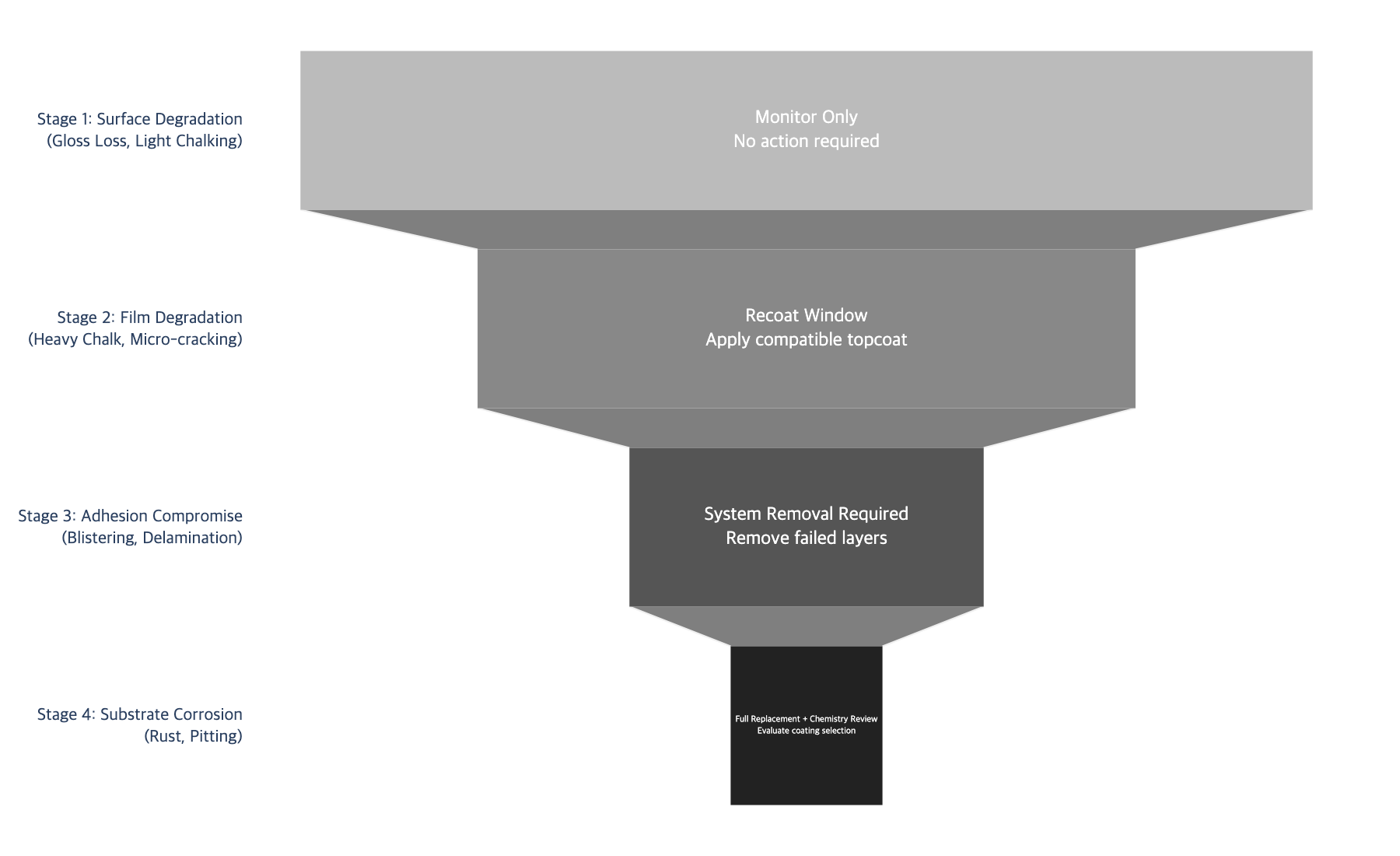
The funnel chart shows how maintenance response escalates with each degradation stage. Most coatings enter Stage 1 as part of normal aging, but only a fraction of well-selected systems progress to Stage 3 or 4 within their expected service life. Premature progression is the primary signal that the coating chemistry does not match the environment.
IV. Field Assessment: Connecting Observations to Root Causes
The preceding sections provide the diagnostic vocabulary. This section provides the assessment methodology that connects field observations to actionable root cause conclusions, preventing the most common error in coating maintenance: treating the symptom rather than the cause.
The Three-Question Diagnostic
Every coating degradation assessment should begin with three questions. First, what is the degradation type? Identifying whether the primary sign is chalking, blistering, cracking, or rust breakthrough narrows the possible mechanisms. Second, what is the distribution pattern? Uniform degradation points to systemic chemistry or exposure issues, while localized degradation at specific features points to application or design issues. Third, what is the timeline? Degradation within the expected service life suggests normal aging, while premature degradation suggests a chemistry-environment mismatch.
Surface Preparation as a Hidden Variable
Industry estimates attribute 60 to 80 percent of premature coating failures to inadequate surface preparation (AMPP CoatingsPro, 2021). A coating that blisters and delaminates within its first two years is far more likely to have been applied over contaminated steel than to have a chemistry deficiency. Soluble salt contamination is a particularly common cause of osmotic blistering, as chloride and sulfate salts at the coating-substrate interface drive water through the film by osmotic pressure.
The original surface preparation standard, if documented, provides critical context. A system prepared to SSPC-SP 6 (Commercial Blast) that shows adhesion failure may simply need SSPC-SP 10 (Near-White Blast) for maintenance. A system prepared to SSPC-SP 10 that still shows adhesion failure suggests contamination as the root cause.
Dry Film Thickness as a Diagnostic Clue
Measuring remaining dry film thickness (DFT) across the degraded coating reveals both original application quality and degradation rate. A topcoat that has chalked from 75 microns to 40 microns over eight years has lost roughly 4 to 5 microns per year, within normal ranges for polyurethane systems. The same topcoat at 25 microns after three years has lost approximately 17 microns per year, indicating either an excessively thin original application or a binder degrading far faster than expected.
DFT variation across the surface is equally informative. If rust breakthrough occurs where DFT reads 50 to 60 microns but the coating remains intact at 120 to 150 microns, the failure is application-related. The correction is improving application technique, not changing the coating product.
V. Decision Framework: Repair, Recoat, or Reselect
The decision between spot repair, full recoat with the same system, and switching to a different coating chemistry depends on two factors: the degradation stage and whether the degradation pattern is consistent with expected aging or indicates environmental incompatibility.
Figure 1. Coating Maintenance Decision Matrix by Degradation Stage
Degradation Stage | Pattern Consistent with Normal Aging | Pattern Indicates Environmental Incompatibility |
|---|---|---|
Stage 1: Surface (gloss loss, light chalk) | Monitor, no action needed | Increase monitoring frequency, evaluate topcoat chemistry |
Stage 2: Film (heavy chalk, micro-cracking) | Recoat with same topcoat | Switch topcoat to UV-stable chemistry (e.g., alkyd to polyurethane) |
Stage 3: Adhesion (blistering, delamination) | Remove failed layers, recoat same system with improved surface prep | Remove to substrate, evaluate primer chemistry and surface prep standard |
Stage 4: Substrate corrosion (rust, pitting) | Full removal, repair substrate, recoat same system | Full removal, repair substrate, select new system for actual environment |
The "reselect" decision is triggered when the degradation pattern does not match expectations for the coating age. A polyurethane topcoat at Stage 2 after 10 years is aging normally. The same topcoat at Stage 2 within three years indicates a selection problem, possibly inadequate UV stabilizer loading, incompatible primer, or an exposure condition more severe than assumed.
Key Decision Criteria for System Change
A system change is warranted when the failure mode recurs after recoating with the same product, when the degradation rate exceeds twice the expected rate for the coating type, when the degradation mechanism indicates an exposure condition the current chemistry cannot resist (e.g., epoxy UV chalking in direct sunlight without topcoat), or when environmental conditions have changed since original specification.
The Recoat Compatibility Check
Even when the decision is to recoat with the same chemistry, compatibility between the new coat and the aged existing surface must be verified. Aged epoxy surfaces that have chalked heavily may have surface chemistry that differs from freshly applied epoxy, reducing intercoat adhesion. The manufacturer's overcoat window defines when a subsequent coat can be applied with confidence, and for maintenance recoating over aged surfaces, this window has typically been exceeded by years. Abrasive sweep blasting or mechanical abrading creates a fresh surface profile that compensates. In critical applications, a test patch with adhesion testing after curing confirms compatibility before full-scale recoat.
VI. Coating Chemistry Selection by Environment
When a system change is indicated, the replacement chemistry must be matched to actual exposure conditions rather than original specification assumptions.
Figure 2. Coating System Recommendation by Exposure Environment
Exposure Environment | Recommended Topcoat | Recommended Primer | Key Chemistry Rationale |
|---|---|---|---|
Outdoor, high UV, low chemical | Aliphatic polyurethane | Epoxy or zinc-rich epoxy | Polyurethane resists UV; epoxy provides barrier/adhesion |
Outdoor, high UV, coastal/chloride | Aliphatic polyurethane or fluoropolymer | Zinc-rich epoxy primer | Zinc provides cathodic protection; polyurethane/fluoro resists UV + salt |
Indoor, chemical splash, moderate temp | Novolac epoxy | Novolac epoxy primer | Novolac cross-linking resists chemical penetration |
Immersion (water, wastewater) | High-build epoxy (no topcoat) | Surface-tolerant epoxy | Epoxy barrier maximized; UV not a concern in immersion |
High temperature (>150C) | Silicone or modified silicone | Inorganic zinc silicate | Organic binders degrade above 150C; silicone/inorganic stable |
The table provides general guidance, but site-specific conditions including cyclic temperature range, chemical concentration, and abrasion exposure must be factored in. A coating that performs well in steady-state conditions may fail in cyclic environments where thermal expansion mismatch between coating and substrate generates interfacial stress.
Figure 4. Expected Service Life by Coating Chemistry and Exposure Environment
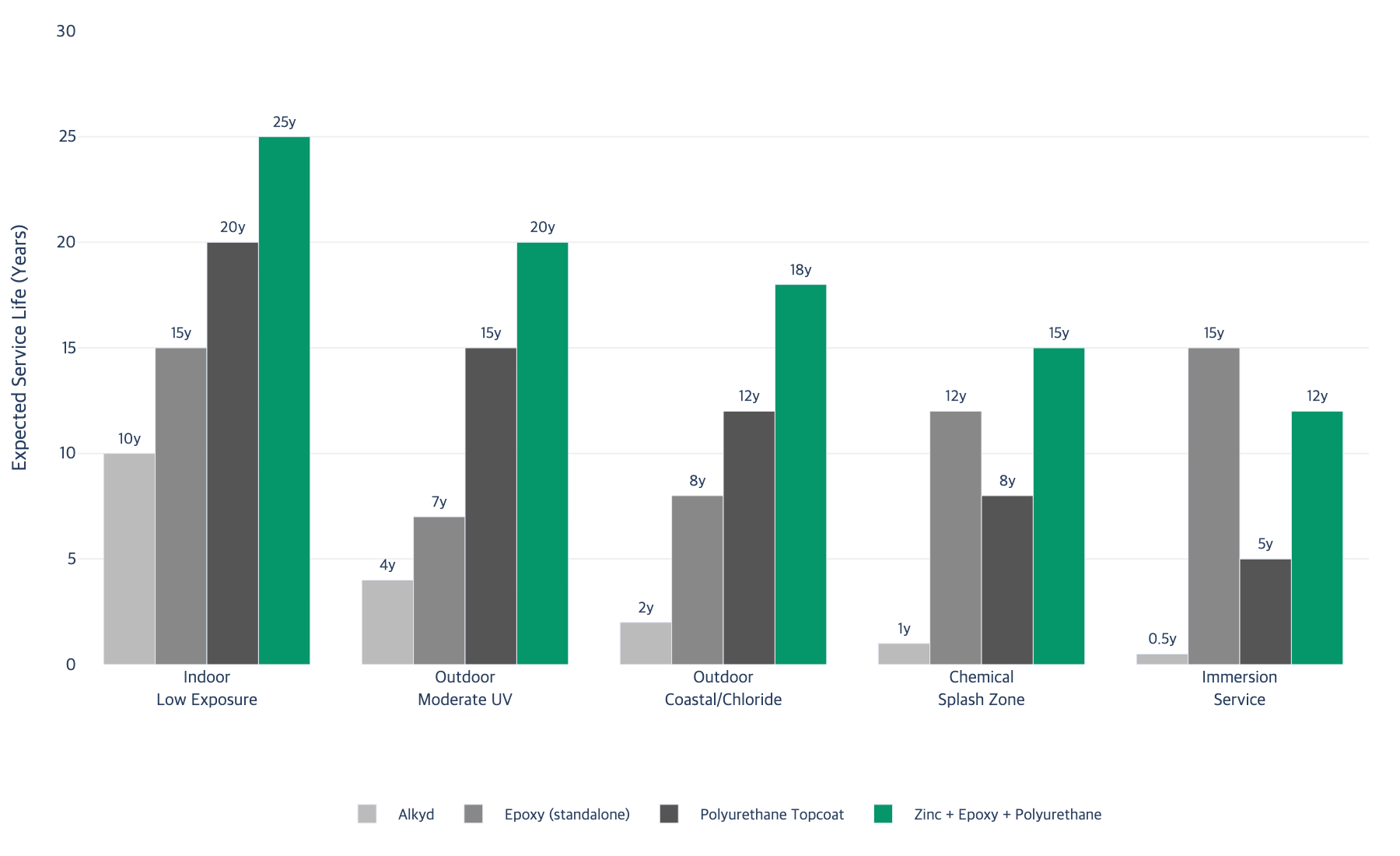
The chart shows how coating service life varies by chemistry type across environments. The zinc-epoxy-polyurethane system consistently outperforms simpler systems. Fluoropolymer topcoats extend service life further, with field experience indicating 30 years or more in ambient outdoor exposure compared to 10 to 15 years for standard polyurethane (AMPP, 2023). Alkyd systems offer reasonable indoor performance but degrade rapidly outdoors, making them the most common candidates for system change during maintenance.
When Alkyd Systems Should Be Replaced
Alkyd coatings remain common in low-exposure industrial environments due to their low cost and ease of application. However, alkyds degrade through oxidation of unsaturated fatty acid chains, leading to embrittlement, yellowing, and loss of flexibility over time. In environments with UV exposure, chemical splash, or temperatures above 60 degrees Celsius, alkyd systems should be replaced with epoxy-polyurethane systems during the next maintenance cycle rather than recoated with the same chemistry.
The transition requires attention to surface preparation. Alkyd residues can interfere with epoxy adhesion if not fully removed. Power tool cleaning to SSPC-SP 11 or abrasive blasting to SSPC-SP 10 is typically required. The investment in thorough removal is repaid through significantly longer service life, with epoxy-polyurethane systems delivering two to three times the service life of alkyds in equivalent outdoor exposure.
When Epoxy Topcoats Should Be Supplemented
Epoxy binders contain aromatic groups that absorb UV radiation and undergo photodegradation, resulting in chalking when used as topcoats in outdoor exposure. This is not a defect but a fundamental limitation of epoxy chemistry. The appropriate response is not to switch away from epoxy but to add an aliphatic polyurethane topcoat over the epoxy system. The polyurethane acts as a UV shield while the epoxy continues to provide barrier and adhesion functions. Facilities recoating bare epoxy systems in outdoor service without a UV-resistant topcoat will see immediate improvement in service life by adding this single layer.
VII. Key Takeaway
Read the degradation pattern, not just the degradation severity. The type of failure (UV breakdown vs moisture ingress vs adhesion loss) determines the correct response.
Match the maintenance decision to the degradation stage. Surface degradation needs monitoring, film degradation needs recoating, adhesion failure needs system removal, and substrate corrosion needs full replacement and possible chemistry change.
Do not default to recoating with the same product. If the degradation rate exceeds expectations or the failure mode recurs, evaluate whether the coating chemistry matches the actual environment.
Use the exposure environment to select replacement chemistry. UV-exposed surfaces need polyurethane or fluoropolymer topcoats, chemical environments need novolac epoxy, and high-temperature environments need silicone-based systems.
Invest in quantitative field assessment. Measuring gloss, DFT, adhesion, and soluble salts turns subjective observations into diagnostic data that supports defensible maintenance decisions.
Lubinpla's coating selection assistant cross-references observed degradation patterns with environmental exposure data and coating chemistry performance profiles, recommending whether to maintain the current system or switch to a better-suited chemistry. By mapping field observations against known degradation mechanisms and service life data, the platform closes the gap between what you see on the surface and the chemistry decision that will prevent the next failure cycle.
VIII. References
[1] Sherwin-Williams, "How to Prevent Premature Coating Failure in Water Infrastructure", 2023. https://industrial.sherwin-williams.com/na/us/en/protective-marine/media-center/articles/prevent-coating-failure-water-infrastructure.html
[2] Marvel Coatings, "Coating Failure Troubleshooting: Blistering, Cracking, Delamination", 2023. https://marvelcoatings.com/blog/coating-failure-troubleshooting-fixing-blistering-cracking-delamination
[3] McGill Restoration, "Breaking Down Coating Failures: 6 Examples", 2023. https://mcgillrestoration.com/breaking-down-coating-failures-6-examples-of-coating-failures-that-should-be-addressed/
[4] Mark Tool, "5 Warning Signs That Your Pipeline Coatings Are Failing", 2023. https://www.marktool.com/case-study-5-warning-signs-that-your-pipeline-coatings-are-failing/
[5] ScienceDirect, "Alkyd Resins Overview", 2023. https://www.sciencedirect.com/topics/chemical-engineering/alkyd-resins
[6] MPU Coating, "Alkyd vs Epoxy vs Polyurethane: Marine Maintenance Paint Comparison", 2023. https://mpucoating.com/blog/marine-maintenance-paint-comparison-alkyd-epoxy/
[7] ScienceDirect, "The Influence of Ageing of Epoxy Coatings on Adhesion of Polyurethane Topcoats", 2023. https://www.sciencedirect.com/science/article/abs/pii/S0300944009001337
[8] DAU, "Onset of Failure in Corrosion Protective Barrier Coatings", 2023. https://www.dau.edu/sites/default/files/Migrated/CopDocuments/Onset%20of%20failure%20in%20corrosion%20protective%20barrier%20coatings.pdf
[9] NACE International, "International Measures of Prevention, Application, and Economics of Corrosion Technologies Study", 2016. http://impact.nace.org/documents/ccsupp.pdf
[10] AMPP, "Fluoropolymer Topcoat Offers Steel Structures Decades-Long Resistance to Weathering", 2023. https://blogs.ampp.org/protectperform/weather-performance-of-fluoropolymer-coatings
[11] AMPP CoatingsPro, "Overview of Common Industrial Coating Failures", 2021. https://content.ampp.org/coatingspro/article/21/5/60/72762/Industrial-Coating-Failures-Knowing-and-Mitigating
[12] Nature, "Prediction of Coating Degradation Based on Environmental Factors", 2025. https://www.nature.com/articles/s41529-025-00614-6
[13] Corrosionpedia, "Coating Holidays and Pinholes: Chinks in the Armor", 2023. https://www.corrosionpedia.com/coating-holidays-pinholes-chinks-in-the-armor/2/5245
Powered by Lubinpla
Discover how technical teams solve complex challenges faster with AI.