Why Generic AI Fails at Chemical Product Selection
Summary
Decision-makers evaluating AI for specialty chemical product selection face a measurable reliability problem. On Vectara's October 2026 leaderboard, general-purpose large language models hallucinated on 1.8 to 24.2 percent of document summaries. In a Stanford study, even retrieval-equipped legal AI tools still hallucinated on 17 to 33 percent of queries, against 43 percent for bare GPT-4. The cause is structural. Training and evaluation reward plausible guessing over admitting uncertainty (OpenAI, 2025), and a generic model has no grounded source of product datasheets, safety data sheets or compatibility tables. This article explains where generic models break on chemical selection, defines the grounding problem across specs, SDS and compatibility, and describes a domain-grounded retrieval architecture that ties every recommendation to a cited source. It also gives a generic-versus-grounded comparison matrix and a buyer evaluation checklist you can use in a vendor review. For evaluators, the conclusion is that AI chemical product selection becomes reliable only when retrieval is grounded in verified domain data and every claim carries a traceable citation.
Table of Contents
I. Introduction
II. Where Generic LLMs Break on Chemical Selection
III. The Grounding Problem: Specs, SDS, Compatibility
IV. Domain-Grounded Retrieval Architecture
V. Evaluation Criteria for Buyers
VI. Field Patterns
VII. Key Takeaway
VIII. References
I. Introduction
Distributors and purchasing teams are starting to test general-purpose AI assistants for product selection, and a practical question is surfacing faster than the marketing claims. Can a generic model be trusted to recommend a specialty chemical product when the wrong answer carries safety, compliance, and cost consequences?
The evidence says not without grounding, that is, without tying each answer to verified source documents. General-purpose models are built to produce fluent, plausible text, not to retrieve verified product facts. This article is written for decision-makers evaluating AI for chemical product selection. It quantifies where generic models fail, explains the grounding problem in terms a technical buyer can audit, and sets out what a domain-grounded retrieval system changes about reliability.
II. Where Generic LLMs Break on Chemical Selection
Generic large language models fail at chemical product selection for two reasons. They generate statistically plausible text instead of retrieving verified facts, and they have no grounded access to product specifications, safety data sheets, or compatibility data. Vectara's document summarization leaderboard, updated in October 2026, checks whether each summary stays faithful to its source document. Its 111 listed models hallucinated on 1.8 to 24.2 percent of summaries, depending on the model (Vectara, 2026). For a selection decision, even a single-digit error rate on an unverifiable answer is operationally unacceptable.
Why Does a Fluent Answer Not Mean a Correct One?
The failure is structural, not a temporary quality gap. A general-purpose model maximizes the likelihood of plausible text learned from broad training data. When product-specific data is sparse, it produces a confident but fabricated answer instead of declining (OpenAI, 2025). The same research shows that standard accuracy-based evaluation rewards guessing and penalizes the honest answer "I do not know," so the incentive to bluff is built into how these models are trained and scored (OpenAI, 2025).
In chemical selection, the problem is that the answer sounds equally fluent whether the model is right or wrong. A recommendation for a corrosion inhibitor, a metalworking fluid, or a coating system reads with the same authority when the underlying specification is real and when it is invented. Without a grounded source and a citation, the buyer has no way to separate the two at the point of decision.
How Often Do These Models Actually Get It Wrong?
Hallucination rates are now measured rather than anecdotal, and they remain material even for top models. The table below brings together 2024 to 2026 benchmark figures so evaluators can size the baseline risk before any domain tuning.
Figure 1. Measured Hallucination Rates of General-Purpose LLMs
Benchmark and Year | Task Measured | Reported Hallucination Rate |
|---|---|---|
Vectara HHEM leaderboard (October 2026) | Document summarization, faithfulness | 1.8 to 24.2 percent across 111 models |
Stanford legal study (Magesh et al., 2025) | General-purpose GPT-4, legal queries | 43 percent of queries |
On the Vectara leaderboard, the lowest summarization error was 1.8 percent, and many widely used models sat near or above 10 percent (Vectara, 2026). General-purpose reasoning on specialized queries did worse: bare GPT-4 hallucinated on 43 percent of legal queries (Magesh et al., 2025). The legal figure is the relevant analogue for chemical selection. Both are high-stakes specialist domains where a plausible-sounding but wrong answer carries real consequences.
III. The Grounding Problem: Specs, SDS, Compatibility
Grounding is the degree to which a generated answer comes from retrieved, verifiable source documents rather than from the model's internal parameters, the patterns it memorized in training. For chemical selection, generic models are weakly grounded. Three categories of authoritative data, product specifications, safety data sheets (SDS), and compatibility tables, are not reliably present in their training and are not retrieved at answer time. A correct selection needs all three, sourced and current.
Why Are Specifications and SDS Data So Hard to Generalize?
Product specifications are precise, versioned, and supplier-specific. Viscosity grade, flash point, pH, active concentration, and operating temperature range are exact values that change between products and revisions. A model that approximates them from general training produces numbers that look right but may not match any real datasheet.
The safety data sheet makes this harder. Incompatibility information sits in SDS Section 7 (handling and storage) and Section 10 (stability and reactivity), and safety data sheets from different suppliers for the same chemical can conflict (eTrain Today, 2026).
When SDS sources conflict, the recommended safety practice is to store to the most conservative compatible category until the discrepancy is reconciled and documented (eTrain Today, 2026). A generic model has no mechanism to detect that two sources disagree, to flag the conflict, or to default to the conservative reading. Instead it blends the conflicting inputs into one fluent answer, which is exactly the failure grounding is meant to prevent.
Why Is Compatibility the Highest-Consequence Gap?
Compatibility is where a selection error turns directly into physical risk. Incompatible chemicals can react to produce heat, fire, explosion, toxic gases, corrosive substances, or dangerous pressure buildup (Alliance Chemical, 2026). A recommendation that misses a single incompatibility is not a quality defect to smooth over in a later revision; it is a hazard. That is the core reason a generic answer without a cited compatibility source is unfit for industrial selection, and why grounding against verified compatibility data is necessary rather than optional.
IV. Domain-Grounded Retrieval Architecture
A domain-grounded retrieval architecture pairs a language model with a curated, verified chemical knowledge base. Every recommendation is retrieved from and cited against source documents instead of being generated from model memory. Retrieval-augmented generation (RAG) is the established method: it combines a model with an external retrieval system to improve factual grounding and reduce hallucination (arXiv survey, 2025). Because each claim becomes traceable to a source the buyer can inspect, the reliability picture changes.
How Does Retrieval Grounding Change the Reliability Calculus?
Grounding turns the model from the author of an answer into a summarizer of retrieved evidence. Instead of generating a viscosity value from memory, the system retrieves the relevant datasheet passage and constrains the answer to that passage, so the output can be checked against the cited source. A grounding score measures how much of an answer comes from retrieved documents versus model parameters, and a high score signals that the system is behaving as intended (Maxim AI, 2025).
Evaluators should hold a realistic expectation: grounding is necessary but not sufficient. The Stanford study found that even commercial legal tools built on retrieval still hallucinated on 17 percent of queries for two products and 33 percent for a third (Magesh et al., 2025). Retrieval alone does not eliminate error. The quality of the retrieval, the curation of the source corpus, and the discipline of citing every claim determine final reliability. Retrieval noise, and misalignment between the retrieved evidence and the generated text, can still lead to hallucinations (arXiv survey, 2025).
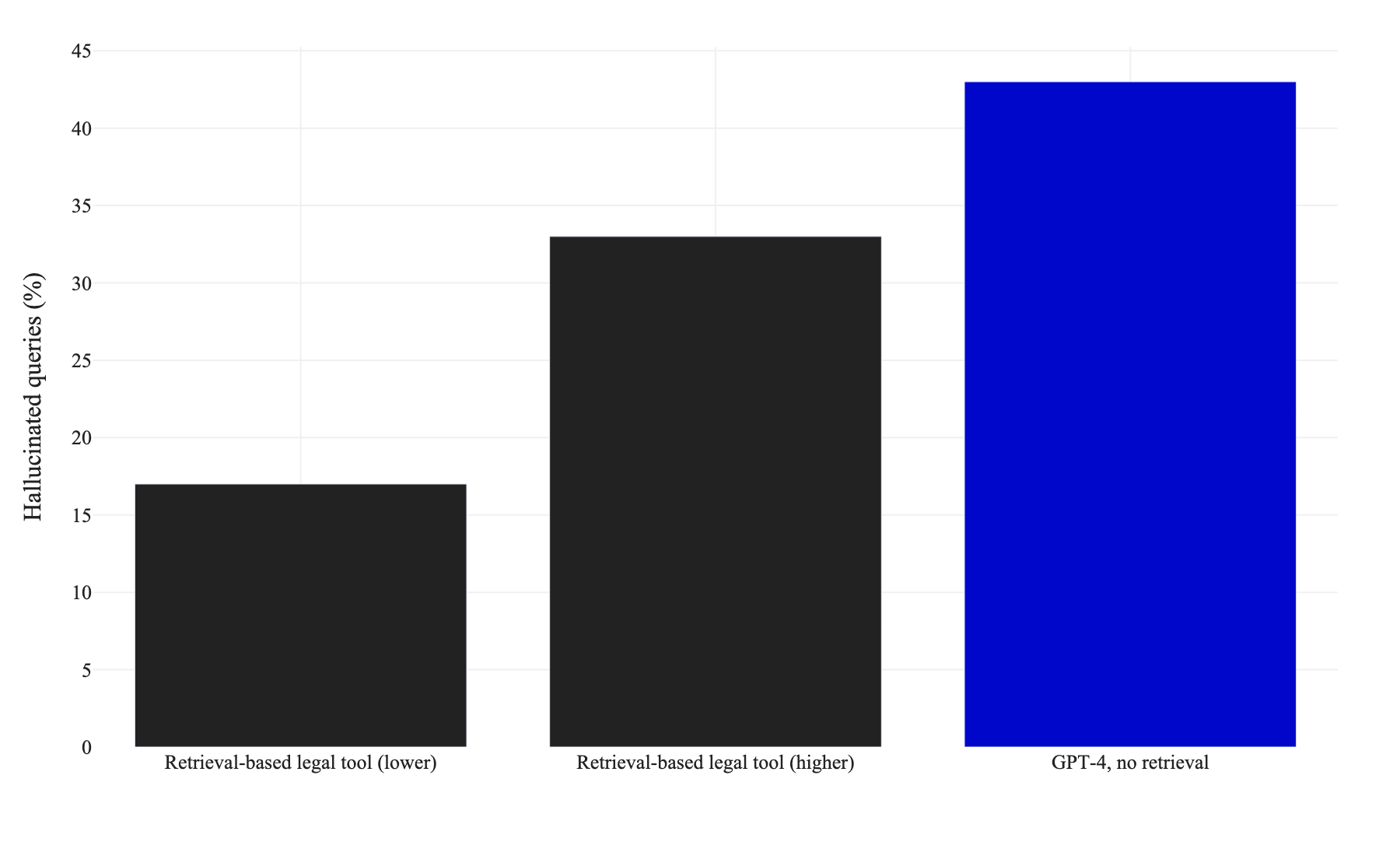
Figure 2. Retrieval Lowers but Does Not Eliminate Hallucination: share of benchmark queries with hallucinated answers, GPT-4 without retrieval versus two retrieval-based commercial legal tools. Source: Stanford study (Magesh et al., 2025).
What Does Domain Tuning Add Over Generic Retrieval?
Domain tuning can improve retrieval precision on specialist terminology, which is exactly where chemical selection lives. Retrievers can combine keyword and vector search, and reranking the retrieved documents improves the faithfulness of RAG systems (arXiv survey, 2025). In chemistry, the hard terminology is specific product families, trade designations, and reactivity terms, which a generic retriever can index poorly.
For buyers, the architectural conclusion is that the source corpus matters as much as the model. A grounded system is only as reliable as the specifications, SDS records, and compatibility tables it retrieves from, and those must be verified and version-controlled. The principle for an evaluator: a recommendation is trustworthy only when it is tied to a cited, verifiable source.
V. Evaluation Criteria for Buyers
Buyers should judge AI chemical product selection tools on four questions. Is every recommendation grounded in a verifiable source? Does the system cite that source? Does it flag conflicting or missing data? Does it decline when evidence is insufficient? A tool that answers every question fluently, with no citations and no abstention (never declining to answer), is showing the exact failure mode the benchmarks measure. The two decision aids below are built for a vendor review.
Generic Versus Grounded Comparison Matrix
The matrix contrasts the two architectures on the dimensions that decide reliability in a selection decision. Use it to structure a side-by-side vendor comparison.
Figure 3. Generic LLM Versus Domain-Grounded Retrieval
Dimension | Generic LLM | Domain-Grounded Retrieval |
|---|---|---|
Source of answer | Model parameters (memorized) | Retrieved, cited source documents |
Specs and SDS handling | Approximated, may not match any real datasheet | Retrieved from verified, version-controlled records |
Conflicting-source behavior | Silently blends into one answer | Flags conflict, defaults to conservative reading |
Behavior when evidence is missing | Generates a plausible guess | Abstains or states uncertainty |
The decisive differences are not fluency or speed but traceability and honest abstention. A grounded system can be audited because each claim points to a source. A generic system cannot, because its answer originates in opaque model memory. The conflicting-source and missing-evidence rows are the highest-value tests: they expose whether a tool was built for a safety-relevant domain or merely adapted from a general assistant.
Buyer Evaluation Checklist
The checklist below is a pass or fail screen. Run each item against a candidate tool using your own real selection questions, not vendor demos.
Citation present: Does every product recommendation cite a specific source document, with a passage a buyer can open and verify? Pass requires a citation on every claim, not a general disclaimer.
Source verifiability: Can you confirm the cited specification or SDS value against the actual supplier datasheet? Pass requires the cited value to match the source.
Conflict handling: When you supply two conflicting SDS inputs, does the tool flag the conflict and default to the conservative reading? Pass requires explicit conflict detection (eTrain Today, 2026).
Honest abstention: When you ask about a product or condition outside its corpus, does the tool decline or state uncertainty instead of guessing? Pass requires abstention, consistent with calibrated behavior (OpenAI, 2025).
Compatibility grounding: Does every compatibility statement trace to a verified compatibility source rather than a generated assertion? Passing is mandatory given the physical-hazard consequence (Alliance Chemical, 2026).
Domain retrieval quality: On specialist, long-tail product terminology, does retrieval return the correct records? Pass requires correct retrieval on your hardest real queries (arXiv survey, 2025).
A tool that fails items 1, 4, or 5 should be disqualified for selection use, however well it performs on fluency or breadth. Those three items are the difference between a grounded recommendation and a confident guess.
VI. Field Patterns
Three patterns follow from the benchmarks above. They separate tools likely to hold up in chemical product selection from tools that will not, and they are described at the industry level rather than as named cases.
The Fluency Trap
In the fluency trap, a generic assistant produces selection advice that reads as authoritative, and the team adopts it without verification. A correct and an incorrect answer look the same on the surface, so teams can over-trust the output until a downstream mismatch, such as a wrong viscosity grade or an unflagged incompatibility, surfaces the error. The countermeasure is procedural: require a citation on every recommendation and verify it against the source before acting. It is the same discipline that sets grounded tools apart in the comparison matrix.
The Retrieval-Is-Not-Enough Pattern
The second pattern appears when teams assume that any retrieval-equipped tool is automatically safe. The Stanford finding that retrieval-based legal tools still hallucinated on 17 to 33 percent of queries is the cautionary benchmark (Magesh et al., 2025). In chemical selection, the same gap can appear when the source corpus is thin, outdated, or poorly curated: retrieval returns weak evidence, and the model fills the gap with a guess. The countermeasure is to test the corpus directly, using items 2 and 6 of the buyer checklist on your own hardest queries.
The Conservative-Default Pattern
The third pattern is positive and marks mature tools. When sources conflict or evidence is missing, a well-built grounded system defaults to the conservative reading and flags the gap instead of resolving it silently. This mirrors the established safety practice of storing to the most conservative compatible category until SDS discrepancies are reconciled (eTrain Today, 2026). A tool that behaves this way in a vendor test is showing what the underlying research says lets a model avoid hallucination: abstaining when uncertain (OpenAI, 2025).
VII. Key Takeaway
General-purpose LLMs hallucinate at measurable rates, 1.8 to 24.2 percent on a summarization leaderboard and 43 percent for bare GPT-4 on legal queries, because training and evaluation reward plausible guessing over honest uncertainty (Vectara, 2026; Magesh et al., 2025; OpenAI, 2025). Treat any uncited fluent answer as unverified.
The grounding problem in chemical selection has three parts: exact specifications, conflicting safety data sheets, and high-consequence compatibility data. Generic models lack grounded access to all three, and compatibility errors carry physical-hazard consequences (eTrain Today, 2026; Alliance Chemical, 2026).
Domain-grounded retrieval changes the reliability picture by tying every claim to a cited, verifiable source, but retrieval alone is not sufficient: corpus curation, domain-tuned retrieval, and citation discipline determine final reliability (arXiv survey, 2025; Magesh et al., 2025).
Evaluate vendors with the generic-versus-grounded matrix and the six-item buyer checklist. Disqualify any tool that fails on citation, honest abstention, or compatibility grounding, regardless of fluency.
Run the evaluation on your own hardest real selection questions, not vendor demos. The failure modes show most clearly on conflicting-source and missing-evidence inputs.
VIII. References
[1] Alliance Chemical, "Chemical Compatibility Chart Guide: Safe Storage and Handling", 2026. https://alliancechemical.com/blogs/articles/chemical-compatibility-chart-guide-safe-storage-handling
[2] arXiv, "Retrieval-Augmented Generation: A Comprehensive Survey of Architectures, Enhancements, and Robustness Frontiers", 2025. https://arxiv.org/html/2506.00054v1
[3] eTrain Today, "6 Ways to Reconcile SDS Inconsistencies and Strengthen Chemical Storage Safety", 2026. https://etraintoday.com/blog/6-ways-to-reconcile-sds-inconsistencies-and-strengthen-chemical-storage-safety/
[4] Magesh, V., Surani, F., Dahl, M., Suzgun, M., Manning, C. D., and Ho, D. E., "Hallucination-Free? Assessing the Reliability of Leading AI Legal Research Tools", Journal of Empirical Legal Studies, 2025. https://dho.stanford.edu/wp-content/uploads/Legal_RAG_Hallucinations.pdf
[5] Maxim AI, "Complete Guide to RAG Evaluation: Metrics, Methods, and Best Practices for 2025", 2025. https://www.getmaxim.ai/articles/complete-guide-to-rag-evaluation-metrics-methods-and-best-practices-for-2025/
[6] OpenAI, "Why Language Models Hallucinate", 2025. https://openai.com/index/why-language-models-hallucinate/
[7] Vectara, "Hallucination Leaderboard", 2026. https://github.com/vectara/hallucination-leaderboard/
Updated 2026-10-30: checked figures and sources; removed outdated product references
