Why Hydraulic Systems Fail Repeatedly: The Contamination Cascade Effect
Summary: Hydraulic system failures that recur within weeks of repair, despite complete component replacement, account for some of the most frustrating and expensive maintenance problems in industrial operations. This article traces the contamination cascade mechanism, where a single particle ingression event generates secondary contamination through valve erosion, seal degradation, and abrasive wear, creating a self-amplifying cycle that component replacement alone cannot break. By understanding the ISO 4406 cleanliness framework and the three-barrier approach to contamination control, engineers can eliminate the root cause of repeat failures and achieve significant reductions in hydraulic maintenance costs.
Table of Contents
I. The Repeat Failure Problem in Hydraulic Systems
II. How the Contamination Cascade Works
III. Where Contamination Enters: The Five Ingression Points
IV. ISO 4406 Cleanliness Codes and Component Sensitivity
V. The Three-Barrier Approach to Breaking the Cascade
VI. Field Cases: Breaking the Repeat Failure Cycle
VII. Key Takeaway
VIII. References
I. The Repeat Failure Problem in Hydraulic Systems
Few maintenance scenarios are as costly and demoralizing as replacing a hydraulic component only to see it fail again within weeks. The technician replaces the pump, changes the filters, refills the fluid, and restarts the system. Three weeks later, the same pump shows cavitation damage, the proportional valve drifts out of specification, and the cylinder seals begin leaking. The cycle repeats, consuming parts budgets, extending downtime, and eroding confidence in the maintenance program. This pattern is not random equipment failure. It is the predictable result of a contamination cascade that was never interrupted.
The Scale of the Problem
Fluid contamination is responsible for 70 to 90 percent of all hydraulic system failures (Machinery Lubrication, 2022). This statistic is widely cited but rarely acted upon with the precision it demands. The financial impact is substantial. Hydraulic system breakdowns cost industrial operations an average of USD 95,000 per event when accounting for parts, labor, lost production, and consequential damage (Construction Equipment, 2023). More critically, contamination-related failures carry a cost multiplier of 3x to 5x compared to simple component replacement, because the contamination that destroyed the original component remains in the system to destroy its replacement (Hydromechanical Systems, 2024).
Figure 3. Hydraulic System Failure Causes by Category
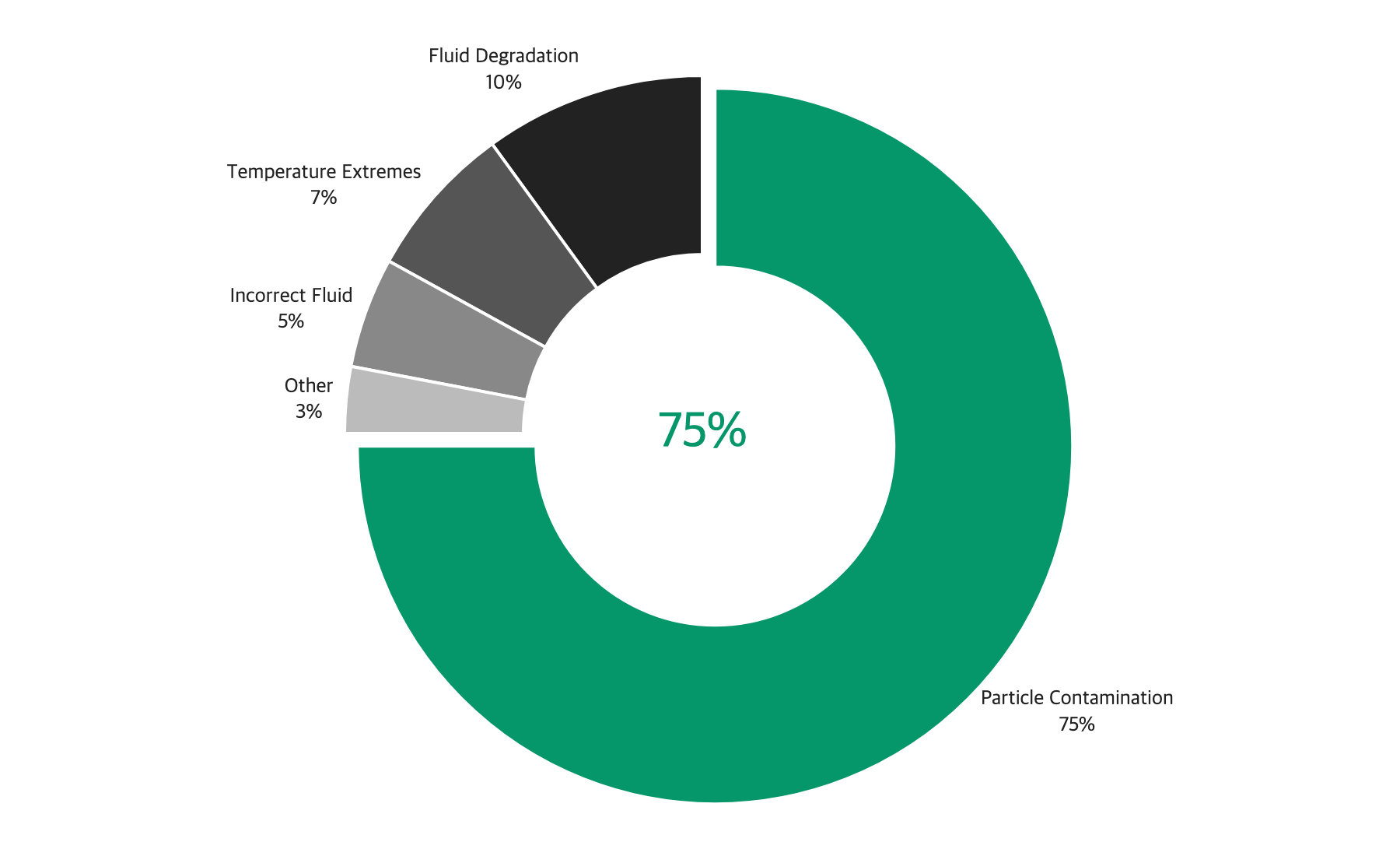
This chart illustrates the overwhelming dominance of particle contamination as the primary cause of hydraulic system failures. At 75 percent, contamination dwarfs all other failure causes combined. This data reinforces why a contamination-focused maintenance strategy delivers disproportionate returns compared to approaches that treat all failure modes equally.
Why Component Replacement Alone Fails
The fundamental error in the replace-and-hope approach is the assumption that the failed component was the problem. In most contamination-driven failures, the component is the victim, not the cause. The actual problem is a population of abrasive particles circulating through the system, grinding against every precision surface on every cycle. Replacing the pump without addressing the particle population is equivalent to replacing a patient's damaged lung without removing them from the toxic atmosphere that caused the damage. The new component enters a hostile environment and begins degrading immediately.
II. How the Contamination Cascade Works
The contamination cascade is a self-amplifying degradation cycle where particles generated by one damaged component become the agents of damage to every other component in the circuit. Understanding this mechanism explains why contamination problems accelerate rather than stabilize over time, and why they cannot be solved by addressing individual component failures.
Stage 1: Initial Particle Ingression
The cascade begins with a particle ingression event. This could be dust entering through a worn cylinder rod seal, moisture-laden air drawn through an inadequate reservoir breather, debris from a maintenance operation, or simply the built-in contamination present in new hydraulic fluid. New hydraulic oil from the drum typically arrives at an ISO 4406 cleanliness code of 21/19/16 or worse, far above the 16/14/11 target required by most servo and proportional valve systems (Machinery Lubrication, 2020). This initial contamination load, if not filtered before entering the system, provides the seed particles that initiate the cascade.
Stage 2: Abrasive Wear and Secondary Particle Generation
Once contamination particles are circulating in the system, they are forced through the tight clearances of pumps, valves, and motors at high velocity and pressure. Silt-sized particles in the 2 to 10 micrometer range are particularly destructive because they match the operating clearances of precision components. A servo valve spool-to-bore clearance is typically 1 to 4 micrometers, meaning particles in this size range wedge between moving surfaces and act as cutting tools. As these particles abrade internal surfaces, they generate secondary particles, metal fragments stripped from the component surfaces themselves. Each abrasion event produces multiple new particles, each of which becomes an agent of further abrasion. This is the core amplification mechanism of the cascade. The particle population grows exponentially rather than linearly, because each generation of particles produces more particles than the generation before it.
Stage 3: Component Performance Degradation
As internal clearances increase from abrasive wear, component performance degrades in measurable ways. Pump volumetric efficiency drops as internal leakage increases across worn sealing surfaces. Valves lose positional accuracy as spool-to-bore clearances widen, allowing cross-port leakage. Cylinder seals, abraded by particles embedded in the fluid film on the rod surface, begin to leak externally. System pressure becomes unstable as worn relief valves fail to maintain consistent settings. Operating temperature rises because increased internal leakage converts hydraulic energy to heat rather than mechanical work. This temperature increase further accelerates fluid degradation and particle generation, adding another amplifying loop to the cascade.
Stage 4: Catastrophic Failure
The final stage occurs when component degradation reaches a threshold where the system can no longer perform its intended function. A pump seizure, a valve lockup, or a catastrophic seal blowout forces an unplanned shutdown. At this point, the system contains not just the original contamination but an entire population of secondary particles generated by months of cascading degradation. If the maintenance response addresses only the failed component without addressing this particle population, the cascade simply restarts from Stage 2 with the new component.
III. Where Contamination Enters: The Five Ingression Points
Interrupting the contamination cascade requires identifying and controlling the sources of particle ingression. Five primary ingression points account for the vast majority of contamination entering hydraulic systems. Each point requires a specific countermeasure, and overlooking even one can sustain the cascade despite effective control of the others.
Cylinder Rod Seals
Cylinder rod seals are the most common ingression point in mobile and industrial hydraulic systems. Every time a cylinder retracts, the rod surface carries a thin film of hydraulic fluid past the wiper seal and into the external environment. This film picks up dust, abrasive particles, and moisture. When the cylinder extends, the contaminated film is drawn back past the rod seal and into the system. A worn rod seal or a scored rod surface dramatically increases the volume of contamination that bypasses the seal on each cycle. In dusty environments such as mining, construction, or cement production, this single ingression point can introduce enough contamination to sustain a full cascade within days of a clean system startup.
Reservoir Breathers
As cylinders extend and retract, the fluid level in the reservoir rises and falls. Each drop in fluid level draws ambient air through the reservoir breather to equalize pressure. If the breather is a simple mesh cap rather than a desiccant or high-efficiency particulate breather, every breath cycle introduces airborne dust and moisture directly into the reservoir. In a system cycling 20 times per minute, the cumulative air volume exchanged through the breather over an 8-hour shift can exceed 10,000 liters, carrying with it the full contamination load of the ambient environment (Precision Filtration Products, 2022).
New Fluid
New hydraulic fluid is one of the most overlooked contamination sources. Oil stored in drums and totes is exposed to temperature cycling that causes condensation, particulate settling from the container walls, and contamination introduced during handling and transfer. Studies consistently show new hydraulic oil arriving at ISO 4406 codes of 21/19/16 to 25/22/19, which can be 10 to 100 times dirtier than the target cleanliness level for the system it enters (Machinery Lubrication, 2020). Pouring new oil directly from the drum into the reservoir without pre-filtration is equivalent to deliberately contaminating the system.
Maintenance Activities
Every time a hydraulic connection is broken for maintenance, the internal surfaces of fittings, hoses, and ports are exposed to ambient contamination. Metal chips from cutting and threading operations, dust from the maintenance environment, and debris from improperly cleaned replacement components all enter the system during reassembly. A single maintenance event on an unprepared system can introduce contamination equivalent to weeks of normal ingression through other pathways.
Built-In Contamination
New systems and newly manufactured components contain residual contamination from the manufacturing process. Welding slag, machining chips, casting sand, sealant fragments, and assembly debris are common built-in contaminants. Original equipment manufacturer (OEM) hydraulic systems are typically flushed before delivery, but the effectiveness of this flushing varies widely. Some new systems arrive with fluid cleanliness levels that would be unacceptable for continued operation, requiring commissioning filtration before the system can safely begin service.
IV. ISO 4406 Cleanliness Codes and Component Sensitivity
The ISO 4406 standard provides a universal language for quantifying fluid contamination and setting cleanliness targets. Without this framework, contamination control becomes subjective and inconsistent. With it, engineers can set measurable targets, verify filtration performance, and demonstrate return on investment for contamination control programs.
Understanding the Three-Number Code
The ISO 4406 code consists of three numbers separated by slashes, such as 18/16/13. Each number represents a range of particle counts per milliliter at three cumulative size thresholds. The first number corresponds to particles 4 micrometers and larger, the second to particles 6 micrometers and larger, and the third to particles 14 micrometers and larger. The scale is logarithmic: each increment of one code number represents approximately a doubling of the particle count. This means the difference between ISO 16 and ISO 18 at a given size is not 2 additional particles but a fourfold increase in particle population.
Figure 1. ISO 4406 Code Ranges and Particle Counts
ISO Code | Particles per mL (minimum) | Particles per mL (maximum) | Scale Factor vs Code 12 |
|---|---|---|---|
12 | 20 | 40 | 1x |
14 | 80 | 160 | 4x |
16 | 320 | 640 | 16x |
18 | 1,300 | 2,500 | 64x |
20 | 5,000 | 10,000 | 256x |
22 | 20,000 | 40,000 | 1,024x |
The logarithmic nature of the ISO scale means that what appears to be a modest difference of a few code numbers actually represents orders-of-magnitude differences in particle population. Moving from ISO 22 to ISO 16 at a given size threshold requires removing approximately 98 percent of the particles at that size. This explains why achieving and maintaining target cleanliness requires persistent, system-wide effort rather than occasional intervention.
Component Sensitivity and Target Cleanliness
Different hydraulic components have different tolerance levels for contamination based on their internal clearances and operating pressures. Servo valves and proportional valves, with spool-to-bore clearances of 1 to 4 micrometers, require the highest cleanliness levels. Gear pumps and directional valves, with clearances of 10 to 25 micrometers, can tolerate somewhat higher contamination levels. Setting the system cleanliness target based on the most sensitive component ensures that all components are protected.
Figure 2. Target ISO 4406 Codes by Component Sensitivity
Component Type | Typical Clearance | Target ISO Code | Risk Level if Exceeded |
|---|---|---|---|
Servo valves | 1-4 micrometers | 16/14/11 | Spool erosion, drift, lockup |
Proportional valves | 3-8 micrometers | 17/15/12 | Response degradation, hunting |
Vane pumps | 5-13 micrometers | 18/16/13 | Vane and ring wear, efficiency loss |
Piston pumps/motors | 5-40 micrometers | 18/16/13 | Barrel and slipper wear |
Gear pumps | 10-25 micrometers | 20/18/15 | Gear and bearing wear |
Cylinders | 50-250 micrometers | 20/18/15 | Seal wear, bypass leakage |
Test stands | varies | 15/13/10 | Component damage during testing |
This table reveals a critical insight: new hydraulic oil from the drum, arriving at a typical ISO code of 21/19/16, is already too contaminated for every component type except the least sensitive gear pumps and cylinders. Every system benefits from pre-filtering new oil before introduction to the reservoir. Systems with servo or proportional valves require pre-filtration as a mandatory practice, not an optional one.
V. The Three-Barrier Approach to Breaking the Cascade
Breaking the contamination cascade requires more than better filtration. It requires a systematic approach that addresses contamination at three levels: preventing ingression, removing particles that do enter, and monitoring to verify that the first two barriers are working. This three-barrier framework ensures that no single point of failure can sustain the cascade.
Barrier 1: Exclusion (Preventing Ingression)
The most cost-effective particle is the one that never enters the system. Exclusion measures target each of the five ingression points identified in Section III. Desiccant breathers replace mesh caps on reservoirs, reducing airborne particle and moisture ingression by 90 percent or more. Rod seal condition is verified on a scheduled basis, and rods are inspected for scoring or pitting that could compromise seal effectiveness. New oil is pre-filtered through a 3-micrometer absolute filter cart before entering the reservoir. Maintenance procedures include port plugging protocols, clean assembly practices, and flushing procedures for new hoses and fittings. These exclusion measures typically reduce total particle ingression by 60 to 80 percent compared to uncontrolled systems.
Barrier 2: Removal (Filtration)
Particles that bypass the exclusion barrier must be captured and removed by the filtration system. Effective hydraulic filtration requires filters sized and rated to achieve the target ISO cleanliness code under actual operating conditions, not just at system startup. Filter placement matters: return-line filters capture particles generated by downstream components before they reach the reservoir, while pressure-line filters protect sensitive components from particles generated upstream. Offline filtration, also called kidney-loop filtration, provides continuous polishing of the reservoir fluid independent of the main hydraulic circuit. The filter beta ratio, which quantifies filtration efficiency at a given particle size, must be matched to the target cleanliness and the expected ingression rate. A filter with a beta ratio of 200 at 6 micrometers captures 99.5 percent of particles at that size in a single pass, but achieves its full effectiveness only when fluid passes through it at the rated flow and viscosity.
Barrier 3: Monitoring (Verification)
The third barrier is continuous or periodic monitoring that verifies the first two barriers are functioning as intended. Particle counting at scheduled intervals, using online particle counters or laboratory analysis, provides objective evidence of system cleanliness and trend data that reveals developing problems before they cause failures. A rising particle count trend indicates either increased ingression (barrier 1 breach) or reduced filtration effectiveness (barrier 2 breach) and triggers investigation before the contamination level reaches the failure threshold. Water content monitoring complements particle counting because moisture accelerates corrosion, reduces lubricant film strength, and promotes microbial growth, all of which generate secondary contamination that feeds the cascade.
VI. Field Cases: Breaking the Repeat Failure Cycle
The following cases demonstrate how identifying and addressing the contamination cascade, rather than individual component failures, transforms maintenance outcomes.
Case 1: Company A, Steel Mill Hydraulic Press System
Company A operated a 2,500-ton hydraulic press system in a steel mill environment, with 6 servo-proportional valves controlling ram position and pressure. The system used ISO VG 46 hydraulic fluid circulating at approximately 800 liters per minute through a 4,000-liter reservoir. Over a 12-month period, the facility replaced 4 servo valves, 2 piston pumps, and 8 cylinder seal kits, at a total parts and labor cost of approximately USD 185,000. Each replacement provided temporary improvement lasting 3 to 8 weeks before performance degradation recurred. The maintenance team suspected fluid quality but could not pinpoint the source.
A contamination audit revealed the root cause was not a single source but a combination of three ingression points operating simultaneously. First, the reservoir breather was a standard mesh cap that allowed steel mill dust, with particle concentrations exceeding 500 micrograms per cubic meter, to enter the reservoir on every breath cycle. Second, new oil was being added directly from drums without pre-filtration, introducing fluid at ISO 22/20/17 into a system requiring 16/14/11. Third, two cylinder rod seals on the main ram were worn, drawing mill scale particles into the return line on every retraction stroke. Fluid analysis confirmed the system was operating at ISO 22/20/18, six code numbers above the target for servo valve protection.
The corrective program involved three simultaneous actions. First, desiccant breathers with 3-micrometer filtration were installed on all reservoir access points. Second, an offline filtration cart with 3-micrometer absolute elements was installed for new oil transfer and continuous reservoir polishing. Third, all cylinder rod seals were replaced and rod surfaces were reconditioned to remove scoring. ### Figure 4. ISO 4406 Cleanliness Code Improvement: Before vs After Three-Barrier Program
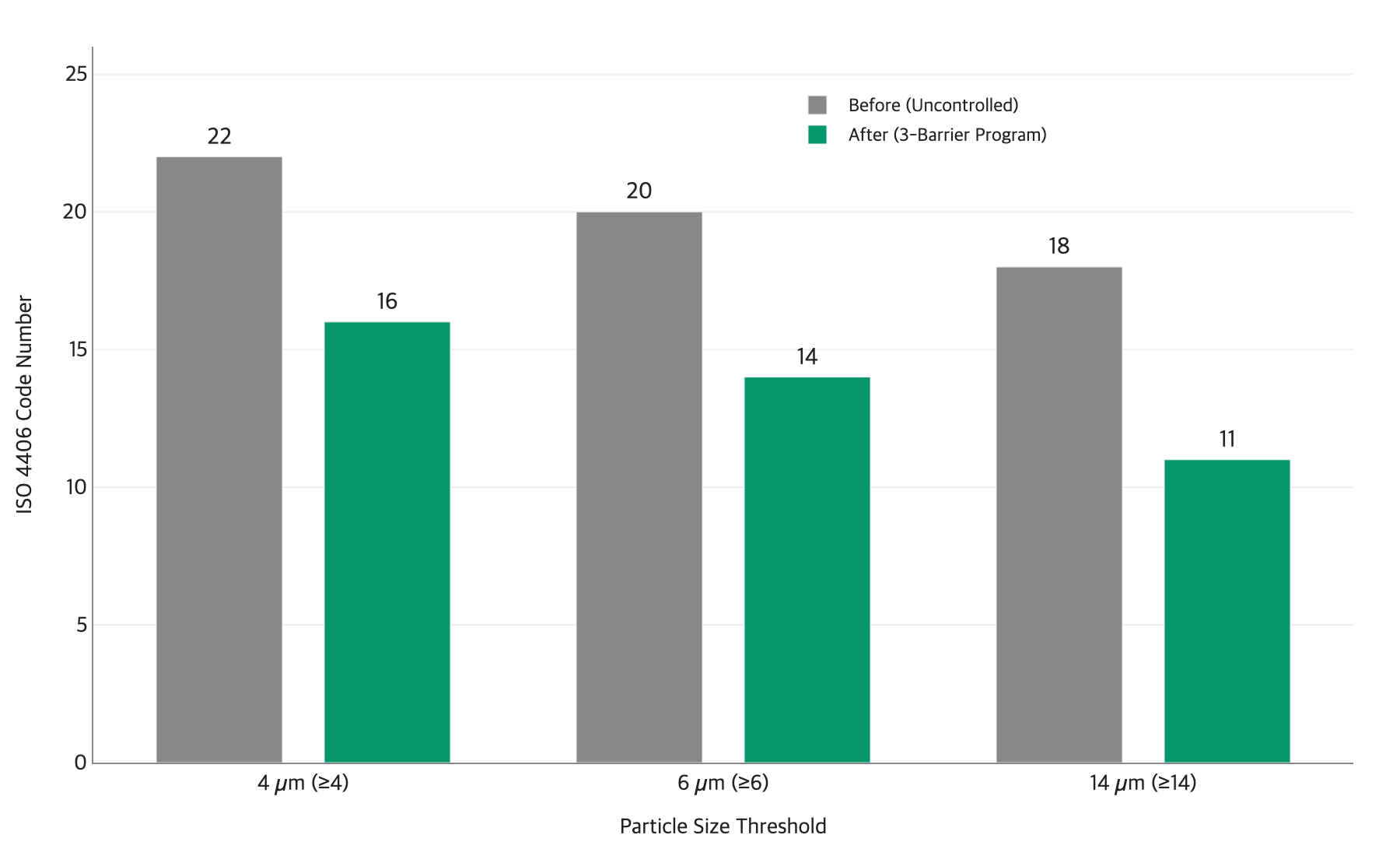
This comparison shows the dramatic improvement achievable through systematic contamination control. The before values of 22/20/18 represent conditions that actively destroy servo valves and precision pumps. The after values of 16/14/11 meet or exceed the target cleanliness for even the most sensitive hydraulic components. The 6-code-number reduction at each threshold represents approximately a 98 percent reduction in particle population.
Within 6 weeks, system cleanliness improved from ISO 22/20/18 to 16/14/11. Over the following 12 months, zero servo valves and zero pumps required replacement. Annual hydraulic maintenance costs dropped from USD 185,000 to USD 28,000, a reduction of 85 percent. The total investment in contamination control equipment was approximately USD 22,000, achieving payback in less than 8 weeks.
Case 2: Company B, Plastics Injection Molding Plant
Company B operated 12 injection molding machines, each with independent hydraulic power units rated at 45 to 110 kW. The plant experienced an average of 3.2 hydraulic-related breakdowns per month across the 12 machines, resulting in approximately 96 hours of unplanned downtime per month at a production loss rate of USD 850 per hour. Total monthly cost of hydraulic failures, including parts, labor, and lost production, averaged USD 105,000. The maintenance strategy followed a reactive pattern: when a component failed, it was replaced, the system was topped up with new oil, and the machine was restarted.
A systematic contamination assessment revealed that the root cause was not component defects but a plant-wide absence of contamination control. Particle counts across all 12 systems averaged ISO 20/18/16, while the proportional valves on these machines required ISO 17/15/12 or better. The primary ingression sources were new oil added without filtration, open-top reservoirs with no breather protection, and maintenance practices that did not include port protection or system flushing after component replacement.
The plant implemented the three-barrier approach in stages over 90 days. In Stage 1, during weeks 1 through 4, all reservoirs received desiccant breathers and hinged covers to replace open-top designs. In Stage 2, during weeks 4 through 8, a centralized oil transfer system with 3-micrometer inline filtration replaced drum-pour practices. In Stage 3, during weeks 8 through 12, offline filtration units were rotated across all 12 machines on a 2-week cycle, and a maintenance SOP requiring port plugging and flushing was implemented. Monthly fluid analysis tracked progress. By week 8, average system cleanliness improved from ISO 20/18/16 to 18/16/13. By week 16, all systems achieved the target of 17/15/12 or better. Hydraulic breakdowns dropped from 3.2 per month to 0.4 per month within 6 months. Monthly hydraulic costs decreased from USD 105,000 to approximately USD 18,000. The total investment in contamination control equipment and training was USD 45,000, with payback achieved in less than 3 weeks based on the reduction in downtime costs alone.
VII. Key Takeaway
Hydraulic contamination operates as a self-amplifying cascade: particles generate more particles through abrasive wear, making the problem exponentially worse over time. Replacing the failed component without addressing the particle population guarantees repeat failure.
Fluid contamination causes 70 to 90 percent of hydraulic system failures, yet most maintenance programs focus on component replacement rather than contamination control. Shifting this focus typically reduces hydraulic maintenance costs by 70 to 85 percent.
Five ingression points, cylinder rod seals, reservoir breathers, new fluid, maintenance activities, and built-in contamination, must all be controlled simultaneously. A single unaddressed ingression point can sustain the cascade despite effective control of the others.
The ISO 4406 cleanliness code provides the measurement framework for contamination control. New hydraulic oil from the drum typically arrives 5 to 10 code numbers above the target for most system components, making pre-filtration essential.
The three-barrier approach of exclusion, removal, and monitoring provides a systematic framework that prevents the cascade from establishing, interrupts it if it begins, and verifies that control measures remain effective over time.
Lubinpla's Assistant can analyze your hydraulic system's component list, operating environment, and current fluid analysis data to identify which ingression points pose the highest cascade risk and calculate the ISO 4406 target cleanliness specific to your most sensitive component.
VIII. References
[1] Machinery Lubrication, "Reducing the Effects of Contamination on Hydraulic Fluids and Systems", 2022. https://www.machinerylubrication.com/Read/957/hydraulic-fluids-contamination
[2] Construction Equipment, "Defend Your Hydraulics from Dangerous Contaminants", 2023. https://www.constructionequipment.com/conexpo/maintenance-repair/article/10709142/defend-your-hydraulics-from-dangerous-contaminants
[3] Hydromechanical Systems, "Hidden Maintenance Costs That Destroy Hydraulic System Budgets", 2024. https://hydromechanical.com/hidden-maintenance-costs-that-destroy-hydraulic-system-budgets/
[4] Hypro Filtration, "Understanding ISO 4406 Cleanliness Codes: A Complete Guide", 2023. https://www.hyprofiltration.com/blog/iso-4406-cleanliness-codes
[5] Machinery Lubrication, "How to Define and Achieve Hydraulic Fluid Cleanliness", 2020. https://www.machinerylubrication.com/Read/581/hydraulic-fluid-cleanliness
[6] Machinery Lubrication, "How to Mitigate Contaminant Ingression in Hydraulic Systems", 2022. https://www.machinerylubrication.com/Read/30773/mitigate-contaminant-ingression
[7] Precision Filtration Products, "Common Points of Reservoir Contamination", 2022. https://www.precisionfiltration.com/blog/common-points-of-reservoir-contamination/
[8] Mobile Hydraulic Tips, "Understanding ISO 4406", 2023. https://www.mobilehydraulictips.com/understanding-iso-4406/
[9] Separator Equipment, "ISO 4406 Cleanliness Code Explained", 2023. https://separatorequipment.com/iso-4406-cleanliness-code-explained/
[10] Durafilterna, "Hydraulic Fluid Contamination: Causes, Effects and Prevention Guide", 2023. https://www.durafilterna.com/blog/hydraulic-fluid-contamination-causes-effects-and-how-to-prevent-it/
[11] Neilson Hydraulics, "Contamination in Hydraulic Systems: Causes, Effects, Prevention and Remediation", 2023. https://www.neilson-hydraulics.co.uk/blogs/news/contamination-in-hydraulic-systems-causes-effects-prevention-and-remediation
[12] Chase Filter Company, "How Fluid Contamination Causes Mechanical Failure", 2023. https://chasefiltercompany.com/blog/how-fluid-contamination-causes-mechanical-failure/
[13] MDPI Applied Sciences, "Degradation of Hydraulic System due to Wear Particles or Medium Test Dust", 2023. https://www.mdpi.com/2076-3417/13/13/7777
[14] Schroeder Industries, "Contamination How-To Guide", 2022. https://schroederindustries.com/wp-content/uploads/L-4532_Contamination-How-To-Guide.pdf
Powered by Lubinpla
Discover how technical teams solve complex challenges faster with AI.