Circular Economy in Industrial Chemistry: Reclamation and Recycling and Extended Product Life
Summary: Circular economy initiatives in industrial chemistry, including lubricant re-refining, solvent reclamation, and metalworking fluid recycling, represent a market exceeding USD 228 billion in 2024 and growing at 13.5 percent annually. However, not all circular approaches deliver equal value. This article examines the chemistry of reclamation, the contaminants that must be removed, the properties that can be restored, and the energy and quality trade-offs of recycling versus virgin product. The analysis maps where circular practices deliver both economic and environmental benefits versus where virgin product remains the rational choice, and provides a circular economy opportunity assessment for common industrial chemical categories ranked by feasibility and economic benefit.
Table of Contents
I. The Circular Economy Opportunity in Industrial Chemistry
II. The Chemistry of Reclamation: What Can Be Restored
III. Lubricant Re-Refining: The Most Established Circular Practice
IV. Solvent Reclamation: High Recovery, Clear Economics
V. Where Circular Approaches Face Limitations
VI. Building Circular Practices into Chemical Management
VII. Key Takeaway
VIII. References
I. The Circular Economy Opportunity in Industrial Chemistry
The circular economy chemicals market exceeded USD 228.4 billion in 2024 and is projected to grow at a compound annual growth rate of 13.5 percent through 2034, driven by advances in depolymerization, solvent recovery, and re-refining technologies (GM Insights, 2025). Within this broad market, the specialty chemicals recycling segment was valued at USD 2.2 billion in 2024 and is expected to reach USD 33.8 billion by 2034, growing at a remarkable 29.6 percent CAGR (GM Insights, 2025). These growth rates reflect a fundamental shift in how industrial organizations view chemical waste: not as a disposal problem but as a resource recovery opportunity.
Figure 1. Circular Economy Chemicals Market Segments (2024 Values, USD Billion)
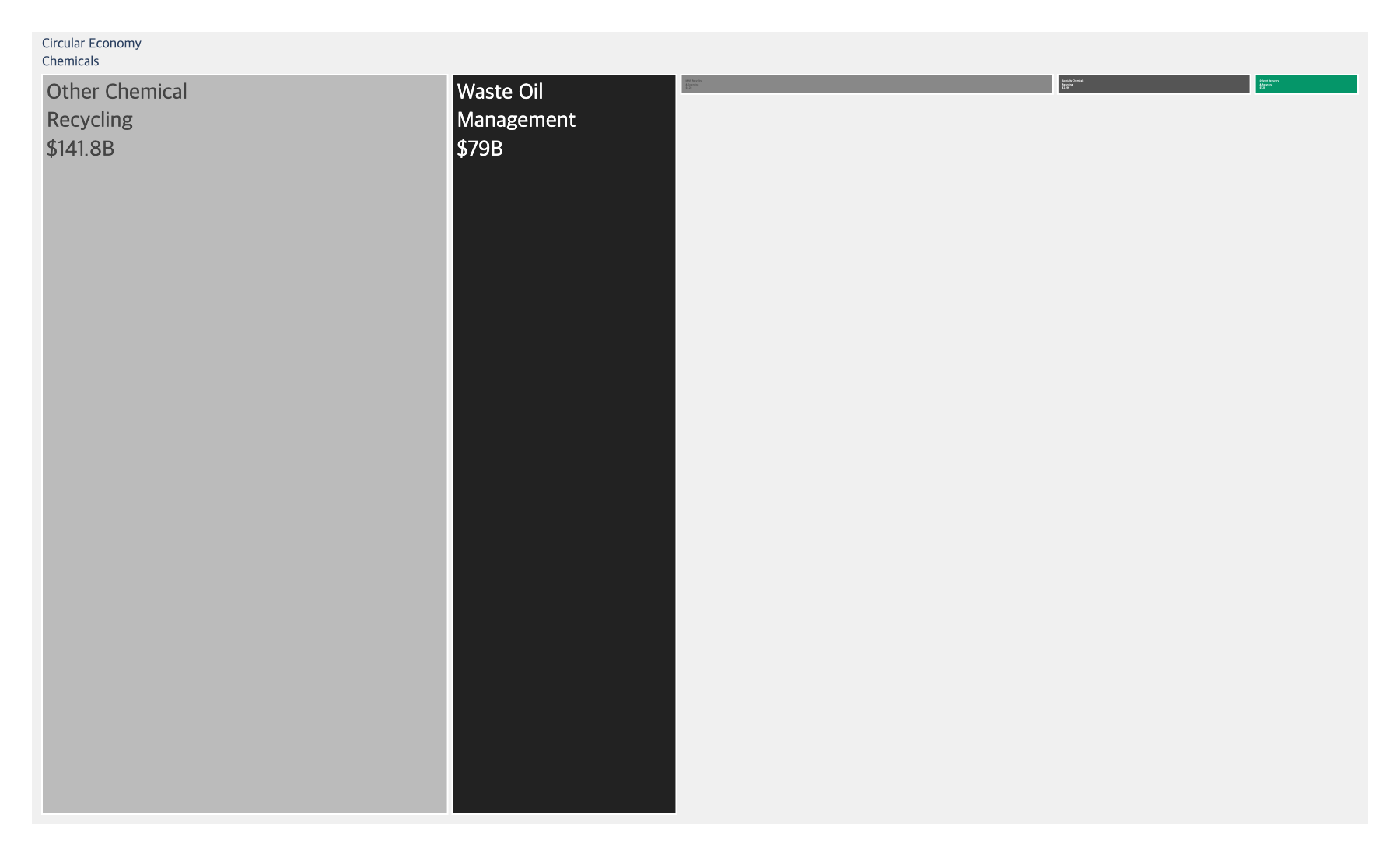
The treemap illustrates the relative scale of circular economy market segments within industrial chemistry. Waste oil management dominates at USD 79 billion, reflecting the enormous volume of lubricants and process oils that flow through industrial operations annually. Solvent recovery and specialty chemicals recycling, while smaller in absolute terms, represent the fastest-growing segments with the highest CAGR projections. This visualization helps prioritize where circular investment delivers the most impact.
For industrial chemical users, the circular economy presents a practical question: which chemical categories offer genuine circular potential with acceptable quality and economics, and which are better served by continued use of virgin products? The answer depends on the chemistry of the product, the nature of contamination during use, the energy required for reclamation, and the quality requirements of the application.
The Economic Driver
The economic case for circular chemistry is strongest when virgin product prices are high, waste disposal costs are significant, and the reclamation process is technically straightforward. The waste oil market alone was valued at USD 78.9 billion in 2024 (Precedence Research, 2025), reflecting the enormous volume of used lubricants, hydraulic fluids, and process oils that flow through industrial operations annually. Approximately 1.3 billion gallons of used oil are collected annually in the United States, with about 70 percent being recycled (EPA, 2024). However, over 50 percent of used lubricants worldwide are still discarded or improperly disposed of, representing both an environmental liability and a missed economic opportunity.
The Quality Question
The most important question in circular chemistry is whether the reclaimed product meets the quality requirements of its intended application. For some products and applications, reclaimed material is functionally equivalent to virgin product. For others, the reclamation process cannot fully restore critical properties, making reclaimed material suitable only for less demanding applications (downcycling) or unsuitable for reuse entirely. Understanding the chemistry behind this quality distinction is essential for making informed circular procurement decisions.
II. The Chemistry of Reclamation: What Can Be Restored
Reclamation processes work by selectively removing contaminants that accumulated during use while preserving the functional chemistry of the base product. The feasibility and quality outcome of reclamation depend on the nature of contamination and the stability of the base chemistry under reclamation conditions. For field engineers evaluating whether a used product can be reclaimed versus replaced, the distinction between reversible contamination and irreversible degradation is the critical technical judgment.
Contaminant Categories
Physical contaminants include particulate matter, water, and immiscible fluids that can be removed by filtration, settling, centrifugation, or distillation. These contaminants are the easiest to remove and their presence does not typically indicate degradation of the base product chemistry. Lubricant filtration to remove wear metals and particulate contamination is the simplest form of circular practice and can extend product service life significantly before full reclamation is necessary.
Chemical contaminants include oxidation products, thermal decomposition byproducts, and reaction products from interaction with metals, seals, or process materials. These contaminants represent actual chemical changes in the product and may require more aggressive reclamation processes such as acid-clay treatment, solvent extraction, or re-additivation to restore product performance.
Additive depletion occurs as performance additives such as antioxidants, anti-wear agents, corrosion inhibitors, and emulsifiers are consumed during use. Additive depletion does not change the base product chemistry but reduces its performance. Re-additivation, adding fresh additive packages to depleted but otherwise intact base fluid, is a cost-effective circular practice that extends product life without full reclamation.
What Can and Cannot Be Restored
The base fluid chemistry of lubricants, solvents, and many process fluids is inherently stable and can be restored to near-virgin quality through appropriate reclamation processes. Base oil molecular structures (paraffinic, naphthenic, or ester chains) are thermally and chemically robust under most operating conditions and survive distillation and re-refining processes intact.
What cannot easily be restored are products that undergo irreversible chemical reactions during use. Thermosetting coating resins, cured adhesives, fully polymerized sealants, and exhausted chemical reagents have undergone permanent molecular changes that cannot be reversed economically. For these products, chemical recycling (breaking down into basic feedstock) rather than reclamation (restoring original function) is the appropriate circular pathway, if one exists.
III. Lubricant Re-Refining: The Most Established Circular Practice
Lubricant re-refining is the most mature and economically validated circular practice in industrial chemistry. The global waste oil recycling market is valued at approximately USD 4.2 billion in 2024 and is projected to reach USD 7.8 billion by 2033, growing at a CAGR of 7.5 percent (Verified Market Reports, 2025). The re-refining segment captures approximately 35.7 percent of the waste oil management market, reflecting established infrastructure and demonstrated quality outcomes.
The Re-Refining Process
Modern re-refining technology can produce API Group I and Group II equivalent base oils from used lubricants through a multi-stage process. Dehydration removes water contamination. Vacuum distillation separates base oil fractions from heavy residues and light contaminants. Hydrofinishing or solvent extraction removes remaining impurities and restores color and odor characteristics. The resulting base oil meets the same quality specifications as virgin base oil and can be blended with fresh additive packages to produce finished lubricants indistinguishable from those made with virgin base stock.
The energy economics of re-refining are favorable. Producing base oil through re-refining requires approximately 50 to 70 percent less energy than refining crude oil to produce virgin base oil. Each time oil is re-refined rather than produced from crude, fewer barrels need to be extracted, transported, and processed, reducing the total environmental footprint across the upstream supply chain (Petronaft, 2025). This energy advantage translates directly to a lower carbon footprint, with re-refined base oil achieving 50 to 80 percent lower lifecycle carbon emissions compared to virgin product.
Quality Validation
The key concern for lubricant users evaluating re-refined products is quality consistency. Modern re-refining processes produce base oils that meet the same industry specifications (API, SAE, ISO) as virgin base oils. Re-refined products have been approved by major OEMs including Mercedes-Benz, Volvo, and several heavy equipment manufacturers for use in their equipment. The US EPA has mandated that federal agencies give preference to re-refined lubricants when they meet applicable specifications, providing institutional validation of quality equivalence.
Figure 1. Lubricant Lifecycle: Linear vs. Circular Model
Stage | Linear Model | Circular Model | Economic Impact |
|---|---|---|---|
Raw material | Crude oil extraction and refining | Used oil collection and re-refining | 50-70% lower energy cost |
Base oil production | Atmospheric and vacuum distillation | Vacuum distillation and hydrofinishing | 20-40% lower production cost |
Additive blending | Fresh additive packages | Fresh additive packages (identical) | Equivalent cost |
Product use | Standard service interval | Standard service interval (equivalent performance) | Equivalent |
End of life | Waste disposal or burning as fuel | Collection for re-refining | Disposal cost avoided |
Carbon footprint | Baseline (100%) | 20-50% of baseline | Significant reduction |
This comparison demonstrates that the circular model delivers economic advantages at the raw material and production stages while maintaining equivalent performance during use. The key enabler is the collection infrastructure that routes used oil to re-refining facilities rather than disposal or fuel burning.
IV. Solvent Reclamation: High Recovery, Clear Economics
The global solvent recovery and recycling market was valued at USD 1.2 billion in 2024 and is expected to reach USD 2.3 billion by 2033, growing at a CAGR of 6.7 percent (Custom Market Insights, 2025). Solvent reclamation is technically straightforward for most industrial solvents because the base chemistry is a single compound or simple mixture that can be separated from contaminants by distillation.
Recovery Rates and Quality
Industrial solvent distillation typically achieves recovery rates of 85 to 95 percent by volume, with the recovered solvent meeting or closely approaching virgin solvent specifications for purity, water content, and boiling range. Common industrial solvents including acetone, methyl ethyl ketone (MEK), toluene, xylene, isopropyl alcohol, and various glycol ethers are all excellent candidates for reclamation due to their well-defined boiling points and chemical stability under distillation conditions.
The quality of reclaimed solvent depends on the contamination profile. Solvents contaminated primarily with dissolved solids, water, or other easily separable liquids produce high-quality reclamate. Solvents contaminated with dissolved resins, polymers, or reactive chemicals may require multiple distillation passes or supplementary purification steps, reducing recovery rates and increasing costs.
On-Site vs. Off-Site Reclamation
Organizations with consistent, high-volume solvent waste streams often find that on-site distillation equipment delivers positive return on investment within 12 to 24 months. Batch distillation units suitable for small to medium operations are available at investment levels of USD 15,000 to 100,000, depending on capacity and automation level. The payback calculation depends on virgin solvent prices, waste disposal costs, and volume, but organizations spending more than USD 50,000 annually on solvent purchases and disposal are typically strong candidates for on-site reclamation.
Off-site toll reclamation is an alternative for organizations with lower volumes or variable solvent waste streams. Toll reclaimers collect waste solvent, process it at centralized facilities, and return reclaimed solvent to the customer. This model avoids capital investment but typically costs more per liter than on-site reclamation due to transportation and processing margins.
The payback timeline for on-site solvent recovery depends heavily on solvent unit cost and volume. Facilities using high-cost specialty solvents can achieve payback in as little as 6 months, while automated continuous distillation systems typically reach payback within 12 months and batch-recycling units average closer to 18 months (CBG Biotech, 2025). Overall, on-site recovery can reduce solvent-related operating costs by 70 to 80 percent when factoring in both purchase avoidance and disposal cost elimination.
Metalworking Fluid Extension and Recycling
Metalworking fluid management represents a different circular model focused on extending product life rather than end-of-life reclamation. Proper metalworking fluid management, including concentration monitoring, pH control, biocide management, and tramp oil removal, can extend fluid service life from weeks to months or even years, dramatically reducing consumption volume and waste generation.
When metalworking fluids do reach end of life, the recycling options depend on the fluid type. Straight oils (neat cutting oils) can be re-refined through processes similar to lubricant re-refining. Water-based metalworking fluids (soluble oils, semi-synthetics, and synthetics) require water-oil separation followed by separate treatment of each phase, making recycling more complex and often less economically attractive than proper life extension practices.
V. Where Circular Approaches Face Limitations
Not all industrial chemical categories are equally suited to circular practices. Understanding where circular approaches deliver diminishing returns or face fundamental limitations helps organizations allocate resources to the highest-value opportunities.
Reactive Chemistry Products
Products that are consumed through chemical reaction during use cannot be reclaimed in their original form. Corrosion inhibitors that form protective films on metal surfaces, biocides that react with biological organisms, and chemical treatment agents that precipitate contaminants from wastewater are all examples of consumable chemistry. For these products, the circular opportunity lies not in reclamation but in dosing optimization to minimize consumption and in selecting products with lower environmental footprints.
Cross-Contaminated Waste Streams
When multiple chemical products are mixed in a single waste stream, separation and individual reclamation become technically complex and economically prohibitive. Mixed solvent waste, commingled lubricant types, and contaminated cleaning solutions may require processing as generic waste streams rather than reclaimed as specific products. Maintaining segregated waste collection systems is a prerequisite for effective chemical reclamation.
Small Volume and Variable Composition
Circular economics depend on scale. Organizations with small volumes of used product may not generate sufficient material to justify reclamation infrastructure, whether on-site equipment or off-site collection logistics. Similarly, organizations with highly variable waste compositions, such as job shops processing many different materials, face challenges in maintaining consistent reclamate quality.
Regulatory Constraints
In some jurisdictions, reclaimed chemical products face regulatory hurdles that virgin products do not. Re-refined lubricants may require additional certification or testing to be sold for certain applications. Reclaimed solvents may be classified differently under waste management regulations depending on their source and processing history. These regulatory considerations affect the economics and feasibility of circular practices and should be evaluated early in the planning process.
VI. Building Circular Practices into Chemical Management
Organizations looking to implement circular practices in their chemical management programs should start with the highest-value, lowest-risk opportunities and expand progressively.
Phase 1: Low-Hanging Fruit
Begin with lubricant consolidation and used oil collection for re-refining, solvent reclamation for high-volume, single-solvent waste streams, and metalworking fluid life extension through improved fluid management practices. These three areas typically offer the clearest economic returns and the lowest implementation risk.
Phase 2: Systematic Integration
Expand to include procurement policies that specify re-refined or recycled-content products where quality equivalence has been demonstrated, waste stream segregation programs that maximize the quality and value of recyclable chemical waste, and vendor partnerships with reclamation service providers for products and volumes that do not justify on-site processing.
Phase 3: Advanced Circular Strategies
Investigate product-as-a-service models where chemical suppliers retain ownership and responsibility for product lifecycle management, closed-loop systems where used products are returned to the manufacturer for reprocessing and reuse, and chemical leasing arrangements where payment is based on the function delivered rather than the volume of product consumed. Chemical leasing, promoted by UNIDO since 2004, has been adopted by more than 100 companies worldwide (UNIDO, 2025). In this model, a supplier charges per function delivered rather than per liter sold, creating a direct incentive for both parties to minimize consumption while maintaining performance.
Figure 2. Recovery Rate and Cost Savings by Chemical Category
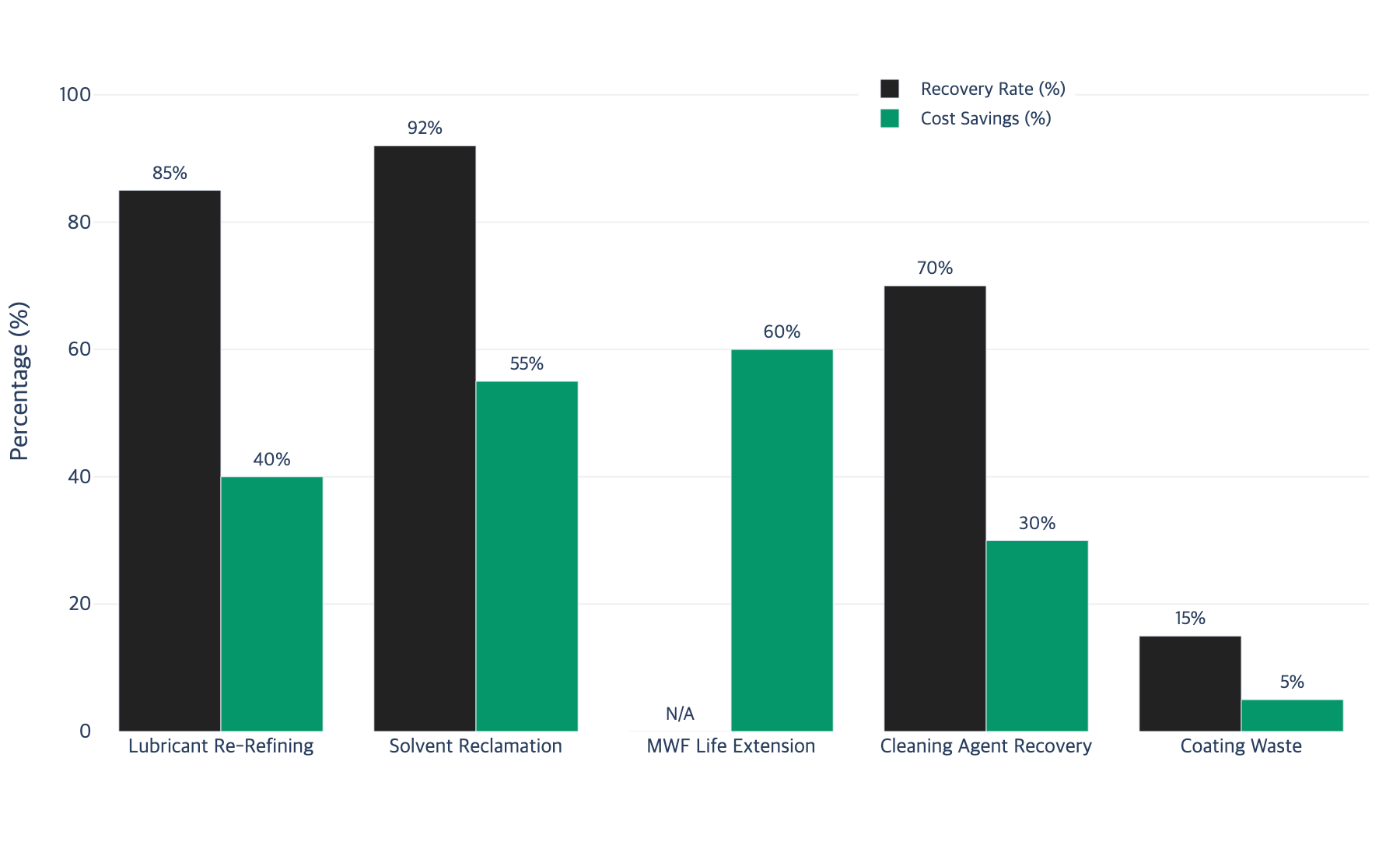
The grouped bar chart compares material recovery rates with cost savings across five chemical categories. Solvent reclamation achieves the highest recovery rate at 92 percent with 55 percent cost savings, making it one of the most attractive circular practices. Lubricant re-refining follows with 85 percent recovery and 40 percent cost savings. Metalworking fluid life extension, while not involving material recovery, delivers the highest cost savings at 60 percent by dramatically extending service intervals. Coating waste shows the lowest scores across both metrics, confirming that this category is better served by waste reduction strategies than reclamation.
Figure 2b. Circular Economy Opportunity Assessment by Chemical Category
Chemical Category | Reclamation Feasibility | Economic Benefit | Environmental Benefit | Implementation Complexity | Overall Priority |
|---|---|---|---|---|---|
Lubricants (engine, hydraulic, gear) | High | High (50-70% cost of virgin) | High (50-80% carbon reduction) | Low-Moderate | Highest |
Industrial solvents | High | High (85-95% recovery) | High (avoids virgin production) | Low (distillation) | Highest |
Metalworking fluids (neat oils) | High | Moderate | Moderate-High | Moderate | High |
Metalworking fluids (water-based) | Low-Moderate (life extension preferred) | High (extended service life) | Moderate | Low (management practices) | High (life extension) |
Cleaning agents (solvent-based) | Moderate-High | Moderate | Moderate | Moderate | Medium |
Cleaning agents (aqueous) | Low (typically single-use) | Low | Low (biodegradable) | N/A | Low |
Corrosion inhibitors | Not applicable (consumed) | N/A | N/A | N/A | Focus on dosing optimization |
Water treatment chemicals | Not applicable (consumed) | N/A | N/A | N/A | Focus on dosing optimization |
Coating materials | Low (cured, irreversible) | Low | Low-Moderate | High | Low (focus on waste reduction) |
Adhesives and sealants | Very Low (cured, irreversible) | Very Low | Low | Very High | Lowest |
This assessment makes clear that lubricants and solvents represent the highest-priority circular economy opportunities for industrial chemical users. These categories offer proven reclamation technology, clear economic benefits, and significant environmental gains. Other categories are better addressed through optimization of use (reducing consumption) rather than end-of-life reclamation.
VII. Key Takeaway
Lubricant re-refining and solvent reclamation are mature, economically validated circular practices that deliver 50 to 80 percent carbon reduction and 20 to 40 percent cost savings compared to virgin product procurement.
Product life extension through proper management practices, particularly for metalworking fluids and hydraulic systems, often delivers greater economic and environmental benefit than end-of-life reclamation.
Not all chemical categories are suited to circular approaches. Reactive chemistry products (corrosion inhibitors, biocides, water treatment chemicals) are consumed during use and cannot be reclaimed, making dosing optimization the appropriate circular strategy.
Waste stream segregation is a prerequisite for effective chemical reclamation. Mixed waste streams typically cannot be economically separated into individual products for reclamation.
Start with the highest-value, lowest-risk circular opportunities (lubricant re-refining, solvent reclamation, metalworking fluid life extension) and expand progressively to systematic integration and advanced circular models.
Deciding which chemicals in your portfolio are candidates for reclamation, life extension, or circular procurement requires cross-referencing product chemistry, contamination profiles, and operating conditions. Lubinpla's AI-powered chemical knowledge platform enables technical teams to perform this analysis systematically, assessing base fluid stability under reclamation conditions, identifying mechanism-compatible recycled alternatives, and building condition-based management programs that extend product service life. Rather than relying on rules of thumb alone, teams can ground circular procurement decisions in the same chemical mechanism reasoning that drives product selection and troubleshooting.
VIII. References
[1] GM Insights, "Circular Economy Chemicals Market Size and Share Report, 2025", 2025. https://www.gminsights.com/industry-analysis/circular-economy-chemicals-market
[2] GM Insights, "Specialty Chemicals Recycling Market Size and Share Report, 2034", 2025. https://www.gminsights.com/industry-analysis/specialty-chemicals-recycling-market
[3] Precedence Research, "Waste Oil Market Size to Hit USD 147.22 Billion by 2034", 2025. https://www.precedenceresearch.com/waste-oil-market
[4] Custom Market Insights, "Solvent Recovery and Recycling Market Size Report, 2033", 2025. https://www.custommarketinsights.com/report/solvent-recovery-and-recycling-market/
[5] Verified Market Reports, "Waste Oil Recycling Market Size and Forecast, 2033", 2025. https://www.verifiedmarketreports.com/product/waste-oil-recycling-market-size-and-forecast/
[6] McKinsey, "Growing the Circular Economy in Chemicals", 2024. https://www.mckinsey.com/industries/energy-and-materials/our-insights/blog/growing-the-circular-economy-in-chemicals
[7] RSC Publishing, "Mapping the End-of-Life of Chemicals for Circular Economy Opportunities", 2024. https://pubs.rsc.org/en/content/articlehtml/2024/su/d4su00517a
[8] Coherent Market Insights, "Waste Oil Market Size and Opportunities, 2032", 2025. https://www.coherentmarketinsights.com/industry-reports/waste-oil-market
[9] MDPI, "Recycling within the Chemical Industry: The Circular Economy Era", 2024. https://www.mdpi.com/2313-4321/3/2/22
[10] Coherent Market Insights, "Automotive Oil Recycling Market Share and Forecast, 2025-2032", 2025. https://www.coherentmarketinsights.com/industry-reports/automotive-oil-recycling-market
[11] GM Insights, "Chemical Recycling Market Size and Share Report, 2034", 2025. https://www.gminsights.com/industry-analysis/chemical-recycling-market
[12] Petronaft, "Re-Refined Base Oils: The Circular Economy of Lubricant Production", 2025. https://www.petronaftco.com/re-refined-base-oils/
[13] CBG Biotech, "What is the Payback Period for an Industrial Solvent Distillation Unit?", 2025. https://www.cbgbiotech.com/blog/what-is-the-payback-period-for-an-industrial-solvent-distillation-unit-or-still
[14] UNIDO, "Chemical Leasing Goes Global", 2025. https://www.unido.org/news/chemical-leasing-goes-global
Powered by Lubinpla
Discover how technical teams solve complex challenges faster with AI.