Choosing the Right Corrosion Inhibitor: A Decision Framework by Substrate and Environment and Budget
Summary: Corrosion inhibitor selection in industrial facilities frequently defaults to supplier recommendations or past practice rather than systematic analysis of protection requirements. With global corrosion costs estimated at USD 2.5 trillion annually, representing 3.4 percent of global GDP, the stakes of getting inhibitor selection wrong are enormous even at the single-facility level (NACE International, 2016). This article provides a structured decision framework that maps substrate metallurgy, environmental severity, protection duration, and budget constraints to the appropriate inhibitor category. The framework covers four major inhibitor families (VCI, contact inhibitors, water-based systems, and oil-based systems) and includes a multi-factor scoring methodology and validation protocol using accelerated testing.
Table of Contents
I. Why Inhibitor Selection Fails
II. Corrosion Inhibitor Categories and Their Protection Mechanisms
III. Requirement Analysis: Defining What Protection You Need
IV. Multi-Factor Selection Scoring
V. Validation Protocol: Confirming Your Selection Works
VI. Common Selection Pitfalls and How to Avoid Them
VII. Key Takeaway
VIII. References
I. Why Inhibitor Selection Fails
A maintenance engineer at a metal fabrication facility switches from oil-based rust preventive to a water-based VCI solution because the new product is easier to apply and requires no removal before downstream processing. Three months later, in-process inventory stored in the warehouse develops rust spots on machined surfaces that were previously protected. The root cause is not a defective product. It is a mismatch between the inhibitor's protection mechanism and the actual storage environment conditions.
The NACE International IMPACT study found that implementing available corrosion control practices could realize savings of 15 to 35 percent of total corrosion costs, translating to USD 375 billion to USD 875 billion annually on a global basis (NACE International, 2016). A significant portion of these preventable losses stems not from the absence of corrosion protection, but from the wrong protection being applied to the wrong situation.
Corrosion inhibitor selection failures typically fall into three categories. First, substrate mismatch: an inhibitor formulated for ferrous metals is applied to a mixed-metal assembly containing aluminum or copper, causing galvanic corrosion acceleration rather than protection. Second, environment mismatch: a contact-phase inhibitor is specified for a situation that requires vapor-phase protection of surfaces not in direct contact with the product. Third, duration mismatch: a short-term in-process inhibitor is expected to provide long-term storage protection, and the inhibitor film degrades or depletes months before the parts are actually used.
Each of these failures is preventable through systematic requirement analysis and selection. The framework in this article replaces ad-hoc selection with a structured approach that addresses substrate metallurgy, environmental severity, required protection duration, and acceptable cost per unit area.
II. Corrosion Inhibitor Categories and Their Protection Mechanisms
Understanding the protection mechanism of each inhibitor category is essential for matching the right product to the right application. Four major categories cover the majority of industrial corrosion prevention needs. Each operates through a fundamentally different mechanism, and this mechanistic difference determines where each category excels and where it falls short.
Vapor Corrosion Inhibitors (VCI) for Enclosed Spaces
VCI products release volatile organic molecules that diffuse through air within an enclosed space and adsorb onto metal surfaces, forming a protective molecular layer. Per NACE International Standard TM0208, VCI substances operate through volatilization, vapor transport within an enclosed atmosphere, and subsequent condensation onto metal surfaces, inhibiting both anodic and cathodic corrosion reactions. This vapor-phase protection reaches all exposed surfaces within the enclosure, including internal cavities, threads, and recesses that contact-applied products cannot reach (Zerust, 2024).
The protection mechanism is self-replenishing: as VCI molecules are consumed or displaced from the metal surface, additional molecules from the vapor phase re-adsorb. The protective layer is nanometers thin, yet it blocks the electron flow necessary for corrosion to advance by preventing moisture and dissolved oxygen from reaching active surface sites (Cortec Corporation, 2024). The most favorable vapor pressure range for VCI compounds is 10 to the negative 3 to 10 to the negative 2 Pascals at room temperature. Below this range, the protective layer establishes too slowly. Above it, the source material depletes rapidly, shortening effective protection duration.
VCI is most effective in enclosed spaces with limited air exchange. Open or semi-open environments allow VCI molecules to escape, reducing concentration below protective levels. For multi-metal assemblies, VCI formulations are available that protect both ferrous and non-ferrous metals simultaneously.
Contact Inhibitors for Machined Surfaces
Contact inhibitors are applied directly to the metal surface as thin films through dipping, spraying, or brushing. The hydrophobic end of the inhibitor molecule orients toward the environment, creating a water-repellent barrier that prevents moisture and dissolved oxygen from reaching the substrate. Protection effectiveness depends on coverage completeness and film integrity under expected conditions.
Solvent-based formulations provide faster drying and more uniform film formation but carry VOC emission concerns. Water-based alternatives are environmentally preferable but require more careful application because water's higher surface tension can lead to incomplete wetting on oily or contaminated surfaces. These products are ideal for machined surfaces and precision components requiring controlled film thickness that does not affect dimensional tolerances.
Contact inhibitors only protect surfaces that are directly coated. Internal cavities and enclosed spaces remain vulnerable unless supplemented with VCI protection. For complex geometries, a combination approach using contact inhibitor on accessible surfaces and VCI for enclosed volumes provides the most complete coverage.
Water-Based Inhibitors for Cooling and Process Systems
Water-based corrosion inhibitors are added to process water, cooling water, and boiler water to reduce corrosion rates on wetted metal surfaces. They work through multiple mechanisms: anodic inhibitors (nitrites, molybdates) form passive oxide films, cathodic inhibitors (zinc, calcium, phosphate compounds) reduce cathodic reaction rates, and film-forming inhibitors (phosphonates, azoles) create barrier layers at the metal-water interface (ChemTreat, 2024).
Mixed-metal systems present particular challenges because inhibitors effective for steel may be aggressive to copper alloys. Azole-based inhibitors are specifically required for copper and brass protection in mixed-metal cooling systems. The interaction between corrosion inhibitors and scale inhibitors must also be evaluated, as certain corrosion inhibitor components can interfere with scale prevention chemistry (AMPP, 2024). Unlike other inhibitor categories where application is a discrete event, water-based inhibitors must be maintained at a target concentration continuously, with under-dosing leaving surfaces unprotected and over-dosing wasting chemical and risking deposit formation.
Oil-Based Inhibitors for Long-Term Storage
Oil-based corrosion preventives combine barrier protection (oil film excluding moisture and oxygen) with active inhibitor chemistry (sulfonates, phosphates, or VCI additives dissolved in the oil carrier). The oil carrier provides inherent water displacement, making these products more tolerant of imperfect surface preparation than water-based alternatives.
Products are classified by film characteristics: thin-film preservative oils for precision surfaces, medium-film products for general storage, and thick-film waxy coatings for severe outdoor exposure. Thick-film coatings can provide protection exceeding two years in semi-outdoor conditions. The primary disadvantage is that parts must be cleaned before painting, welding, assembly, or further machining. Alkaline cleaners are the standard removal method, followed by thorough rinsing to prevent flash rusting from residual cleaning solution (Production Machining, 2024).
Figure 1. Inhibitor Category Comparison by Application Characteristics
Characteristic | VCI | Contact Inhibitor | Water-Based (System) | Oil-Based |
|---|---|---|---|---|
Protection mechanism | Vapor-phase adsorption | Direct film barrier | Electrochemical passivation | Oil film + active inhibitor |
Coverage area | All surfaces in enclosure | Coated surfaces only | Wetted surfaces only | Coated surfaces only |
Typical protection duration | 6-24 months (sealed) | 1-12 months | Continuous (maintained) | 12-36+ months |
Substrate versatility | Multi-metal capable | Formulation-specific | System-specific | Broad compatibility |
Removal required? | No (self-dissipating) | Sometimes | N/A (in-system) | Yes (cleaning required) |
Environmental conditions | Enclosed spaces required | Indoor/outdoor | Closed-loop systems | Indoor/outdoor |
Relative cost per unit area | Medium | Low-medium | Low (per volume) | Medium-high |
Surface prep sensitivity | Low | Medium | N/A | Low |
No single category scores best across all characteristics. This inherent trade-off structure is why a systematic selection framework is necessary rather than defaulting to the most familiar product type.
Figure 4. Corrosion Inhibitor Category Classification

The sunburst chart illustrates the full taxonomy of corrosion inhibitor categories and their subtypes. The outermost ring shows specific product forms (film, paper, emitter, thin oil, heavy wax), while inner rings show broader mechanistic categories. Starting from the correct branch eliminates entire classes of unsuitable products early in the selection process.
III. Requirement Analysis: Defining What Protection You Need
Systematic inhibitor selection begins with a clear definition of protection requirements across four dimensions: substrate metallurgy, environmental severity, protection duration, and acceptable cost. Writing down requirements before evaluating products prevents the common trap of selecting a product first and then rationalizing why it should work.
Substrate Metallurgy Assessment
Identify all metals present in the application. Single-metal applications simplify selection because compatibility concerns are limited. Multi-metal assemblies require inhibitors effective on all metals present without accelerating galvanic corrosion. For galvanic corrosion to initiate, three conditions must be present: electrochemically dissimilar materials, an electrical connection between them, and exposure to a common electrolyte. An inhibitor that passivates one metal but not the other can shift corrosion potential and accelerate attack on the less noble metal.
Surface condition matters as well. Precision-machined surfaces require thin, uniform films that preserve dimensional tolerances. Cast surfaces with rough texture may need higher inhibitor loading for complete coverage. Heat-treated surfaces may have different electrochemical characteristics, particularly in heat-affected zones near welds, creating localized corrosion cells even on single-metal assemblies.
Environmental Severity Classification
Environmental severity determines the minimum protection capability required. The key variables are relative humidity, temperature cycling, airborne contaminants, and degree of enclosure.
Figure 2. Environmental Severity Classification for Inhibitor Selection
Severity Level | Conditions | Examples | Minimum Protection Class |
|---|---|---|---|
Mild | Indoor, climate-controlled, RH below 50% | Clean rooms, climate-controlled warehouse | Basic contact inhibitor or VCI paper |
Moderate | Indoor, uncontrolled, RH 50-70% | Standard warehouse, production floor | VCI packaging or medium-film oil |
Severe | Indoor/outdoor, RH above 70%, temperature cycling | Unheated warehouse, port storage area | VCI + desiccant or heavy-film oil |
Extreme | Outdoor, coastal/marine, chemical exposure | Open yard storage near coast, chemical plant | Heavy-film oil or wax coating |
The most frequent classification error is rating an environment as "moderate" when temperature cycling makes it "severe." A warehouse at 55 percent relative humidity during the day may experience condensation on metal surfaces during overnight temperature drops, creating severe conditions despite moderate average readings.
Protection Duration Mapping
In-process protection (hours to days) requires fast-acting, easily removable products. Intra-facility storage (weeks to months) requires moderate-duration products balancing effectiveness against removal effort. Export or long-term storage (months to years) demands the highest-performance systems.
For export shipments, account for the entire logistics chain: exporter warehouse time, ocean transit (14 to 45 days), customs clearance, and importer storage. Container interiors during ocean transit can reach 60 degrees Celsius or higher, with extreme humidity cycling between climate zones. These conditions require inhibitor systems rated for severe or extreme environments.
Budget Constraint Integration
The cost of an inhibitor system typically ranges from USD 0.10 to USD 2.00 per square meter. The cost of corrosion damage routinely exceeds USD 50 per square meter for precision components, and can exceed USD 200 per square meter for high-value machined parts when scrap, rework, sorting, claims, and line disruption are all accounted for.
This 25-to-50x cost asymmetry means that under-specifying protection to save material cost is rarely justified. Prioritize effectiveness first, then optimize cost within products that meet the minimum requirement.
IV. Multi-Factor Selection Scoring
After defining requirements, the following scoring methodology narrows the selection to the most suitable product category.
Scoring Criteria
Each option is scored on five factors, weighted by application priority.
Figure 3. Multi-Factor Selection Scoring Matrix
Factor | Weight | VCI Film | Contact (Solvent) | Contact (Water) | Oil (Thin) | Oil (Heavy) |
|---|---|---|---|---|---|---|
Protection effectiveness | 30% | 7 | 6 | 5 | 8 | 9 |
Application ease | 20% | 9 | 7 | 7 | 6 | 4 |
Removal requirements | 15% | 10 | 6 | 7 | 3 | 2 |
Environmental compliance | 20% | 9 | 4 | 8 | 5 | 5 |
Cost per unit area | 15% | 6 | 7 | 8 | 5 | 4 |
Scoring is on a 1-10 scale where 10 is the best. A precision machining facility needing in-process protection with easy removal would score VCI Film and water-based contact inhibitors highest. A port storage operation requiring 18-month outdoor protection would score heavy oil highest. When two options score within 5 percent of each other, practical considerations like existing equipment and operator familiarity serve as the tiebreaker.
Figure 5. Multi-Factor Scoring Profile Comparison
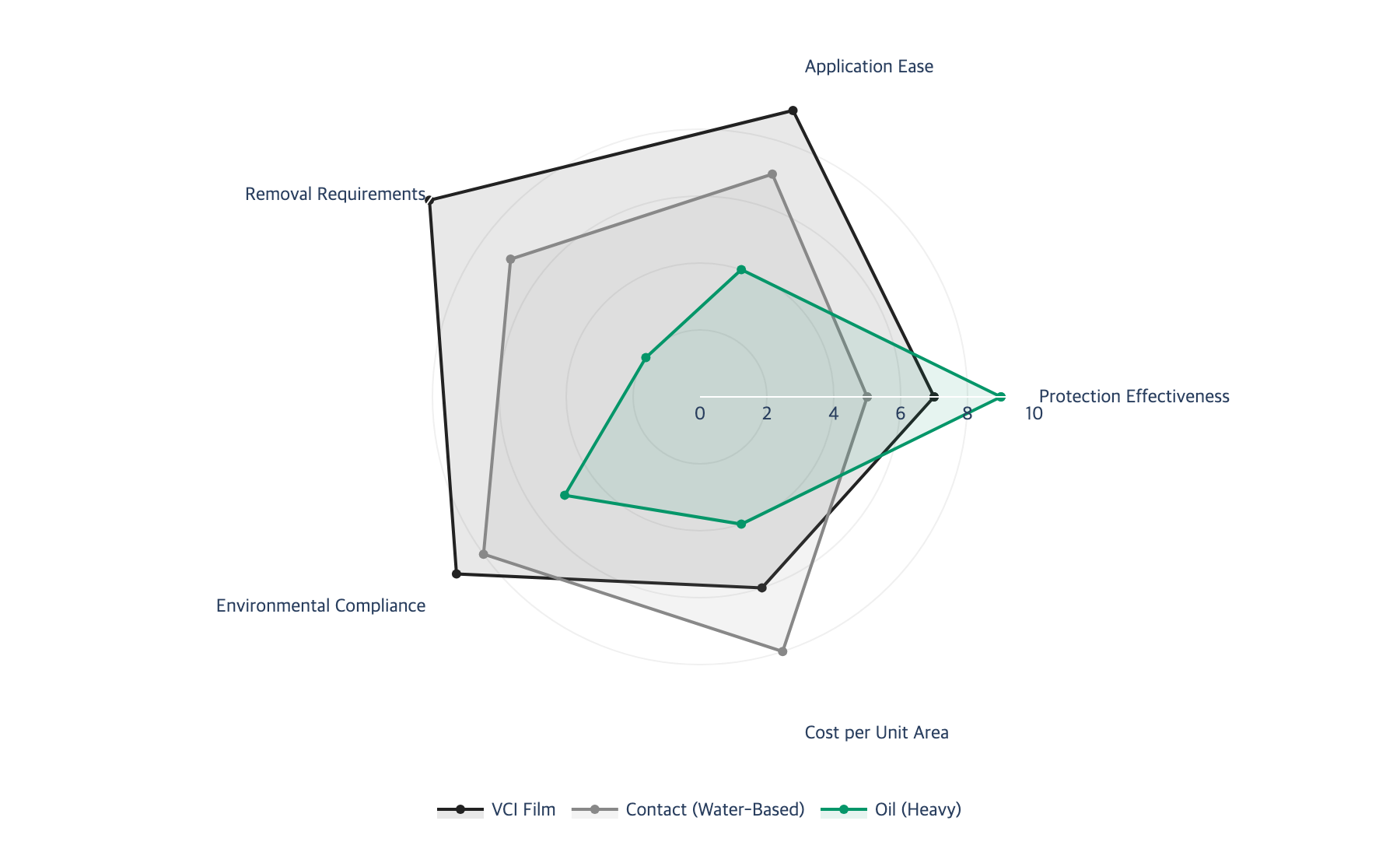
The radar chart visualizes trade-off profiles of three representative inhibitor types. VCI Film offers the best balance of ease and compliance. Oil-based heavy coatings dominate in protection effectiveness but score poorly on ease and removal. Water-based contact inhibitors provide a moderate, balanced profile. The optimal choice depends on which factors carry the highest weight.
Selection Worksheet Summary
Step 1: list all metals and eliminate incompatible categories. Step 2: classify environmental severity and eliminate products below the minimum protection class. Step 3: determine protection duration and eliminate products that cannot achieve it. Step 4: apply multi-factor scoring with adjusted weights. Step 5: select the highest-scoring option and proceed to validation testing.
Document the rationale at each step for quality audit trail, troubleshooting, and institutional knowledge.
V. Validation Protocol: Confirming Your Selection Works
No selection should be deployed at scale without validation testing. Three accelerated test methods provide increasing confidence levels.
Salt Spray Testing (ASTM B117)
ASTM B117 maintains specimens at 35 degrees Celsius in a 5 percent sodium chloride fog at 95 percent relative humidity. Duration ranges from 24 to 500 or more hours. It provides standardized, reproducible relative performance assessment for comparing inhibitor options (Q-Lab, 2024). Its primary limitation is testing only chloride-induced corrosion in a constantly wet environment, while real-world corrosion involves multiple simultaneous mechanisms. Use ASTM B117 for comparative ranking rather than absolute service life prediction.
Humidity Cabinet Testing (ASTM D1748)
ASTM D1748 exposes specimens to constant high humidity at 48.9 degrees Celsius, testing metal preservative rust prevention under humidity conditions (ASTM International, 2024). Steel panels are dipped in the test preservative, drained, and suspended in the humidity chamber. This test is particularly useful for validating VCI and contact inhibitor performance for indoor storage because it simulates the dominant warehouse corrosion driver: sustained high humidity. Comparisons should be limited to similar preservative types for similar applications.
Electrochemical Methods
Electrochemical impedance spectroscopy (EIS) applies a small-amplitude AC signal across frequencies to measure impedance response. From equivalent circuit modeling, three parameters are extracted: coating resistance, water uptake, and corrosion rate (Springer, 2021). EIS is non-destructive, provides results in hours rather than weeks, and delivers mechanistic insight distinguishing between barrier protection, anodic inhibition, and cathodic inhibition. It is particularly valuable for optimizing inhibitor concentration in water treatment systems.
Validation Decision Criteria
Establish pass/fail criteria before testing: no visible rust within a specified period, corrosion rate below 0.1 mm per year for protected steel, and no compromise to downstream coating adhesion or process quality. Document all conditions, results, and conclusions. Over time, this database accelerates future selection decisions by reducing evaluation cycles from weeks to days.
VI. Common Selection Pitfalls and How to Avoid Them
Even with a structured framework, certain errors recur frequently enough to warrant explicit discussion.
Pitfall 1: Defaulting to Familiarity
Choosing the inhibitor the facility has always used, regardless of whether it matches current requirements. A facility that defaults to oil-based preservatives for everything may apply heavy oil to precision components better served by VCI, resulting in excessive removal cost and occasional paint adhesion failures from incomplete cleaning.
Pitfall 2: Ignoring Downstream Process Compatibility
Silicone-containing inhibitors can cause paint adhesion defects. Chlorinated inhibitors can cause stress corrosion cracking in stainless steel. Sulfur-containing oil-based preservatives can poison welding processes. Verify compatibility not only with the substrate but with all downstream processes.
Pitfall 3: Underestimating Environmental Variability
Specifying inhibitors based on average rather than peak environmental conditions causes intermittent failures that are difficult to diagnose. Select based on the most severe conditions the product will encounter during the full protection period.
Pitfall 4: Neglecting Chemical Interactions
In water treatment systems, interactions between corrosion inhibitors and other treatment chemicals (scale inhibitors, biocides, dispersants) can reduce effectiveness. Laboratory compatibility testing of the complete program is essential before changing any single component.
VII. Key Takeaway
Begin selection with requirement analysis across four dimensions: substrate metallurgy, environmental severity, protection duration, and budget constraints.
Match the inhibitor mechanism to the application: VCI for enclosed spaces, contact inhibitors for precision surfaces, water-based for cooling systems, oil-based for long-term outdoor storage.
Use multi-factor scoring with application-specific weights to identify the optimal category.
Never deploy at production scale without accelerated testing (ASTM B117, ASTM D1748, or EIS) with predefined pass/fail criteria.
Under-specifying protection to save material cost is rarely justified, as damage costs exceed inhibitor costs by 25 to 50 times. When in doubt, select one protection class above the minimum.
Lubinpla's condition-based selection engine can cross-reference your specific substrate metallurgy, storage environment data, and protection duration requirements against its inhibitor performance database to generate a ranked shortlist with predicted protection effectiveness for your exact operating conditions. Rather than navigating the four-dimensional selection space manually, the platform applies multi-variable condition analysis to narrow hundreds of inhibitor options to the most suitable candidates in seconds.
VIII. References
[1] NACE International, "IMPACT: International Measures of Prevention, Application, and Economics of Corrosion Technologies Study", 2016. http://impact.nace.org/economic-impact.aspx
[2] Zerust, "What Is VCI: Understanding Vapor Corrosion Inhibitors", 2024. https://www.zerust.com/faq/what-is-vci/
[3] ChemTreat, "Corrosion Inhibitors for Cooling Systems", 2024. https://www.chemtreat.com/solutions/applications/cooling-water-treatment/corrosion-inhibition/
[4] Q-Lab, "ASTM B117: Standard Practice for Operating Salt Spray Fog Apparatus", 2024. https://www.q-lab.com/corrosion/corrosion-test-standards/astm-b117
[5] Cortec Corporation, "How VCI Works", 2024. https://www.cortecvci.com/how-vci-works/
[6] ASTM International, "D1748 Standard Test Method for Rust Protection by Metal Preservatives in the Humidity Cabinet", 2024. https://store.astm.org/d1748-24.html
[7] ASTM International, "B117 Standard Practice for Operating Salt Spray Fog Apparatus", 2019. https://store.astm.org/b0117-19.html
[8] Springer, "Electrochemical Impedance Spectroscopy: A Useful Tool for Monitoring the Performance of Corrosion Inhibitors", 2021. https://link.springer.com/chapter/10.1007/978-3-030-89101-5_5
[9] AMPP, "Field Case Study: Impact of Corrosion Inhibitor on Scale Control", 2024. https://content.ampp.org/ampp/proceedings/CONF_MAR2024/2024/1/60301
[10] Production Machining, "Maximizing Cleaning and Rust Preventive Programs", 2024. https://www.productionmachining.com/blog/post/maximizing-cleaning-and-rust-preventive-programs
[11] Cannon Water Technology, "Know How to Choose the Right Corrosion Inhibitor", 2024. https://cannonwater.com/blog/how-to-choose-corrosion-inhibitor/
[12] Daubert Cromwell, "Vapor Phase Corrosion Inhibitors", 2024. https://daubertcromwell.com/blog/vapor-phase-corrosion-inhibitors/
[13] Clearwater Technology, "Nitrite vs Molybdate vs Organic as Corrosion Inhibitors", 2024. https://clearwatershelton.com/corrosion-inhibitors/
[14] Matcor, "Vapor Corrosion Inhibitors Viable for Corrosion Prevention", 2024. https://www.matcor.com/vapor-corrosion-inhibitors/
Powered by Lubinpla
Discover how technical teams solve complex challenges faster with AI.