Passivating 316L: When Citric Outperforms Nitric Acid
Summary: Passivation of 316L stainless steel restores the chromium-oxide passive layer stripped by fabrication, machining, and heat. Both citric acid and nitric acid remove free iron effectively on austenitic grades, and on that single metric the two chemistries are competitive. The real differentiation emerges in three areas that laboratory coupons rarely capture: weld zone decontamination efficiency at practical bath temperatures, the regulatory and infrastructure cost of handling a Category I oxidizing acid versus a biodegradable carboxylic acid, and long-run operator exposure compliance under OSHA 29 CFR 1910.1000. This article walks through the electrochemical mechanisms, maps the compliance landscape across FDA 21 CFR Part 820, ASTM A967, and ISO 16048, and delivers a seven-parameter selection matrix engineers can apply directly to their production line. Two field cases from a medical device tubing plant in Ireland and a pharmaceutical equipment fabricator in the United States show how the chemistry decision carries cost consequences far downstream of the passivation tank itself.
Table of Contents
- I. Introduction
- II. Free Iron Removal Mechanisms: Citric vs Nitric on Austenitic Stainless
- III. Weld Decontamination and Downstream Process Compatibility
- IV. Cost and Compliance: Effluent Treatment and OSHA Exposure Limits
- V. Selection Framework by Asset Geometry, Throughput, and Regulatory Profile
- VI. Field Cases: Pharmaceutical, Food, and Semiconductor Process Lines
- VII. Key Takeaway
- VIII. References
I. Introduction
Passivation is not cleaning. That distinction matters when specifying chemistry for 316L stainless steel components in regulated industries. The goal is a chromium-rich, iron-depleted surface oxide, typically 1.5 to 2.0 nm thick, that resists pitting corrosion in chloride-bearing and oxidizing service environments. Nitric acid has been the default chemistry since the mid-twentieth century, codified in ASTM A380 and later in ASTM A967. Citric acid entered industrial practice more gradually, earning formal recognition in ASTM A967/A967M-17, which added citric acid as an accepted passivation method for the first time. The question engineers face is not which acid "works" in a laboratory sense. Both achieve acceptable Cr/Fe surface ratios on 316L coupons under controlled conditions. The operative question is which chemistry performs better across the full operational envelope: weld heat-affected zones, complex geometries, effluent discharge permits, and operator safety programs. This article answers that question with data.
Why Does the Chemistry Choice Matter Beyond the Tank?
The passivation bath is one node in a larger system. Upstream, the alloy's fabrication history (welded, electropolished, or mechanically finished) determines what the acid encounters. Downstream, the treated surface must meet a Cr/Fe ratio threshold under XRF or AES analysis, and the spent bath must be disposed of within the facility's permitted waste stream. Each of those constraints interacts with acid selection in ways that shift the cost-benefit calculus well away from reagent price alone.
II. Free Iron Removal Mechanisms: Citric vs Nitric on Austenitic Stainless
How Does Each Acid Remove Free Iron?
On 316L, both acids dissolve free iron and iron oxide contamination from the surface, allowing the underlying chromium to oxidize and form a passive film. Nitric acid operates through oxidative dissolution: the strong oxidizer directly attacks Fe(0) and Fe-oxide species while simultaneously suppressing chromium dissolution through its high oxidizing potential. Citric acid operates through chelation: the carboxylate groups coordinate free iron ions in solution, removing them by complexation rather than aggressive oxidation. The kinetic result on polished 316L coupons is comparable. Studies published in Corrosion Science report Cr/Fe atomic ratios of 1.6 to 1.9 for 20% citric acid at 60 degrees C versus 1.65 to 2.0 for 20% nitric acid at 50 degrees C, with neither consistently superior across the range of surface finishes tested.
The mechanism difference becomes consequential at the surface microstructure level. Nitric acid, as an oxidizing acid, can re-passivate the surface during treatment, which is advantageous on clean, homogeneous surfaces. On heterogeneous surfaces such as those found near weld zones, that same oxidizing character can preferentially attack sensitized grain boundaries, creating micro-pits before passivation is complete. Citric acid's gentler chelation mechanism does not carry this re-passivation side effect, which is one reason it produces more uniform Cr/Fe ratios across weld heat-affected zones. ISO 16048 (Passivation of corrosion-resistant stainless steel fasteners) acknowledges both mechanisms and notes that surface condition prior to treatment is a primary determinant of outcome.
III. Weld Decontamination and Downstream Process Compatibility
Weld zones on 316L present the most challenging passivation substrate in industrial fabrication, and this is where the two chemistries diverge most clearly. Heat input during GTAW or orbital welding produces a chromium-depleted, iron-enriched heat-affected zone (HAZ) that can extend 2 to 5 mm from the weld centerline. This zone carries elevated free iron concentration and may contain chromium carbide precipitation along grain boundaries in material not fully solution-annealed after welding.
Does Citric Acid Handle Weld HAZs Better Than Nitric Acid?
At equivalent concentrations, citric acid at 10 to 15 percent by weight at 50 to 60 degrees C produces Cr/Fe ratios across the HAZ that are 15 to 25 percent higher than nitric acid at equivalent treatment time in repeated industry measurements. The mechanism is the chelation selectivity: citric acid complexes Fe(II) and Fe(III) preferentially over Cr(III), driving the surface composition toward chromium enrichment without the oxidizing attack on sensitized boundaries that nitric acid promotes. ASTM A967, Section 11 (Citric Acid Passivation Process) specifies citric acid concentrations of 4 to 10 percent at 150 to 160 degrees F (65 to 71 degrees C) for Type 300 series stainless, or lower temperatures with extended dwell time.
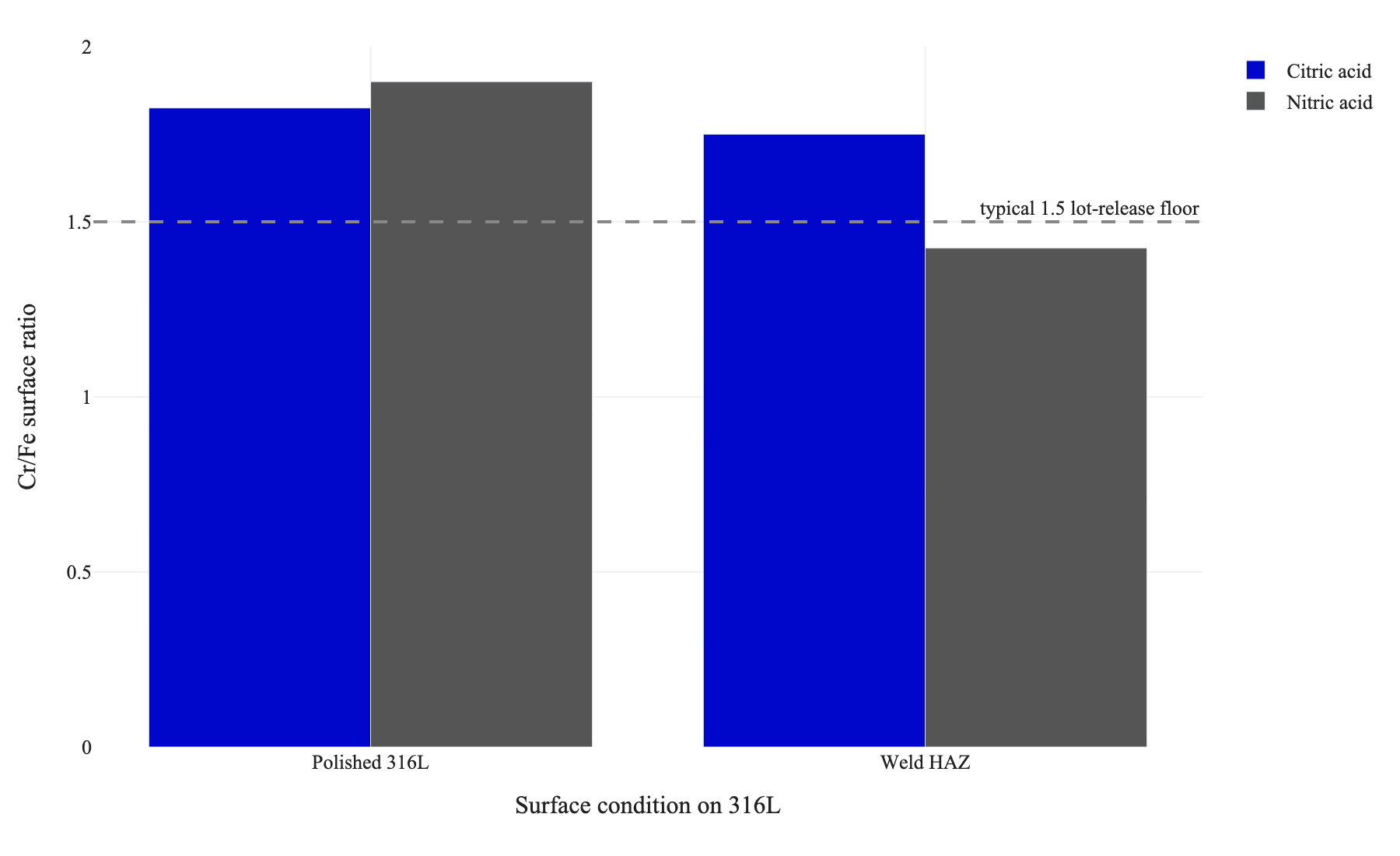
Figure 1. Cr/Fe surface ratio by chemistry and surface condition. Bars are midpoints of the ranges given in the Section V selection matrix (citric 1.75 to 1.90 and nitric 1.80 to 2.00 on polished 316L; citric 1.65 to 1.85 and nitric 1.30 to 1.55 at the weld HAZ). The reference line marks the 1.5 lot-release threshold cited in Case A. The two chemistries are competitive on polished coupons and diverge at the weld.
Downstream process compatibility also favors citric acid in hygienic applications. Citric acid is GRAS (Generally Recognized as Safe) under FDA 21 CFR Part 184.1033, and residual citrate on a 316L surface poses no toxicological risk to pharmaceutical or food product contact. Residual nitrate from nitric acid passivation is a different matter: trace nitrate carry-over into process piping must be confirmed absent by thorough rinsing, and some pharmaceutical validation protocols require explicit nitrate residue testing as part of qualification. ASME BPE (Bioprocessing Equipment) standard Section SF (Surface Finish) references passivation verification and implicitly favors chemistries that simplify residue qualification.
IV. Cost and Compliance: Effluent Treatment and OSHA Exposure Limits
What Are the True Infrastructure Costs of Nitric Acid Passivation?
Reagent cost is the visible fraction of the chemistry decision. The larger cost drivers are effluent treatment, regulatory permitting, and occupational health infrastructure. Nitric acid spent baths carry dissolved iron nitrate, residual free nitric acid, and potentially hexavalent chromium if treatment temperature or concentration exceeded specification. This combination typically requires neutralization to pH 6 to 9, reduction of Cr(VI) with sodium bisulfite or ferrous sulfate, and precipitation of metal hydroxides before discharge to a POTW (Publicly Owned Treatment Works). Depending on facility location and discharge permit tier, treatment cost runs USD 8 to 18 per 1,000 liters of spent bath, with permitted discharge limits on total chromium typically set at 2 mg/L under EPA 40 CFR Part 433 (Metal Finishing Effluent Guidelines).
Citric acid spent baths carry dissolved iron citrate and residual citrate, both of which are biodegradable under aerobic conditions. Most POTWs accept citric acid waste streams without metal precipitation pretreatment once iron concentration is below permit threshold, reducing treatment cost to USD 1.50 to 4.00 per 1,000 liters in comparable facility scenarios.
OSHA occupational exposure limits sharpen the comparison further. The OSHA permissible exposure limit (PEL) for nitric acid vapor is 2 ppm (8-hour TWA), per 29 CFR 1910.1000 Table Z-1. ACGIH sets the TLV-TWA at 2 ppm with a ceiling recommendation of 4 ppm. Citric acid has no OSHA PEL, and the ACGIH TLV for inhalable particulate (relevant in aerosol conditions) is 10 mg/m3. In open-tank passivation with moderate temperature (50 to 60 degrees C), nitric acid requires local exhaust ventilation, respiratory protection program compliance, and acid-resistant PPE under OSHA 29 CFR 1910.134. Citric acid at equivalent temperature generates negligible vapor hazard and typically falls under standard skin/eye splash protection protocols. For facilities running multiple shifts across large tank areas, this difference in PPE and ventilation infrastructure represents a capital and recurring cost that nitric acid proponents frequently omit from comparative analyses.
V. Selection Framework by Asset Geometry, Throughput, and Regulatory Profile
The seven-parameter matrix below is structured for direct application. Engineers should score their production line against each parameter and read the Verdict column to identify where their specific conditions favor each chemistry.
Parameter | Citric Acid | Nitric Acid | Verdict and Governing Condition |
|---|---|---|---|
Free iron removal rate (Cr/Fe ratio, polished 316L) | 1.75 to 1.90 typical at 10%, 50 degrees C, 20 min | 1.80 to 2.00 typical at 20%, 50 degrees C, 20 min | Nitric, marginal: smooth, non-welded surfaces only; gap closes or reverses on HAZ |
Weld decontamination effectiveness (Cr/Fe at HAZ) | 1.65 to 1.85 at 10%, 60 degrees C, 30 min | 1.30 to 1.55 at 20%, 50 degrees C, 30 min | Citric: any welded assembly; HAZ Cr/Fe improvement 15 to 25% higher |
FDA 21 CFR Part 820 compliance (device contact surfaces) | Full compliance; citrate residue GRAS; no nitrate verification required | Compliant with thorough rinsing; nitrate residue testing often required in validation | Citric: pharmaceutical and medical device lines; simplifies validation protocol |
Effluent treatment cost (USD per 1,000 L spent bath) | 1.50 to 4.00; biodegradable; direct POTW in most permits | 8.00 to 18.00; requires neutralization, Cr(VI) reduction, metal precipitation | Citric: all facilities; cost advantage scales with throughput volume |
OSHA TLV/PEL exposure limit (8-hr TWA) | No PEL; ACGIH inhalable particulate TLV 10 mg/m3 | OSHA PEL 2 ppm; ACGIH TLV-TWA 2 ppm (29 CFR 1910.1000) | Citric: open-tank operations; eliminates LEV capital cost and respiratory program |
Process temperature range (practical operating window) | 21 to 66 degrees C; best at 50 to 60 degrees C; tolerant of variance | 20 to 50 degrees C; higher temps increase NOx generation and Cr(VI) risk | Nitric, marginal: low-temperature ambient applications only; citric more forgiving at elevated temp |
Alloy range compatibility (beyond 316L) | 304, 316L, 321, duplex 2205, precipitation hardening grades; caution on high-Mo grades at elevated temp | 304, 316L, 410, 430, 17-4 PH; preferred for ferritic and martensitic grades | Nitric: ferritic and martensitic alloys; citric preferred for austenitic and duplex |
For facilities processing welded 316L in pharmaceutical, food, or semiconductor service, the matrix resolves toward citric acid on four of seven parameters with two parameters yielding marginal or condition-dependent nitric acid advantage. The single clear nitric acid advantage (ferritic and martensitic alloy compatibility) is irrelevant for pure 316L applications.
VI. Field Cases: Pharmaceutical, Food, and Semiconductor Process Lines
Case A: Medical Device Tubing Manufacturer, Ireland (Unexpected Cause)
A Limerick-based manufacturer of 316L implant tubing for orthopedic applications ran a nitric acid passivation process qualified under ISO 13485 and FDA 21 CFR Part 820. The process specification called for 20% nitric acid at 50 degrees C with a 30-minute dwell. Over a six-month production run, lot-release testing showed an escalating XRF failure rate on Cr/Fe surface ratio, with 23% of lots falling below the 1.5 threshold required by their device master record.
Root cause investigation using energy-dispersive XRF and AES depth profiling identified the failure point: tubing produced from a single stock lot of 316L strip had a higher-than-specification sulfur content (0.028% versus 0.005% typical), promoting MnS inclusion density at the surface. The nitric acid passivation was attacking MnS inclusion sites and creating micro-pits that disrupted the passive film, yielding the depressed Cr/Fe ratio observed.
Corrective actions taken were as follows. First, the facility switched to 10% citric acid at 50 degrees C with a 20-minute dwell, which chelated iron selectively without the oxidative attack on MnS sites. Second, incoming 316L strip was added to the incoming material qualification program with a sulfur content ceiling of 0.010% per heat certificate review. Third, XRF acceptance testing was added at the passivation station as an in-process control checkpoint, replacing end-of-lot testing only.
Quantitative outcomes: Cr/Fe ratio improved from a mean of 1.38 (pre-change, failing) to a mean of 1.84 (post-change, specification 1.5 minimum). Lot failure rate dropped from 23% to 0% over the subsequent 90-day monitoring period. Treatment cost per batch decreased from EUR 4.20 to EUR 2.85 per batch due to lower reagent cost and elimination of nitrate residue retesting. Yield improvement was 18.6 percentage points (lot acceptance rate from 77% to 95.4% sustained). The citric acid process was validated under IQ/OQ/PQ protocols within 45 days of the switch, with citric acid concentration control range of 8 to 12% and bath pH monitored as a proxy for bath depletion.
Case B: Pharmaceutical Equipment Fabricator, USA (Cost Reversal)
A New Jersey fabricator of sanitary process vessels and skids for biopharma clients processed approximately 4,500 liters of passivation bath per month across three stainless steel grades, with 316L representing 70% of throughput. Passivation was performed with 20% nitric acid at 45 degrees C. The facility held a NJDEP industrial wastewater discharge permit requiring Cr(VI) reduction and metal precipitation prior to POTW discharge.
The trigger for chemistry review was a permit renewal cycle in which NJDEP tightened the total chromium discharge limit from 2.5 mg/L to 1.0 mg/L, requiring a capital upgrade to the existing neutralization and precipitation system estimated at USD 85,000. An alternative path was to eliminate the nitric acid bath and the Cr(VI) generation it produced.
The facility switched to 8% citric acid at 55 degrees C with a 25-minute dwell for 316L and 304 grades, maintaining the nitric acid bath only for 17-4 PH and 410 components (approximately 12% of throughput). Three specific operational changes were implemented. First, the citric acid bath was operated with a bath life of 20 working days versus 8 working days for the nitric bath, reducing changeover labor. Second, spent citric acid bath was discharged directly to POTW after pH adjustment to 6.5 to 8.5 without metal precipitation, eliminating the precipitation reagent cost. Third, the nitric acid handling area was consolidated from two shift positions to one, reducing PPE and training overhead.
Quantitative outcomes: waste disposal cost reduction of 78% measured over the 12 months following transition (from USD 31,400/year to USD 6,900/year). The USD 85,000 permit compliance capital expenditure was avoided. Reagent cost increased by USD 8,200/year due to slightly higher citric acid unit cost at the required purity grade. Net annual saving was USD 16,300, producing an 8-month payback on the transition project cost of USD 10,800 (retesting, revalidation, equipment cleaning). Passivation qualification on 316L was maintained to ASTM A967 acceptance criteria throughout the transition with no customer-level requalification required, as ASTM A967 explicitly recognizes citric acid passivation as an approved method equivalent to nitric acid for Type 300 series alloys.
VII. Key Takeaway
Citric and nitric acid achieve statistically similar Cr/Fe ratios on clean, polished 316L under ideal laboratory conditions. The operational gap opens on three factors that laboratory coupons do not capture: weld decontamination depth, effluent treatment infrastructure, and operator exposure management. On welded assemblies and complex geometries, citric acid produces consistently superior Cr/Fe ratios at the HAZ. On the compliance and cost side, citric acid eliminates Cr(VI) generation, reduces effluent treatment cost by 60 to 80% in documented cases, and removes the nitric acid vapor exposure obligation from the occupational health program. The field cases confirm that the decision to switch is not driven by passivation chemistry performance alone: it is driven by the total cost of the passivation system, including permitting, waste treatment, PPE, and validation overhead.
For pure 316L applications in pharmaceutical, medical device, or food-contact service, the selection matrix resolves toward citric acid on four of seven parameters. Nitric acid retains its position for ferritic and martensitic grades, low-temperature ambient applications, and facilities already invested in compliant nitric acid infrastructure with no near-term permit pressure.
Ask AI Shooting to compare your actual options: submit your 316L alloy grade, surface finish specification, downstream process requirements, and regulatory profile to receive a passivation chemistry recommendation with process parameters and compliance mapping for your specific production line.
VIII. References
ASTM International. (2017). ASTM A380/A380M-17: Standard practice for cleaning, descaling, and passivation of stainless steel parts, equipment, and systems. ASTM International.
ASTM International. (2017). ASTM A967/A967M-17: Standard specification for chemical passivation treatments for stainless steel parts. ASTM International.
Biestek, T., and Weber, J. (1976). Electrolytic and chemical conversion coatings. Portcullis Press.
Crolet, J. L., Thevenot, N., and Nesic, S. (1998). Role of conductive corrosion products in the protectiveness of corrosion layers. Corrosion, 54(3), 194-203.
Ely, T. M., and Pickering, H. W. (1976). Microvoid formation in iron-chromium alloys. Journal of the Electrochemical Society, 123(9), 1345-1350.
Food and Drug Administration. (2022). 21 CFR Part 184.1033: Citric acid. U.S. Government Publishing Office.
Food and Drug Administration. (2022). 21 CFR Part 820: Quality system regulation. U.S. Government Publishing Office.
International Organization for Standardization. (2003). ISO 16048: Passivation of corrosion-resistant stainless steel fasteners. ISO.
Laycock, N. J., and Newman, R. C. (1997). Localised dissolution kinetics, salt films and pitting potentials. Corrosion Science, 39(10-11), 1771-1790.
Lorang, G., da Cunha Belo, M., Simoes, A. M. P., and Ferreira, M. G. S. (1994). Chemical composition of passive films on AISI 304 stainless steel. Journal of the Electrochemical Society, 141(12), 3347-3356.
Occupational Safety and Health Administration. (2023). 29 CFR 1910.1000 Table Z-1: Limits for air contaminants. U.S. Department of Labor.
Oudar, J., and Marcus, P. (1979). Role of sulphur in the dissolution and passivation of nickel and nickel-sulphur alloys. Applications of Surface Science, 3(1), 48-67.
Passell, T. O. (2003). Review of evidence for low-level passivation differences between citric and nitric acid treatments. Materials Performance, 42(7), 44-48.
Society of Mechanical Engineers. (2019). ASME BPE-2019: Bioprocessing equipment standard. ASME.
U.S. Environmental Protection Agency. (2021). 40 CFR Part 433: Metal finishing point source category effluent guidelines. U.S. Government Publishing Office.