What Is Technical Reasoning in Specialty Chemicals?
Technical reasoning in specialty chemicals moves from a customer's conditions to the mechanism, then to candidates, evidence and a conclusion. Along the way it keeps what is confirmed, what is inferred and what is unknown apart until the answer is delivered, so the engineer who approves it knows what still needs checking.
A chemical substance can be described by generic, systematic, common and trade names, while a CAS Registry Number designates only one substance (CAS, accessed 2026).
Under the US OSHA Hazard Communication Standard, Section 3 of a safety data sheet lists the chemical name, CAS number and concentration of a mixture's health-hazard ingredients, unless the identity or concentration is withheld as a trade secret (29 CFR 1910.1200, Appendix D).
Residues of a silicate cleaning solution left on a metal surface by insufficient rinsing can form tenacious silicate layers that are very difficult to remove (US Patent 9,222,176, 2015).
Lubinpla's agents compare products component by component, identified by CAS number where one is known, and keep what is confirmed, what is inferred and what is unknown separate to the end of the answer.
Tested on identical product recommendation cases and documents, Lubinpla needed under an hour of hands-on time per case, where a general AI agent needed about 4.6 hours (Lubinpla internal benchmark, Tasks page, 2026).
How does a specialty chemical team answer a product or field problem question today?
A specialty chemical team often answers a product or field problem question by matching it to a catalog entry, asking the most senior engineer, and replying by email. Say an application engineer at a distributor reads a message from a die casting plant's quality lead: the housings come out of the washer with white stains, and could the distributor suggest a stronger cleaner?
The first move is the catalog. The engineer searches for products described as aluminum safe, compares the shortlist by pH, appearance and the use wording on each TDS, and picks the one that sounds closest to the request. The trade name on the customer's current drum tells nobody what is in it.
The second move is memory. A senior engineer remembers a stain problem at another plant and suggests the product that fixed it.
The third move is the email. The reply names a product and a dilution. It does not say what caused the stain, which explanations were set aside, or what the plant should check first. If the stain comes back, the next conversation starts from the same guess.
Why does product-name matching fail in technical reasoning?
Product-name matching fails because a specialty chemical behaves according to what is in it and the conditions it meets, not its name. The same white stain at two plants can need two answers: one plant has a single rinse stage, the other runs hard rinse water.
Trade names settle nothing, and ingredient names vary by supplier. The unit of comparison is the component, identified by CAS number where one is known, and the SDS composition section is where those numbers usually sit. A comparison that rests only on appearance, specific gravity, pH or use phrasing is marketing-level, not technical.
Technical reasoning also treats a CAS number as incomplete for surfactants and polymers, where one number can cover grades whose ethoxylation degree or molecular weight changes the behavior. That gap is written down as a question for the manufacturer, not guessed.
Sometimes the composition is incomplete: the SDS withholds an identity as a trade secret, or no SDS is on file. Technical reasoning then works at the level of the role each component plays, such as the alkalinity source or the corrosion inhibitor, and labels it as inference: what it rests on, which conclusion turns on it, and which check would settle it. A missing ingredient list narrows the confidence of the answer, not whether one is given.
How does technical reasoning trace a field problem to its mechanism?
Technical reasoning traces a field problem by naming the chain of reactions and state changes that ends in what the plant sees, before it reaches for a product. A white stain is usually the last visible step of that chain, not the cause.
Take an illustrative case. ADC12 aluminum die castings show white stains that re-washing does not remove. The cleaner's SDS lists sodium metasilicate, CAS 6834-92-0, whose solution in water is a strong base (ILO and WHO, ICSC 0359, 2004). The chain the reasoning proposes: silicate left behind by a poor rinse dries on the casting and polymerizes into insoluble silica, which the same alkaline cleaner cannot take back off. Patent literature on aluminum cleaners supports the residue step: insufficient rinsing leaves tenacious silicate layers that are very difficult to remove, including on warm surfaces "which dry the cleaning solution very quickly" (US Patent 9,222,176, 2015).
Look at the customer's strongest objection. "Re-washing does not remove it" sounds like a reason to drop the residue idea. Under the mechanism it is the opposite: the residue candidate predicts exactly that observation, so the objection supports it.
The chain also names its own checks: the number of rinse stages, rinse water quality, and an acidic desmut trial on a stained part.
Field problem candidates stay on the list until evidence strikes them
In technical reasoning, a field problem candidate stays on the list until a confirmed condition or a reported observation defeats its premise. It includes unlikely candidates, candidates that implicate your own product, and causes outside the product: water, material, process, season and measurement. For a product recommendation, the candidates are products across manufacturers, laid out before what the team already carries narrows them; whether one can be procured is a note for the engineer, not a reason to leave it out.
Striking a candidate needs a reason, and the reason is kept. A value nobody has measured strikes nothing, so an unmeasured rinse water quality leaves the water candidate standing. Whatever survives is challenged for flaws and alternative explanations, and the list is rebuilt when one appears.
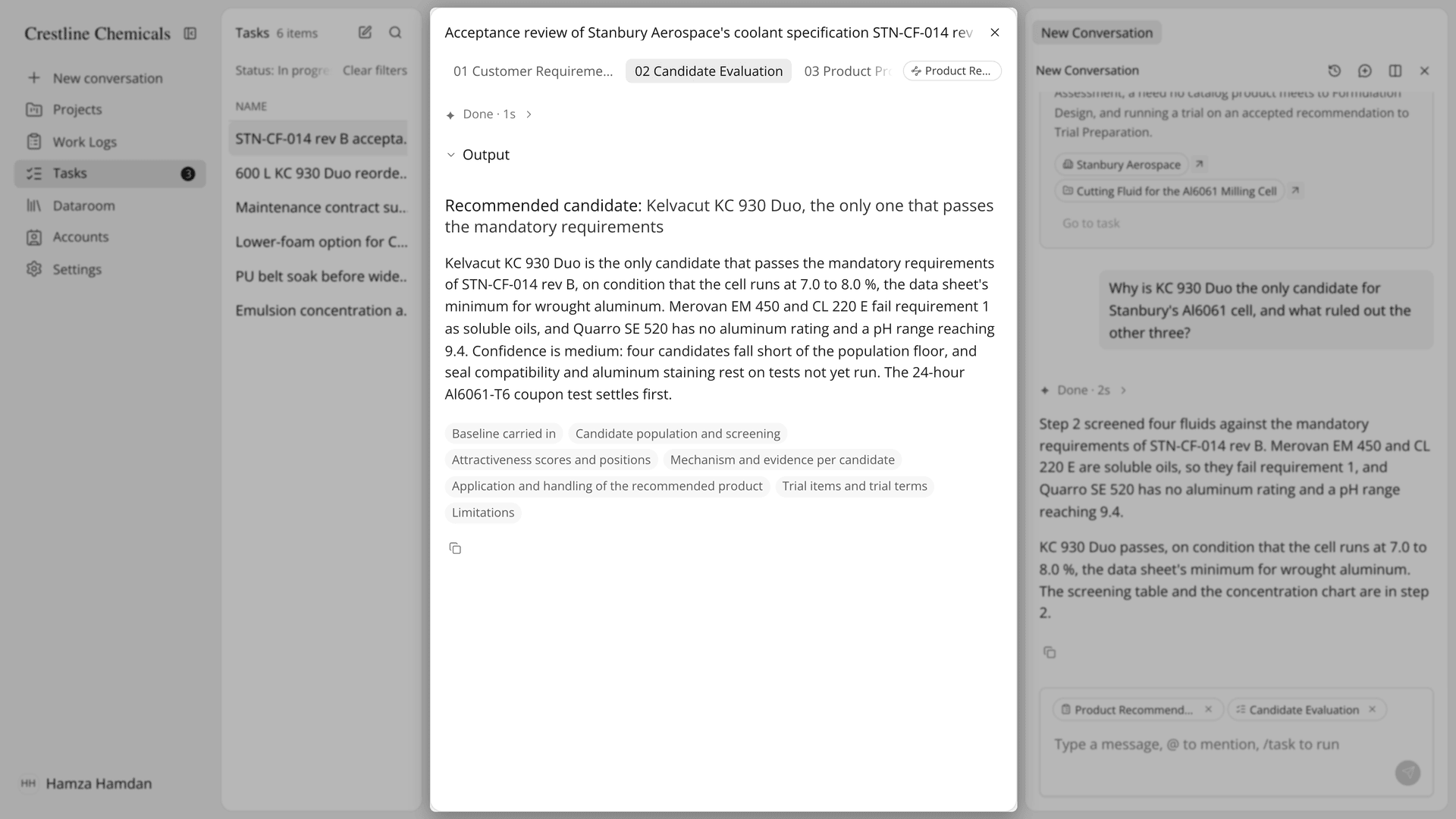
Figure 1. A candidate evaluation step on a sample account, with the comparison table that supports its conclusion opened.
The cheapest way to separate candidates is often a question the plant can answer right now. Does the mark wipe off with water? Does it appear on other materials that go through the same washer? Ask that before designing a lookup or a lab test.
What settles a fact in technical reasoning?
In technical reasoning, a fact is settled by the source suited to its kind. The customer's conditions, observations and history are settled by field records and the customer's own answers. Chemical identity, properties, reactivity and regulatory status are settled only by lookup in authoritative sources, and where what the engineer or the model recalls disagrees with a lookup, the lookup wins. A statement with neither a record nor a lookup behind it is verified first or stated as inference.
Internal records do two jobs. They test the hypotheses against this case's field data, test reports and performance history. They also supply precedent: a similar past case, offered as the next-best answer when the mechanism-grounded one is out of reach, and labeled as precedent rather than as a confirmed cause.
External references are searched by default, even when the internal material looks sufficient. The delivered answer keeps its three layers. A confirmed statement carries its source, an inference carries its one-sentence mechanism and the check that would settle it, and an unknown that could alter the conclusion is named. Several candidates, each with the check that tells them apart, is a finished answer.
Where do general AI tools fall short on technical reasoning?
General AI tools are a real help on technical reasoning at first: they answer in seconds and know a great deal of chemistry. In the ChemBench evaluation, Mirza and colleagues found that "the best models outperformed the best human chemists in our study on average", and also that "the models struggle with some basic tasks and provide overconfident predictions" (Mirza et al., 2024).
That overconfidence is the problem in a customer case. A general tool answers from recall, so a substance's properties come from memory rather than from a lookup by CAS number, and a fluent sentence reads the same whether it is confirmed or guessed. It tends to pair the symptom with a product in one step, because nobody asked for the chain in between. It sees only what was pasted in: the SDS, perhaps, but not the plant's rinse setup, the notes from the last site visit or why an earlier candidate was dropped. Keeping confirmed, inferred and unknown apart depends on someone writing that into the prompt every time.
In Lubinpla, a summary of this discipline sits in the standing instructions for AI Chat and for task steps, and both are told to load the full guideline whenever an answer turns on a technical judgment. A step lists the records it read and flags web sources apart from the team's own records.
How does technical reasoning compare with catalog matching?
Technical reasoning differs from catalog matching at almost every step of a customer case, from how the problem is framed to what the reply contains. The table below sets the two side by side for one customer question:
Step in the case | Catalog matching or a general AI tool | Technical reasoning in Lubinpla |
|---|---|---|
Frame the problem | The customer's wording, taken as given | The function the product must perform and the failure it must prevent |
Compare products | Trade names, pH, appearance and use wording | Components, identified by CAS number where known |
Explain the symptom | One step from symptom to product | A chain of reactions ending in what the plant sees |
Rule out candidates | Dropped by impression | Struck only by a confirmed condition or observation, reason kept |
Settle a chemical fact | Recall | Lookup in authoritative sources |
Use past cases | One engineer's memory | Precedent from the team's records, labeled as precedent |
Deliver | One product and a dilution | Confirmed, inferred and unknown, each with its source or check |
The row that matters most is ruling out candidates. In catalog matching, a candidate disappears because it did not sound right, and nobody can say later why. In technical reasoning, a candidate leaves the list only when something recorded or reported at the plant defeats it, and the reason stays with the case.
That record pays off when the first answer turns out wrong. Suppose the stains return after the recommended change. With catalog matching, the team starts again from the catalog. With technical reasoning, the team reopens the list: the candidates still standing, the checks not yet run, and the unknowns named in the first answer show where to look next.
Limits of technical reasoning in Lubinpla
Technical reasoning in Lubinpla works only from what it can read. It knows a plant through the accounts, projects, work logs and Dataroom files your team keeps. When neither your records nor a public search yields an ingredient list, composition is inferred from the product's category and catalog description, at lower confidence. A gap that a CAS number cannot close, such as a surfactant's ethoxylation degree, stays an open question for the manufacturer.
Reasoning is not proof. A well-argued candidate still has to pass the customer's lab check and a trial on the line before anyone can call it qualified, and the plant, not the agent, runs the desmut trial.
People keep the decision. By default, nothing runs until someone approves the task, and the finished document is filed only once someone approves it. A reviewer who finds the evidence too thin for the conclusion can send the document back with a note.
For the platform, start with what Lubinpla is. The Tasks page lists the tasks that apply this reasoning, and our post on why every technical case ends in one document covers where the settled answer goes.