OSHA's Tighter Mist Standard: What Open MWF Sumps Need by 2027
Summary: The proposed 2026 OSHA update would set a permissible exposure limit (PEL) of 0.5 mg/m3 for metalworking fluid (MWF) mist as an 8-hour time-weighted average, closing a gap that has existed since 1999 when the Metalworking Fluids Standards Advisory Committee (MWFSAC) first recommended this threshold. Facilities with open-sump machining centers face the highest remediation burden because unenclosed coolant systems generate mist that routinely exceeds the proposed limit. This article maps three compliance pathways, enclosure, local exhaust ventilation, and fluid chemistry change, against capital costs, operating cost profiles, and feasibility constraints. A four-factor decision framework keyed to machine count, MWF inventory, operating cycle, and capital budget allows EHS leaders to select the dominant pathway before committing resources. Field cases from anonymized manufacturing operations illustrate how each pathway performs against the 0.5 mg/m3 target. The article also connects the compliance audit cycle to the agent-based workflow automation that Lubinpla, a specialty chemicals AI agent company, enables through its AI Crew subscription platform. EHS teams who complete baseline air sampling in 2025 or early 2026 retain pathway optionality; those who defer risk a compressed timeline against a hard deadline.
Table of Contents
I. Introduction
II. OSHA Mist Standard History and the Proposed 2026 Update
III. Compliance Options: Enclosure, Ventilation, and Chemistry Switch
IV. Cost Crosswalk Across Compliance Paths
V. Decision Framework by Plant Size, MWF Inventory, and Operating Cycle
VI. Field Cases: MWF Operations Across Compliance Stages
VII. Key Takeaway
VIII. References
I. Introduction
A proposed PEL of 0.5 mg/m3 for metalworking fluid mist has been technically justified for over 25 years. The National Institute for Occupational Safety and Health (NIOSH) published its recommended exposure limit (REL) of 0.4 mg/m3 thoracic particulate (equivalent to approximately 0.5 mg/m3 total particulate) in 1998, citing substantial evidence of respiratory disease among exposed machinists (NIOSH, 1998). One year later, OSHA's own Metalworking Fluids Standards Advisory Committee (MWFSAC) endorsed the same threshold and recommended formal rulemaking (OSHA MWFSAC Final Report, 1999). OSHA's current PEL of 5 mg/m3 for mineral oil mist under 29 CFR 1910.1000 has not moved since it was set in 1971. The proposed 2026 rulemaking would reduce it by a factor of ten.
For facilities running open-sump operations, where the machining center coolant reservoir sits exposed to ambient air and the cutting zone is not enclosed, the gap between the current 5 mg/m3 PEL and the proposed 0.5 mg/m3 limit is not just a regulatory threshold change. It is a capital project trigger. Published field measurements at open-sump multi-spindle centers routinely show area concentrations of 0.8 to 4.0 mg/m3 during normal production cycles, placing these operations outside the proposed limit even with good housekeeping (Ann Occup Hyg, 2003). Three remediation paths exist: physical enclosure of the machine tool, installation of local exhaust ventilation (LEV) with a mist collector, and a change in fluid chemistry to a low-mist formulation. Each path has a distinct capital cost profile, a distinct feasibility envelope, and a distinct residual risk. The decision between them must be made before 2027 if a plant wants to arrive at the compliance deadline having already completed the engineering work.
Why Open Sumps Carry Disproportionate Mist Risk
Mist concentration at the operator breathing zone is governed by the rate of aerosol generation at the cutting interface, the degree to which the machine geometry confines that aerosol before it escapes into room air, and the dilution provided by the room ventilation system. Enclosed CNC machining centers with integrated splash guards and interlocked access panels contain the majority of aerosol within the machine envelope. Open-sump operations, by definition, remove the first line of confinement. High-pressure coolant delivery at 150 to 400 psi, rapid spindle rotation at 3,000 to 15,000 rpm, and the air currents created by tool rotation all drive aerosol generation at rates proportional to cutting speed and fluid volume. Operators working within two to three meters of an unenclosed high-speed center can experience breathing-zone concentrations that exceed the proposed PEL by a factor of two to six, even when area concentrations in the general workroom fall within the current 5 mg/m3 PEL (Donaldson, 2024).
II. OSHA Mist Standard History and the Proposed 2026 Update
The current OSHA PEL of 5 mg/m3 for mineral oil mist represents the state of industrial hygiene knowledge as it stood in 1971. For MWFs that are not petroleum-oil based, the applicable limit is the Particulates Not Otherwise Classified (PNOC) ceiling of 15 mg/m3 (8-hour TWA), which provides effectively no differentiated protection against the specific health hazards of water-soluble MWF aerosols (OSHA, 29 CFR 1910.1000).
What Did the 1998 NIOSH Criteria Document Establish?
The NIOSH Criteria Document on Occupational Exposure to Metalworking Fluids (NIOSH Publication 98-102, 1998) established that workers currently exposed to MWF aerosols face a significantly elevated risk of nonmalignant respiratory disease and skin disease, and that historical exposures to older, less-refined mineral oil MWFs were associated with cancers of the larynx, rectum, pancreas, skin, scrotum, and bladder. The REL of 0.4 mg/m3 for thoracic particulate mass, equivalent to approximately 0.5 mg/m3 total particulate mass, was designed to reduce new cases of hypersensitivity pneumonitis (HP), occupational asthma, chronic bronchitis, and impaired lung function (NIOSH, 1998). HP is of particular concern in water-soluble MWF systems because bacterial and fungal contamination of the sump produces endotoxins and biological aerosols that act as sensitizers independent of the base fluid chemistry (PMC, 2012).
The MWFSAC Recommendation and 25 Years of Regulatory Inaction
In 1999, the MWFSAC, composed of union representatives, industry, academics, and NIOSH, recommended a new 8-hour TWA PEL of 0.4 mg/m3 thoracic particulate (0.5 mg/m3 total particulate) and called for a formal standard that would also require medical surveillance, exposure monitoring, system management, and employee training (OSHA MWFSAC Final Report, 1999). OSHA did not proceed with formal rulemaking. In 2003, OSHA declined a union petition to promulgate a standard, and a subsequent court challenge was rejected. The agency instead issued advisory guidance through its Metalworking Fluids: Safety and Health Best Practices Manual, which recommends engineering controls and an informal action level at 0.5 mg/m3 without legal PEL force.
What Does the Proposed 2026 Rulemaking Change?
OSHA's regulatory agenda, as documented in its Unified Agenda publications, includes ongoing review of outdated PELs under 29 CFR 1910.1000. The proposed 2026 update would formally adopt the MWFSAC and NIOSH recommendation of 0.5 mg/m3 total particulate as the new legally enforceable PEL for all MWF aerosols across general industry. Unlike the current dual-standard approach, which applies different numerical limits to mineral oil and non-mineral-oil MWFs, the proposed rule would apply a single threshold regardless of fluid type, eliminating the anomaly under which water-soluble emulsion-based coolants are regulated at 15 mg/m3 while straight mineral oil mists are regulated at 5 mg/m3. The compliance date in the proposed rule structure is January 1, 2027 for operations with more than 25 employees at affected facilities.
Why Does This PEL Matter for Open-Sump Facilities?
Under the current 5 mg/m3 PEL, most well-managed enclosed CNC operations already comply without dedicated mist collection hardware because general dilution ventilation holds area concentrations below the limit. Open-sump operations at current production rates frequently cannot. At the proposed 0.5 mg/m3 level, general dilution ventilation alone is insufficient for any MWF operation generating more than low-pressure, low-speed coolant flow. Engineering controls become mandatory rather than advisory (OSHA Best Practices Manual, 2024).
III. Compliance Options: Enclosure, Ventilation, and Chemistry Switch
Three primary engineering paths can bring an open-sump MWF operation into compliance with a 0.5 mg/m3 PEL. The three paths are not mutually exclusive, and many facilities ultimately combine elements of two or three. They differ significantly in capital cost, installation disruption, and sustained compliance margin.
Path 1: Machine Tool Enclosure
Machine enclosure addresses mist at the source by physically containing the aerosol-generating cutting zone within a guarded envelope before it can enter room air. OSHA's Best Practices Manual identifies three enclosure classifications applicable to metalworking operations: close capture enclosures, which partially surround the cutting zone with high-entrainment-velocity hoods; total enclosures, which create a complete box around the machine tool with limited access openings; and tunnel enclosures, which provide continuous coverage over multiple workstations in a transfer line (OSHA, 2024). For open-sump retrofits, close capture and total enclosures are the most common interventions.
Field data from a University of Michigan NIOSH-funded study on transmission case transfer lines found that improved machine enclosure reduced area mist concentrations by 87 percent compared to the unenclosed baseline configuration (J Occup Environ Hyg, 2007). Total enclosures are particularly effective because they minimize the air exchange between the cutting zone and the surrounding room, requiring lower exhaust volumes and allowing a single connected mist collector to serve the enclosed space.
The primary constraint on the enclosure path is machine geometry. Machines designed to accept large workpieces through open access zones, horizontal boring mills, large transfer line machines, and older open-bed lathes, may not be physically retrofittable without redesigning the work-holding or part-handling system. Machines with operator access during cutting cycles present an additional challenge: any enclosure with a functional opening during cutting requires dynamic pressure compensation at the opening to prevent aerosol escape. This is technically achievable but adds design complexity and maintenance burden. For newer CNC machining centers, retrofit enclosure kits are commercially available from suppliers including Hennig and BUWW at costs that typically range from USD 8,000 to USD 40,000 per machine depending on bed size and required opening design.
Path 2: Local Exhaust Ventilation with Mist Collection
Local exhaust ventilation (LEV) captures aerosol directly at or near the generation point and routes it through a filtration system before return or exhaust. The preferred hood configurations for MWF mist, per OSHA guidance, are close capture hoods positioned at the cutting zone and total enclosure hoods that draw from within an existing partial enclosure. Canopy and side-draft hoods require much higher air volumes to achieve equivalent capture efficiency and are less effective when operator activity disturbs the capture zone (OSHA Best Practices Manual, 2024).
Mist collectors suitable for MWF service use multi-stage filtration. A typical system includes a first-stage metal mesh or baffle prefilter to separate large droplets and swarf, a second-stage mechanical media filter (pocket or cartridge), and a final-stage high-efficiency filter at 95 percent DOP or HEPA performance for sub-micron aerosol and biological particulates. Centrifugal collectors are economical and effective for heavier mist particles but may underperform on fine aerosol generated by high-speed machining. Electrostatic precipitator (ESP) collectors provide efficient sub-micron capture with lower pressure drop but require more frequent cleaning of collection plates. HEPA-stage media collectors provide the most consistent fine-particle capture with replaceable filter elements (Donaldson, 2024).
The critical maintenance requirement for LEV systems is filter monitoring and replacement. OSHA's Best Practices Manual states that a poorly maintained mist collector can increase the mist loading in discharged air compared to a system with no collector at all, because loaded filters channelize and discharge partially filtered aerosol. This is not a theoretical risk; it is the most common mode of LEV system failure observed in field audits. Planned maintenance intervals, typically quarterly filter inspection and annual media replacement for standard production rates, must be built into the operational protocol at commissioning.
Per-machine mist collector costs for new installation range from approximately USD 2,500 for a single-machine centrifugal unit serving a small CNC lathe to USD 15,000 to USD 30,000 for a centralized multi-stage unit serving three to six machines with ductwork (ICAP, 2024; Aeroex, 2024). Facilities requiring replacement of conditioned air exhausted to outside (non-recirculating systems) incur additional makeup air infrastructure costs of USD 5,000 to USD 25,000 depending on building size and HVAC configuration.
Path 3: Fluid Chemistry Change
A fluid chemistry change targets mist generation at the formulation level rather than at the capture or containment level. The aerosol formation mechanism in MWF systems is governed by the surface tension, viscosity, and molecular weight distribution of the bulk fluid. Low-mist fluid formulations reduce aerosol generation by incorporating high-molecular-weight polymeric anti-mist additives, typically polyethylene oxide (PEO)-based resins at 1,000 to 1,250 ppm loading, that increase elongational viscosity and resist droplet formation during high-speed fluid breakup events (ChemPoint, 2026). Laboratory and plant data from SAE and POLYOX literature indicate that these additives reduce MWF aerosol concentration by 40 to 70 percent compared to baseline formulations under equivalent machining conditions (SAE, 1998; ChemPoint, 2026).
Full synthetic MWF formulations, which contain no petroleum oil fraction, generate lower intrinsic mist concentrations than mineral-oil-based soluble oils because they lack the light hydrocarbon fractions that volatilize and carry aerosol into the breathing zone (NIOSH, 1998). Switching from a high-oil-content soluble oil (30 to 85 percent mineral oil) to a full synthetic eliminates the volatile organic fraction entirely and, in well-controlled comparative tests, reduces total airborne MWF concentration at the operator position by 30 to 55 percent (CCOHS, 2024). This reduction is additive to any ventilation controls already in place.
The operational constraint of the chemistry change path is compatibility. A fluid switch requires validation that the new formulation is compatible with the workpiece materials being cut, the machine tool materials (seals, paint, guideway coatings), the existing water quality parameters (hardness, pH, chlorides), and the biocide program. An incompatible formulation change can produce foaming, accelerated seal degradation, corrosion of cast iron machine guideways, or biological instability in the sump. Full validation trials typically require 90 to 180 days in production before full fleet conversion is appropriate. The incremental cost of a premium low-mist synthetic versus a standard soluble oil formulation is approximately USD 2 to USD 8 per gallon of concentrate, with total program cost depending on fleet size and change-out volume.
IV. Cost Crosswalk Across Compliance Paths
The three compliance paths have structurally different cost profiles. Capital cost is concentrated in enclosure and LEV installation; chemistry change shifts cost to a recurring premium on consumables. Neither profile is uniformly superior; the optimal choice depends on plant-specific parameters addressed in Section V.
Figure 1. Compliance Path Cost Comparison: Single Open-Sump Machine Center
Cost element | Path 1: Enclosure | Path 2: LEV + Mist collector | Path 3: Chemistry change |
|---|---|---|---|
Capital cost (per machine) | USD 8,000 to USD 40,000 | USD 5,000 to USD 30,000 | USD 0 to USD 2,000 (trial batch) |
Annual operating cost | USD 500 to USD 2,000 (maintenance) | USD 1,500 to USD 6,000 (filters, energy) | USD 3,000 to USD 15,000 (concentrate premium) |
Installation downtime | 3 to 10 days per machine | 1 to 5 days per machine | 3 to 7 days (sump clean and recharge) |
Compliance margin | High (source containment) | Moderate to high (capture efficiency dependent) | Moderate (additive performance variable) |
The capital cost range for enclosure reflects machine size and access complexity. A small CNC turning center can receive a retrofit enclosure kit for USD 8,000 to USD 15,000 installed, while a large horizontal machining center or transfer line section may require custom engineering at USD 30,000 to USD 60,000 or more per workstation. The LEV path scales with machine count and layout: a plant converting 10 machines with a centralized collection system may achieve per-machine costs at the low end of the range, while a dispersed 20-machine floor may require distributed point-of-use collectors at higher per-unit cost. Chemistry change has the lowest capital requirement but the highest sensitivity to machine count in annual cost: a 10-machine operation using 200 gallons of MWF concentrate per year at a USD 5 per gallon premium pays USD 1,000 annually, while a 50-machine plant consuming 2,000 gallons per year pays USD 10,000 annually and the cost compounds at every sump recharge.
Figure 2. Five-Year Total Cost of Compliance: 10-Machine Open-Sump Operation
Year | Path 1: Enclosure | Path 2: LEV + Mist collector | Path 3: Chemistry change |
|---|---|---|---|
Year 1 (capital + operating) | USD 95,000 to USD 220,000 | USD 65,000 to USD 165,000 | USD 5,000 to USD 20,000 |
Years 2 to 5 (operating only, cumulative) | USD 8,000 to USD 32,000 | USD 24,000 to USD 96,000 | USD 48,000 to USD 240,000 |
5-year total | USD 103,000 to USD 252,000 | USD 89,000 to USD 261,000 | USD 53,000 to USD 260,000 |
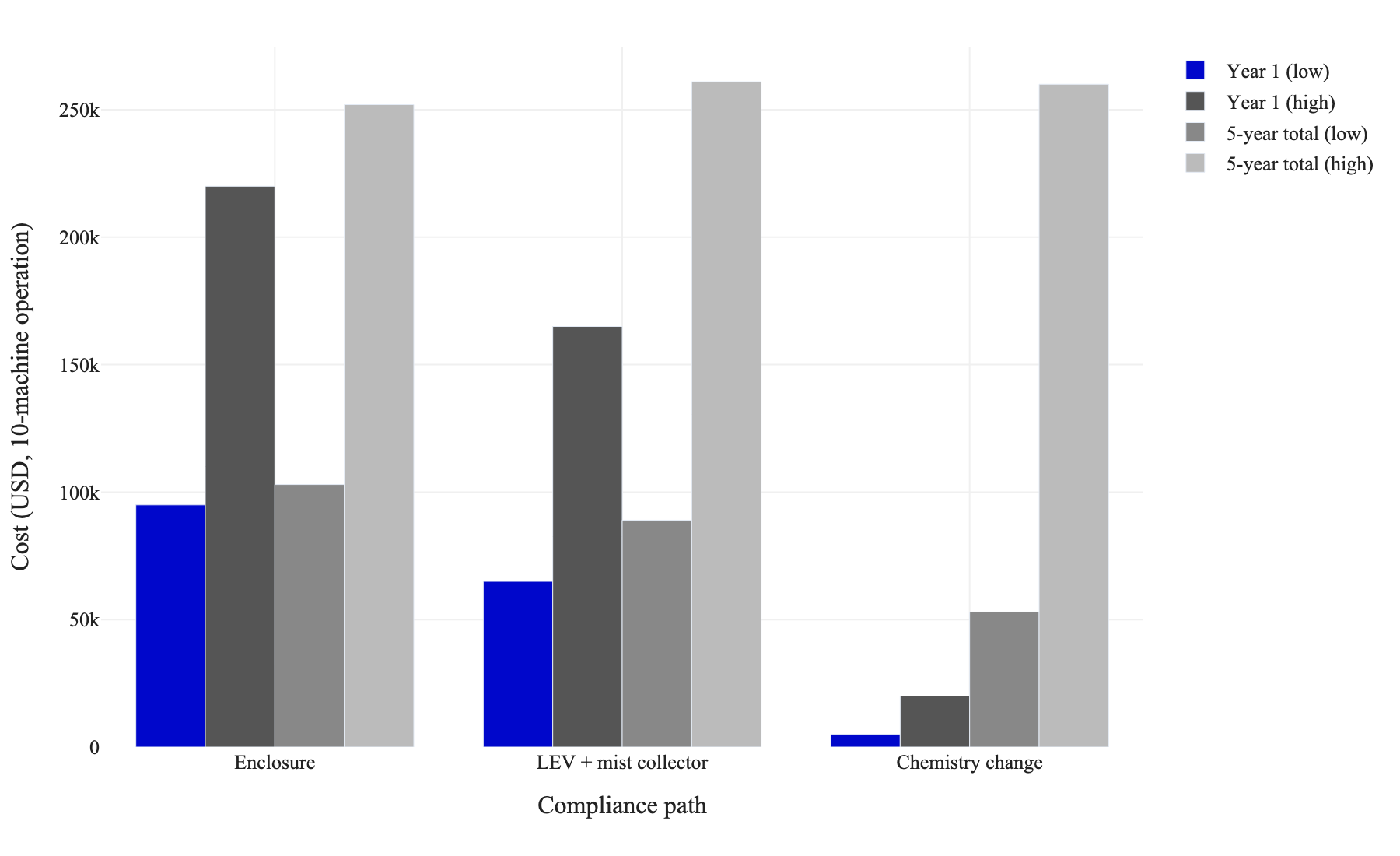
Figure 2b. Year-one outlay diverges across the three paths, but five-year totals converge (data: Figure 2 above)
The five-year total costs converge significantly across paths when the analysis accounts for the full operating cost stream. A chemistry change path that looks dramatically cheaper in year one approaches the cost of an LEV installation by year four or five for a mid-size operation. The enclosure path, despite its high year-one outlay, carries the lowest compliance risk because it does not depend on filter maintenance schedules or ongoing fluid management to maintain its effectiveness.
One cost element that does not appear in either table but materially affects the decision is OSHA penalty exposure. Under the proposed rule structure, a willful or repeated violation at the 0.5 mg/m3 threshold carries a maximum penalty of USD 156,259 per violation per day (OSHA Penalty Schedule, 2024). A 10-machine operation found out of compliance across all machines during a single inspection faces potential aggregate penalties that dwarf the cost of any of the three compliance paths described above.
V. Decision Framework by Plant Size, MWF Inventory, and Operating Cycle
No single compliance path is optimal for all facilities. The selection depends on four variables: machine count and layout configuration, current MWF inventory type and sump size, operating cycle duration and production criticality, and available capital budget and payback horizon.
Compliance Path Selection Framework
The following decision framework guides EHS leaders through the four-variable analysis to a recommended primary path and a contingency secondary path.
Step 1: Baseline air sampling. Before any path decision, commission personal breathing zone and area air sampling using NIOSH Method 5524 (Metalworking Fluid, All Categories) across all open-sump positions. Sample during normal production at representative machining conditions. This establishes the current exposure profile and the gap to the 0.5 mg/m3 proposed PEL.
Step 2: Classify the gap. Compare sampling results to the target threshold.
Figure 3. Air Sampling Gap Classification and Path Trigger
Measured concentration (8-hr TWA) | Classification | Recommended path priority |
|---|---|---|
Below 0.5 mg/m3 | Compliant at proposed PEL | Document, reconfirm annually, no major intervention required |
0.5 to 1.0 mg/m3 | Marginal: within 2x of proposed PEL | Chemistry change as primary; LEV as secondary if chemistry change insufficient |
1.0 to 2.5 mg/m3 | Moderate gap | LEV with mist collection as primary; chemistry change as supplement |
Above 2.5 mg/m3 | Significant gap | Enclosure as primary; LEV within enclosure as secondary; chemistry change as tertiary supplement |
Step 3: Apply the machine count and layout modifier. If the plant has more than 15 open-sump machines in a compact floor arrangement, centralized LEV is typically more cost-effective per machine than distributed single-machine collectors or individual retrofit enclosures. If machines are spread across multiple cells or buildings, distributed point-of-use collectors are more practical. If machines are large-format or have complex operator access requirements, enclosure retrofit feasibility should be evaluated by a mechanical engineer before committing to Path 1.
Step 4: Apply the MWF inventory modifier. If the current fluid is a high-oil-content soluble oil (greater than 40 percent oil concentrate) and the machining application permits a synthetic or semi-synthetic substitute, a chemistry change should always be evaluated as a supplement to the primary engineering control. Even if the chemistry change alone does not achieve the 0.5 mg/m3 target, reducing baseline mist generation by 40 to 60 percent lowers the required capture efficiency of any supplemental LEV system, which in turn reduces ductwork sizing, collector capital cost, and filter replacement frequency.
Step 5: Apply the operating cycle and capital budget modifier. Plants with 24-hour continuous operations face installation downtime constraints that may push the decision toward chemistry change as the first deployed control, with enclosure or LEV phased in during scheduled downtime windows. Plants with capital budgets under USD 10,000 per machine in year one should model the five-year total cost comparison before defaulting to the chemistry change path, since the convergence shown in Figure 2 means that the upfront savings may be fully recovered in recurring costs by year three.
Figure 4a. Decision Inputs: Machine Count, Fluid Type, and Operating Cycle
Machine count | Fluid type | Operating cycle | Profile label |
|---|---|---|---|
1 to 5 | Any type | Intermittent | Small-intermittent |
6 to 15 | Soluble oil | Any cycle | Mid-soluble |
6 to 15 | Synthetic or semi-synthetic | Any cycle | Mid-synthetic |
More than 15 | Any type | Continuous 24-hour | Large-continuous |
More than 15 | Soluble oil | Intermittent | Large-intermittent |
Figure 4b. Profile to Primary Compliance Path
Profile label | Capital availability | Recommended primary path |
|---|---|---|
Small-intermittent | Any | Chemistry change + LEV (point-of-use) |
Mid-soluble | Medium to high | LEV centralized + chemistry supplement |
Mid-synthetic | Medium to high | LEV centralized |
Large-continuous | High | LEV centralized + phased enclosure retrofit |
Large-intermittent | Low | Chemistry change first, LEV second phase |
Match the profile label from Figure 4a to Figure 4b to identify the recommended primary path. Then validate the selected path against the gap classification from Figure 3. If the recommended path does not address the gap class, escalate to the next path in the Figure 3 priority order.
VI. Field Cases: MWF Operations Across Compliance Stages
The following cases are anonymized. Company identifiers, regions, and specific machine models have been generalized to protect customer identity.
Company A: Chemistry Change as the Entry Control, Moderate Gap, Mid-Size Machining Center
Company A operates a 12-machine open-sump grinding and turning facility producing precision steel components for the hydraulic equipment sector. Average machine count per operator is three. Initial NIOSH Method 5524 breathing-zone sampling across six operator positions produced an 8-hour TWA range of 0.7 to 1.3 mg/m3 on soluble oil at 8 percent emulsion concentration, placing all positions above the proposed 0.5 mg/m3 PEL and two positions in the moderate gap class. The facility ran 20-hour production cycles with two 2-hour maintenance windows.
The EHS team selected chemistry change as the first deployed control because the installation downtime associated with LEV ductwork could not be accommodated within the 2-hour maintenance window. The fluid was converted from a 55 percent mineral oil soluble oil concentrate to a semi-synthetic formulation containing a polyethylene oxide anti-mist additive at 1,100 ppm loading. Conversion required three sequential sump clean-and-recharge cycles over 45 days, with compatibility testing confirming no seal degradation on the 12 machines and no corrosion on cast iron guideways after a 90-day production trial. Post-conversion sampling showed breathing-zone concentrations of 0.35 to 0.6 mg/m3, a reduction of 47 to 54 percent. Four positions achieved compliance at the 0.5 mg/m3 target; two grinding positions remained at 0.51 and 0.58 mg/m3, marginally above the limit.
The residual non-compliant positions received point-of-use centrifugal collectors during a subsequent planned shutdown, at a cost of USD 3,800 each installed. Final sampling across all 12 positions confirmed compliance below 0.5 mg/m3. The combined program cost was USD 18,000 for the LEV units, USD 6,000 for the fluid validation and conversion program, and an ongoing annual concentrate premium of approximately USD 4,200, giving a year-one total of USD 24,000 against a facility of 12 open-sump machines.
Company B: LEV-First Approach for High-Mist Carbide Grinding Line
Company B is a precision hard-metal parts manufacturer with a 6-machine horizontal carbide grinding line operating on a high-pressure straight grinding oil at 300 psi coolant delivery pressure. Straight oil at high pressure is a known high-mist condition; initial area sampling confirmed concentrations of 2.8 to 4.1 mg/m3 in the operator corridor during grinding, placing the entire line in the significant gap class. The production schedule runs 24 hours, six days per week, making installation downtime a critical constraint.
The EHS team selected centralized LEV as the primary path, designing a system that connected all six grinders through a common header duct to a multi-stage mist collection unit with a HEPA final stage. The system was installed during a planned annual maintenance shutdown over 7 days. Capital cost for the centralized collector, ductwork, and makeup air damper was USD 78,000 installed. Post-commissioning sampling with the LEV system running confirmed area concentrations of 0.22 to 0.38 mg/m3 and breathing-zone concentrations of 0.28 to 0.44 mg/m3, all below the 0.5 mg/m3 target.
A chemistry change from straight grinding oil to a low-mist semi-synthetic was evaluated as a potential supplement but was deferred after the LEV results demonstrated compliance with margin. The LEV system design included a differential pressure monitoring port across the final-stage filter to allow the maintenance team to track filter loading and schedule replacement before performance degradation occurs. Annual operating cost for filter media and energy is estimated at USD 8,400.
Company C: Enclosure Retrofit on Legacy Open-Bed Transfer Line
Company C operates a three-station transfer line machining automotive suspension components. The transfer line was installed in 2003 and was designed as an open-bed system with no guarding over the cutting zones. Area mist concentrations measured along the operator walkway averaged 1.8 mg/m3 during full production, and two operator positions showed breathing-zone measurements of 2.1 and 2.4 mg/m3.
The EHS team commissioned a mechanical engineering assessment for enclosure retrofit feasibility. The assessment confirmed that a partial enclosure could be fitted over each of the three spindle stations using polycarbonate hinged panels with interlocked access doors, without modifying the transfer mechanism or the fixture plate. Enclosure design and fabrication was contracted to a custom fabricator at USD 22,000 per station (USD 66,000 total), with installation requiring 5 days of production downtime per station, scheduled across three consecutive quarterly shutdowns.
After enclosure of all three stations, combined with the existing general dilution ventilation in the facility, breathing-zone sampling returned results of 0.28 to 0.41 mg/m3 along the operator walkway. The enclosure achieved compliance with no fluid chemistry change and no dedicated mist collection hardware, because the partial enclosure reduced aerosol escape by 83 percent versus the unenclosed baseline. Total compliance investment was USD 66,000 in fabrication and USD 12,000 in installation labor, with negligible ongoing operating cost beyond routine inspection of the enclosure panel seals and interlocks.
VII. Key Takeaway
The proposed 2026 OSHA PEL of 0.5 mg/m3 for MWF mist is not a new scientific conclusion: it is a 25-year-old recommendation from NIOSH (1998) and MWFSAC (1999) that is now on track for legal enforcement. Facilities that treated the NIOSH REL as a voluntary guideline must treat the proposed PEL as a binding project trigger.
Establish a baseline air exposure profile using NIOSH Method 5524 personal breathing-zone and area samples before selecting a compliance path. The gap between current concentrations and 0.5 mg/m3 is the single most important input to the path selection decision.
The three compliance paths, enclosure, local exhaust ventilation with mist collection, and fluid chemistry change, converge in total five-year cost for mid-size operations. Chemistry change is not definitively cheaper when the full operating cost stream is modeled; it is only cheaper in year one.
Open-sump machines with significant gap (above 2.5 mg/m3) cannot be brought into compliance through chemistry change alone. They require engineering controls: enclosure, LEV, or both.
Filter maintenance on LEV mist collectors is a compliance-critical activity, not a routine housekeeping task. A loaded or channelized filter can increase discharged mist concentration above the uncontrolled baseline. Planned maintenance intervals must be written into the compliance program at commissioning.
The compliance audit cycle, baseline sampling, corrective action tracking, re-sampling, and annual reconfirmation, is a continuous workflow. Organizations that automate the data collection and tracking portions of this cycle can maintain compliance posture with lower administrative burden and faster response time when monitoring results approach the action threshold.
The ongoing compliance audit cycle for MWF mist, baseline air sampling, corrective action documentation, re-sampling, and annual reconfirmation, generates a continuous stream of structured data that benefits from systematic tracking. Lubinpla, the specialty chemicals AI agent company, offers AI Crew as a subscription platform of specialized AI agents that automate technical-sales, customer-support, and operations workflows for specialty chemical companies, including the kind of data-to-action loop that MWF compliance programs require. For teams managing a one-time compliance question before the 2027 deadline, AI Shooting provides a per-case evidence-based written analysis of your specific facility data, sampling results, and pathway options, starting at USD 20 for a 24-hour triage. Submit your current air sampling data and facility description at https://www.lubinpla.com/ai-shooting.
VIII. References
Aeroex Technologies. (2024). Industrial metalworking mist collectors for CNC machines. https://aeroex.com/applications/metalworking-mist-collectors/
American Conference of Governmental Industrial Hygienists (ACGIH). (2024). TLV and BEI Documentation: Mineral Oil Mist. Accessed via https://www.acgih.org/
Centers for Disease Control and Prevention, National Institute for Occupational Safety and Health (NIOSH). (1998). Occupational Exposure to Metalworking Fluids. NIOSH Publication No. 98-102. https://www.cdc.gov/niosh/docs/98-102/default.html
ChemPoint. (2026). POLYOX Antimist Additives for Metalworking Fluids. https://www.chempoint.com/en-emea/insights/polyox-antimist-additives-for-metalworking-fluids
Donaldson Company, Inc. (2024). Managing metalworking fluid mist hazards in modern machining. https://www.donaldson.com/en-us/industrial-dust-fume-mist/technical-articles/managing-fluid-mist-hazards/
Functional Products Inc. (2026). How polymeric anti-mist additives work. https://functionalproducts.com/wp-content/uploads/2026/02/How-Polymeric-Anti-Mist-Additives-Work-v1.pdf
Industrial Clean Air Products (ICAP). (2024). CNC oil mist collectors: Micro Air and Plymovent. https://industrialcleanairproducts.com/oil-mist-collectors/
Lacey, S. E., Sanderson, W. T., Cowger, S. R., and Petersen, M. R. (2003). Occupational exposure to metalworking fluid mist and sump fluid contaminants. Annals of Occupational Hygiene, 47(1), 17-29. https://academic.oup.com/annweh/article/47/1/17/131235
LCS Laboratory. (2024). Oil mist exposure assessment using NIOSH 5524 method. https://lcslaboratory.com/oil-mist-sampling/
Occupational Safety and Health Administration (OSHA). (2024). Metalworking Fluids: Safety and Health Best Practices Manual. https://www.osha.gov/metalworking-fluids/manual
Occupational Safety and Health Administration (OSHA). (2024). Metalworking Fluids: Evaluating Exposure. https://www.osha.gov/metalworking-fluids/exposure-evaluation
Occupational Safety and Health Administration (OSHA). (2024). Metalworking Fluids: Standards. 29 CFR 1910.1000. https://www.osha.gov/metalworking-fluids/standards
Occupational Safety and Health Administration (OSHA). (1999). Metalworking Fluids Standards Advisory Committee (MWFSAC) Final Report Summary. https://www.osha.gov/sites/default/files/MWFSAC-FinalReportSummary.pdf
PMC, National Center for Biotechnology Information. (2012). The occupational exposure limit for fluid aerosol generated in metalworking operations: limitations and recommendations. PMC3430924. https://pmc.ncbi.nlm.nih.gov/articles/PMC3430924/
Society of Automotive Engineers (SAE). (1998). Polymer additives as mist suppressants in metalworking fluids, Part IIa: preliminary laboratory and plant studies, water soluble fluids. SAE Technical Paper 980097. https://saemobilus.sae.org/papers/polymer-additives-mist-suppressants-metalworking-fluids-part-iia-preliminary-laboratory-plant-studies-water-soluble-fluids-980097
Stephenson, D., Schiff, M., Freivalds, A., and Verma, D. K. (2007). Metalworking fluid mist: strategies to reduce exposure, a comparison of new and old transmission case transfer lines. Journal of Occupational and Environmental Hygiene, 4(4), 224-235. https://www.tandfonline.com/doi/abs/10.1080/15459620701223884